
Driveway Concrete Slabs: PA, MD, DE, NJ Guide 2026
A lot of homeowners in Pennsylvania, Maryland, Delaware, and New Jersey start looking at a driveway when it stops being easy to ignore. The asphalt is breaking at the edges. Gravel keeps washing out. Pavers shift just enough to catch a shovel or tire. Water sits where it shouldn't. What used to feel like a simple entrance now looks tired and works poorly.
That's usually the point where a concrete driveway moves from “maybe someday” to a real project. A well-built slab doesn't just improve curb appeal. It gives you a cleaner surface, more predictable maintenance, and a structure that handles daily vehicle use far better than a patchwork fix. In the Mid-Atlantic, where winter moisture, freeze-thaw cycling, and drainage problems can punish weak work, the details under and around the slab matter as much as the finish on top.
Your Driveway A Foundation for Your Home's Curb Appeal
A driveway should be treated like a small foundation system, not a decorative skin. Homeowners often focus on the visible concrete, but the slab is only one layer in a chain that includes the soil below, the compacted support layer, the slope, and the joints that control movement.
That matters in PA, MD, DE, and NJ because a driveway sees more than parked cars. It deals with wet seasons, winter freezing, snowmelt, deicing products, and repeated loading near the garage where vehicles slow, turn, and sit. If the support below the slab is weak or water is allowed to stay in the wrong place, the concrete starts losing the uniform support it needs.
What a quality driveway system includes
A long-lasting driveway usually comes down to a few fundamentals:
- Prepared soil: The native ground has to be stripped, graded, and stabilized so the slab isn't sitting on soft pockets.
- Compacted granular base: One technical guide recommends a 4 to 6 inch compacted granular base below an ordinary residential driveway slab, along with joint spacing in the 8 to 12 ft range to help control cracking, as noted in this driveway thickness guide.
- Correct slab thickness: Passenger vehicles and heavier use don't call for the same slab design.
- Planned drainage: Water has to move away from the slab and away from the house.
Practical rule: If water can sit under a driveway, the slab won't stay where you poured it.
The best-looking finish in the neighborhood won't save a driveway that was poured over poor prep. Homeowners searching for driveway contractors near me often compare color, pattern, or price first. The better question is simpler: what is this slab built on, and where does the water go?
Why this matters beyond the driveway
The same thinking applies to other exterior improvements. When homeowners coordinate driveway work with garage upgrades, entry access, or other exterior changes, it helps to look at adjoining systems as one envelope. If you're also comparing entry upgrades, this overview of door installation in Winnipeg is a good example of how building elements perform better when fit, movement, and weather exposure are considered together.
For homeowners in the Mid-Atlantic, driveway concrete slabs aren't a cosmetic afterthought. They're a long-term surface that has to be built like a load-bearing exterior structure, because that's exactly what they are.
The Anatomy of a High-Quality Concrete Driveway
The visible slab gets all the attention, but a durable driveway is built in layers. If one layer is wrong, the surface tells on it later through cracking, settlement, or edge failure. That's why experienced concrete contractors and excavation crews spend so much time below finished grade.
Start from the ground up
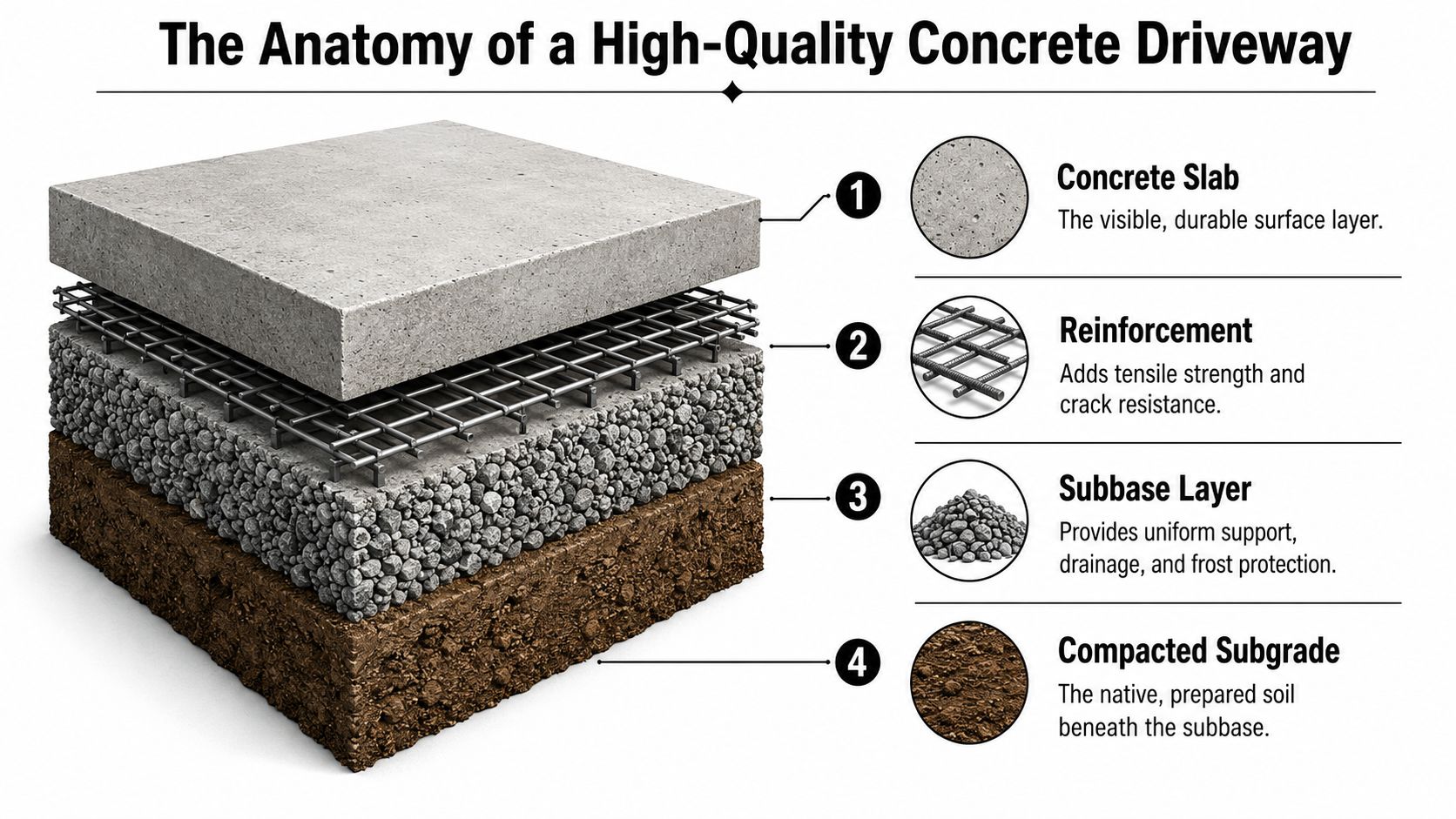
A driveway system has four working layers:
| Layer | What it does | Why it matters |
|---|---|---|
| Compacted subgrade | Supports everything above it | Soft or uneven soil leads to settlement |
| Subbase layer | Adds support and helps manage moisture | Reduces weak spots and seasonal movement |
| Reinforcement | Helps the slab hold together | Limits crack spread and supports load transfer |
| Concrete slab | Provides the wearing surface | Carries vehicle traffic and weather exposure |
The compacted subgrade is the native soil after excavation and grading. This step is where many failures begin. Topsoil, organic matter, and soft spots must be removed because they compress over time. If one section settles more than another, the slab bends. Concrete doesn't like that.
Above that sits the subbase layer, usually crushed stone or similar granular material. This layer does two jobs at once. It spreads loads more evenly, and it gives water less chance to collect directly under the slab.
Thickness is not a cosmetic choice
For residential driveway slabs, technical guidance sets 4 inches (100 mm) as a minimum for typical cars and light SUVs, while 5 inches or more is recommended for heavier loads or less stable soils, according to Concrete Network's driveway basics. That same guidance notes that moving from 4 inches to 5 inches increases concrete cost by about 20%, but improves load margin.
This is one of the most important decisions on a driveway project. A homeowner may only see one extra inch. A contractor sees a different bending capacity, a better margin against fatigue cracking, and a slab more suited to heavier vehicles or weaker ground.
A 4-inch slab is standard for normal residential use. A 5-inch slab is a design choice for tougher conditions, not an upsell for appearance.
In this region, that decision often comes down to how the driveway will be used. If a work truck, loaded trailer, camper, or delivery traffic is part of normal life, a thicker section is usually the smarter move.
Reinforcement and why placement matters
Reinforcement isn't there to make bad base prep acceptable. It's there to help a properly supported slab resist tension and hold tighter if small cracks form.
Common options include:
- Wire mesh: Often used on standard residential work where loading is moderate.
- Rebar: More common when the slab design calls for added strength, heavier use, or more demanding site conditions.
What works is reinforcement that's planned for the slab and placed correctly. What doesn't work is assuming steel alone will prevent cracking if the ground is soft, the base is thin, or water is trapped below the slab.
For homeowners also planning other concrete foundations, garage footings and foundations, or a concrete foundation for garage use, this same layer-by-layer logic applies. Driveway concrete slabs perform well when the unseen work is handled with the same care as the finish.
Designing for Durability Joints Drainage and Finishes
Most driveway cracks don't start because concrete is “bad.” They start because movement wasn't managed. Concrete shrinks as it cures, expands and contracts with temperature, and reacts to changing support below the slab. In the Mid-Atlantic, freeze-thaw conditions make those movement issues more severe.
Control joints and isolation points
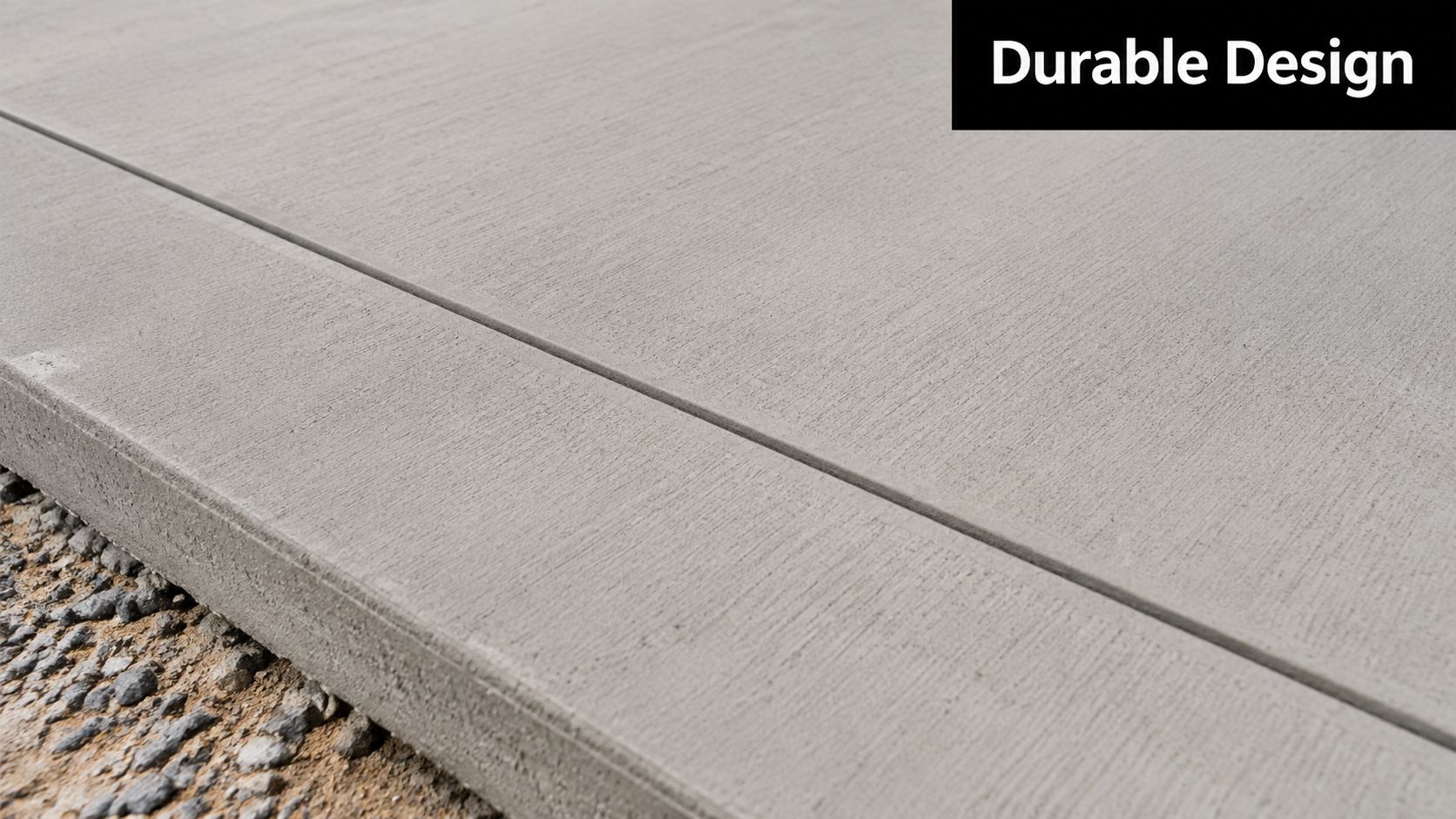
For a standard 4-inch slab, industry guidance recommends control joints no more than 10 feet apart and cut to a depth of roughly one-quarter of the slab thickness, with the driveway sloped at least 1/8 inch per foot away from foundations, according to the Indiana Ready Mixed Concrete Association homeowner guidance.
Control joints are planned weak points. They give the concrete a place to crack neatly instead of randomly. That doesn't eliminate cracking. It directs it.
There's another joint homeowners should ask about, especially at the garage or house connection. A slab shouldn't be locked hard against the structure without allowing for independent movement. That interface is one of the most common trouble spots in real-world driveway work.
Water management drives performance
Drainage is where function and appearance meet. A driveway that looks flat and elegant but holds water is not well designed. Water that runs back toward the garage, sits at the apron, or drains under the slab can soften support and speed up cracking and movement.
A few practical checks matter:
- Look at the house line: Water should leave the structure, not return to it.
- Check side runoff: The driveway edge should not dump water into soil that erodes away support.
- Watch low spots after rain: Ponding usually points to grading or finishing problems.
If you're trying to solve water issues beyond the slab itself, well-planned roof runoff also matters. This guide to expert gutter drainage systems is useful because driveway performance often depends on whether roof water is being discharged near the pavement.
Homeowners wanting more background on installation choices can also review how to concrete a driveway to understand how preparation, forming, and finishing fit together.
Good drainage is not a nice extra. It is part of the slab design.
Finishes that fit the region
Finish choice should match both style and use.
| Finish | Best fit | Practical note |
|---|---|---|
| Broom finish | Most residential driveways | Offers dependable traction in wet conditions |
| Stamped concrete | Decorative front-facing driveways | Needs thoughtful layout so pattern and joints work together |
| Exposed aggregate | Homes wanting texture and visual contrast | Surface texture can help with grip |
A standard broom finish remains the most practical choice for many homes in PA, MD, DE, and NJ because it gives reliable traction during rain and winter use. Decorative options can look excellent, but they still need the same jointing and drainage discipline as any plain slab. A pretty surface without a sound water plan won't stay pretty for long.
Cost vs Lifespan Concrete Pavers Asphalt and Gravel
Material choice usually starts with budget, but smart driveway decisions don't stop at install price. They should include service life, maintenance, and how the surface behaves in local weather. In the Mid-Atlantic, that means looking past the first invoice and asking what the driveway will ask of you over time.
Concrete isn't the cheapest upfront option. It often earns its place by staying useful and presentable longer, with fewer cycles of patching and replacement.
What the installed cost numbers show
Concrete driveways cost an average of $6 to $15 per square foot, while asphalt averages $5 to $12 per square foot, and concrete driveways often last over 30 years, according to HomeGuide's cost comparison. The same summary notes that 96% of existing concrete-driveway owners said they would choose concrete again.
Those numbers tell a familiar story. Concrete usually costs more at the start, but homeowners often choose it as a long-term capital improvement rather than the lowest entry price.
Driveway material comparison
| Material | Avg. Cost / Sq. Ft. | Est. Lifespan | Key Maintenance |
|---|---|---|---|
| Concrete | $6 to $15 | Often over 30 years | Cleaning, joint and crack monitoring, occasional sealing depending on finish and exposure |
| Asphalt | $5 to $12 | Shorter service life than concrete is typical | More frequent maintenance and replacement over time |
| Pavers | Qualitatively higher labor and installation complexity in many cases | Can perform well if base prep is excellent | Joint sand, resetting shifted units, weed control |
| Gravel | Qualitatively lower initial cost | Ongoing reshaping and top-up are common | Raking, replenishment, edge maintenance, washout management |
The trade-offs homeowners actually feel
Concrete gives you a rigid, finished surface with strong curb appeal and less routine upkeep than gravel. It also handles a broad range of home styles, from simple broom finish to decorative work.
Asphalt costs a bit less on average, and it can be a practical choice for some properties. But homeowners often end up dealing with more regular maintenance cycles and a shorter replacement horizon.
Pavers look great when installed well, but they require base preparation that's every bit as important as a slab. If the support below moves, the surface telegraphs it.
Gravel works for some rural or long-drive applications, especially where homeowners prioritize low initial cost. The downside is daily usability. Tires move it, storms move it, snow removal moves it, and weeds like it.
The cheapest driveway to install is not always the least expensive driveway to own.
For homeowners in PA, MD, DE, and NJ who want a clean, long-service surface with predictable performance, driveway concrete slabs often make the most sense when the project is built for drainage, movement, and actual vehicle load.
Driveway Maintenance and When to Repair vs Replace
A concrete driveway can last a long time, but it still needs attention. Most major failures don't appear overnight. They start with water getting into a small crack, a joint that stops doing its job, or a corner that loses support and drops slightly. In a freeze-thaw climate, those small issues usually get bigger, not better.
What homeowners should do each year
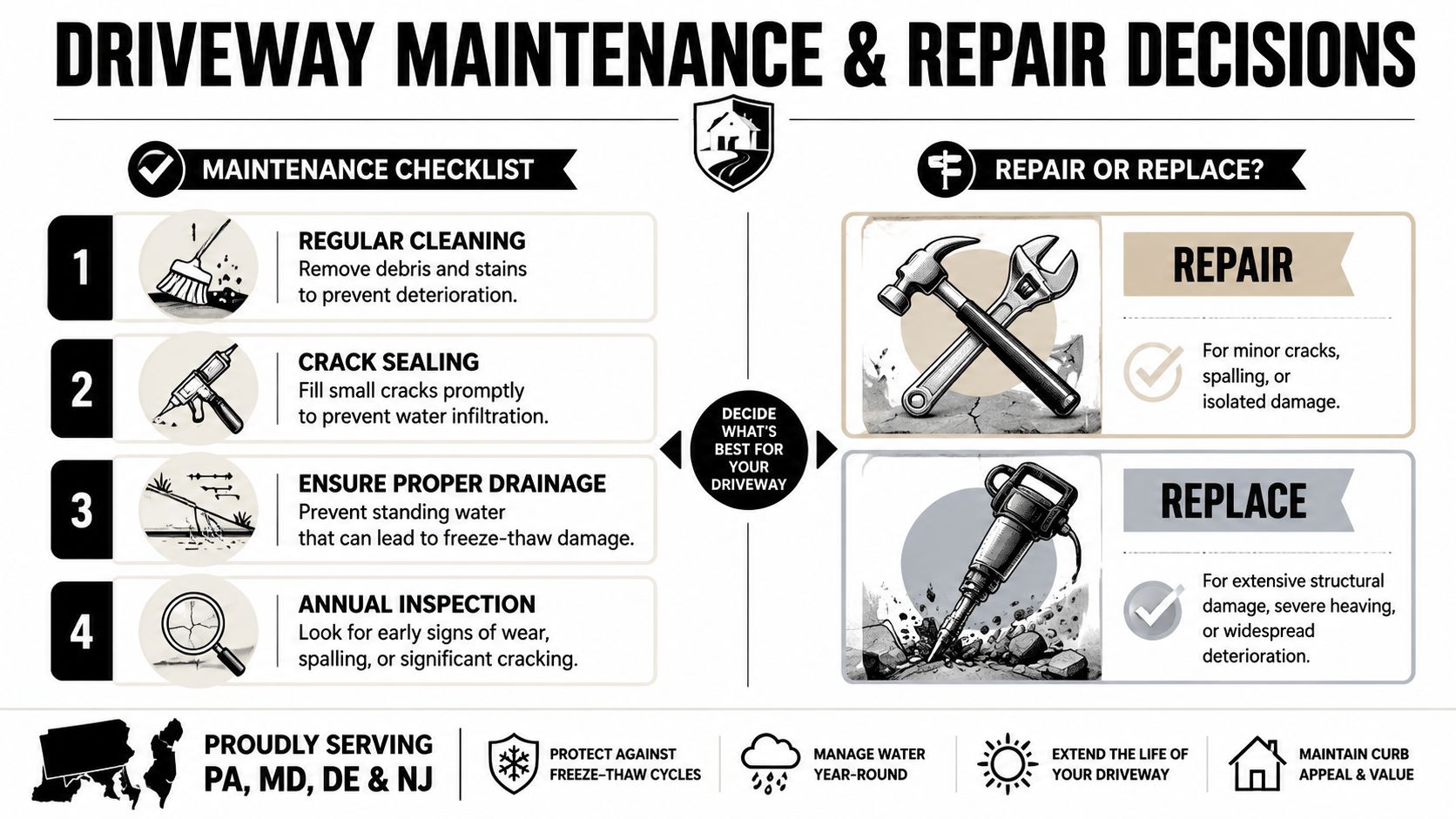
Routine care doesn't have to be complicated. A few simple habits catch problems before they become structural.
- Clean the surface: Dirt, leaves, and staining materials should be removed so you can see the condition of the slab.
- Watch the joints: Open joints or failed filler can let water move where it shouldn't.
- Check drainage after storms: Water should run off, not pool near the garage or edges.
- Inspect after winter: Look for new chipping, widening cracks, or areas that feel uneven underfoot.
If you already have isolated slab issues and want a clearer sense of what repair options may involve, this page on concrete pad repair is a useful reference.
Repair or replacement
Not every crack means replacement. Hairline surface issues may stay cosmetic for a long time if the slab remains level and supported. Localized damage can often be repaired if the rest of the driveway is sound.
Replacement becomes the better option when the problem is no longer isolated. A slab that is heaving, settling in multiple areas, breaking apart at joints, or draining poorly from the start usually needs more than patching.
A practical perspective:
| Condition | Usually points toward |
|---|---|
| Small isolated crack, slab still level | Repair or sealing |
| Minor surface wear in one area | Targeted repair |
| Uneven slab creating a noticeable lip | Lifting or replacement, depending on cause |
| Widespread cracking with movement | Replacement |
Cracked and unlevel slabs can become tripping hazards and increase liability risk for homeowners, as noted in this overview of common concrete driveway questions. That's why the decision isn't only about appearance.
A driveway problem becomes urgent when it affects safety, drainage, or support. At that point, patching the surface usually won't solve the real issue.
For homes with regular foot traffic, garage access, kids playing nearby, or equipment moving in and out, waiting too long often turns a manageable repair into a larger replacement.
Hiring a Driveway Contractor in PA MD DE and NJ
The quality of a driveway project usually comes down to decisions made before the first truck arrives. Homeowners often compare quotes by square footage and finish, but the key difference between contractors shows up in excavation, base preparation, drainage planning, forming, joint layout, and how the slab meets nearby structures.
That's especially true in the Mid-Atlantic. Freeze-thaw conditions expose shortcuts fast. A driveway can look great on pour day and still be set up for avoidable cracking if the contractor ignored water movement or tied the slab too rigidly into the garage.

What to ask before you sign
A good estimate should answer more than price. It should show how the contractor thinks.
Ask questions like:
- How will the site be excavated and graded? A contractor should explain what gets removed, how soft spots are handled, and how grade is established.
- What is the planned base system? You want to hear how the support layer will be placed and compacted, not vague language about “putting some stone down.”
- How will the slab be jointed? Joint layout should be deliberate, especially on long runs and wider parking areas.
- How will water leave the driveway? The answer should cover slope, runoff direction, and protection near the house and garage.
- How will the slab meet the garage or foundation? This is one of the most important details on the whole job.
One often-overlooked detail is the use of expansion joints where a new slab meets an existing structure, such as a garage floor or foundation. That separation helps prevent stress and cracking caused by independent movement, as explained in this driveway FAQ discussion.
Local permitting and real project conditions
Permitting requirements vary by township, borough, municipality, and county. Some areas focus on apron work, stormwater impact, curb cuts, or right-of-way rules. Others care more about setbacks, grading, and runoff. A qualified local concrete contractor should be able to tell you what applies to your project and whether a permit is required before work starts.
That local knowledge matters because no two sites behave the same way. One driveway may need straightforward excavation and a clean pour. Another may involve poor subgrade, runoff from a downspout, a garage threshold that needs careful transition work, or turning movements from heavier vehicles.
Homeowners searching for garage foundation contractors near me, shed foundations contractors near me, excavation near me, or driveway companies near me are often solving related site problems at the same time. The best contractor conversations take the whole property into account instead of treating each slab as an isolated rectangle.
Signs you're talking to the right contractor
You don't need a sales pitch. You need clear process.
Look for a contractor who can show:
- Licensed and insured operation: Basic protection matters on any excavation and concrete job.
- Transparent quoting: The estimate should describe scope, not just a lump sum.
- Experience with foundation work: Contractors who also build concrete foundations, garage footings and foundations, gazebo foundation pads, and shed foundation systems usually understand load, drainage, and site prep at a deeper level.
- Regional familiarity: Work in PA, MD, DE, and NJ should reflect actual weather and soil conditions, not generic advice.
- Proof of past local work: Photos, project descriptions, and references help you verify that the company performs the kind of work you need.
Since 2011, Firm Foundations has worked across Pennsylvania, Maryland, Delaware, and New Jersey on gravel pads, driveway slabs, garage slabs, and other concrete foundations where excavation, drainage, and long-term support are central to performance.
Red flags that usually lead to trouble
Some warning signs are easy to miss because they sound convenient at first.
Be careful if a contractor:
- Promises a flat slab without discussing drainage
- Treats cracks as purely cosmetic on an existing failed surface
- Can't explain where joints will go
- Doesn't mention the garage or foundation connection
- Provides a quote with almost no scope detail
Those are the jobs that often look affordable at first and become expensive after the first hard winter.
A driveway is one of the most used concrete surfaces on a property. Cars, foot traffic, snow shovels, delivery vehicles, and weather all hit the same slab year after year. If the contractor builds it with the same discipline used for a garage slab, shed base, or other structural foundation work, the driveway usually performs better and stays looking better longer.
If you're planning a new driveway, replacing a failing slab, or coordinating driveway work with a shed pad, garage foundation, or site excavation project, Firm Foundations can provide a clear quote and practical guidance for your property in PA, MD, DE, or NJ. A well-built driveway starts with the right prep, the right drainage plan, and a contractor who treats the slab like a structure, not just a surface.