
Driveway Cement Contractors Near Me: A Homeowner Guide
You're standing in a cracked driveway after another Mid-Atlantic freeze-thaw cycle, phone in hand, searching for driveway cement contractors near me. The results are crowded with sponsored ads, directory listings, and companies you don't recognize. The hard part isn't finding a phone number. It's finding a local crew that understands your soil, drainage, access limitations, concrete specifications, and the consequences of getting the work wrong.
Firm Foundations serves homeowners across Pennsylvania, Maryland, Delaware, and New Jersey with excavation and concrete work for driveways, shed pads, garages, patios, gazebos, houses, barns, and other structures. Whether you're also comparing driveway companies near me, garage foundation contractors near me, or concrete contractors for a larger project, the same rule applies: look below the finished surface. Base preparation, grading, reinforcement, jointing, curing, and communication will determine whether the project performs for decades.
Why Homeowners Search for Driveway Cement Contractors Near Me
Most homeowners who search that phrase want more than a nearby address. They want a contractor who has poured residential slabs in conditions similar to theirs, carries appropriate insurance, provides a clear written estimate, and can explain what will happen before the first machine arrives.
That matters because no two driveway sites behave exactly alike. A narrow side entrance may limit truck access. A steep approach may require careful grading. A low point near the garage may need a drainage solution rather than another layer of concrete. A local contractor should inspect those conditions instead of pricing the job from an aerial image and a rough measurement.
What a productive local search should reveal
Start by narrowing the list to companies that can answer practical questions without becoming evasive. A useful search should help you find:
- Relevant project photos: Look for completed residential driveways, not only commercial slabs or stock images.
- Documented customer feedback: Reviews should describe communication, preparation, cleanup, scheduling, and the finished work.
- A written scope: The estimate should identify demolition, excavation, base material, slab thickness, reinforcement, finish, joints, drainage, and cleanup.
- Proof of coverage: Ask for current licensing information where required and certificates for general liability and workers' compensation insurance.
- An on-site visit: A contractor should see the grade, soil, access route, drainage pattern, and connection points before finalizing the quote.
A low number can be attractive, but it may leave out excavation, stone, reinforcement, disposal, permits, or difficult access. Those omissions tend to appear later as change orders or as performance problems after the crew has left.
Practical rule: A contractor who can't explain what sits below the slab probably hasn't evaluated the part of the project that matters most.
Before you call, gather the driveway's approximate length and width, photos of cracks or standing water, information about vehicles that will use it, and any concerns about widening or changing the entrance. Then ask who will handle permits and utility locating, how long the crew expects to need on site, and what the warranty covers. Those answers will quickly separate a real site-based estimate from a generic lead form.
What a Quality Concrete Driveway Is Actually Made Of
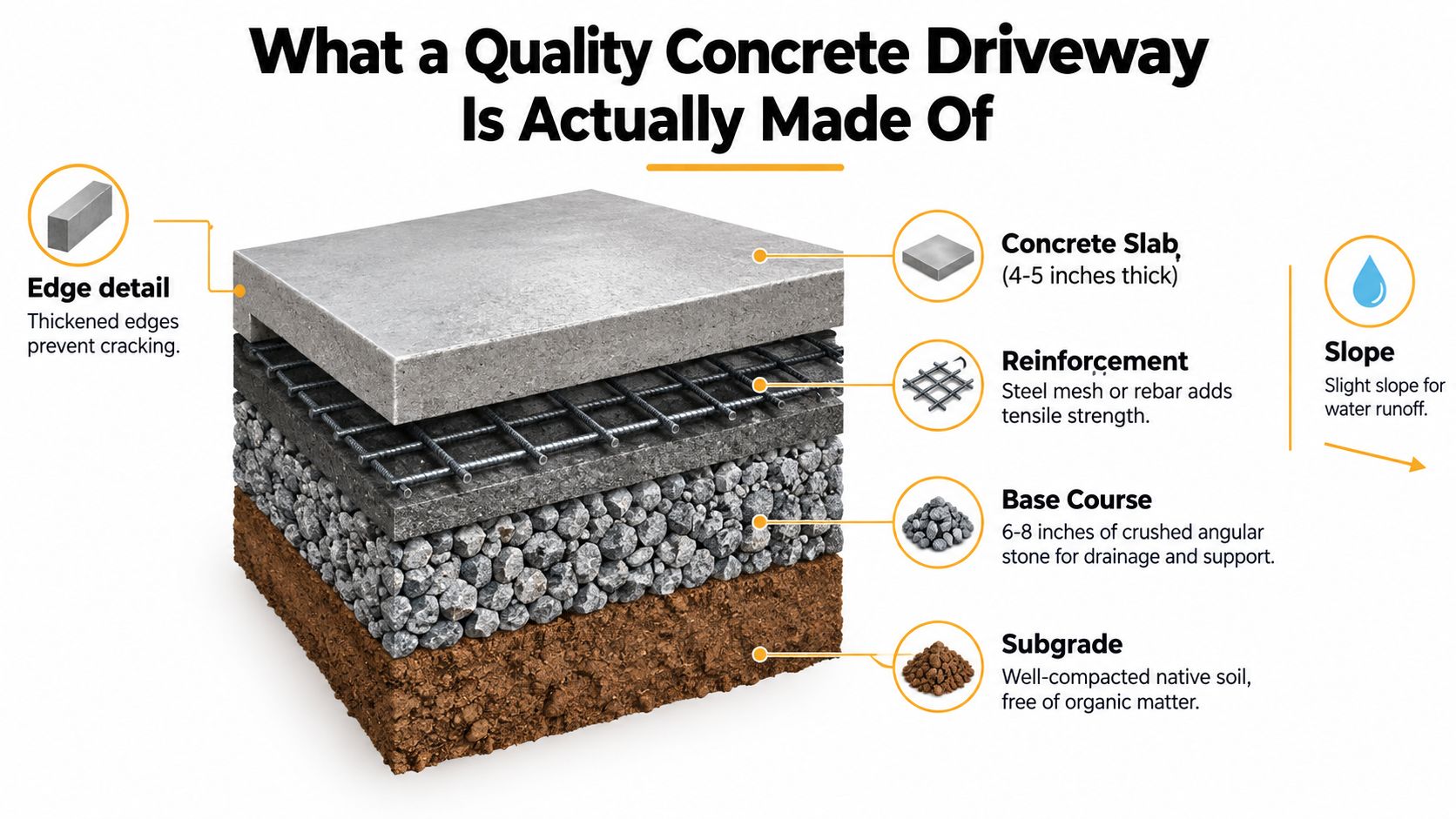
A driveway is a layered system, not just a gray surface. The visible slab receives the traffic, but the soil and aggregate below it distribute loads and manage water. If those lower layers move or stay saturated, a strong concrete mix can still crack, settle, or heave.
The layers below the finished surface
The process begins with the subgrade, usually compacted native soil. Crews remove organic material, soft spots, loose fill, and unsuitable soil before shaping the area. The goal is a stable platform with drainage that won't leave the slab sitting on a wet, shifting pocket.
Above the subgrade, a compacted gravel or crushed-stone base carries load and helps water move through the assembly. Guidance for concrete driveways commonly places this base at 6 to 12 inches, depending on site conditions, with the source explaining how the base improves both drainage and load-carrying capacity. County Materials' concrete driveway FAQ also identifies grading, joint placement, and curing as central durability details.
The slab itself is commonly 4 inches for passenger vehicles. Heavier use, freeze-thaw exposure, or an unstable subgrade can justify 5 to 6 inches with rebar, because added thickness improves compressive capacity while steel helps resist tensile cracking. Build Tool HQ's slab thickness guidance explains why a reinforced, thicker slab is better suited to RVs, work trucks, and demanding subgrades than a thin, unreinforced pour.
Reinforcement, joints, and water movement
Wire mesh can help distribute cracking, while rebar provides a more substantial reinforcement approach for heavier loads. Fiber reinforcement may supplement the mix, but it doesn't replace a properly prepared base, correct thickness, or thoughtful joint layout.
Control joints create planned weak points so normal shrinkage has somewhere to occur. A common specification places joints about 8 to 12 feet apart and cuts them to roughly one-quarter of the slab depth. Concrete Driveway's construction guide describes the typical relationship between slab thickness and joint depth. Expansion material is generally used where the driveway meets a garage, sidewalk, or street.
The surface should slope away from structures at least 1/4 inch per foot to direct stormwater away from the house. That grade is not cosmetic. It protects the edge of the slab, reduces ponding, and helps keep runoff from concentrating against the garage or foundation.
What Really Drives the Cost of a Driveway Project
Price per square foot is only a starting point. Two driveways with similar dimensions can require very different work if one is a clean, flat replacement and the other involves demolition, poor soil, limited access, or complicated runoff.
Five variables that change the estimate
Excavation and demolition often create the first major difference. Removing an old slab, hauling debris, digging through unsuitable soil, or correcting a failed base takes more labor and equipment than preparing an open, stable site.
Access affects both production and logistics. A truck that can discharge close to the forms is different from a property that requires long runs, a smaller pump, hand work, or careful protection of landscaping and finished surfaces.
Thickness and reinforcement change material quantities and structural capacity. A standard passenger-vehicle slab may use the common 4-inch specification, while heavier loads or freeze-thaw conditions may call for 5 or 6 inches with rebar. Decorative broom or stamped finishes also add labor compared with a straightforward textured finish.
Finish grade and layout influence forming and drainage. Curves, transitions, widened parking areas, steps, retaining details, and connections to existing concrete require more layout and finishing control than a simple rectangle.
Stormwater work can be the hidden cost. Standard concrete is impervious, so a site may need grading, swales, drains, or other runoff measures. A homeowner comparing driveway contractors near me should ask whether the quote addresses where water will go, not just what the surface will look like.
For a separate explanation of how dimensions and project variables affect estimates, review this guide to driveway cost per square foot.
Cost Drivers of a Concrete Driveway Project
| Cost Driver | Impact on Price | Typical Reason |
|---|---|---|
| Excavation and demolition | Can raise labor, disposal, and equipment needs | Old concrete, unsuitable soil, or difficult digging |
| Site access | May require smaller equipment or additional handling | Narrow drives, steep grades, or limited truck reach |
| Thickness and reinforcement | Increases concrete and steel requirements | RVs, work trucks, freeze-thaw exposure, or weak subgrades |
| Finish and layout | Adds forming and finishing labor | Curves, stamped patterns, broom textures, or transitions |
| Drainage and grading | Adds earthwork and water-control details | Runoff toward a garage, house, sidewalk, or property edge |
Regional labor availability also affects scheduling and crew continuity. Industry coverage for 2025 identifies labor shortages as a major concrete and construction challenge, while an AGC/NCCER workforce survey reported that 92% of companies had difficulty hiring for open positions. ForConstructionPros' 2025 concrete industry coverage explains why a promised start date deserves as much scrutiny as the quoted price.
Ready-mix delivery minimums, short loads, weather windows, and rushed scheduling can add cost too. The better question is not “What's your square-foot price?” It's “What work is included, and what protects the slab over its service life?”
How the Driveway Installation Process Works From Start to Finish
A professional driveway installation starts before excavation. On a typical Pennsylvania, Maryland, Delaware, or New Jersey property, the contractor first evaluates slope, drainage, access, existing surfaces, and the relationship between the driveway, garage, sidewalk, street, and house.
From property visit to prepared forms
The site visit produces measurements and a workable plan. The written estimate should then identify the proposed base, slab thickness, reinforcement, concrete mix, finish, control joints, drainage work, cleanup, payment terms, and warranty documentation.
Before digging, the contractor coordinates the required permit process and underground utility locate. Depending on the state and location, that may involve PA One Call, 811, or the equivalent state service. Scheduling must account for crew availability and a suitable weather window, because concrete placement and finishing depend on conditions that the contractor can manage.
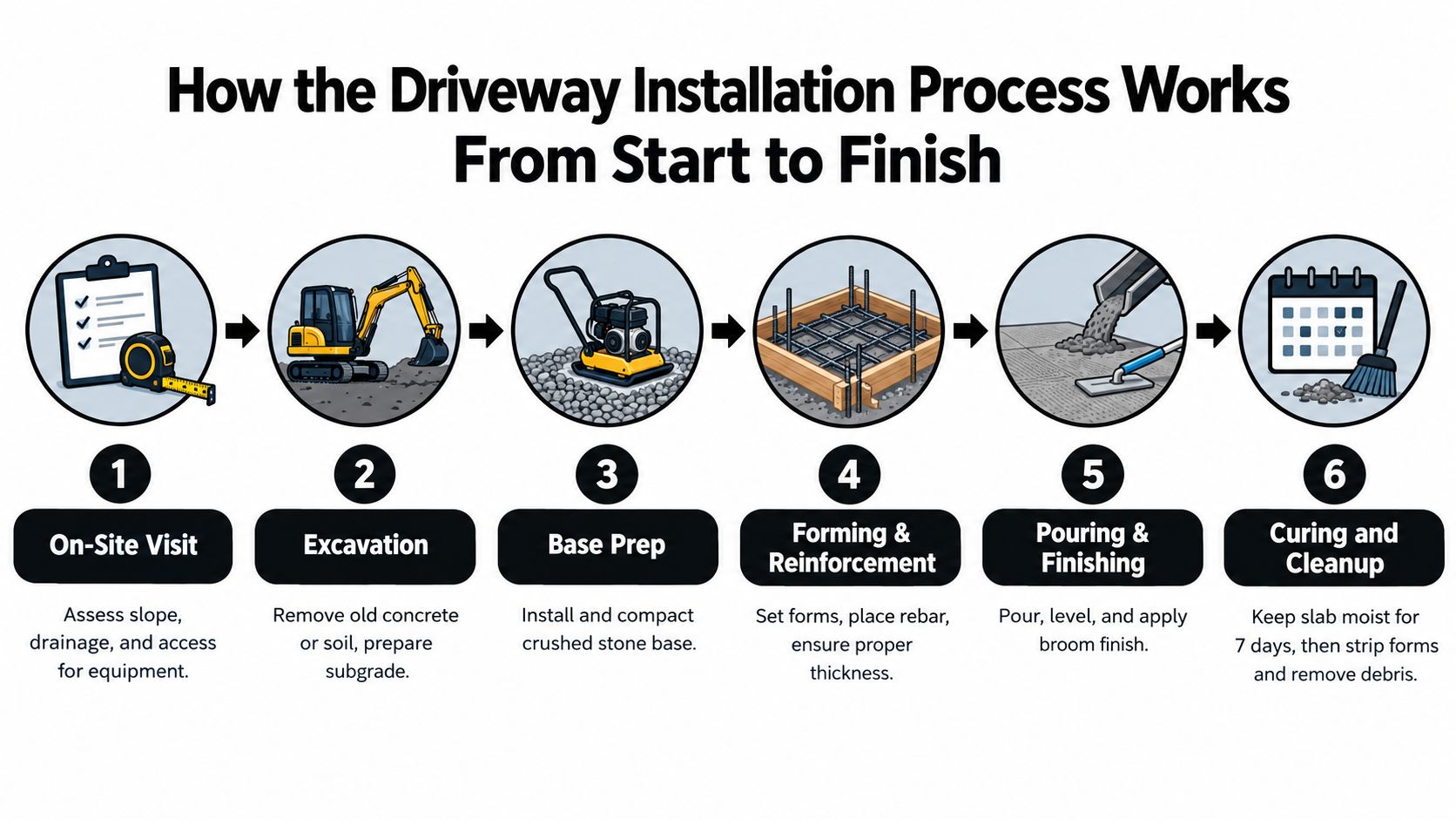
The crew then removes old material or excavates soil, addresses soft spots, and compacts the subgrade. Crushed stone is placed and compacted in a way that creates a stable, draining base. Forms establish the driveway's dimensions, edges, slope, and transitions, while rebar or wire mesh is positioned according to the agreed specification.
Pouring, finishing, and curing
During the pour, the crew places concrete, strikes it to grade, consolidates it, and applies the selected finish. A broom texture provides traction for ordinary residential use, while decorative finishes require additional timing and workmanship. Control joints are tooled or saw-cut according to the layout, and the crew applies curing compound or uses another approved curing method.
The slab needs a protected curing period before regular vehicle use. Driveway guidance calls for curing to continue for at least 7 days to reduce random cracking associated with shrinkage and early moisture loss. County Materials' driveway FAQ provides the supporting specifications for curing, joints, slope, and base preparation.
For a visual explanation of forming, reinforcement, placement, and finishing, see these concrete driveway construction details.
After the initial cure, the contractor strips forms, removes debris, checks edges and transitions, and completes a final walkthrough. The homeowner should receive the final payment terms, care instructions, and warranty documentation in writing.
Comparing Concrete and Gravel Driveway Options
The right surface depends on the site, not on a universal preference. Standard concrete offers a finished appearance and a firm, low-routine-maintenance surface. Gravel can make more sense for a long rural lane, a temporary access route, or a property where repeated grading is acceptable.
Permeable concrete adds another option where stormwater rules, soil conditions, and local approvals make runoff control important. The material and installation approach allow water to move through the surface, but the system still needs appropriate excavation, base design, edge restraint, and maintenance. It isn't a shortcut around drainage planning.
Driveway Surface Comparison
| Factor | Standard Concrete | Permeable Concrete | Compacted Gravel |
|---|---|---|---|
| Upfront cost | Usually higher than basic gravel | About $2 to $5 more per sq ft than standard concrete in the cited comparison | Often lower for simple or long areas |
| Stormwater handling | Impervious and may shed runoff toward low points | Can reduce surface runoff when designed correctly | Allows infiltration but can migrate under heavy flow |
| Maintenance | Mainly joint, crack, drainage, and surface care | Requires attention to clogging and drainage performance | Needs periodic raking, adding stone, and pothole repair |
| Freeze-thaw performance | Depends heavily on base, drainage, thickness, and joints | Depends on the full permeable assembly and local soil | Can move or rut when saturated and repeatedly frozen |
| Service life | A properly installed residential driveway typically lasts 25 to 40 years, with practical planning horizons often placed at 30 to 50 years when maintained and protected from drainage problems, freeze-thaw stress, and heavy loads. Concrete driveway lifespan guidance | Can perform well when the base and maintenance plan suit the site | Varies with drainage, traffic, grading, and replenishment |
| Curb appeal | Clean, finished, and adaptable to decorative work | Modern appearance with stormwater benefits | Informal, practical, and suited to rural settings |
The stormwater economics deserve attention. The cited comparison places permeable driveway installation at about $2 to $5 more per square foot than standard concrete and notes that some cities may offer stormwater fee reductions of roughly $10 to $30 per month, sometimes recovering the premium in 5 to 10 years. RainPlan's driveway cost and stormwater discussion explains why a lower upfront quote isn't always the lower lifetime cost.
A simple decision rule works well. Choose concrete when you want a stable finished surface and can build the drainage and base correctly. Consider permeable concrete where runoff compliance and local credits matter. Choose gravel for rural or extended drives when periodic maintenance fits your expectations.
Vetting Questions and Red Flags Before You Hire
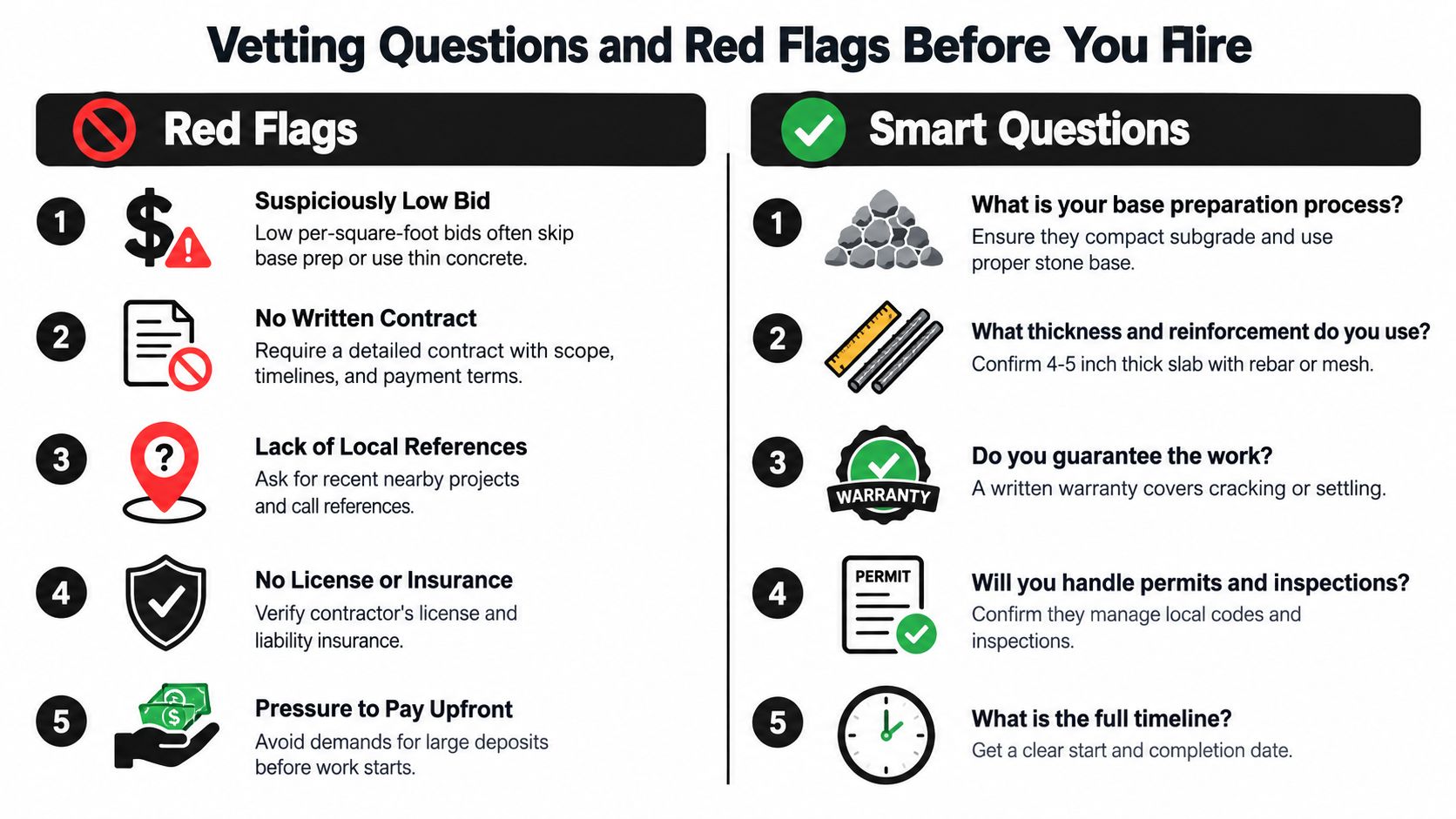
A suspiciously low driveway bid often looks attractive because it leaves out the work that homeowners can't see. If the estimate says only “remove and pour,” you don't yet know how the contractor will handle subgrade preparation, stone, reinforcement, joints, drainage, disposal, or curing.
Ask for a written scope before signing anything. The proposal should identify the materials and sequence, not just provide a total price and a vague start window.
Questions that expose weak proposals
- How will you prepare the subgrade? Ask what unsuitable material gets removed and how the remaining soil will be compacted.
- What base material and depth are included? The answer should identify crushed stone or aggregate, not just “gravel.”
- What slab thickness and reinforcement will you install? Confirm whether the plan calls for mesh, rebar, fiber, or a combination suited to the intended vehicles.
- Where will control joints go? The layout should account for the driveway's shape and connections to existing concrete.
- How will you manage water? Ask where runoff will travel and whether grading, drains, swales, or other measures are included.
- Who handles permits and utility locating? Get the responsibility in writing.
- What does the warranty cover? A warranty should state how the contractor handles settling, workmanship concerns, and cracking disputes.
- How are changes priced? You should understand the approval process before unexpected soil or access conditions alter the scope.
Red flags include cash-only demands, pressure for a large upfront payment, no certificate of insurance, no local references, and a crew that can't explain who will supervise the pour. Vague scheduling is another concern. Labor shortages can affect lead times, but a professional contractor should still communicate the expected window and what could change it.
If the finished driveway will also serve as a basketball court, review an independent guide to the best driveway basketball hoops before you finalize the slab layout and clear playing area.
Use a simple hire-or-pass checklist:
- Scope: Every major task appears in writing.
- Credentials: Licensing and insurance information is available.
- References: Recent local customers can describe the work.
- Site plan: Grade, drainage, joints, thickness, and access have been discussed.
- Communication: Start timing, payment terms, warranty, and change orders are clear.
Maintenance Tips and Your Next Step With Firm Foundations
Concrete needs routine care, especially in a climate that cycles through freezing, thawing, rain, and winter deicers. A properly built residential driveway can last 25 to 40 years, and many planning references place a well-installed, maintained slab within a 30 to 50 year practical horizon when drainage problems, freeze-thaw stress, and heavy loads are controlled. The driveway lifespan reference connects that range to installation quality and ongoing protection.
A practical maintenance routine
Sealing is one part of the plan. Apply sealer at 12 to 18 months after installation, then renew it every 3 to 5 years, using a product appropriate for the finish and exposure. Avoid ammonium sulfate and rock salt during the first winter. Calcium chloride or sand can provide traction with less risk to new concrete.
Inspect joints each spring. Seal hairline cracks once they exceed 1/8 inch, and address any opening that allows water to reach the base. Pressure-wash at low pressure so you don't erode joint edges or wash material out of small cracks.
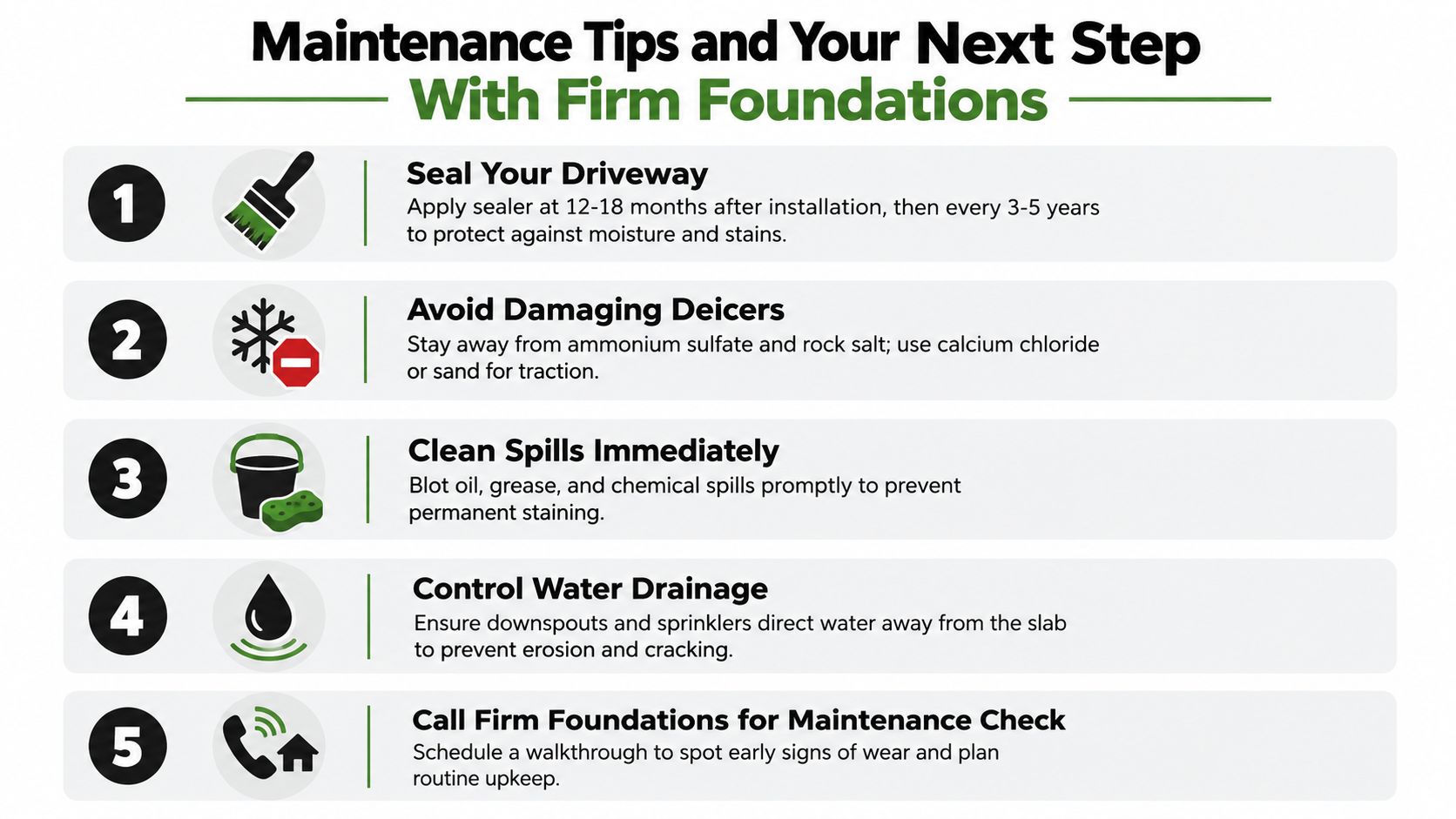
Keep heavy trucks away from unsupported slab edges, especially near transitions and shoulders. Redirect downspouts and sprinkler spray away from the driveway approach, and reseal areas where the aggregate becomes visibly exposed. For homeowners planning a cleaning project, this practical guide to the best way to clean concrete driveway offers additional surface-care context.
Getting a project-specific quote
Firm Foundations provides excavation and gravel or concrete driveway services across Pennsylvania, Maryland, Delaware, and New Jersey. The quote process should begin with a mobile call or an online request that includes your address, driveway dimensions, photos, intended vehicle use, and any known drainage concerns.
A project manager can then assess the site, access, slope, existing surface, and subgrade conditions before preparing a written, line-item estimate. Ask for the proposed base, rebar, PSI mix, slab thickness, finish, drainage details, joint plan, cleanup, warranty, and payment schedule to be shown clearly. Firm Foundations' published process includes a free quote workflow and scheduling with a 10% deposit, so confirm the current terms when you request your estimate.
Early spring or fall scheduling can help you avoid the busiest summer backlog, but weather and site readiness still control the actual pour window. The most durable driveway isn't defined by decorative texture alone. It's defined by excavation, compaction, water management, correctly placed joints, suitable reinforcement, and disciplined curing.
Firm Foundations can evaluate your site, prepare the subgrade, install the required base, and build a concrete or gravel driveway suited to your property across Pennsylvania, Maryland, Delaware, and New Jersey. Visit Firm Foundations to request a free quote and start with a written plan that addresses drainage, access, materials, and long-term performance.