
Concrete Driveway Cost Per Square Foot: A 2026 Guide
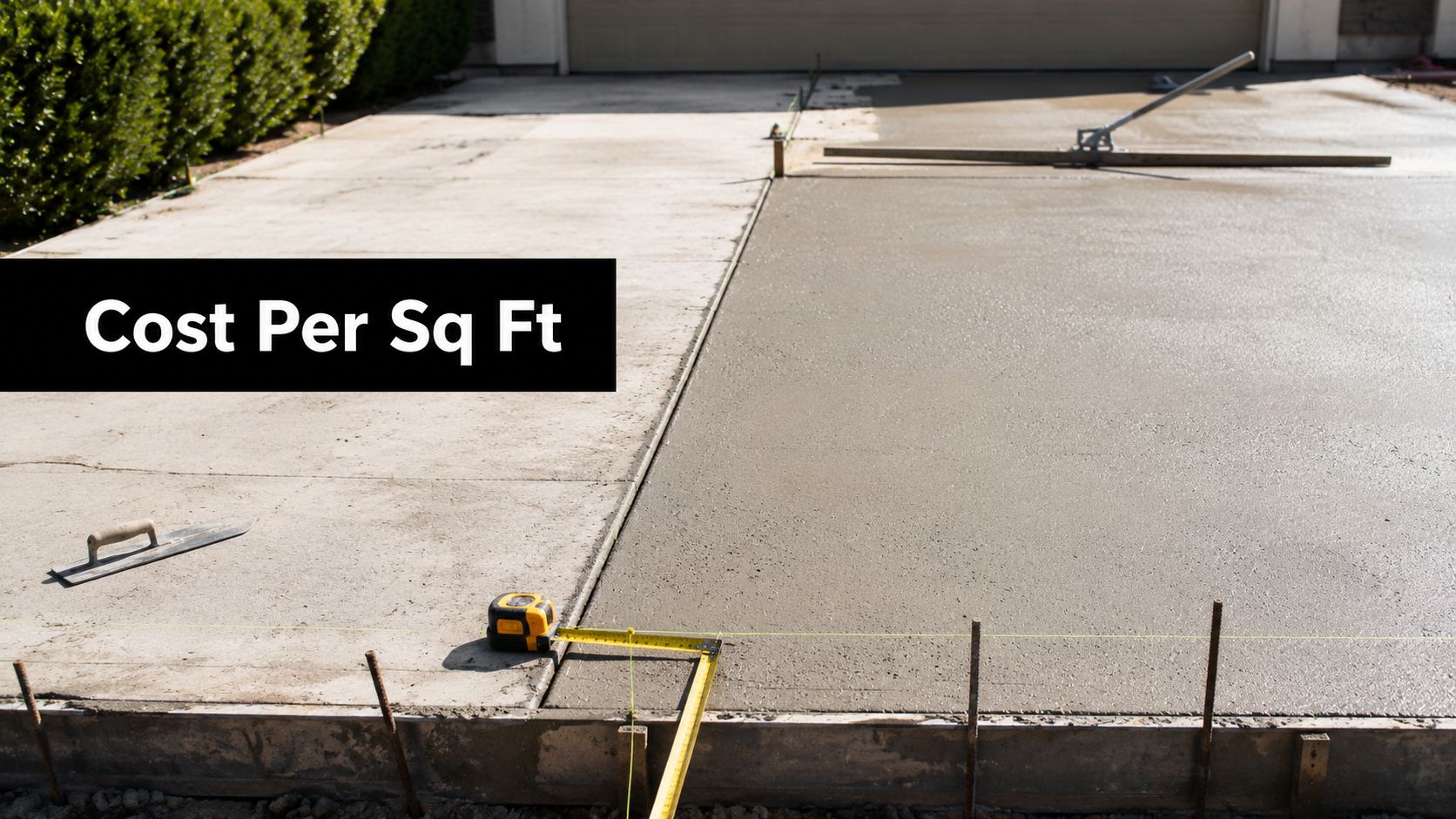
Concrete driveway cost per square foot in 2026 usually lands between $8 and $20 per square foot, and a typical two-car driveway often comes in around $3,000 to $12,000 depending on size, finish, and site conditions. That range makes sense once you look past the headline number, because thickness, reinforcement, sub-base work, drainage, and finish all change the final price.
A homeowner usually sees that difference right away when two quotes for the same driveway don't match. One contractor may be pricing a plain replacement with simple access, while another is including tear-out, thicker concrete, and a cleaner finish that takes more labor.
What Concrete Driveway Cost Per Square Foot Looks Like in 2026
A couple in Chester County might look at two bids for the same driveway and wonder why one lands near the middle of the estimate band while the other sits higher. The answer usually isn't mystery pricing, it's scope. One quote may cover a plain replacement, while the other includes demolition, thicker slab work, and finishing details that take more time and skill.
The current working range is $8 to $20 per square foot installed, with the average project around $6,400 and total project costs ranging from $1,600 to $32,000 depending on size, finish, and site conditions, according to the 2026 benchmark in the market (Angi driveway cost guide). That spread matters because it shows the per-square-foot price is not a single fixed number. It scales with driveway size, and it moves when the job gets harder.
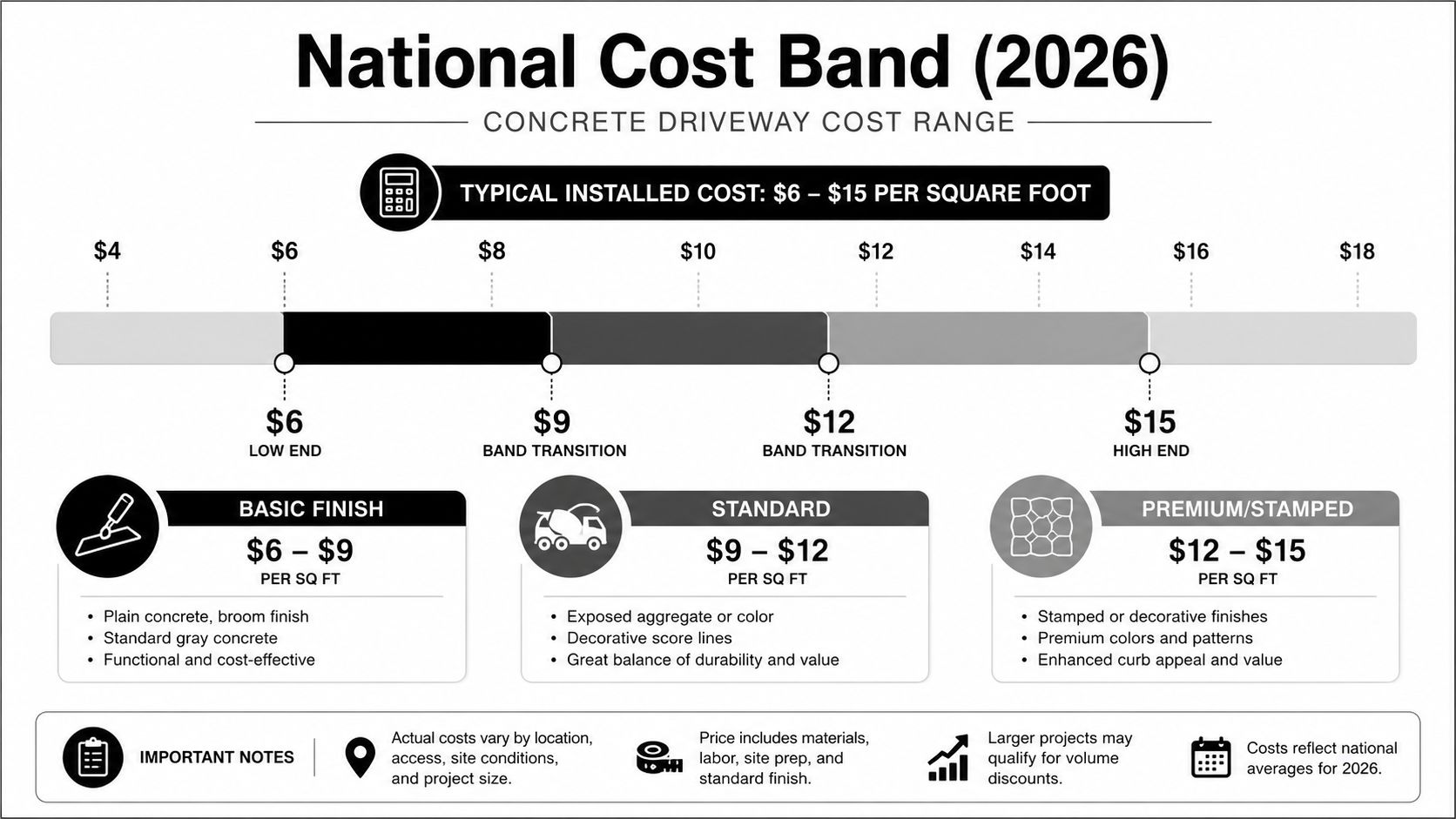
For planning purposes, it helps to think in bands, not a single figure. Plain replacement work can sit near the lower end, while decorative work, thicker slabs, or difficult access can push the number toward the top of the range. Contractors quote this way because the square footage is the cleanest way to compare bids, especially when two driveways look similar but the scope underneath is not.
Why the range is wider than most homeowners expect
A driveway is not just a slab. It's excavation, grading, forming, concrete placement, finishing, curing, and, in many cases, removal of an old surface. That's why two jobs with the same square footage can land at very different totals.
Recent pricing guides reinforce that pattern. One 2026 guide places plain gray concrete at $5 to $8 per square foot and decorative concrete at $8 to $21 per square foot, while another national guide puts standard installed concrete at $6 to $15 per square foot and gravel at $1 to $3 per square foot for comparison (Costorie concrete driveway cost guide). The takeaway is simple, the material name matters less than the finish and the labor involved.
Practical rule: If two quotes are far apart, ask what each one includes before you compare the bottom line.
The Cost Drivers That Move Your Per Square Foot Price
The biggest mistake I see is homeowners comparing a base price without checking what the contractor built into it. A quote that looks cheap can leave out demolition, sub-base work, or reinforcement, then those costs show up later. A fair estimate makes the line items visible from the start.
Thickness and reinforcement change the structure, not just the price
A standard residential driveway often uses a 4-inch slab, but reinforced 5 to 6 inch sections cost more because they use more material and more labor. Rebar or wire mesh also adds cost, and higher-PSI mixes can add more again when the job calls for stronger concrete. Neutral calculators note that soil prep or a gravel sub-base can add $1 to $3 per square foot, demolition and removal can add $2 to $5 per square foot, reinforcement such as rebar or wire mesh can add $1 to $3 per square foot, and higher-PSI concrete can add $1 to $4 per square foot (Kijanix driveway calculator).
That's where the core decision lies. The cheapest quote may price a thinner slab with minimal prep, while a better-built driveway can cost more upfront and perform better for years.
Finish type and labor are usually the visible premium
A plain broom finish is usually the most efficient choice to place and finish. Decorative work, stamped surfaces, exposed aggregate, borders, and color all add handwork, timing sensitivity, and a greater chance of problems if the crew can't finish before the concrete starts to set. The concrete network pricing guide places a plain broom-finish driveway around $5 to $8 per square foot, while decorative or stamped work commonly lands at $8 to $21 per square foot (Concrete Network driveway cost).
That's why I tell homeowners to treat finish as a budget choice, not just a style choice. You're buying labor time as much as you're buying appearance.
What to ask on site: Does the quote include tear-out, gravel base, reinforcement, finish type, and cleanup, or just the pour itself?
If you want a simple overview of how contractors lay out the work, this concrete driveway construction details page is a useful reference point for the scope that should be on paper.
Regional Pricing in Pennsylvania, Maryland, Delaware, and New Jersey
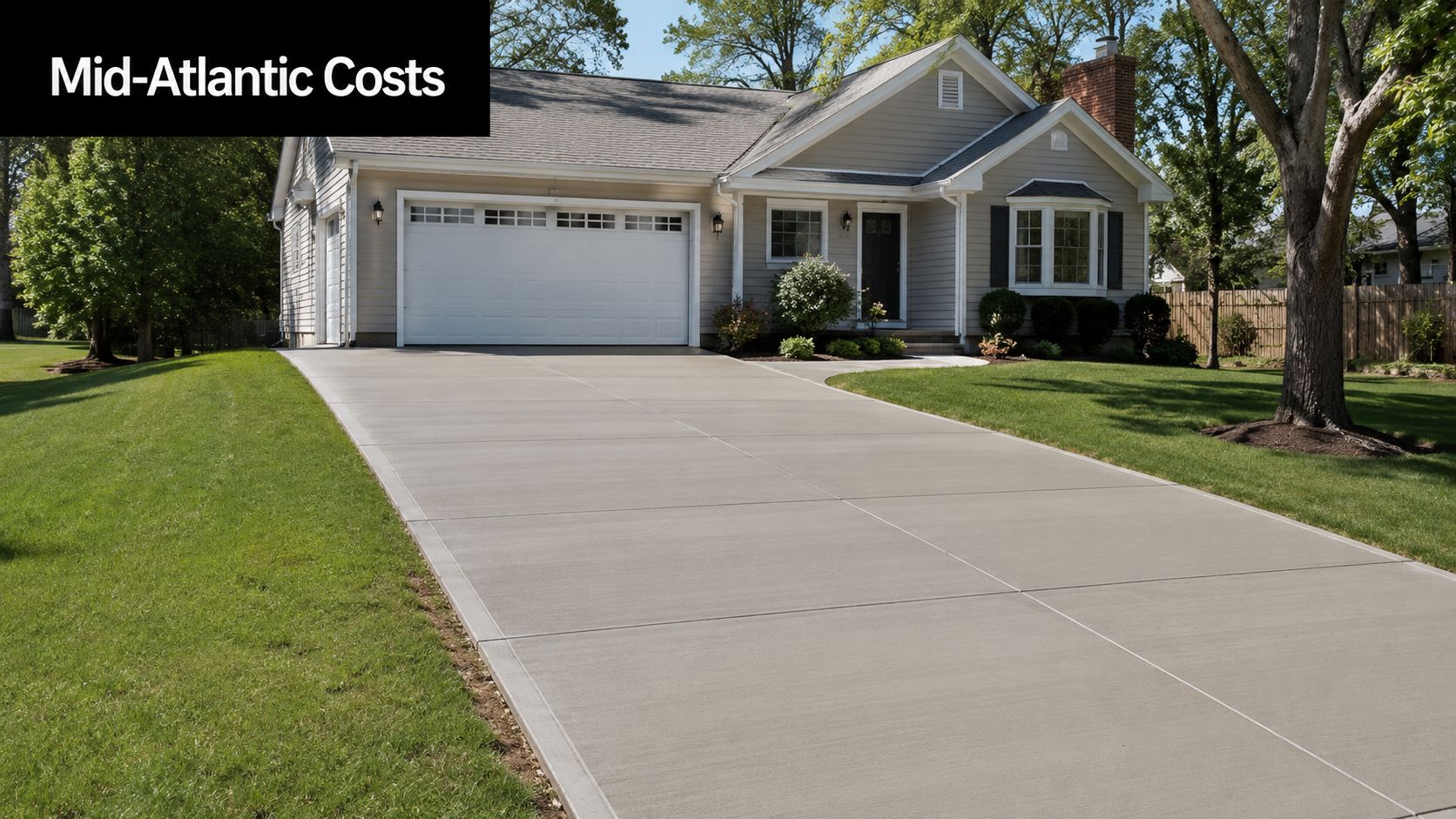
In the Mid-Atlantic, concrete driveway pricing usually clusters in the middle of the national range rather than at the extremes. That's because the work often has to account for winter movement, drainage, access, and municipal approvals, even on ordinary suburban driveways. Homeowners in Pennsylvania, Maryland, Delaware, and New Jersey often see more site prep detail in the estimate than they expect.
Why local conditions change the quote
Frost cycles and drainage issues matter here. In this region, a driveway that looks simple from the street can need extra excavation, better compaction, or more careful grading so water doesn't push problems into the slab or the garage approach. Township and county rules can also add time, because some jobs need permits or inspections before concrete can be placed.
That's one reason suburban driveways from Chester County to the Delaware beaches often get priced with more attention to prep than a homeowner expects. The project isn't just about pouring concrete, it's about building a stable base that handles seasonal movement.
What usually shows up on local bids
In this market, I'd expect to see plain residential finishes more often than elaborate decorative work, especially where the goal is a clean, durable driveway rather than a showpiece surface. Many homeowners also ask for transitions, aprons, or repair tie-ins, and those details should be spelled out line by line so the bid stays comparable.
A Mid-Atlantic quote should tell you how the contractor is handling drainage, access, and base prep, not just the square-foot number.
Firm Foundations handles the excavation and foundation side of that work for homeowners who want the driveway or slab built on a proper base rather than on guesswork. For projects that include a garage approach, shed pad, or other concrete work, that kind of scope control makes the estimate easier to trust.
Sample Math for Common Driveway Sizes
The fastest way to understand concrete driveway pricing is to run the math on your own square footage. A per-square-foot quote only becomes useful when you multiply it by the actual area you need. That's where the budget either stays manageable or starts to climb.
Two-car and extended driveways
A common 600-square-foot two-car driveway gives you a good baseline. At $8 to $20 per square foot, that works out to $4,800 to $12,000. If the job is plain and straightforward, you're closer to the lower end. If the project includes decorative work or more difficult access, the total moves up quickly.
A 1,000-square-foot extended driveway is a different conversation. At the same installed range, you're looking at $8,000 to $20,000. That's why larger driveways deserve more attention to scope and finish, because small changes in the per-square-foot number have a bigger effect on the final invoice.
Smaller replacement jobs still deserve a proper estimate
For a 400-square-foot single-lane or replacement project, the same range lands at $3,200 to $8,000. Smaller jobs often look simpler, but they can be more expensive per square foot in practice if tear-out, access, or cleanup take extra time.
| Sample Project Totals by Driveway Size and Finish | Plain broom finish | Decorative finish | Heavily reinforced build |
|---|---|---|---|
| 400 square feet | $2,000 to $3,200 | $3,200 to $8,400 | $3,200 to $8,000 |
| 600 square feet | $3,000 to $4,800 | $4,800 to $12,600 | $4,800 to $12,000 |
| 1,000 square feet | $5,000 to $8,000 | $8,000 to $21,000 | $8,000 to $20,000 |
The most important thing in that table is not the exact total. It's the way the finish and build quality change the budget before you even get into site-specific issues.
How to Read a Contractor Estimate Line by Line
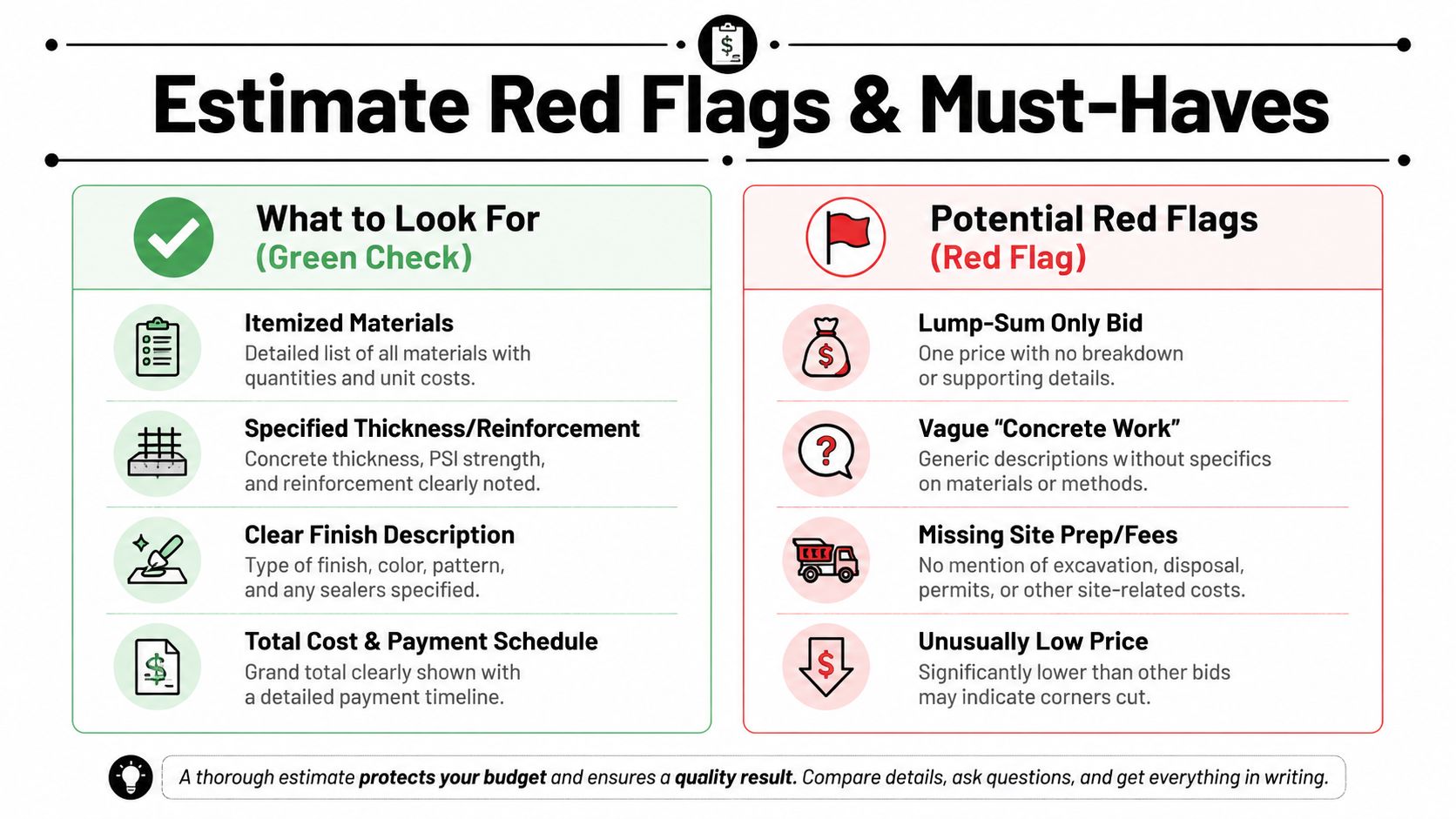
A good estimate should read like a scope of work, not a mystery number. If the quote only says “concrete driveway” with one total at the bottom, you're not getting enough information to compare bids fairly. The paper should show what the contractor is charging for.
What should be on the page
A solid estimate usually includes the driveway square footage, the thickness of the slab, whether reinforcement is included, what finish will be used, and whether demolition or base prep is part of the job. You should also see the payment schedule, because a vague lump sum tells you less than a clear breakdown.
The clearest way to compare bids is to put them side by side and look for missing work. A low number can look attractive until you realize it excludes tear-out, gravel, or drainage correction. That's the part that gets expensive later.
Red flags that deserve a follow-up question
An unusually low per-square-foot number can be a warning sign if it's built on thin concrete or light prep. A vague line like “concrete work” doesn't tell you whether the contractor is including forms, reinforcement, cleanup, or the driveway apron. If those pieces aren't written down, they can become change orders.
For a useful side-by-side comparison on another type of exterior project, the 2026 privacy fence price breakdown shows the same principle, the lowest number on paper isn't always the clearest scope.
Why the Cheapest Quote Is Not Always the Lowest Life Cycle Cost
The cheapest driveway bid can cost more over time if it leaves out the things that keep concrete stable. A thinner slab, weak base prep, or poor drainage can lead to cracking, settling, and premature patch work. Once that starts, the original savings disappear fast.
Pay for the parts that prevent repeat work
Thickness and reinforcement matter because they support the slab under real use, not ideal conditions. A driveway that sees delivery trucks, RVs, or steep grades needs more than the minimum build if you want it to hold up. The same is true when the soil is soft or the base is uneven.
That's why I'd rather see a homeowner spend a little more on the right structure than chase the lowest number and gamble on repairs. If you're already dealing with cracked concrete, the guidance in repair your cracked patio is a good reminder that surface problems usually start below the surface.
When a higher quote makes sense
A better-built driveway usually makes sense when the site needs more excavation, stronger reinforcement, or careful water control. Those are not luxury upgrades, they're the parts that keep the slab from moving. The work costs more because the labor and material requirements are higher.
For homeowners planning sealing and long-term care, this driveway sealer guide is a practical companion to the installation budget. A good surface still needs maintenance, but maintenance works best when the slab beneath it was built correctly.
Bottom line: A slightly higher quote can be the cheaper decision if it reduces cracking and replacement risk later.
Practical Ways to Lower Your Concrete Driveway Cost
You can cut cost without cutting the wrong corners. The easiest savings usually come from simplifying the shape, avoiding unnecessary width, and choosing a straightforward finish instead of a decorative one. If the project is already tied to other excavation work, combining the jobs can also help reduce repeated mobilization.
Where to save and where not to
Skip extra curves, borders, and custom detailing unless they serve the property. Those features add labor time and usually don't improve the driveway's function. A clean layout with sensible dimensions often gives the best value.
Don't save by shaving down the base prep or asking for an undersized slab. That's the kind of shortcut that turns into settlement or cracking later. If the contractor recommends a sturdier build for soil or access reasons, that advice should be taken seriously.
Get the quote aligned with the real job
Ask for the same scope on every bid. If one contractor includes tear-out, reinforcement, and cleanup while another doesn't, the lower number isn't really lower. A fair comparison starts with identical assumptions.
If you want a driveway, garage approach, or shed pad priced with the right base from the beginning, a proper site visit is the best next step. That's how you avoid surprises and keep the work moving.
Frequently Asked Questions About Concrete Driveway Costs
How long does a concrete driveway last
A properly installed driveway can last for decades, but its life depends on the base, slab thickness, and drainage. Good installation matters more than the surface finish.
When does repair beat replacement
Repair usually makes sense when the damage is limited to isolated cracking or minor surface wear. If the slab has settled, moved, or failed over a wide area, replacement is often the more reliable answer.
Is a thicker slab worth it
Yes, when the driveway will handle heavier vehicles or tougher site conditions. Paying more for the right thickness can reduce future cracking risk.
How do I get an accurate quote
Get an on-site estimate and make sure the contractor lists thickness, reinforcement, base prep, finish, and demolition if needed. For planning the rest of the exterior, how to light your home's exterior is a helpful reminder that the driveway should work with the whole property, not just stand alone.
Firm Foundations builds concrete foundations, gravel pads, and driveway-related excavation work across Pennsylvania, Maryland, Delaware, and New Jersey. If you're comparing quotes for a driveway, garage slab, or shed base, visit Firm Foundations to request a clear estimate and get the scope spelled out before work starts.