
Questions to Ask Concrete Driveway Contractor

Can a driveway look finished on day one and still be a poor investment? It can. Settlement, standing water, and cracking often begin with decisions made before the concrete arrives, including weak excavation, poor grading, inadequate drainage, or a vague mix specification.
That's why the best questions to ask a concrete driveway contractor focus on the entire project lifecycle, not just the color, finish, or lowest price. You want clear answers about credentials, site preparation, concrete strength, reinforcement, curing, payment, warranties, and follow-up. Those answers help you compare contractors on process and accountability, which protects your budget and your property.
Firm Foundations is a licensed, insured foundation and excavation contractor serving Pennsylvania, Maryland, Delaware, and New Jersey. The team provides transparent, free quotes for driveway and foundation work, including excavation, forming, concrete placement, and finishing. Homeowners searching for driveway contractors near me, concrete foundations, or related foundation services can use this guide to prepare for a productive estimate.
You'll also find regional owner notes, sample wording for difficult follow-ups, warning signs that deserve attention, and a printable checklist at the end. If you're researching contractor marketing as well as construction services, Digital Skyrocket's lead generation guidance for contractors offers relevant background on reaching homeowners who are ready to request a quote.
1. What Experience and Licensing Does Your Concrete Driveway Contractor Have?
Start with credentials before you compare prices. Ask, “Are you licensed and insured, and can you provide written proof of both?” Contractor insurance requirements often depend on state licensing rules and project contracts rather than one federal standard. Industry guidance commonly identifies general liability coverage of about $1 million per occurrence and $2 million aggregate, while workers' compensation is mandatory in nearly all states once employees are hired. Commercial auto coverage and an umbrella policy may also appear in project requirements, with umbrella limits sometimes ranging from $1 million to $5 million according to concrete contractor insurance guidance.
A driveway project includes excavation, formwork, reinforcement, concrete placement, and finishing. Each stage creates jobsite risks, including those addressed by OSHA rules for concrete and masonry construction, formwork, reinforcing steel, and silica exposure. A professional contractor should explain who carries responsibility for workers, equipment, property damage, and compliance.
Verify the business, not just the salesperson
Ask how long the company has operated, how many driveways it completes, and whether it has worked in your township or neighborhood. Search the contractor's license number through the applicable state licensing board, then contact the insurance provider to confirm that coverage remains active.
Firm Foundations has served Pennsylvania, Maryland, Delaware, and New Jersey since 2011, with licensing and insurance coverage for its foundation and excavation work. The company is also trusted by shed builders including Stoltzfus Structures and Sheds Unlimited, a useful indicator of experience coordinating foundation work with structure installation.
Practical rule: Don't discuss the final price until you've seen current license and insurance documentation.
Request recent driveway references and ask how the surface has performed after weather, vehicle use, and seasonal maintenance. A contractor who answers directly and documents credentials gives you a stronger basis for moving forward than one who relies on verbal assurances.
2. Can You Explain Your Driveway Site Preparation and Excavation Process?
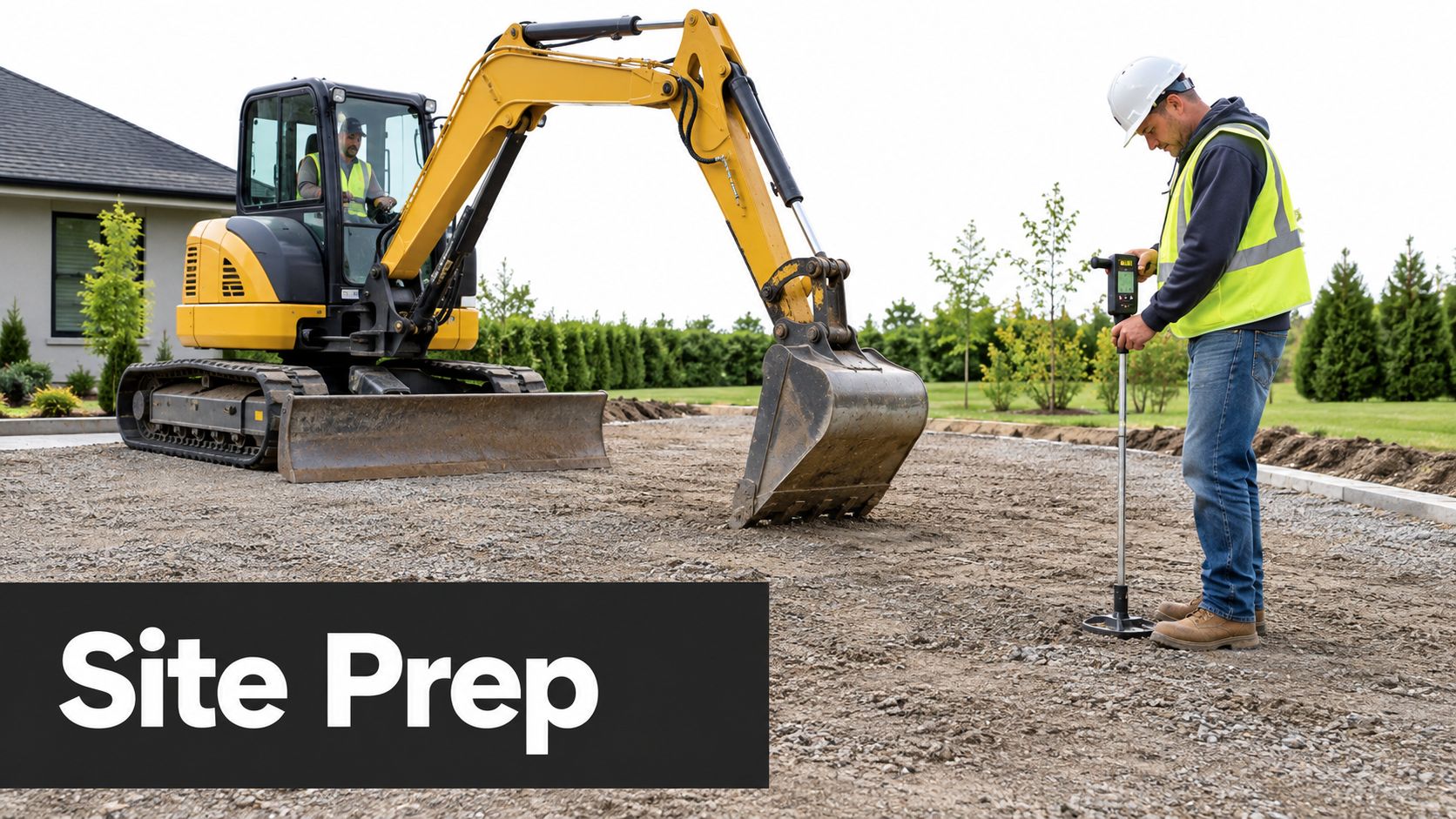
The concrete is only as reliable as the ground supporting it. Ask the contractor to walk you through the excavation plan, including how they'll remove topsoil or soft material, establish grades, prepare the subgrade, and compact the base. You should also ask what depth they'll excavate and what gravel or crushed-stone material they'll install beneath the slab.
A strong answer should address soil conditions, compaction, drainage, and access. If the property slopes toward the house, the contractor needs a plan to move water away from the foundation rather than allowing runoff to collect beside the garage or basement wall. If the existing ground is unstable, pouring thicker concrete over it won't solve the underlying problem.
Firm Foundations specializes in site preparation and precise excavation for driveways, shed pads, garage foundations, and other foundation builds throughout the region. The same preparation principles apply whether you need a gravel shed foundation, a base for a storage shed, or a residential driveway. You can also review this practical guide to how to concrete a driveway before your estimate.
Get the underground work in writing
Ask for written specifications covering excavation depth, base material, compaction procedures, grading, and any drainage structures. A contractor should be able to explain how the base will be placed and compacted, not just state that “proper prep” is included.
This question also exposes misleading low bids. One quote may include demolition, excavation, gravel, and grading, while another may price only the concrete placement. Compare the scope line by line before deciding which contractor is more affordable.
Watch the site assessment portion of the process carefully. A contractor who measures grades, checks access, discusses nearby structures, and identifies drainage risks is evaluating the project. A contractor who provides a firm price without examining the ground may be leaving important work undefined.
3. What Is Your Concrete Mix Design and Reinforcement Plan?
“Concrete” isn't one universal product. Ask, “What compressive strength will you order, what aggregate will the mix contain, and will it be air-entrained for freeze-thaw conditions?” Independent driveway guidance identifies 4,000 PSI at 28 days as a minimum compressive-strength target and recommends air entrainment for exterior concrete exposed to freezing and thawing. Review the driveway PSI guidance with your contractor, then request the selected mix in writing.
For Pennsylvania, Maryland, Delaware, and New Jersey, the conversation should include winter exposure, de-icing salt, vehicle weight, and drainage. Air entrainment creates microscopic spaces that help concrete tolerate water expansion during freezing conditions. The contractor should explain how the mix fits your site and use rather than offering the same specification for every driveway.
Ask what controls cracking
Reinforcement may include rebar, welded wire mesh, or fiber reinforcement. Each option has a role, but the important question is why the contractor selected it for your soil, slab design, and expected traffic. A driveway supporting ordinary passenger vehicles may have different reinforcement needs from one serving work trucks, trailers, or frequent deliveries.
Ask where the reinforcement will sit in the slab and how the crew will keep it in position during placement. Reinforcement that ends up lying on the base cannot perform as intended. Also ask where control joints will go. Joints don't prevent every crack, but they help direct shrinkage cracking into planned lines.
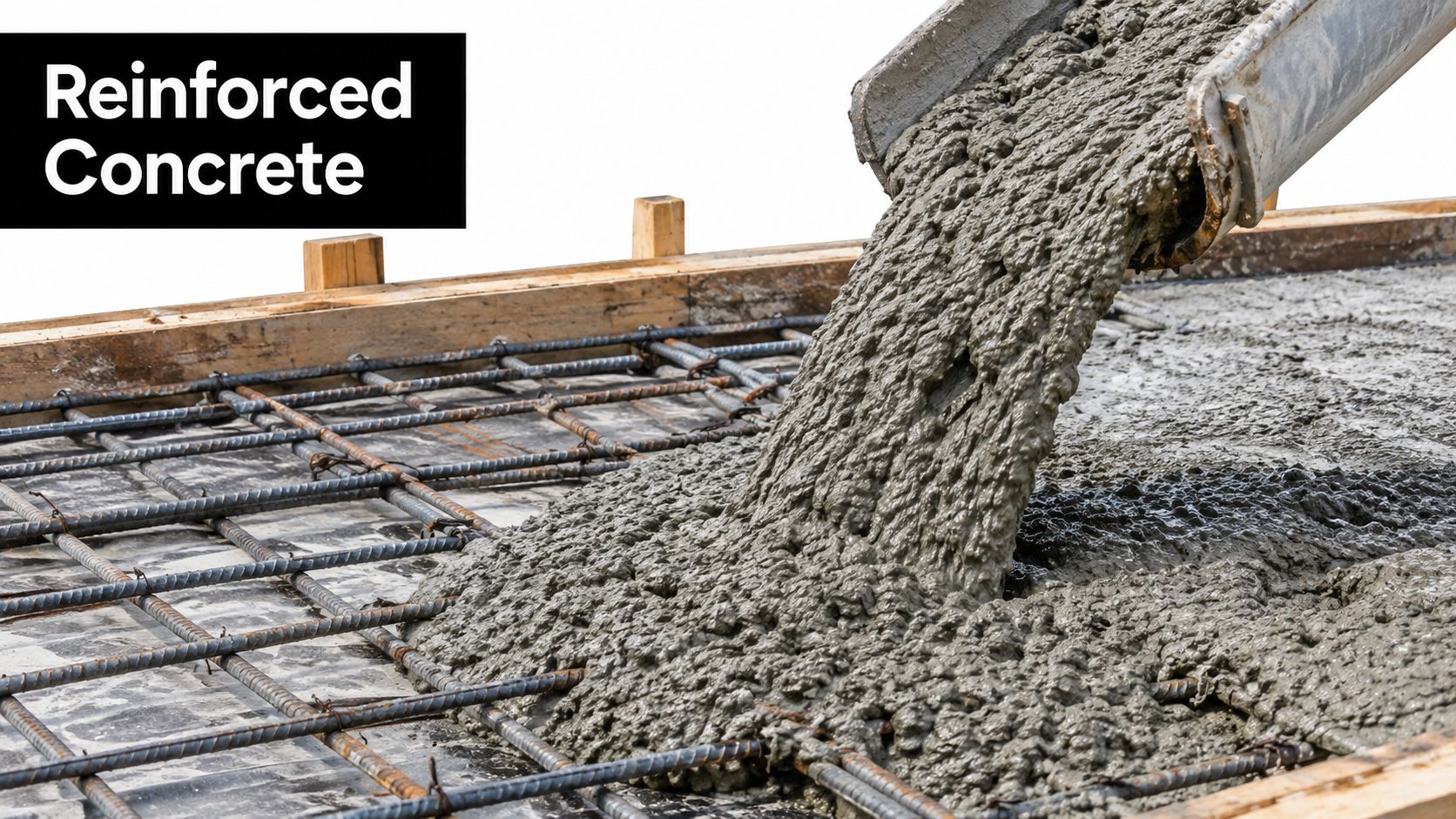
Request the ready-mix supplier's batch documentation when appropriate, along with the contractor's written specifications for PSI, air entrainment, aggregate, reinforcement, slab thickness, and joints. A contractor who welcomes those questions is showing that the design matters as much as the finish.
4. How Long Will My Concrete Driveway Last, and What Is Your Warranty?
Ask for a realistic service-life expectation, not a sales promise. Neutral industry and transportation guidance commonly place properly installed concrete pavement in the 25-to-50-year range, with 30 years or more often used as a benchmark for well-installed and maintained concrete. Minor repairs may arise around the 15-to-20-year mark, while resurfacing or major rehabilitation is more likely in the 30-to-50-year range, as outlined in this concrete driveway durability guidance.
Those ranges aren't guarantees. Drainage, soil movement, freeze-thaw exposure, de-icing practices, vehicle loads, curing, joint layout, and maintenance all influence performance. A contractor should connect the expected lifespan to the actual conditions at your home.
Make the warranty concrete
Ask, “What does your warranty cover, and what does it exclude?” Separate workmanship coverage from material performance. Then clarify how the contractor defines unacceptable cracking, settlement, spalling, drainage failure, or surface defects.
Your written warranty should explain:
- Coverage period: Identify the time period for workmanship and any separate material coverage.
- Maintenance duties: Confirm whether cleaning, sealing, snow removal, or crack care affects eligibility.
- Claim process: Ask whom to contact, what documentation is required, and how inspections are handled.
- Property changes: Determine whether coverage transfers if you sell the home.
Firm Foundations builds driveways and concrete foundations with attention to structural integrity, drainage, and longevity. Still, a warranty shouldn't replace good questions about preparation and specifications. If a contractor offers a broad guarantee but won't explain the base, mix, or curing plan, the promise has limited value.
“A warranty is strongest when the contract clearly defines both the contractor's obligations and the homeowner's responsibilities.”
Ask for the warranty before signing. Vague language at the estimate stage rarely becomes clearer after a problem appears.
5. What Is Your Concrete Finishing Method and Will You Seal the Driveway?
The finish affects traction, appearance, cleaning, and how the driveway handles daily use. Ask whether the contractor recommends a broom finish, hand finishing, exposed aggregate, stamped details, borders, or another treatment. A smooth surface may look attractive, but a textured broom finish can provide useful traction, particularly where rain, snow, or ice is common.
Ask to see comparable finished projects rather than relying on a small sample. Look for consistent edges, clean transitions, sensible joint placement, and a surface that doesn't appear excessively slick. If you're considering decorative borders or geometric patterns, ask whether the design creates maintenance concerns around snow removal, salt exposure, or drainage.
Discuss sealing before the pour
Sealing can help reduce water penetration, staining, and exposure to road salt, but it isn't a substitute for sound concrete or proper curing. Ask whether sealing is included in the quote, which product will be used, and what preparation is required before application. Acrylic, polyurethane, and epoxy products behave differently, so the contractor should explain why a particular sealer suits an exterior driveway.
The timing matters. A standard curing recommendation is 7 days for general-purpose work, while curing can be shortened to 3 days only for high-early-strength concrete. FHWA's summary of ACI guidance also recognizes an early endpoint when field-cured specimens reach 70% of specified strength, allowing contractors to verify performance rather than rely only on calendar days. See the FHWA curing guidance for that distinction.
Ask when you may walk and drive on the surface, when the sealer will be applied, and how often the contractor recommends resealing. Firm Foundations emphasizes finishing from forming through final curing and protection, so those details should be part of the project conversation rather than an afterthought.
6. What Is Your Timeline, and How Do You Handle Weather Delays?
A reliable schedule starts with a realistic sequence. Ask when the crew can begin, how long excavation and base preparation should take, when forming and reinforcement will occur, and how the concrete placement will be scheduled. You'll need to plan parking, deliveries, access to the home, and possible disruption around the work.
Weather deserves a direct conversation in the Mid-Atlantic. Heavy rain can damage fresh concrete, while cold conditions can affect curing and protection. Ask what conditions would cause the pour to be postponed, how the crew protects a scheduled site, and who contacts you when the forecast changes.
Put communication into the agreement
Request a written timeline with estimated dates for each phase, not just a single completion date. The contract should explain how weather-related changes are communicated and whether a delay affects other work at the property.
Ask these practical questions:
- Concrete placement: What weather conditions will cancel or postpone the pour?
- Cold-weather curing: What protection or adjusted curing process will be used?
- Access planning: When must vehicles, trailers, and deliveries be removed?
- Drive-on timing: What does the contractor require before regular vehicle use?
- Delay communication: Who will update you, and how quickly?
Firm Foundations serves homeowners across Pennsylvania, Maryland, Delaware, and New Jersey and plans driveway work around regional conditions. That local experience matters, but it should still be translated into a clear project schedule for your property.
Don't let a contractor promise an exact date without discussing weather. A postponed pour is often better than placing concrete in conditions that threaten the result. The right contractor treats schedule changes as a quality-control decision, not an inconvenience to hide.
7. What Is the Total Project Cost, and What Does Your Quote Include?
A low price is only useful when the scope matches. Ask for an itemized quote that identifies excavation, demolition if needed, grading, gravel base, forms, reinforcement, concrete, labor, equipment, finishing, sealing, permits, disposal, and cleanup. If one estimate includes a gravel base and another doesn't, the totals aren't comparable.
Firm Foundations provides transparent, free quotes for driveway and foundation work. A clear estimate should describe what happens if the crew uncovers soft soil, buried debris, drainage problems, or an unrecorded utility. Ask how approved change orders work before unexpected conditions arise.
Clarify payment and exclusions
Ask whether a deposit is required, when progress payments are due, and what triggers the final payment. Don't assume sealing, permit handling, old-driveway removal, drainage improvements, or restoration of disturbed lawn are included. Each should appear in the written scope or be identified as excluded.
You can use this wording during the estimate:
“Please separate the concrete work from excavation, base preparation, drainage, reinforcement, finishing, sealing, permits, disposal, and cleanup. I'd also like the payment schedule and change-order process in writing.”
The driveway may be part of a larger improvement plan involving garage footings and foundations, a concrete foundation for a garage, a patio, a gazebo foundation, or excavation near a new house foundation. Ask whether coordinating those scopes will affect site access or drainage.
Compare written proposals by specifications, not just totals. If a quote is substantially different, ask the contractor to explain the difference. Firm Foundations can provide a no-obligation quote so homeowners can understand the work before making a commitment. For businesses refining their local contractor visibility, LocalHQ's local SEO tool is another relevant resource, but the same principle applies to hiring. Clear information makes comparisons fairer.
8. Can You Provide References and Show Me Examples of Previous Driveway Projects?
A portfolio shows appearance. References reveal the working relationship and what happened after the crew left. Ask for recent driveway customers and request permission to contact them. You're not looking only for praise. You want specific information about communication, schedule changes, cleanup, drainage, surface quality, and whether the homeowner would hire the contractor again.
Ask references questions such as:
- Long-term condition: Has the driveway settled, cracked, or developed standing water?
- Project management: Did the contractor explain changes and weather delays?
- Site care: Was the property protected and cleaned after construction?
- Contract accuracy: Did the final cost match the written scope?
- Follow-up: Did the company respond after completion?
Look for comparable work
Request photos of driveways with similar slopes, access limitations, traffic, and finish preferences. A simple suburban driveway doesn't demonstrate the same skills as a narrow replacement beside a house, a sloped approach, or a project coordinated with a garage foundation.
If possible, view a completed local project from the roadside. Look at the edge forms, transitions, drainage direction, joint layout, and relationship to nearby structures. You might also ask whether the contractor has completed related foundation work for a 10×10 storage shed, a 4×8 shed with foundation, a barn shed, or a garage. Those projects can reveal how the company approaches excavation and load support, although the specifications won't be identical.
Firm Foundations is trusted by shed builders including Stoltzfus Structures and Sheds Unlimited and has completed foundation and driveway work across Pennsylvania, Maryland, Delaware, and New Jersey. Ask for examples relevant to your property, not just the most decorative project in a gallery.
Be cautious if a contractor refuses references, can't show recent work, or offers only highly edited images. You're hiring the crew that will manage your soil, drainage, concrete, and property access. Evidence from comparable local projects can help you judge whether the company's process matches your expectations.
Driveway Contractor: 8 Key Questions Comparison
| Item | Implementation complexity | Resource requirements | Expected outcomes | Ideal use cases | Key advantages |
|---|---|---|---|---|---|
| What Experience and Licensing Does Your Concrete Driveway Contractor Have? | Low, document verification and checks | Licenses, insurance certificates, time to contact references | Legal compliance, lower liability risk, proven competency | Initial contractor screening and contract signing | Accountability, insurance protection, verified track record |
| Can You Explain Your Driveway Site Preparation and Excavation Process? | High, requires engineering judgement and on-site work | Heavy equipment, gravel/sub-base, soil testing, compaction tools | Stable base, proper drainage, reduced settlement and cracking | New installations, poor soils, sloped or drainage-prone sites | Longer lifespan, fewer repairs, better drainage control |
| What is Your Concrete Mix Design and Reinforcement Plan? | Medium–High, technical mix selection and placement | Specified concrete mix, reinforcement (rebar/mesh/fiber), testing | Appropriate strength, freeze‑thaw resistance, controlled cracking | High-load driveways, cold climates, long-term performance focus | Improved durability, climate resistance, reduced cracking |
| How Long Will My Concrete Driveway Last, and What is Your Warranty? | Low–Medium, contract wording and expectations | Written warranty, maintenance schedule, documentation | Clear recourse for defects, realistic lifespan expectations | Long-term ownership, resale planning, risk-averse homeowners | Peace of mind, contractor accountability, documented coverage |
| What is Your Concrete Finishing Method and Will You Seal the Driveway? | Medium, skilled finishing and correct timing for sealer | Skilled labor, finishing tools, sealant materials, curing time | Enhanced appearance, traction, surface protection from stains and salts | Projects prioritizing aesthetics or salt/UV exposure | Better curb appeal, easier maintenance, extended surface life |
| What is Your Timeline, and How Do You Handle Weather Delays? | Medium, scheduling complexity and contingency planning | Flexible scheduling, communication plan, seasonal knowledge | Predictable schedule, managed weather-related delays | Busy households, projects scheduled in shoulder seasons | Realistic expectations, improved coordination, fewer surprises |
| What is the Total Project Cost, and What Does Your Quote Include? | Medium, detailed estimating and itemization | Itemized estimate, permit fee info, financing/payment terms | Transparent pricing, clear scope, easier contractor comparison | Budget-sensitive homeowners, competitive bidding | Avoids hidden costs, clarifies scope and payment terms |
| Can You Provide References and Show Me Examples of Previous Driveway Projects? | Low, collecting and verifying portfolios and contacts | Photo galleries, client contacts, permission for site visits | Evidence of workmanship, regional experience confirmation | Final contractor selection, quality validation before hire | Real-world proof, increased confidence in contractor choice |
Turn Your Answers Into a Confident Hiring Decision
Once you've spoken with contractors, compare their written scopes side by side. Confirm that each proposal addresses the same work, including demolition, excavation, grading, base preparation, drainage, concrete strength, slab thickness, reinforcement, control joints, finishing, curing, sealing, cleanup, permits, payment, and warranty coverage.
Verify licensing and insurance before signing. Ask the contractor who will handle permits and inspections, then confirm requirements with the applicable township, borough, city, county, or other local authority. Rules can differ between communities in Pennsylvania, Maryland, Delaware, and New Jersey, so don't assume a neighboring municipality follows the same process.
Record the answers that affect your property most. Note how the contractor will slope water away from the home, what happens if unsuitable soil appears, how concrete trucks will reach the site, where reinforcement will be placed, and how the surface will be protected during curing. If your driveway is exposed to winter salt, snowplow activity, or repeated freeze-thaw cycles, ask how the mix, finish, joints, drainage, and maintenance plan address those conditions.
Review the warning signs
A contractor may not be the right fit if they:
- Provide a vague quote: The proposal says “concrete driveway” without describing excavation, base, reinforcement, thickness, finish, or cleanup.
- Demand full payment upfront: The payment schedule doesn't connect payments to agreed project stages.
- Avoid material details: The contractor won't document the concrete mix, reinforcement, base material, or curing method.
- Dismiss site preparation: The contractor can't explain grading, compaction, drainage, or soft-soil treatment.
- Withhold insurance proof: The company offers verbal assurances but no current certificate or policy information.
- Use evasive warranty language: The contractor promises that the driveway will last but won't define coverage, exclusions, or follow-up.
A professional answer doesn't need to be complicated. It should be specific enough for you to understand what will happen and clear enough to include in the contract.
Printable driveway contractor checklist
Bring these questions to every estimate:
- Are you licensed, insured, and able to provide written proof?
- Do you carry general liability and workers' compensation coverage where required?
- Have you completed driveways in my township or nearby area?
- How will you excavate, grade, compact, and prepare the base?
- What drainage slope and runoff plan will you use?
- What concrete PSI, aggregate, and air-entrainment specifications are included?
- What slab thickness is proposed, and why?
- Will you use rebar, mesh, or fiber reinforcement?
- Where will reinforcement and control joints be placed?
- How long will curing take under the expected weather conditions?
- What finish and sealer are included?
- When can people walk and drive on the driveway?
- What does the itemized quote include or exclude?
- Who handles permits and inspections?
- What are the deposit, progress-payment, and final-payment terms?
- How are change orders approved?
- What does the written warranty cover?
- Can I contact recent references and view comparable projects?
- What maintenance will protect the driveway over time?
Use the answers to choose a contractor who can explain the work, document the scope, and remain accountable after the pour. Homeowners seeking a driveway estimate can request a transparent, free quote from Firm Foundations through shedpads.com.
Firm Foundations provides licensed and insured driveway preparation, excavation, concrete foundation, gravel pad, and finishing services across Pennsylvania, Maryland, Delaware, and New Jersey. Visit Firm Foundations to discuss your site conditions, receive a transparent free quote, and get clear answers about drainage, base preparation, reinforcement, curing, and warranty coverage before work begins.