
Driveway Cost Per Square Foot: A Homeowner’s Guide
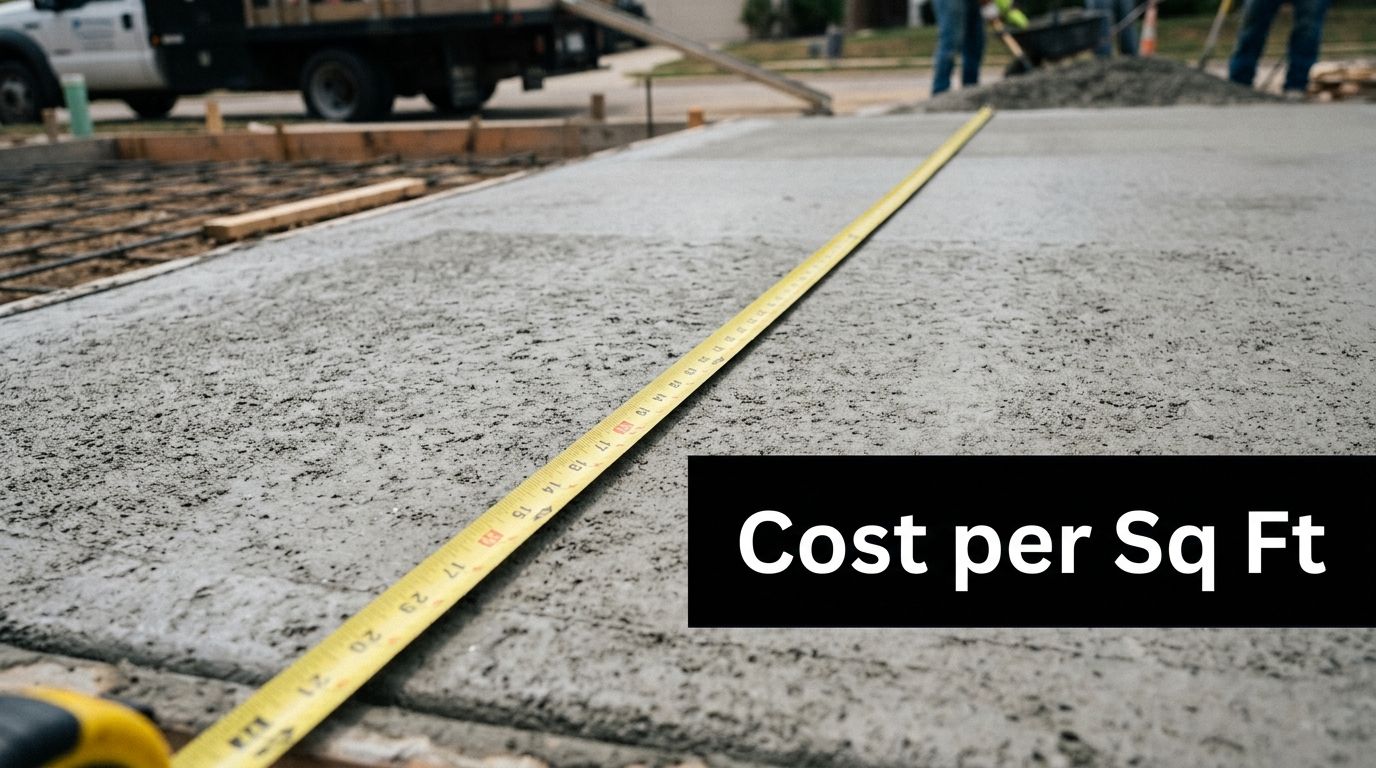
Most homeowners pay between $4 and $15 per square foot installed for a standard residential driveway, depending on the material. Gravel usually costs the least, while concrete generally commands the highest upfront price among common residential surfaces.
You're probably standing at the edge of your driveway with a tape measure, trying to decide whether that cracked surface needs a repair, an overlay, or a complete rebuild. Then the first quote arrives, followed by another that's several thousand dollars higher, and suddenly the phrase “driveway cost per square foot” doesn't feel as simple as it sounded.
The difference usually isn't mysterious or dishonest. One contractor may be pricing only the surface, while another includes excavation, compacted base, drainage, demolition, disposal, and difficult access. Those underground details matter across Pennsylvania, Maryland, Delaware, and New Jersey, where frost, clay, sand, wet ground, slopes, and tight suburban lots can change the job substantially.
Why Driveway Pricing Feels So Hard to Pin Down
A homeowner in Honey Brook Township might measure a driveway, multiply the square footage by a material price, and expect a clean budget. Then three contractors visit the same property and return with very different totals. One quotes by the square foot, another prices the base rock by the ton, and a third gives a lump-sum figure covering excavation, hauling, forming, and paving.
All three methods can be reasonable. The problem is that they don't describe the same scope. A per-square-foot quote may cover only the finished gravel, asphalt, or concrete surface. A lump-sum proposal may include the work that determines whether that surface stays stable after heavy rain and seasonal ground movement.
The surface is only one layer
A driveway has several cost layers. The crew may need to remove grass, excavate unsuitable soil, establish the grade, compact a sub-base, install drainage, build forms, place reinforcement, and finish the surface. Access can add another complication if a concrete truck or excavator can't reach the work area directly.
A long rural drive may be inexpensive per square foot when the site is open and the surface is gravel. A short suburban driveway can cost more per square foot when crews must work around fences, landscaping, utility lines, or a narrow gate. The same area can demand very different labor and equipment.
Practical rule: Compare what each bid includes before comparing the final number.
The most useful starting point is total installed cost divided by total driveway area. That calculation doesn't eliminate site differences, but it puts bids on a common scale. It helps you see whether a contractor is offering a lower surface price while leaving excavation, base correction, or drainage outside the quote.
For a broad 2026 benchmark, concrete driveways in major U.S. residential markets run about $8 to $20 per square foot installed, with typical residential driveways commonly covering about 400 to 800 square feet. Angi also reports an average concrete project estimate of $6,400, with total jobs ranging from $1,600 to $32,000, depending on size, thickness, finish, and site conditions. See the concrete driveway cost benchmarks from Angi for the full range.
That spread is why a normalized cost-per-square-foot figure matters. It doesn't tell you whether the work is good, but it reveals what each contractor is charging for the complete job.
How Cost Per Square Foot Actually Works
The formula is straightforward:
Total installed cost ÷ total driveway square footage = driveway cost per square foot
Measure the paved area, multiply width by length for a simple rectangle, and account for separate parking pads, aprons, or wider turning areas. Then divide the complete installed price by that area.
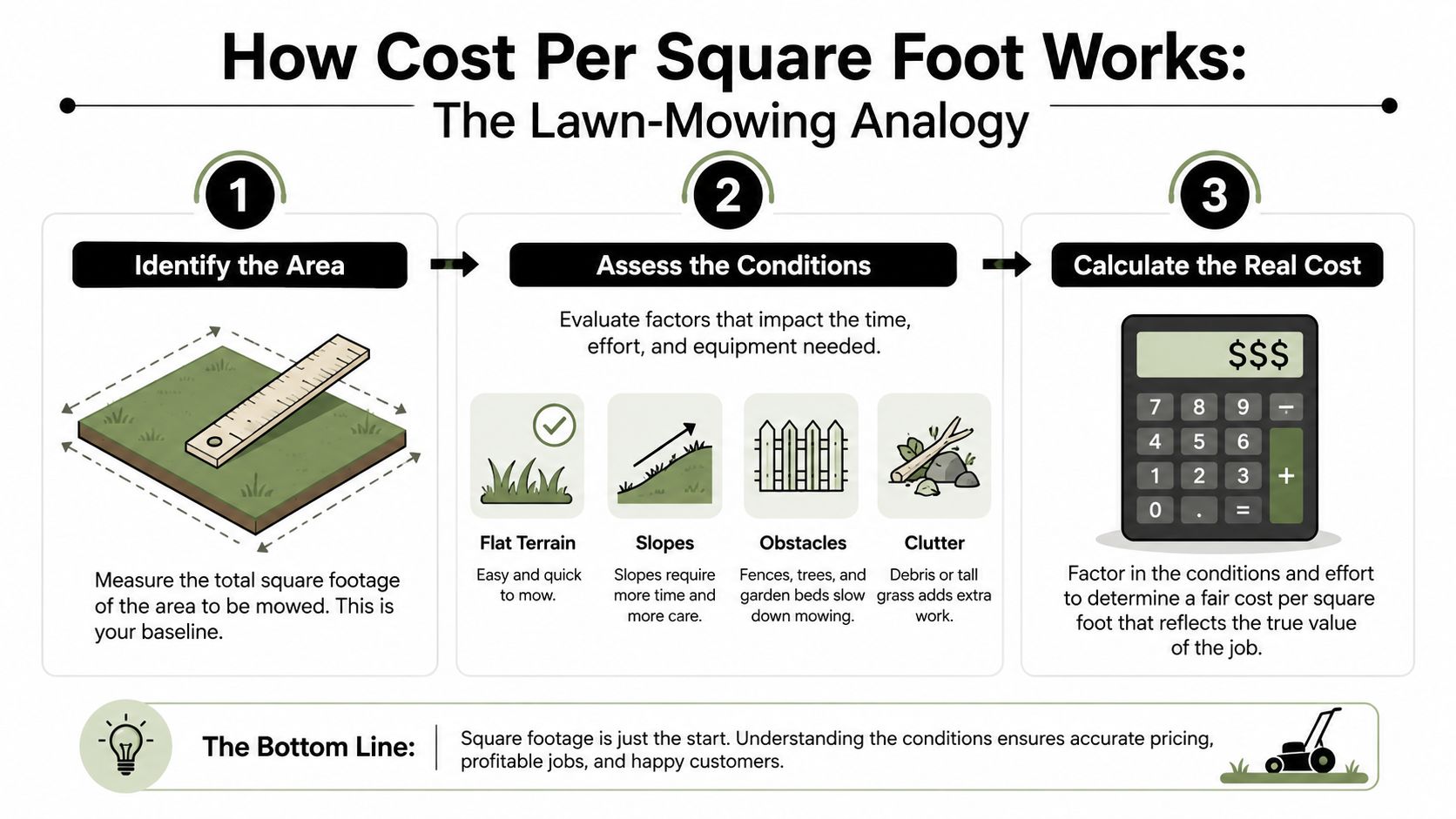
Think about lawn mowing. Two properties may contain the same number of acres, but one is a flat, open lawn while the other has fencing, slopes, trees, and scattered debris. The contractor isn't charging only for grass. The terrain determines the time, equipment, and effort required.
Use installed cost, not material cost
For driveway work, installed cost should include excavation, grading, sub-base preparation, compaction, surface material, labor, and ordinary finishing. Depending on the property, it may also include demolition, drainage, permits, reinforcement, hauling, and disposal.
A short driveway of 400 square feet and a long driveway of 1,800 square feet shouldn't be compared by total project price alone. The larger driveway naturally costs more in total, while the smaller one may carry a higher effective rate because equipment mobilization, permits, and setup are spread across less area.
Watch for incomplete comparisons
Three mistakes create most of the confusion:
- Bare material against installed work: A gravel material rate isn't comparable to a quote that includes excavation and layered base construction.
- Tear-out left outside the number: Replacing an existing driveway can add about $1 per square foot for removal before new paving begins, according to Fixr's concrete driveway pricing guide.
- Thickness and edges ignored: A thicker slab, reinforced edge, wider apron, or unusual shape changes the amount of material and labor required.
Write the area and scope at the top of every proposal. Then list the surface, thickness, base depth, drainage, demolition, disposal, permits, and warranty underneath it. That simple habit turns a vague bid into a practical comparison.
Comparing Driveway Materials By Price
Material choice affects more than the first invoice. Gravel usually has the lowest entry cost, asphalt offers flexibility, concrete delivers a durable finished surface, and pavers provide design options with repairable individual units. The right choice depends on the soil, drainage, slope, access, and how the driveway will be used in Pennsylvania, Maryland, Delaware, or New Jersey.
Broad national guides place gravel around $1 to $3 per square foot, asphalt around $3 to $8, and concrete around $4 to $8, according to HomeGuide's driveway cost guide. A separate guide lists installed concrete around $6 to $15, asphalt around $3 to $8, and gravel around $1 to $3, showing the same general price order in BuildEstimatory's driveway cost guide.
| Driveway Material | Cost Per Sq Ft Installed | Typical Lifespan | Best For |
|---|---|---|---|
| Gravel | About $1.25 to $3.00 for standard projects | Requires periodic replenishment | Long rural runs, flexible budgets, open access |
| Asphalt | About $3 to $8 | Moderate service life with maintenance | Cold-weather flexibility and faster installation |
| Plain concrete | About $6 to $8 for a plain 4-inch residential driveway | Long-lasting with proper preparation | Low-maintenance durability and everyday residential use |
| Decorative concrete | About $8 to $21 | Long-lasting when properly installed | Custom appearance without installing separate pavers |
| Concrete or brick pavers | Often higher than concrete, with exact pricing driven by pattern and base | Long service life with individual-unit repairs | Curb appeal and spot repairs |
Gravel remains the most economical mainstream surface. Standard estimates run about $1.25 to $3.00 per square foot installed, and a 600-square-foot driveway can often fall around $750 to $1,800 before extensive base construction. DG Floors' gravel driveway cost breakdown separates crushed stone, pea gravel, and river rock by material price. Gravel suits long drives, farms, and properties where a loose surface fits the setting, especially when truck access is straightforward.
Asphalt costs more upfront but handles ordinary seasonal movement with more flexibility than a rigid slab. It fits homeowners who want a practical paved surface and accept ongoing maintenance. Limited access or a long haul from the street can raise the installed price because crews and materials have less room to work.
Concrete is often recommended when the homeowner wants a clean, durable, low-maintenance driveway and the ground can be prepared correctly. Plain 4-inch residential concrete generally costs around $6 to $8 per square foot, while decorative finishes commonly reach $8 to $21 per square foot. Review asphalt versus concrete driveways before choosing between those surfaces.
Pavers suit homeowners who prioritize appearance and future spot repairs. They cost more because the base, edge restraint, layout, and individual placement require careful work. Choose according to budget, drainage, slope, climate, access, and curb appeal. No material fits every property.
What Really Moves The Price Tag
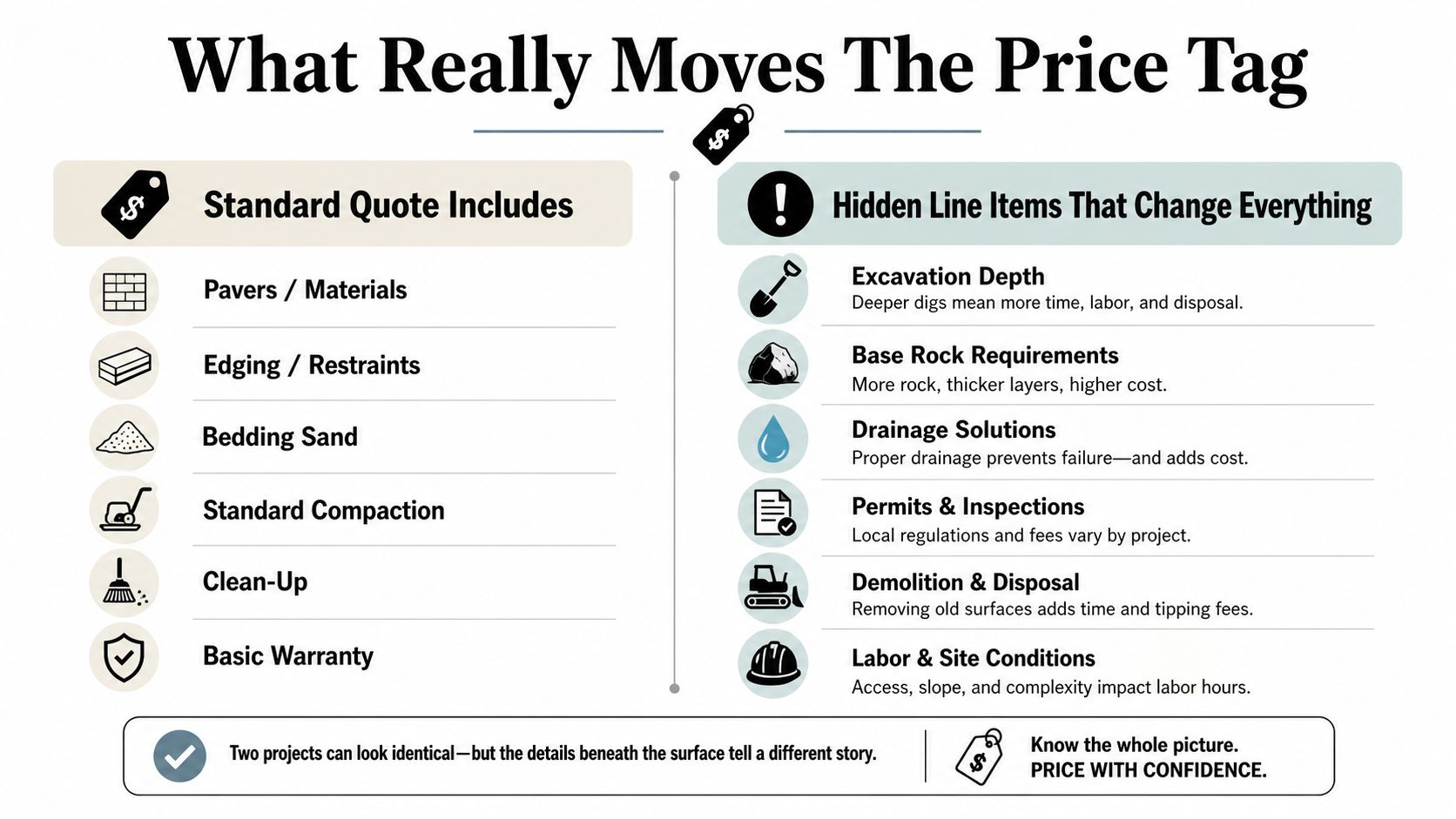
The surface rate gets attention, but the ground underneath controls the result. A durable driveway requires excavation, grading, a stable base, and water management. Standard residential driveway excavation commonly reaches 8 to 12 inches, and site preparation can add about $1 to $3 per square foot when the existing ground needs correction, according to MyRainPlan's driveway cost guide.
Excavation and base work
The crew may need to remove topsoil, soft fill, roots, or wet material before placing stone. Clay-heavy ground can hold water and shift with seasonal changes. Sandy ground may drain quickly but still need stabilization to prevent movement. A proper base isn't decorative rock spread over the lawn. It is a compacted structural layer that distributes vehicle loads and gives the surface a stable platform.
Concrete thickness also affects the bill. A plain residential driveway commonly uses a 4-inch slab, while a heavier-duty 6-inch build requires about 25% to 50% more concrete material than a 4-inch slab, as outlined by Fixr. That upgrade can make sense for work trucks, trailers, or other heavy loads, but it should follow an assessment of the soil and expected use.
Drainage and access
Water is one of the most expensive problems to ignore. If runoff crosses the driveway, collects beside the garage, or travels toward the house, the contractor may need swales, additional stone, a drain, or a pipe connection. A surface that looks excellent on installation day can settle or crack if water remains trapped beneath it.
Access changes labor and equipment. An open front yard may allow direct use of an excavator and delivery truck. A narrow side yard may require smaller equipment, longer handling, or hand work. On a small project, that extra handling can have a noticeable effect on the effective rate.
Demolition and permits
If an old driveway has failed at the base, placing a new surface over it won't solve the structural problem. Concrete replacement projects often add about $1 per square foot for tear-out and removal before new paving, according to Fixr. The exact demolition scope depends on what must be broken, hauled, and disposed of.
Permit requirements vary by township and county. A driveway alteration can involve right-of-way, curb, drainage, or stormwater review. Ask the contractor whether permit research and fees are included instead of assuming they are.
A quote is only useful when the buried work is visible. If you're pricing related exterior work, you can use this guide to calculate pressure washing quotes, then apply the same principle here, separate labor, materials, access, and site conditions rather than relying on one unexplained total.
Estimating Your Own Driveway Cost
Start with the area. For a simple rectangle, multiply width by length. Then multiply the square footage by the selected surface rate, and add fixed or site-specific costs such as demolition, permits, drainage, or additional base.
A 12-by-50-foot driveway equals 600 square feet. The following example uses the same base and permit allowance for both surfaces, so you can see how the material rate changes the result.
| Line Item | Asphalt | Concrete |
|---|---|---|
| Surface installation | $4,200 at $7 per square foot | $6,000 at $10 per square foot |
| 6-inch compacted base | $1,800 | $1,800 |
| Permits | $300 | $300 |
| Estimated total | About $6,300 | About $8,100 |
The asphalt surface rate of $7 per square foot falls within the verified asphalt ranges cited by HomeGuide and BuildEstimatory. The concrete surface rate of $10 per square foot fits the verified installed concrete ranges from Fixr and the broader 2026 benchmark from Angi. The base and permit amounts in this illustration are scenario assumptions, not universal prices, so your contractor must verify them at the property.
Make the estimate useful
Take a quick tape-measure reading before requesting quotes. Record the narrowest access point, the existing surface, visible low areas, nearby downspouts, and any place where water crosses the proposed driveway.
Then request three written bids based on the same dimensions and scope. Ask each contractor to state:
- Base depth: Identify the stone depth and compaction method.
- Surface thickness: State the concrete or asphalt thickness, including any thicker edges or apron.
- Drainage plan: Explain where runoff will go and whether piping or additional stone is included.
- Removal: Separate tear-out, hauling, and disposal from new construction.
- Warranty: Put workmanship coverage and exclusions in writing.
For concrete quantities and slab planning, the concrete slab calculator can help you organize measurements before the site visit. It won't replace an excavation assessment, but it gives you a cleaner starting point for the conversation.
When A Pro Is Worth Every Dollar
DIY makes sense for limited gravel work on flat, open ground when you can safely handle delivery, spreading, and compaction. It stops making sense when the driveway involves clay soil, a steep grade, a high water table, tree roots, or tight access with no room for full-size equipment.
Those conditions require judgment before the first load of stone arrives. The contractor has to read how water moves across the site, determine what soil must be removed, choose a base strategy, and set grades that protect the house, garage, and neighboring property.
A premium surface installed over unstable ground is still a failed driveway waiting for a season of weather.
The common failure pattern starts below the visible surface. The driveway settles in isolated areas, cracks along weak zones, or lifts as water freezes and expands. Replacing the top layer won't fix a subgrade that was never corrected.
A licensed foundation and excavation contractor brings the equipment and sequencing needed for that work. The same principles apply whether you're searching for driveway contractors near me, concrete contractors, garage foundation contractors near me, or a crew to build garage footings and foundations. The surface changes, but the ground preparation determines the outcome.
Firm Foundations serves homeowners and property owners across Pennsylvania, Maryland, Delaware, and New Jersey with excavation, gravel pads, concrete foundations, driveways, and related site preparation. Homeowners also use contractors for shed foundations near me, a base for a storage shed, a gazebo foundation, or cement foundations for a garage, because a small structure still needs stable support and drainage.
Hiring a pro isn't automatically an upgrade. It is risk reduction when the soil, slope, water, or access is complicated. Paying for correct excavation and base work now is usually more sensible than paying to remove and rebuild a settled driveway later.
Regional Notes And Your Next Step
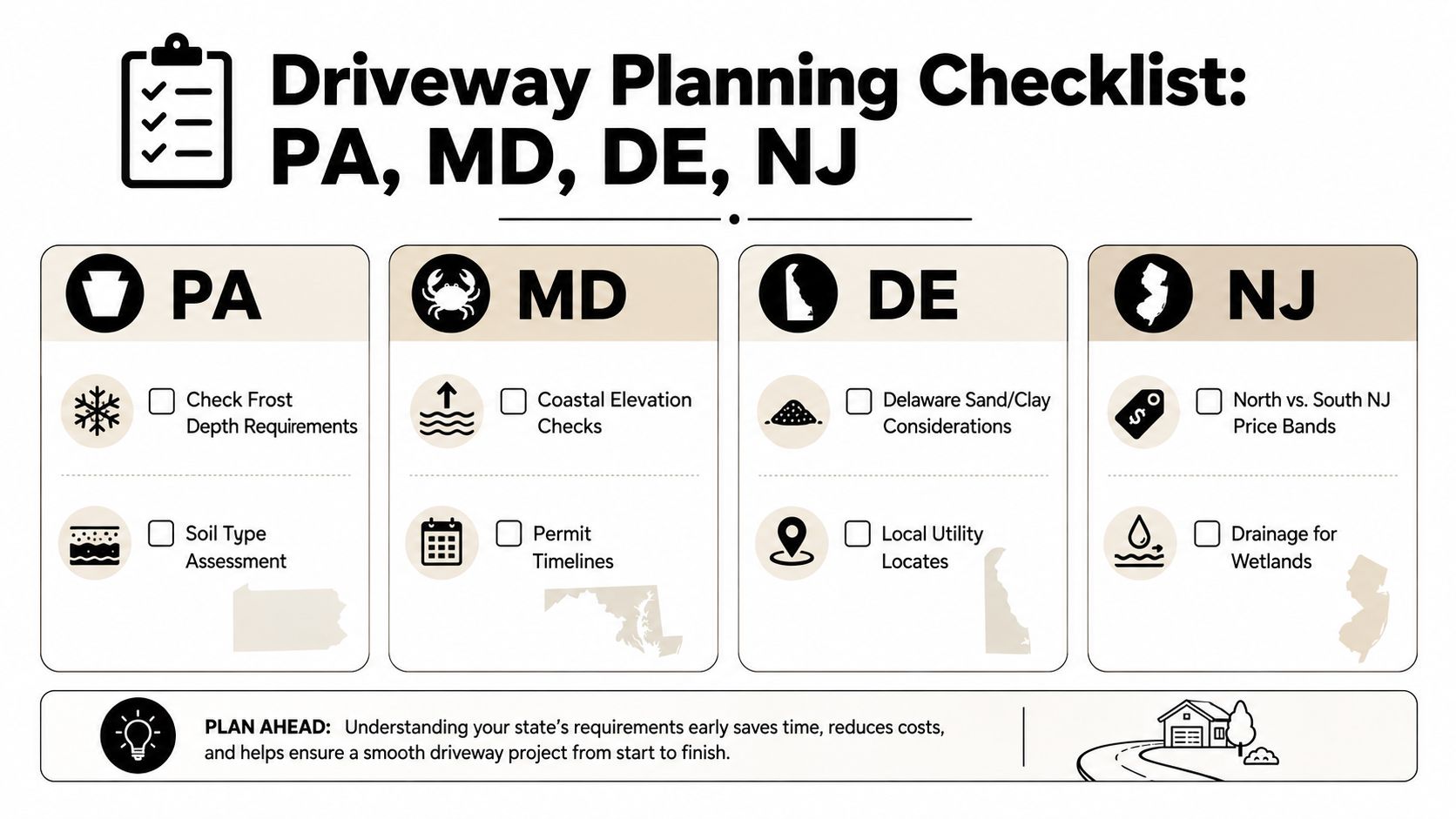
The same driveway cost per square foot can produce different bids across the Mid-Atlantic because the ground and access change from property to property. In Pennsylvania, frost-related movement makes excavation, drainage, and base preparation important. Maryland properties may contain clay-heavy soil that holds water and shifts under seasonal conditions.
Delaware presents its own mix. Coastal and southern sites can have sandy drainage conditions, while other locations still require careful grading and base stabilization. New Jersey homeowners often deal with tight suburban lots, narrow driveways, fences, and limited equipment access, especially where the crew can't bring large machinery directly to the work area.
Check local requirements before signing
Permit rules are controlled locally, not by a single Mid-Atlantic standard. Your county, township, municipality, or homeowners association may have requirements involving curb cuts, drainage, widening, or work near a public right-of-way.
Access can also become a project issue when a property has a controlled entrance or shared private road. If your site is part of a managed community, review the HOA gate access system considerations early so delivery trucks and equipment aren't delayed.
Your next steps are simple:
- Measure the footprint: Record width, length, curves, aprons, parking pads, and the narrowest access point.
- Request two written bids: Make sure each proposal lists excavation, base depth, surface thickness, drainage, removal, permits, and warranty.
- Schedule a site assessment: Have a foundation and excavation specialist inspect soil, grade, water flow, and equipment access before you sign.
Firm Foundations provides excavation, drainage preparation, gravel driveway construction, concrete foundations, garage slabs, shed foundations, and finished driveway work across PA, MD, DE, and NJ. Visit Firm Foundations to request a site assessment and quote based on your actual ground conditions, not a surface-only estimate.