
Driveway Concrete PSI: Choosing the Right Strength
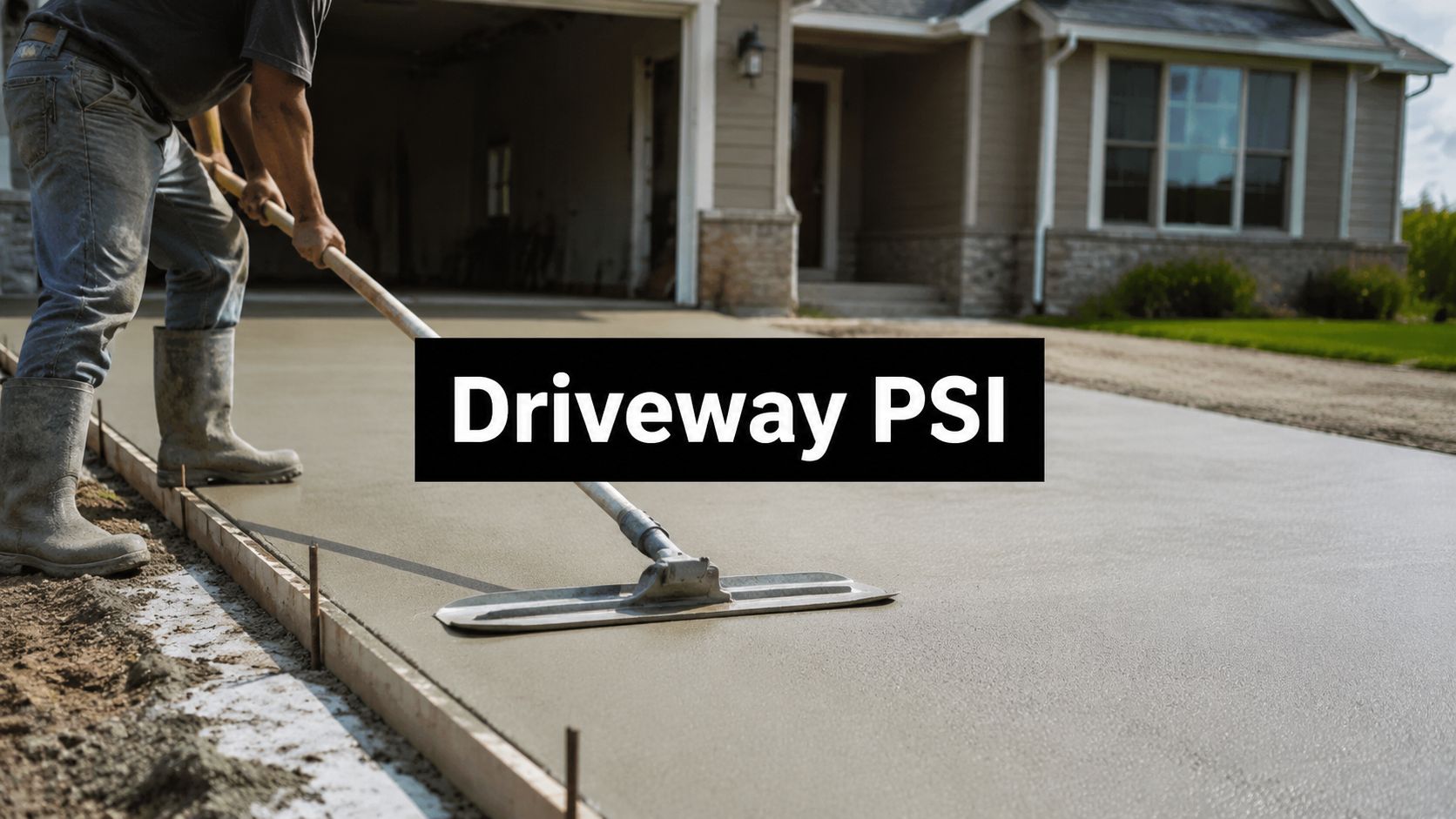
Most residential driveways need 3,500 to 4,000 PSI, with 4,000 PSI the safer standard in freeze-thaw climates or where heavier vehicles will use the slab. A 3,000 PSI driveway may suit light-duty conditions, but it isn't a universal answer for every home.
The popular advice that “3,000 PSI is enough” leaves out the conditions that determine driveway life. A slab carrying only passenger cars in a mild climate faces a different job than one supporting pickups, trailers, delivery vehicles, or an RV through repeated freezing and thawing. Driveway concrete PSI matters, but it works as part of a complete system that includes thickness, drainage, reinforcement, subbase preparation, and curing.
For homeowners in Pennsylvania, Maryland, Delaware, New Jersey, and communities such as Honey Brook Township, the specification should reflect local exposure rather than a generic number. A contractor who only quotes PSI without discussing soil, water, traffic, and slab design hasn't finished the conversation.
Why 3,000 PSI Is No Longer the Driveway Standard
3,000 PSI is a baseline, not a universal driveway specification. Modern residential guidance commonly places driveway concrete in the 3,000 to 4,000 PSI range, with 3,500 to 4,000 PSI often used as the practical target for standard residential driveways. Guidance summarized by TrueGrid's driveway concrete PSI reference also explains that some applications call for 4,000 PSI or more when vehicle loads or climate create additional demands.
That shift makes sense in the field. A driveway doesn't experience strength in a laboratory only. It absorbs water, freezes, thaws, receives deicing salts, and carries vehicles that may be much heavier than the family sedan. A mix that looks adequate on paper can develop surface scaling or premature deterioration when the surrounding conditions are severe.
Why climate changes the recommendation
In colder markets, moisture inside the concrete can freeze and expand. Repeated cycles put stress on the surface, particularly when drainage is poor or salts are used. Concrete Calculator Pro's driveway guidance identifies 3,500 to 4,000 PSI as the practical residential benchmark and emphasizes higher strength and tighter water-cement control for freeze-thaw exposure.
Newer field guidance also places more attention on air entrainment and durability specifications, not PSI alone. Field PM's concrete mix guidance notes that air entrainment, slab thickness, drainage, and water-cement ratio can matter as much as nominal compressive strength in a freezing climate.
Practical rule: Don't ask only, “What PSI are you using?” Ask why that PSI fits your soil, weather, vehicles, and planned slab thickness.
A 3,000 PSI mix may work for a lightly used driveway with favorable conditions and excellent construction. It becomes a weaker choice when the driveway sees frequent freezing, deicing salts, work trucks, or trailer loads. The right specification often moves upward because the homeowner is buying durability, not just a number on a delivery ticket.
What Concrete PSI Actually Means for Your Driveway
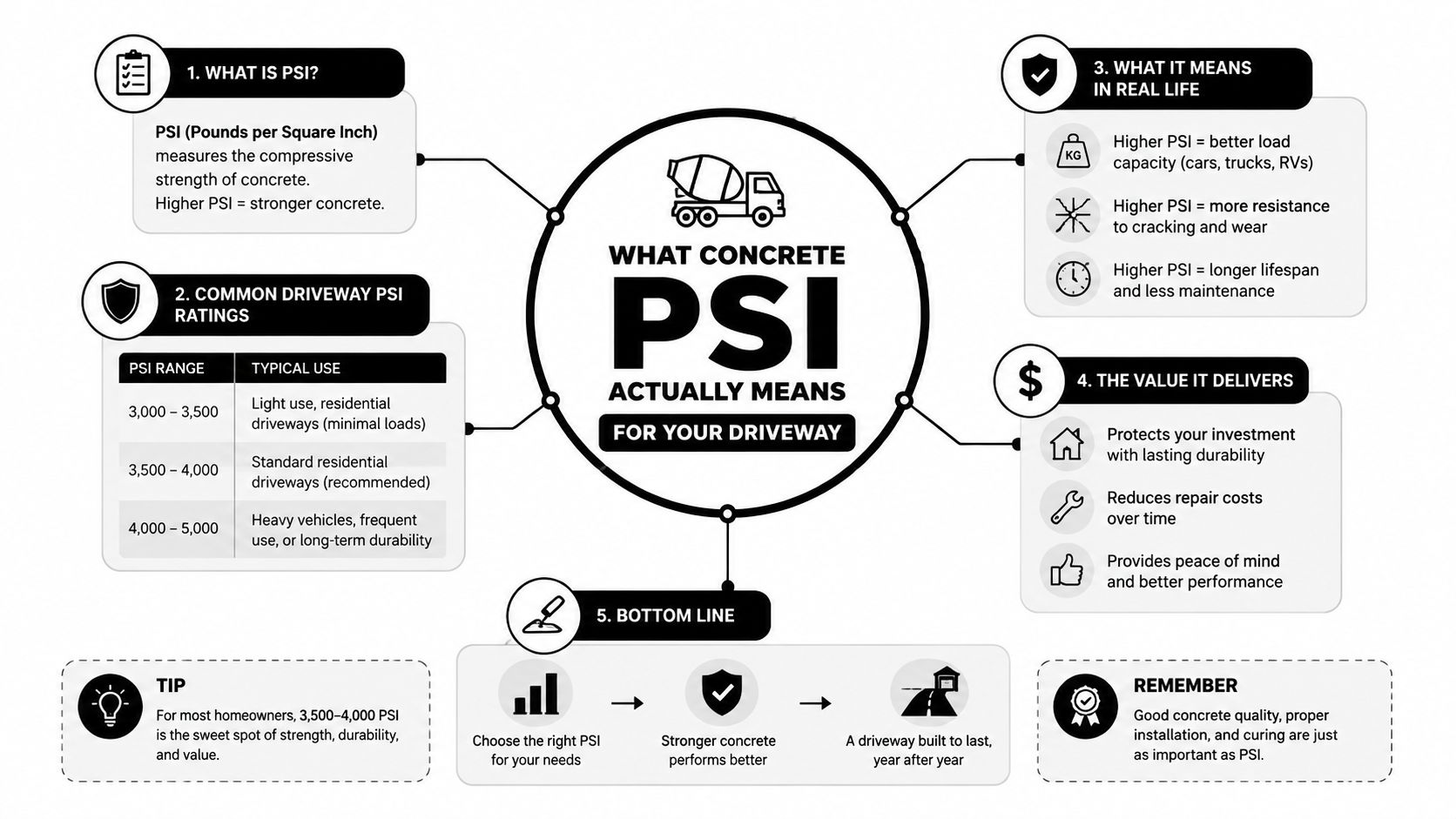
PSI means pounds per square inch, the compressive strength concrete is designed to reach after curing. This is a load rating for a bridge. The rating doesn't describe every part of the bridge, but it tells you how much compressive force a defined part of the structure can handle before failure.
Concrete strength is commonly evaluated at 28 days, which is why a driveway specification may state a 28-day compressive-strength requirement. The Michigan Concrete Association driveway and sidewalk guidance identifies 4,000 PSI at 28 days as a minimum specified strength under its guidance, while also discussing an early-opening threshold when testing confirms 2,500 PSI has been reached.
That doesn't mean the driveway is weak before day 28. Concrete gains strength as cement hydrates, but the final design benchmark gives contractors and homeowners a consistent point for evaluating the mix.
PSI is only one part of driveway performance
Higher PSI doesn't automatically create a better driveway. PSI measures the concrete's resistance to compression, while slab thickness helps the driveway resist bending under vehicle loads. The subbase supports the slab, reinforcement helps control cracking, and drainage limits the amount of water that can enter and remain around the concrete.
That distinction matters because many driveway failures aren't caused by the concrete being crushed. Settlement, poor drainage, inadequate thickness, weak soil, and rushed curing can create cracking or surface damage even when the ordered mix has a strong PSI rating.
A useful conversation with a contractor should cover:
- Strength: What compressive strength is specified at 28 days?
- Exposure: Will the mix include the durability features needed for freezing conditions?
- Structure: What slab thickness and reinforcement match the vehicles using the driveway?
- Support: How will excavation, grading, and the gravel subbase prepare the ground?
The goal isn't to purchase the highest PSI available. It's to match the strength to the entire driveway design.
Recommended PSI by Vehicle Type and Driveway Use
The common advice that 3,000 PSI is enough misses the way vehicle weight, climate, and slab design work together. A passenger-car driveway has different demands from one that regularly carries a loaded pickup, trailer, RV, or delivery vehicle. Rocket Concrete's PSI guidance distinguishes light residential use from heavier vehicle and equipment applications, while Concrete Network's compressive-strength overview places standard residential driveway guidance broadly between 3,000 and 4,000 PSI.
The following ranges pair concrete strength with practical slab-thickness guidance tied to ACI 330R, as summarized by CalStack's concrete driveway calculator.
| Vehicle / Use Type | Recommended PSI | Minimum Slab Thickness |
|---|---|---|
| Passenger cars and light residential use | 3,000 to 3,500 PSI | 4 inches |
| Light trucks and occasional pickups | 3,500 to 4,000 PSI | 5 inches |
| Regular truck traffic or delivery vehicles | 4,000 PSI or more | 6 inches |
| RVs, boats, trailers, or heavy equipment | 4,500 PSI or more | 6 to 8 inches |
Match the mix to actual use
A sedan-only driveway may perform well with a different specification than a property where a loaded pickup parks every day. Trailer jacks, stabilizers, and equipment wheels create concentrated loads that can be harder on the slab than occasional passenger-car traffic.
For a typical residential driveway, 3,500 to 4,000 PSI is a sensible range to discuss with the contractor. In a freeze-thaw region, or where heavier vehicles are expected, 4,000 PSI gives the project a more suitable benchmark than defaulting to 3,000 PSI. The higher rating still depends on proper placement and curing.
Garage slabs and carport pads need the same use-based review. A garage storing ordinary cars has one loading pattern. A workshop with anchored equipment, a vehicle lift, or frequent heavy deliveries has another. Evaluate the slab alongside the garage footings and foundations instead of pricing each concrete surface in isolation.
Specify the driveway for its heaviest regular use, not the lightest vehicle parked there on an average day.
Tell the contractor before excavation if an RV, boat trailer, work truck, or delivery access may be added later. Changing thickness or reinforcement after the pour creates disruption and expense. A driveway specification should reflect the durability required for the actual conditions the slab will face, including the number printed on the delivery ticket.
How Thickness, Reinforcement, and Subbase Work With PSI
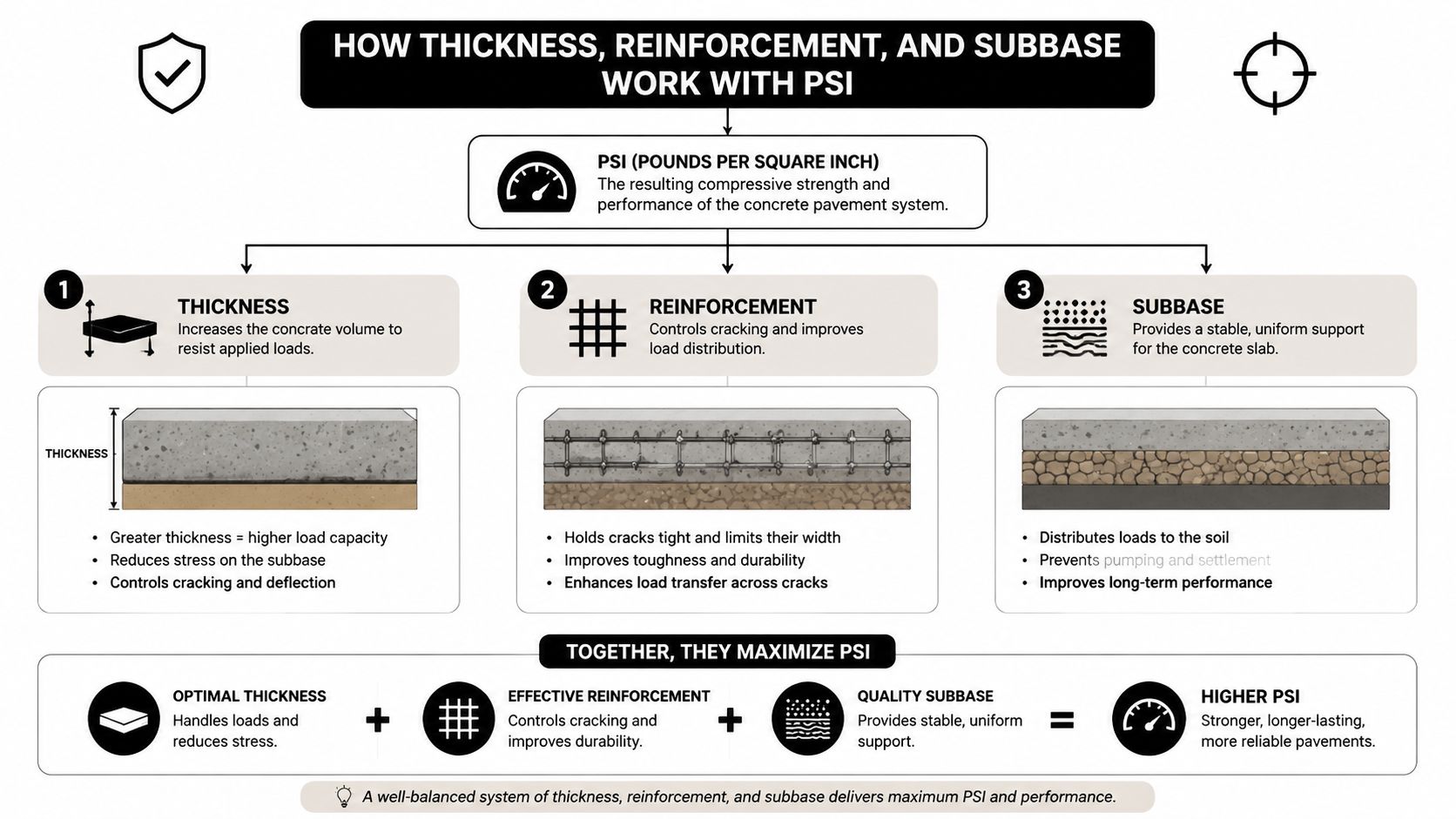
A strong mix cannot rescue a poorly supported slab. PSI is the concrete's compressive-strength rating, while thickness, reinforcement, and subbase determine how the driveway handles bending, movement, and uneven support.
A four-inch slab may suit passenger cars when the ground is stable and properly prepared. Load-based guidance commonly pairs five inches with light trucks, six inches with regular trucks or delivery vehicles, and six to eight inches with RVs or heavy equipment, as summarized in the ACI 330R-based driveway planning guidance.
The layers beneath the surface
Excavation removes topsoil, organic material, and soft spots that can't provide dependable support. The contractor then grades the area, establishes drainage, places suitable gravel, and compacts the base so the concrete has a stable platform.
A driveway with a well-prepared gravel base can perform better than a higher-PSI slab poured over loose or wet material. Water that remains beneath the slab can contribute to settlement, frost movement, and surface distress. The finished concrete needs a base that supports it evenly across the full driveway, not just along the edges.
Reinforcement has a different role. Rebar or welded wire reinforcement doesn't prevent every crack, but it helps control crack width and provides structural support when the slab is designed and installed correctly. Reinforcement should be positioned within the concrete, not left flat on the soil where it can't perform as intended.
Details worth confirming before the pour
Ask how deep the crew will excavate, what aggregate will form the subbase, and how the crew will compact it. Ask where the reinforcement will sit, how the forms will establish the finished thickness, and how water will drain away from the garage and house.
A guide to concrete pad reinforcement can help homeowners understand why reinforcement placement matters for slabs and pads. The same principle applies whether you're planning a driveway, a concrete foundation for a garage, a gazebo foundation, or a base for a storage shed.
The contractor should also plan control joints so shrinkage cracks have intended locations. Good finishing and curing matter just as much. Adding water to make the concrete easier to place may weaken the finished surface, while overworking bleed water into the surface can create a fragile layer that scales.
A short visual explanation of the complete pavement system can be useful before signing a proposal:
Climate and Freeze-Thaw Considerations for Mid-Atlantic Driveways
Mid-Atlantic driveways face a combination of moisture, freezing temperatures, thawing, and winter maintenance. Pennsylvania, Maryland, Delaware, and New Jersey homeowners shouldn't select driveway concrete PSI as if the slab were being installed in a warm, dry climate.
Water enters pores and small surface imperfections. When it freezes, it expands and creates internal pressure. Repeated freeze-thaw exposure can contribute to scaling and surface deterioration, especially when deicing salts increase the stress on the concrete surface.
Strength must work with air and drainage
Air-entrained concrete gives freezing water microscopic spaces in which to expand, reducing internal pressure. It isn't a substitute for suitable PSI, proper finishing, or drainage. A durable exterior slab needs the mix and the site design to work together.
The Michigan guidance provides a useful cold-climate reference point. It specifies 4,000 PSI at 28 days and discusses opening a driveway to traffic after 7 days, or sooner when testing confirms 2,500 PSI, as described in the Michigan Concrete Association driveway guidance.pdf?hsLang=en). New York City's building code sets 3,500 PSI as the minimum specified compressive strength for weather-exposed flatwork that includes driveways, walks, patios, and garage floor slabs, according to the New York City building code.
These references show why colder jurisdictions often set stronger minimums than the basic 3,000 PSI advice repeated online.
Site conditions matter in Honey Brook Township
In Honey Brook Township and surrounding Mid-Atlantic service areas, the contractor should evaluate slope, runoff, soil stability, and how snow and salt will affect the driveway. A driveway that directs water toward the garage or holds moisture along its edges can suffer even with a suitable concrete mix.
Winter maintenance also affects appearance. If salt stains develop on vehicles or equipment during the season, homeowners may find call The Mobile Buff for winter car care useful alongside proper driveway maintenance. The concrete itself still needs sound drainage, appropriate air entrainment, and careful finishing.
For local planning, homeowners can also review guidance on frost-line depth in Pennsylvania when discussing excavation and foundation-related work. Driveways, garage foundations, shed foundation gravel bases, and other exterior slabs all benefit from site-specific decisions rather than a copied template.
Quality Control Tips to Verify Your Concrete Mix and Installation
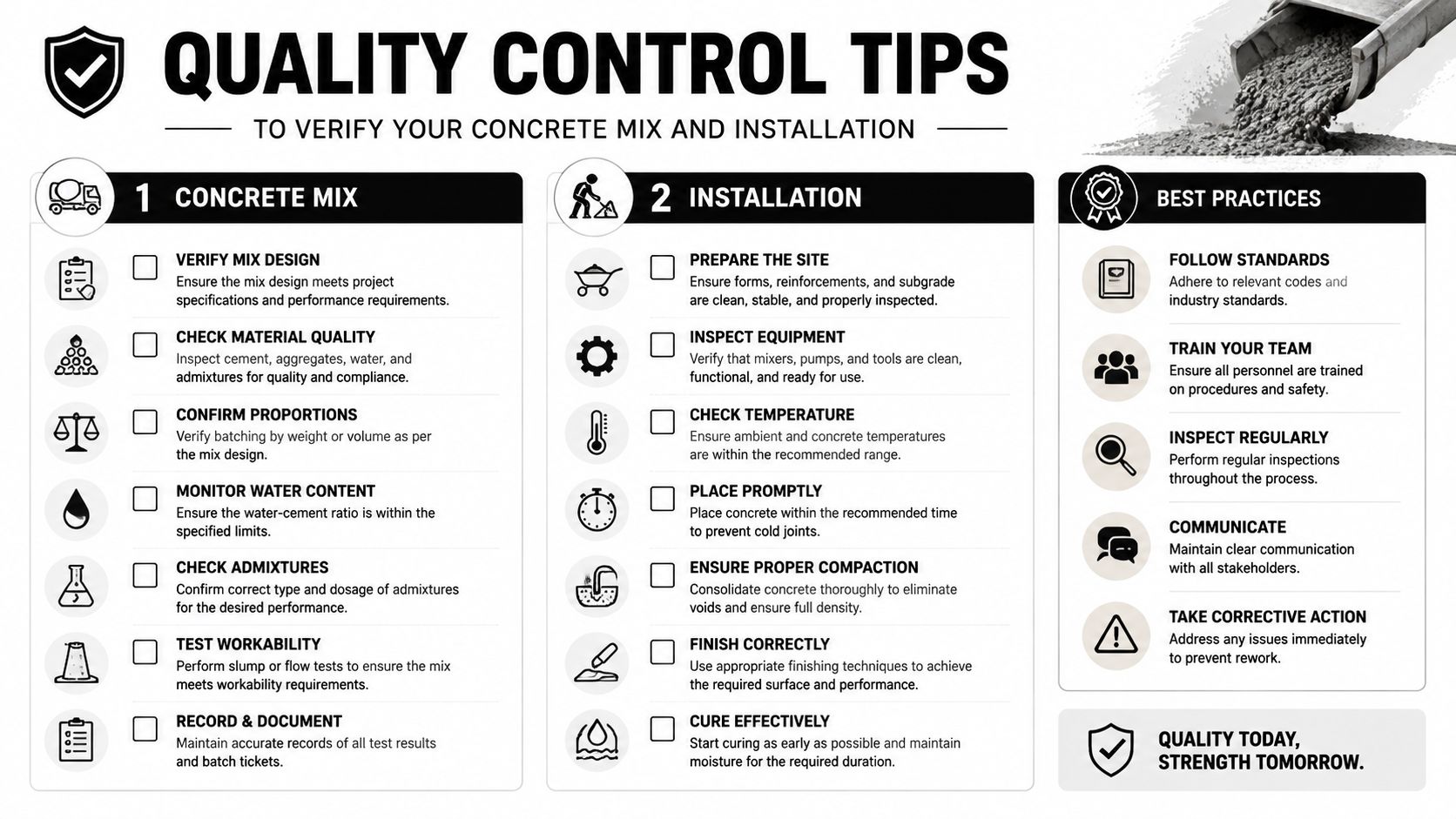
Homeowners don't need to run a concrete laboratory to protect their investment. They do need clear specifications and straightforward documentation before the truck arrives.
Start with the concrete batch ticket. Ask to see the document for the delivered mix and confirm the specified PSI, slump, and air content. The ticket helps connect the material ordered to the material placed. It also gives you a record if questions arise later.
Watch the installation, not just the delivery
Before the pour, look at the prepared area. Forms should establish the agreed dimensions and thickness. The gravel base should be graded and compacted, and reinforcement should be supported within the slab rather than lying directly on the ground.
During placement, the crew should consolidate the concrete so it fills around reinforcement and forms without leaving significant voids. Finishing should wait for the appropriate stage rather than forcing excess water to the surface. Adding water at the site may change the mix's performance and can weaken the finished surface.
Curing deserves a written answer. The concrete continues developing strength through hydration, so the crew should protect it from rapid moisture loss and premature loading. The Michigan guidance recognizes a 7-day traffic milestone when the required early strength has been demonstrated, while the design benchmark is evaluated at 28 days. Those milestones aren't permission to treat every driveway identically. Testing, weather, mix design, and contractor direction all matter.
Red flags include vague answers about PSI, no batch documentation, reinforcement placed on the base, standing water beneath the forms, or pressure to drive on the slab before the agreed curing period. A transparent contractor should explain what was specified, how it was installed, and when the driveway can safely receive traffic.
Cost, Longevity, and Getting a Quote for Your Driveway Project
The cheapest driveway proposal often removes detail rather than expense. A low PSI mix, thin slab, inadequate subbase, poor drainage, or weak reinforcement plan can reduce the initial price while increasing the chance of repairs later.
A 4,000 PSI mix may be the right investment for a Mid-Atlantic driveway exposed to freezing, salts, and heavier vehicles, but higher PSI alone isn't the answer. The sound approach is to balance strength with the correct slab thickness, compacted subbase, reinforcement, air entrainment, finishing, and curing.
You can manage a budget by prioritizing the parts that affect performance. Keep decorative upgrades optional if necessary, but don't treat excavation, drainage, thickness, or structural materials as cosmetic choices. Homeowners comparing proposals should also account for hidden costs in hardscape projects so the final scope doesn't come as a surprise.
Firm Foundations provides excavation, concrete driveways, concrete foundations, garage footings and foundations, shed foundation work, gravel shed foundation pads, and related site preparation across Pennsylvania, Maryland, Delaware, and New Jersey. A quote should identify the proposed PSI, slab thickness, base preparation, reinforcement, drainage approach, and finishing scope in clear language.
Firm Foundations can evaluate your site and design a driveway concrete slab around your soil, climate, drainage, and vehicle use. Visit Firm Foundations to request a transparent quote for driveway, garage, shed, gazebo, or other concrete foundation work in your service area.