
Concrete Foundation Wall Guide for PA, MD, DE & NJ Homes
You're probably at the point where the exciting part of the project is starting to feel a little more serious. The garage is planned. The shed order may already be in. Maybe you're adding a workshop, a barn shed, or a base for a storage shed and realizing the structure is only as good as what sits under it.
That's where homeowners across Pennsylvania, Maryland, Delaware, and New Jersey often hit the same question. What kind of foundation makes sense here, with wet seasons, freeze-thaw cycles, mixed soil conditions, and local code requirements that don't always match generic online advice?
A concrete foundation wall isn't just a construction detail. It's the part that carries the load, resists soil pressure, helps control moisture, and protects the money you're putting into the project. If the wall is undersized, poorly reinforced, or installed on a site that wasn't prepared correctly, the problems usually show up later as cracks, movement, water intrusion, or uneven settling.
Homeowners looking for shed foundations contractors near me, garage foundation contractors near me, or concrete foundations usually want the same thing. They want the project done once, done right, and built to last. That applies whether the job is a house foundation, garage footings and foundations, a gazebo foundation, or a concrete foundation for garage use on a property with slope or drainage challenges.
The Groundwork for Your Project Starts Here
A homeowner in Pennsylvania calls after a wet spring and says the same thing I hear every year. The shed or garage is already picked out, but the site stays soft, the yard slopes more than expected, and every online article gives a different answer about footings, frost depth, and wall type.
That is the point where foundation work stops being a generic concrete job and becomes a local construction decision.
In PA, MD, DE, and NJ, the ground below your project can change fast from one property to the next. Some lots have heavy clay that holds water and pushes hard against foundation walls. Others have looser soils, old fill, or drainage patterns that look harmless in August and turn into a problem by February. Frost depth matters here too. A foundation that is acceptable in a warmer region can move, crack, or settle if it is copied onto a Mid-Atlantic site without adjusting for local conditions.
Homeowners planning concrete foundations for sheds, garages, and other outbuildings usually start with one question. What belongs below grade so the building stays level, dry, and stable for years?
The answer depends on the structure, the soil, and how the site handles water. A small storage shed on well-drained ground calls for a different foundation approach than a detached garage, workshop, barn, or addition on a sloped lot. I have also seen plenty of projects where the biggest problem was not the wall itself. It was poor excavation, shallow bearing soil, rushed backfill, or no real drainage plan.
Practical rule: If the ground prep is wrong, the wall has to fight problems it was never built to solve.
For many full foundations, concrete walls remain the preferred choice because they give the structure a continuous perimeter, good load support, and better long-term performance under soil pressure and moisture than many lighter-duty options. Broader discussions on foundation selection, including investor considerations and project type, are covered in Ofir Engineering's guide for investors.
Most homeowners who call about foundation work are dealing with one of three situations:
- A new structure needs a proper base, such as a shed, detached garage, gazebo, workshop, or small barn.
- An older foundation is showing failure, including cracks, leaning sections, settlement, or recurring water entry.
- The lot presents a significant challenge, with slope, poor drainage, soft areas, or questionable fill that needs to be addressed before concrete is placed.
The right foundation is not the biggest one or the cheapest one. It is the one that matches the building, reaches proper depth for local conditions, and includes the drainage and waterproofing details that keep Mid-Atlantic weather from turning a new project into a repair job.
That is the standard we use at Firm Foundations across Pennsylvania, Maryland, Delaware, and New Jersey. Build for the soil, build for frost, and build for water before water tests the work.
Poured Concrete Walls vs Concrete Block Foundations
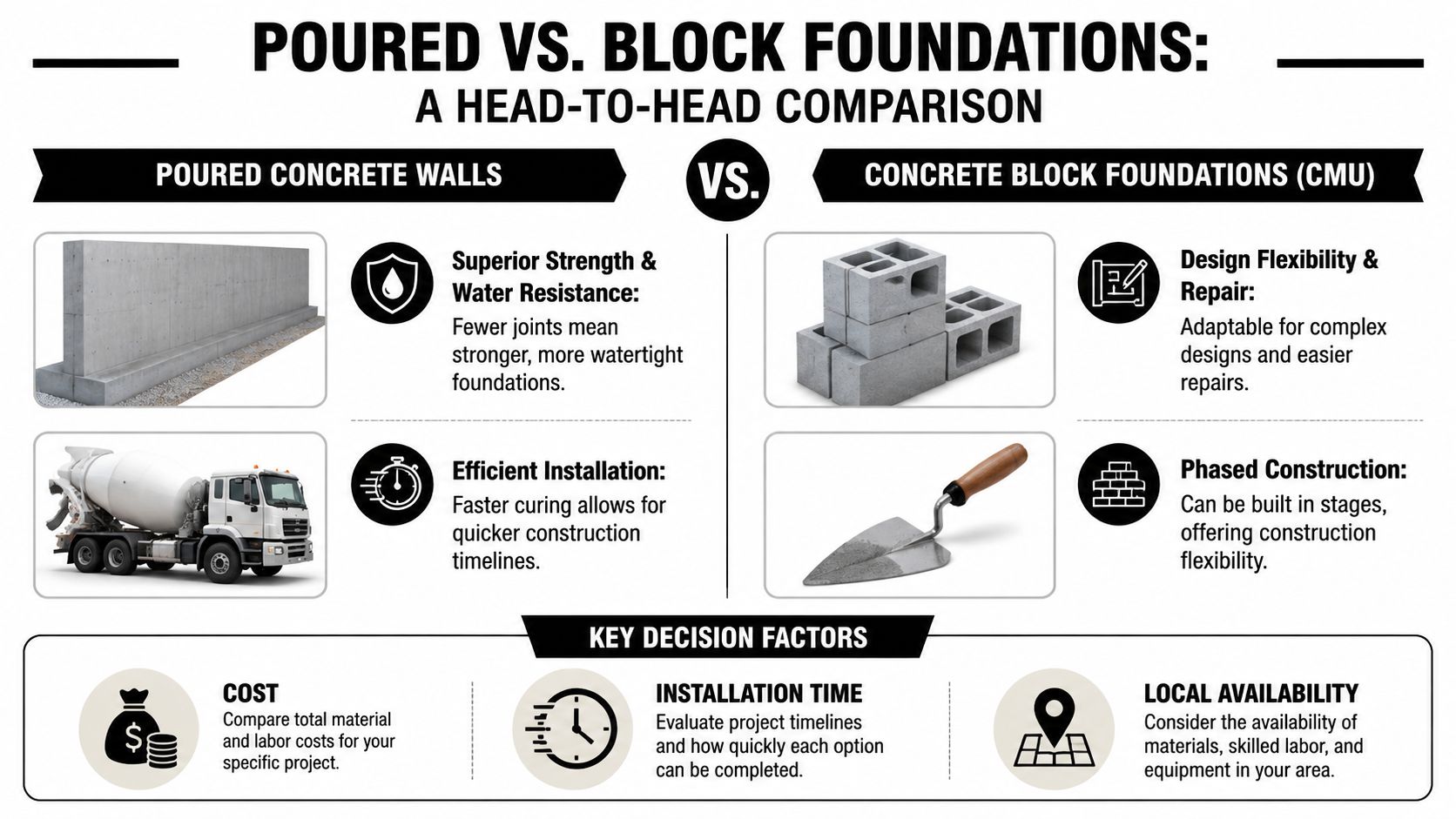
When homeowners compare foundation types, the most common matchup is poured concrete walls versus concrete block foundations. Both can work in the right setting. They are not equal in how they handle moisture, soil pressure, and long-term maintenance.
Where poured walls have the edge
Poured walls form a single continuous assembly. That matters because fewer joints usually mean fewer places for water to enter and fewer weak spots when soil pushes from the outside. In the Mid-Atlantic, where wet ground and seasonal movement are common, that monolithic build is a real advantage.
Modern poured concrete foundation walls are typically 8 to 10 inches thick and use steel rebar, creating a monolithic structure that is more resistant to water leakage and tensile forces than traditional block foundations, as described in Armada Poured Walls' guide to poured concrete foundation walls.
For garages, house foundations, and heavier outbuildings, poured walls usually give homeowners a stronger starting point. That's one reason many investors and property owners reviewing structural options also look at broader overviews like Ofir Engineering's guide for investors, especially when comparing foundation systems before construction begins.
If you're weighing project-specific options for a slab, wall, or full support system, a focused look at concrete foundations from Firm Foundations helps connect those structural choices to actual site work in our region.
Where block still has a place
Concrete block can still make sense in certain builds. It offers flexibility for phased work and can be practical on jobs where access, design changes, or repairability matter more than having a smooth, unbroken wall.
A block wall also lets crews adjust course-by-course during installation, which can help on irregular layouts. If damage occurs later, isolated repairs may be simpler than repairing a large poured section.
That said, block introduces more joints. More joints mean more potential pathways for moisture and more places where workmanship quality has to be exact.
Side-by-side practical comparison
| Foundation type | Main strength | Main drawback | Best fit |
|---|---|---|---|
| Poured concrete wall | Seamless strength and better water resistance | Requires solid formwork and pour planning | Garages, homes, additions, many below-grade walls |
| Concrete block wall | Flexible layout and staged construction | More joints and greater leak risk | Some smaller projects, selected repairs, certain access-limited sites |
A homeowner usually doesn't regret paying for a stronger, better-sealed wall. They do regret dealing with seepage and movement after the building is finished.
For most local garage foundations, house foundation work, and long-term below-grade performance, poured concrete is the safer recommendation. Block isn't wrong by default. It just asks more from the wall system and often more from the owner later.
Designing for Durability in Our Local Climate
National advice tends to flatten everything into one generic checklist. That doesn't work in Pennsylvania, Maryland, Delaware, and New Jersey. Foundation design here has to respect frost, wet periods, changing soil conditions, and the fact that one property may drain well while the next one holds water for days.
Wall thickness and why code starts there
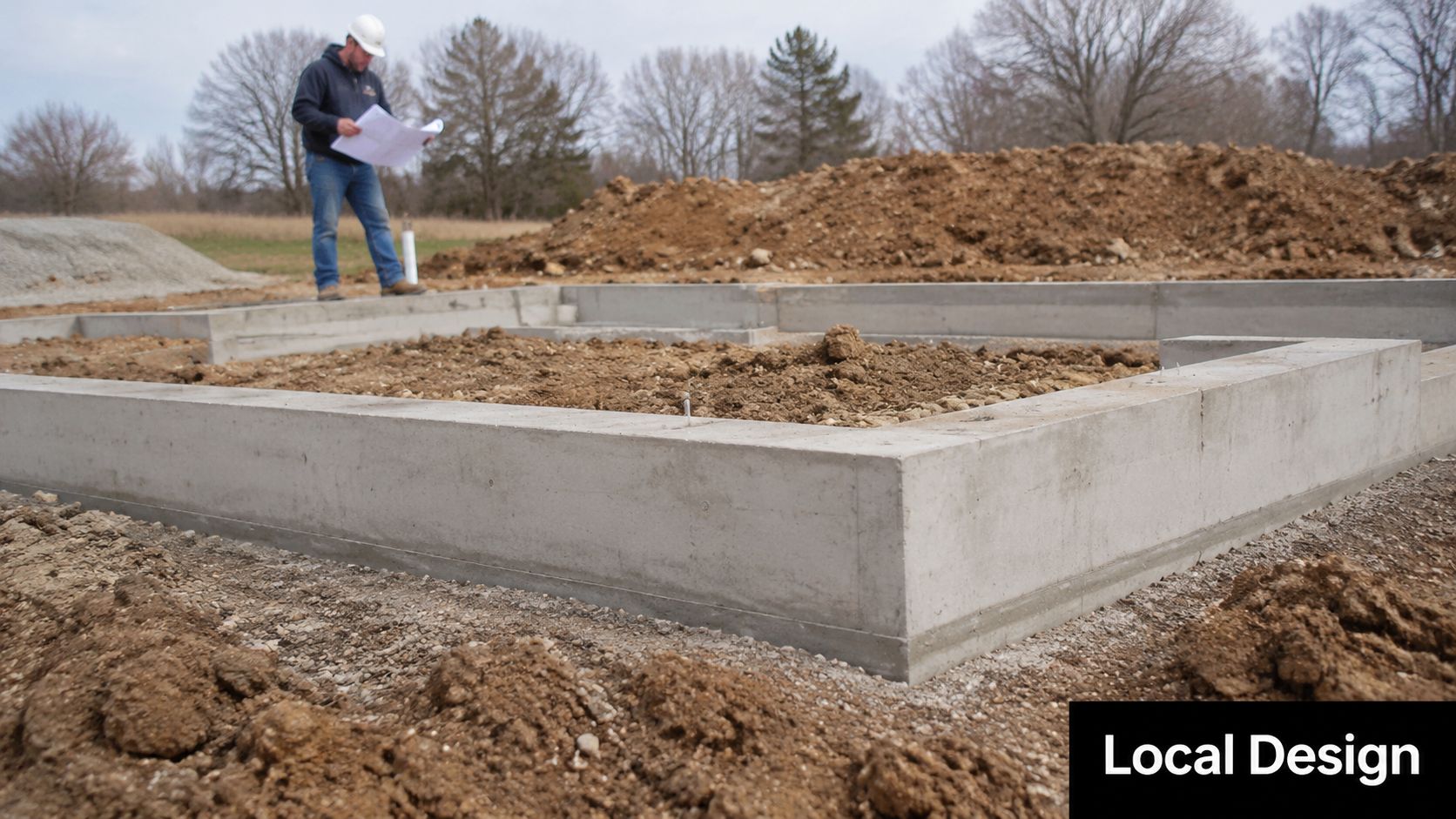
A concrete foundation wall has to match the height of the wall, the amount of soil against it, and the loads it carries. That's why code doesn't leave wall thickness to guesswork.
The 2021 International Residential Code Section R404.1.4.2 requires plain concrete foundation walls to be at least 7.5 inches thick, with a reduction to 6 inches allowed only if the wall height is 4 feet or less, according to the 2021 IRC foundation wall provision.
That rule gives homeowners a useful reality check. If someone proposes a thinner wall on a taller project, or on a site with meaningful backfill pressure, the design needs a closer look.
Frost depth changes how foundations perform
In our service area, frost isn't a small detail. If footings aren't placed at the proper depth for local conditions, freezing soil can lift sections of the foundation. When the ground thaws, the structure doesn't always settle back evenly. That's where you start seeing movement, cracking, and doors that no longer operate the way they should.
For a garage footing and foundation, a gazebo foundation, or a concrete foundation for garage use, frost depth has to be considered before excavation begins. It affects footing depth, drainage planning, and how the finished site sheds water away from the structure.
The wall gets the attention, but the footing depth and the soil under it decide whether that wall stays where it belongs.
One site, two very different designs
Two projects can look similar from the street and still need different foundation designs.
- A level lot with good drainage may allow a straightforward excavation, stable subgrade, and efficient forming.
- A sloped lot with wet soil may require more excavation control, drainage work, and tighter backfill planning.
- A smaller outbuilding might be fine with a simpler support layout.
- A larger garage or home addition usually needs more attention to load path, wall height, and reinforcement details.
Homeowners searching for shed foundations near me or garage foundation contractors near me often expect a price first. A good contractor starts with the site and the intended use. That's how you avoid paying for the wrong foundation twice.
The Keys to Strength Reinforcement and Materials
A foundation wall has to handle more than the weight above it. It also has to resist lateral soil pressure, shrinkage during curing, small shifts in bearing, and the stress that collects around every window, door, and pipe penetration. In PA, MD, DE, and NJ, those demands change with soil type and frost exposure, which is why reinforcement details that look minor on a plan often decide how the wall performs ten years later.
Rebar is what helps a concrete wall stay together under stress
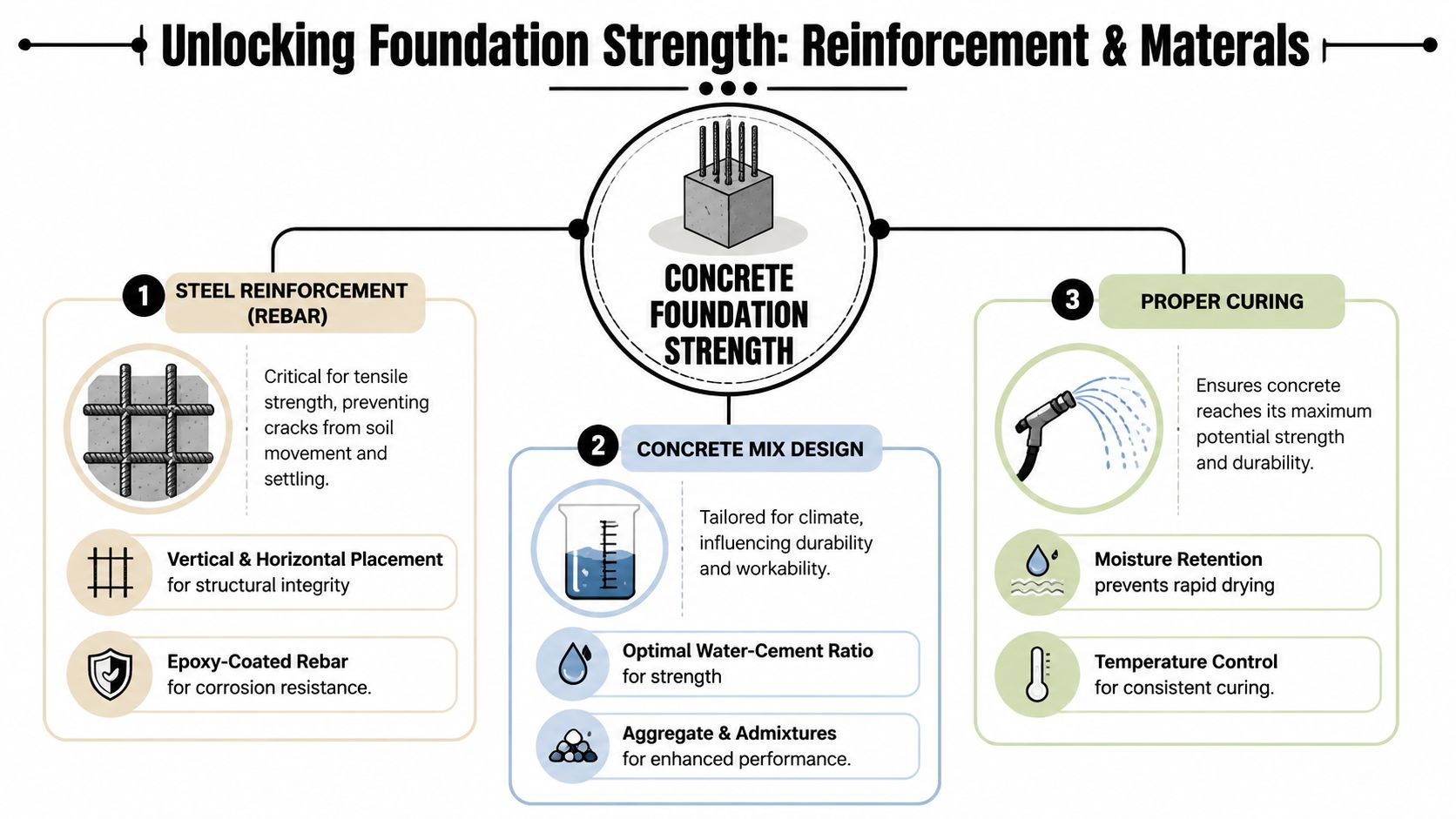
Concrete handles compression well. Steel handles tension and helps control cracking. Put them together correctly, and the wall performs as a single structural unit instead of a rigid panel that splits when the ground pushes back.
ACI 318 requires horizontal and vertical rebar spacing to be no more than 48 inches on center, and it requires reinforcement such as two No. 5 bars around wall openings, as outlined in this foundation wall reinforcement summary. Openings need special attention because they interrupt the wall and create concentrated stress at the corners.
If you want a simple explanation of how structural walls carry loads, All Well Property Services' wall guide gives helpful background in plain language.
Material quality and formwork affect strength before the concrete cures
Homeowners usually focus on thickness. Crews focus on placement, consolidation, bar location, and form alignment, because those are the details that separate a clean, straight wall from one that starts with built-in weakness.
A good wall starts with the right mix for the design, but the mix alone does not save poor workmanship. Rebar has to stay where the plan calls for it. Forms have to be braced so they hold line and grade during the pour. Concrete has to be placed and finished in a way that avoids voids, honeycombing, and cold joints. On poured walls, that quality control is one reason many Mid-Atlantic homeowners choose them over block for garages, additions, and full basements, especially where waterproofing and long-term moisture resistance matter.
Block walls can be built well, but they rely on many individual units, mortar joints, and often grouted cells. Poured walls give you a more continuous wall section, which usually makes reinforcement, water control, and long-term maintenance more predictable in our region's wet seasons and freeze-thaw cycles.
What good reinforcement practice looks like on a real job
- Bars are tied and supported properly so they stay in position during the pour.
- Corners and openings get extra reinforcement because those spots crack first when they are underbuilt.
- Forms are straight and fully braced so the finished wall is plumb and consistent.
- The crew places concrete in a controlled way to reduce voids and weak pockets.
- The wall design matches the drainage plan, because reinforcement and water management work together. foundation drainage design for retaining and foundation walls shows why that connection matters.
At Firm Foundations, we see the same pattern across PA, MD, DE, and NJ. The walls that hold up best are the ones built with the right materials, the right steel, and the discipline to follow the plan on site. That is what gives a homeowner a wall that stays straight, resists cracking, and is easier to keep dry over the long haul.
Site Prep Drainage and Waterproofing
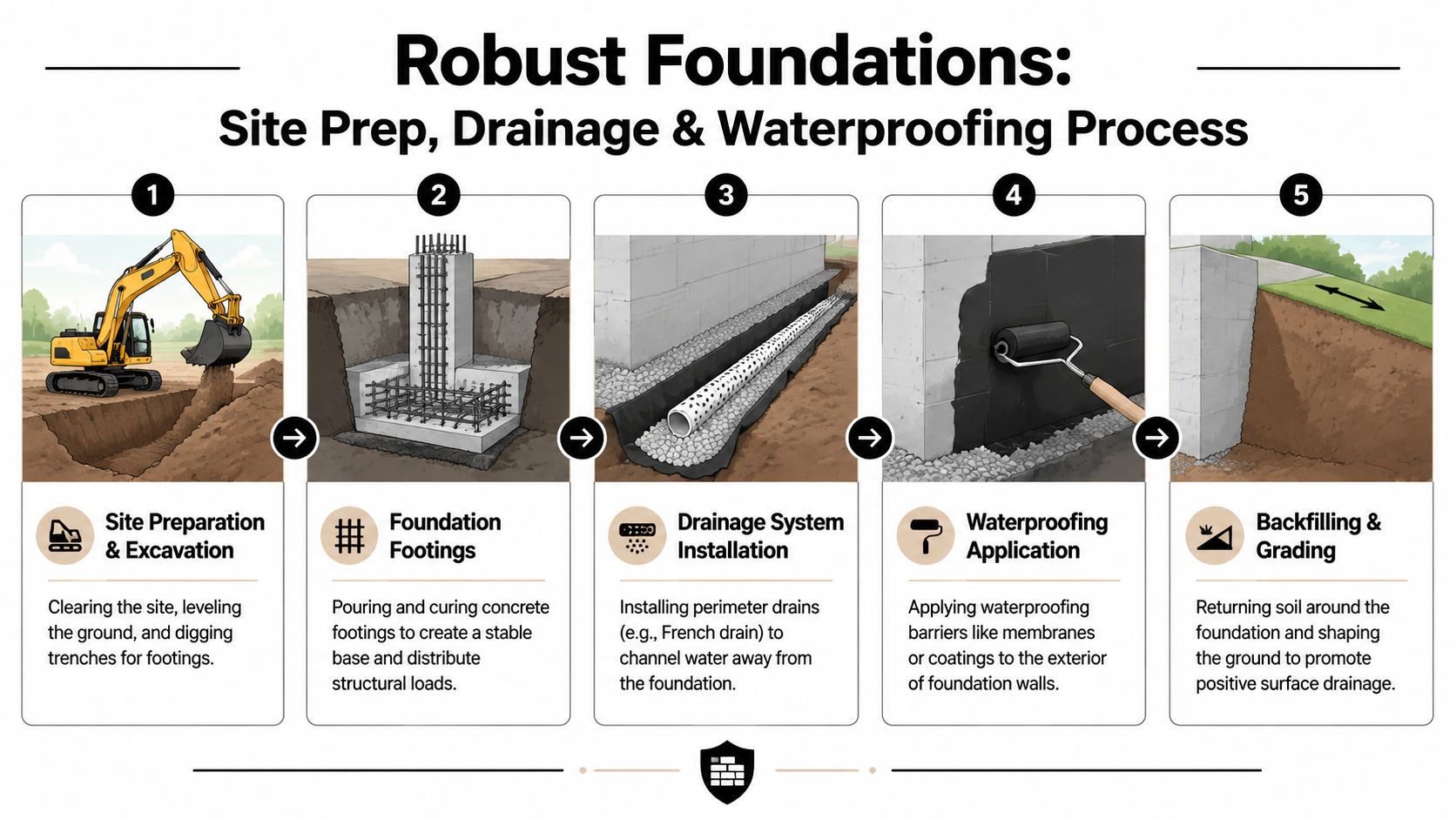
A lot of expensive foundation trouble starts before concrete is ever placed. In PA, MD, DE, and NJ, I see the same pattern over and over. Water sits where it should drain, subgrade gets disturbed during excavation, or backfill goes in too soon and too tight against the wall. A foundation can be well built and still give a homeowner problems if the site work is careless.
Early planning should cover the excavation path, spoil placement, subgrade condition, down-slope water movement, and where collected water will discharge. That matters for a full basement, a garage slab, or a smaller outbuilding. Homeowners searching excavation near me, gravel shed foundation contractors near me, or driveway contractors near me are often looking at the same underlying issue. The site has to handle water correctly before any wall system can perform the way it should.
What happens before the pour
Good site prep starts with stripping out soft, organic, or unstable material and getting down to competent bearing soil. In our region, that can mean very different conditions from one lot to the next. Dense clay, mixed fill, wet pockets, and frost-sensitive soils all change how the footing area should be prepared. The goal is simple. Give the foundation a uniform base so one section is not settling or holding water differently than the next.
Some homeowners assume every wall project needs the same old-school footer detail, no matter the structure. That is not always the right call for sheds, detached garages, and certain lighter buildings. The better approach is to match the foundation system to the load, soil, drainage conditions, and local code requirements. A practical review of foundation drainage design for retaining and foundation walls shows how grading and water control should be tied into that decision from the start.
Drainage protects the wall long after construction
Mid-Atlantic foundations deal with wet seasons, freeze-thaw cycles, and soils that can hold water against the wall for long periods. That is why drainage is not a finishing touch. It is part of the structural plan.
A reliable setup usually includes several parts working together:
- Perimeter drain tile or footing drains to carry groundwater away from the base of the wall.
- Washed stone in the proper zones so water can move down to the drain instead of building pressure against the wall.
- Exterior waterproofing or dampproofing based on the wall type, exposure, and expected moisture conditions.
- Final grading with positive slope away from the house so roof runoff and surface water do not return to the foundation.
This short visual gives homeowners a good field view of how water control around foundations works in practice:
Backfill timing matters more than many owners realize
Backfill should never be treated like a rush job. If the wall has not gained strength, if waterproofing is not complete, or if the drainage layer is not in place, the soil can load that wall before it is ready. I have seen new walls pushed, cracked, or left with moisture problems because the sequence was wrong, not because the concrete itself was bad.
The timing also depends on the wall system. Poured concrete walls, block walls, precast systems, and bolted panel systems do not all get backfilled the same way. On some projects, I recommend waiting until the floor system or slab is in place so the wall has the lateral support it was designed to work with. That is a field decision based on the wall type, height, soil conditions, and the engineer's details, not a one-size-fits-all rule.
Firm Foundations handles this work conservatively because the repair cost is always higher than the cost of doing the sequence right the first time. Homeowners can also pick up useful seasonal warning signs from guides like protecting your home's foundation in Utah, especially around runoff, grading, and early moisture symptoms. A dry basement or crawlspace usually comes from good excavation, smart drainage, proper waterproofing, and disciplined backfill practices, all done in the right order.
Common Foundation Problems and Expert Repairs
When a foundation wall starts showing distress, the pattern usually tells you a lot about the cause. A thin vertical crack raises a different concern than a long horizontal crack. A damp corner points to one problem. A wall bowing inward points to another.
Cracks, leaks, and wall movement
Vertical cracking can show up from settlement, shrinkage, or localized stress. Horizontal cracking often raises more concern because it may indicate unbalanced soil pressure or water pressure pushing against the wall. Bowing or leaning walls point to that pressure winning over time.
Water seepage is another common complaint. Sometimes the wall itself isn't the root issue. The actual cause may be failed exterior drainage, poor grading, clogged perimeter drain lines, or backfill that traps water against the structure.
Small symptoms don't stay small when water and soil pressure keep working on the same spot.
A useful homeowner habit is regular inspection around the foundation, especially after wet periods or seasonal changes. Even though it's written for a different region, protecting your home's foundation in Utah from Northpoint Construction offers a good reminder that early observation often prevents bigger structural and moisture problems later.
Repair depends on the cause, not just the symptom
Foundation repair isn't one service. It's a set of different solutions matched to the actual failure.
| Problem | Likely cause | Typical professional response |
|---|---|---|
| Vertical crack | Settlement, shrinkage, localized stress | Evaluate movement, seal as appropriate, correct drainage or support issue |
| Horizontal crack | Lateral soil or hydrostatic pressure | Reinforcement, pressure relief, possible wall stabilization |
| Bowing wall | Ongoing outside pressure | Wall reinforcing systems, structural correction, drainage work |
| Water seepage | Exterior water management failure | Waterproofing, drainage improvements, grading correction |
For homeowners in PA, MD, DE, and NJ, a contractor should look at the whole system before recommending repair. That includes the wall, surrounding grade, drainage conditions, and how the building loads are being carried.
Firm Foundations provides concrete foundation wall repair and wall reinforcing systems as part of that type of work. On problem walls, reinforcement may be part of the answer, but only after the pressure source and water path are addressed.
What doesn't work
Surface patching alone rarely solves an active structural issue. Interior paint-on products don't fix exterior drainage defects. Cosmetic crack filling doesn't stop a wall from moving if the soil outside is still overloaded with water.
A sound repair plan starts with diagnosis. Then it corrects the underlying condition that made the wall fail.
Hiring the Right Garage Foundation Contractors in Your Area
A garage foundation usually looks simple on paper. Then the excavation opens up, the soil changes from one corner to the next, water starts holding in the cut, or the plan on the permit does not match what the site will support. That is where the right contractor separates from the low bid.
If you are comparing garage foundation contractors near me, concrete contractors, or shed foundations near me, focus on who can explain the job in plain terms and build for local conditions in PA, MD, DE, and NJ. Frost depth, clay content, fill soil, drainage patterns, and township requirements all affect what should be poured and how it should be protected after backfill. A cheap price at the start can turn into cracking, water entry, or costly rework once the garage is built.
What to ask before you sign
Ask the contractor how they size up the site before they price the work. A serious foundation crew should be able to walk you through drainage, excavation access, bearing soil, frost depth, and any grading issues that could affect the wall or slab later.
You should also ask:
- What foundation type they recommend for your garage, shed, barn shed, gazebo foundation, or house foundation, and why that choice fits your site
- How they handle reinforcement and formwork, with specific details instead of broad promises
- What is included in the quote, including excavation, stone, forming, reinforcement, waterproofing, drainage, and backfill
- How they verify dimensions during construction so the finished wall matches the plan
That last point matters more than many homeowners realize. ACI 332-20 says the as-built thickness of a concrete wall cannot be more than 1/2 inch less than its nominal dimension, so a nominal 8-inch wall must measure at least 7.5 inches, according to Concrete Facts Magazine's note on nominal wall thickness. If a contractor cannot speak clearly about layout, forms, tolerances, and inspection points, keep looking.
What a solid quote should do
A useful quote should spell out what is being built, what materials are being used, and what conditions could change the scope. That applies to everything from a shed foundation gravel base to full garage footings and foundations.
In this region, the quote should also reflect local reality. Parts of Pennsylvania and New Jersey deal with frost and mixed soil conditions that call for careful footing depth and drainage planning. Sections of Maryland and Delaware can present softer ground, higher water tables, or runoff concerns that change the waterproofing and backfill approach. Two garages with the same size and layout may need different foundation details because the lot conditions are different.
Firm Foundations works on projects across Pennsylvania, Maryland, Delaware, and New Jersey with that local approach in mind. The job is not just to pour concrete. It is to prepare the site correctly, choose the right wall or slab system, and build a foundation that holds up to Mid-Atlantic weather and soil conditions over the long term.
If you are planning a garage, shed, gazebo, house addition, shipping container base, or another concrete project in Pennsylvania, Maryland, Delaware, or New Jersey, Firm Foundations can help you choose the right foundation type, prepare the site correctly, and build a concrete foundation wall or slab that fits the structure and the property. Request a free quote to get a clear scope, honest recommendations, and a foundation plan built for local conditions.