
Driveway Concrete Sealer: A PA & NJ Homeowner’s Guide
By late winter, a lot of homeowners in Pennsylvania, Maryland, Delaware, and New Jersey are looking at the driveway with fresh eyes. Salt residue is still hanging around. The surface may look dull. A few hairline cracks or shallow flakes suddenly seem more obvious after a season of freezing nights and wet days.
That's usually when the question comes up. Is a driveway concrete sealer worth doing, or is it just one more home maintenance task that sounds better than it performs?
In this region, the answer depends less on trends and more on condition. A sound concrete driveway can benefit from the right sealer and good timing. A driveway with drainage trouble, settlement, or bigger structural issues needs more than a coating. Knowing the difference is what saves money and frustration.
Is Driveway Sealer Worth It for Your PA or NJ Home
You come out in March, the snow is gone, and the driveway looks rougher than it did in the fall. The surface is chalky. Salt residue is still there. A couple of small cracks catch your eye near the apron or by the garage door.
In our part of the country, that is a fair time to ask about sealer.
For a sound concrete driveway in PA, NJ, MD, or DE, sealer is usually money well spent. It helps slow water entry, reduces salt damage at the surface, and makes oil and dirt easier to clean up. Those benefits matter here because winter is hard on concrete. Repeated freeze-thaw cycles, deicing salts, and long stretches of damp weather wear down unprotected slabs faster than many homeowners expect.
The catch is simple. Sealer only pays off when the slab is still healthy.
We see this all the time. A homeowner has flaking at the edges, water sitting in the same low spot after every storm, or cracks that keep widening from one season to the next. They seal it anyway because the driveway still looks mostly intact from the street. A few months later, the same trouble is back because the underlying problem was drainage, settlement, weak concrete near the surface, or movement below the slab.
When sealing is a smart investment
Sealing usually makes sense when the driveway has normal wear but still has good structure. That often includes:
- Light surface aging: The color has faded, the finish looks dry, or there are minor stains and small cosmetic imperfections.
- Minor, stable cracks: Hairline cracks or small non-moving cracks can be compatible with sealing after proper prep.
- Decent drainage: Water runs off instead of sitting for hours in birdbaths or along the garage.
- No vertical movement: One section is not lifting or dropping against another.
- A protection goal: You want to limit salt intrusion, moisture absorption, and surface staining before bigger wear sets in.
That is the sweet spot for a DIY sealer job. If the concrete is solid, prep is manageable, and you are choosing sealer for protection rather than repair, many homeowners can handle it well.
When sealer is the wrong first step
Skip the sealer run for now if you are seeing signs of failure instead of normal wear.
Watch for recurring pooling, scaling across large areas, deep spalling, settled sections, widening cracks, broken edges, or places where one slab panel sits higher than the next. Those problems point to water management issues, base failure, poor past installation, or frost-related movement. A coating on top will not stop that process.
Here is the practical framework I use on estimates:
| Driveway condition | Sealer value |
|---|---|
| Sound slab with light cosmetic wear | High |
| Sound slab with regular salt exposure | High |
| Small stable cracks and minor staining | Moderate to high |
| Standing water or drainage problems | Low until corrected |
| Settlement, movement, major spalling, or surface breakup | Low until repaired |
If your driveway falls in the top three rows, sealing is often worth doing. If it falls in the bottom two, spend the money on diagnosis and repair first.
That is where a local concrete or foundation contractor earns their keep. In PA, MD, DE, and NJ, freeze-thaw damage often starts with water getting where it should not, then expands into cracking, surface loss, and slab movement. When that pattern is already underway, a pro like Firm Foundations can determine whether you need drainage correction, slab repair, replacement of failed sections, or a broader fix tied to the base or nearby foundation conditions.
A good rule is easy to remember. Seal concrete that is aging. Repair concrete that is moving.
Choosing Your Sealer Penetrating vs Film-Forming
A driveway in Pennsylvania or New Jersey does not fail from looks alone. It fails because water gets in, winter locks that water up as ice, and road salt keeps the surface under stress for months at a time. That is why the first sealer decision is about how the product protects the slab, not which label is on the bucket.
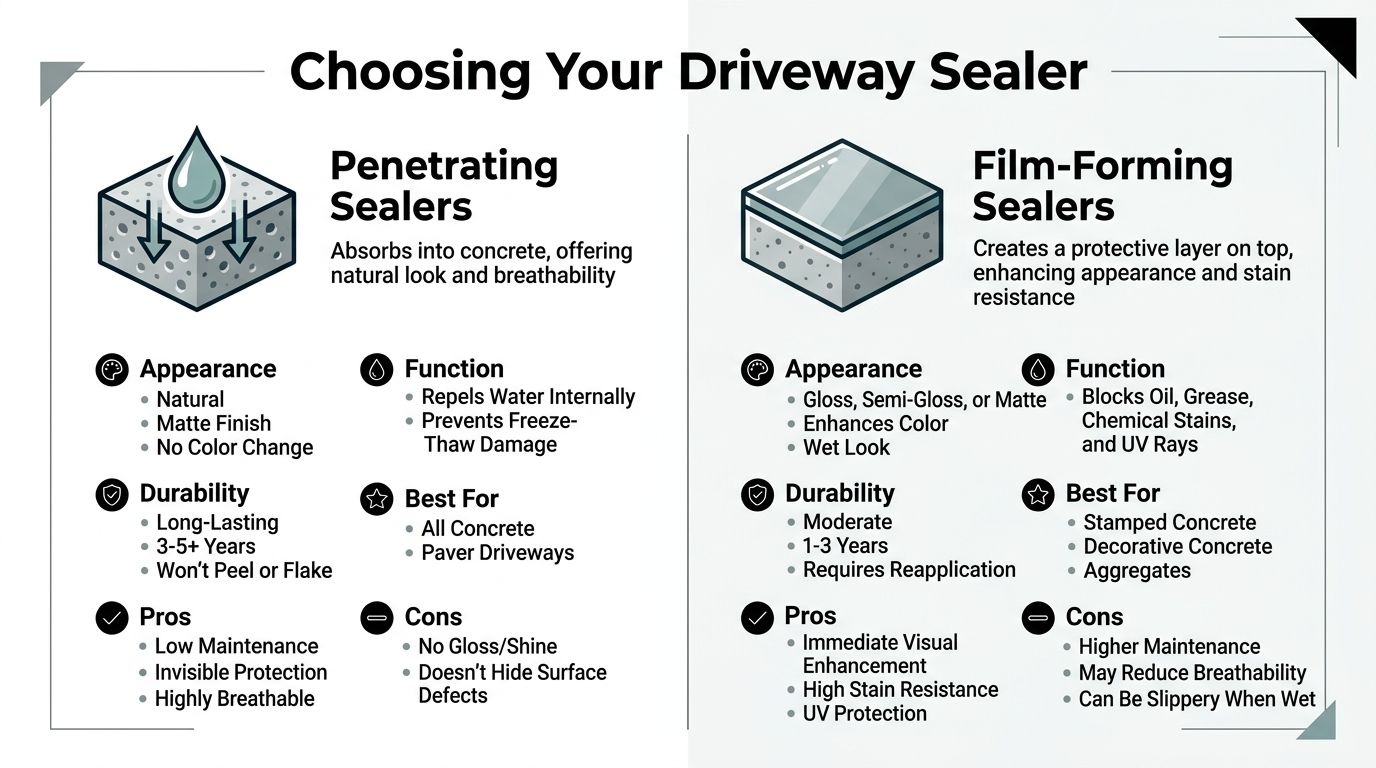
Two categories handle that job differently. Penetrating sealers soak into the concrete and reduce water absorption below the surface. Film-forming sealers leave a coating on top that changes the appearance and creates a surface barrier.
Penetrating sealers
For plain residential driveways in PA, MD, DE, and NJ, penetrating products are usually the safer bet.
They keep the concrete looking close to its natural color, and they do the part that matters most in our climate. They limit moisture intrusion without leaving a topical layer that can wear unevenly under snow shovels, tire traffic, and salt. On a driveway that already looks good and mainly needs protection, that is often the best value.
Some penetrating sealers also have a longer service life than many topical products in favorable conditions, as noted earlier from sealer lifespan guidance. Real-world life still depends on prep, traffic, drainage, and winter exposure.
Penetrating sealers make sense when:
- The driveway is plain broom-finished or lightly textured
- You care more about freeze-thaw protection than shine
- You want lower maintenance between applications
- You are tackling a solid DIY job and want a more forgiving product
That last point matters. Penetrating sealers usually give DIY homeowners a little more margin for error than high-build coatings, especially on standard exterior concrete.
Film-forming sealers
Film-forming products are chosen more for appearance and surface stain resistance.
Acrylics can add a slight sheen or deepen the color. Epoxies and urethanes build a tougher-looking finish, but they are less common for a basic exterior driveway in our region because exterior conditions are hard on coatings. Wet winters, hot summers, deicing salts, and repeated tire traffic can shorten the life of a topical finish or make wear patterns obvious.
They also ask more from the installer. Surface prep has to be right, moisture conditions matter, and uneven application shows up fast. If you are considering a coating because you want the driveway to look dressed up, read through this guide on concrete driveway preparation first. Good prep decides whether a film-forming sealer holds up or starts peeling early.
Film-forming products fit better when:
- Appearance is a major goal
- The slab is decorative, tinted, or stamped
- You are willing to reseal on a tighter schedule
- The surface conditions are controlled and thoroughly prepped
For cleaning steps before any sealer goes down, this complete pressure washing guide is a useful companion resource.
Which one usually makes more sense here
In the Mid-Atlantic, I tell homeowners to match the product to the risk.
If the main risk is water, salt, and winter cycling, start with a penetrating sealer. If the main goal is appearance and the driveway is in good enough shape to justify extra upkeep, a film-forming product can work. The key is being honest about maintenance. A glossy finish can look sharp at first, but it is rarely the lowest-hassle option on a working driveway in this region.
Here is the practical comparison:
| Sealer type | Best for | Main trade-off |
|---|---|---|
| Penetrating | Natural look, moisture resistance, freeze-thaw protection | Less color enhancement |
| Acrylic film-forming | Mild sheen and surface-level appearance boost | More frequent resealing and wear at the surface |
| Epoxy or urethane film-forming | Decorative finish and stronger surface coating | Higher prep sensitivity and less forgiving application |
A simple rule works well here. Choose penetrating sealer for protection. Choose film-forming sealer only if the appearance gain is worth the added maintenance.
Preparing Your Concrete Driveway for a Perfect Finish
A lot of Mid-Atlantic sealing jobs go wrong before the sealer bucket is even opened. The driveway looks clean enough, the surface feels dry enough, and then winter shows you where prep was skipped.
In PA, MD, DE, and NJ, that matters more than many homeowners expect. Freeze-thaw cycles push moisture through weak spots. Road salt finds open pores, small cracks, and soft surface areas. If the slab is dirty, damp, or already breaking down, sealer will not fix the underlying problem. It will only sit on top of it.
Start with a clean, absorbent surface
The goal is simple. Get the concrete clean, dry, and able to absorb sealer evenly.
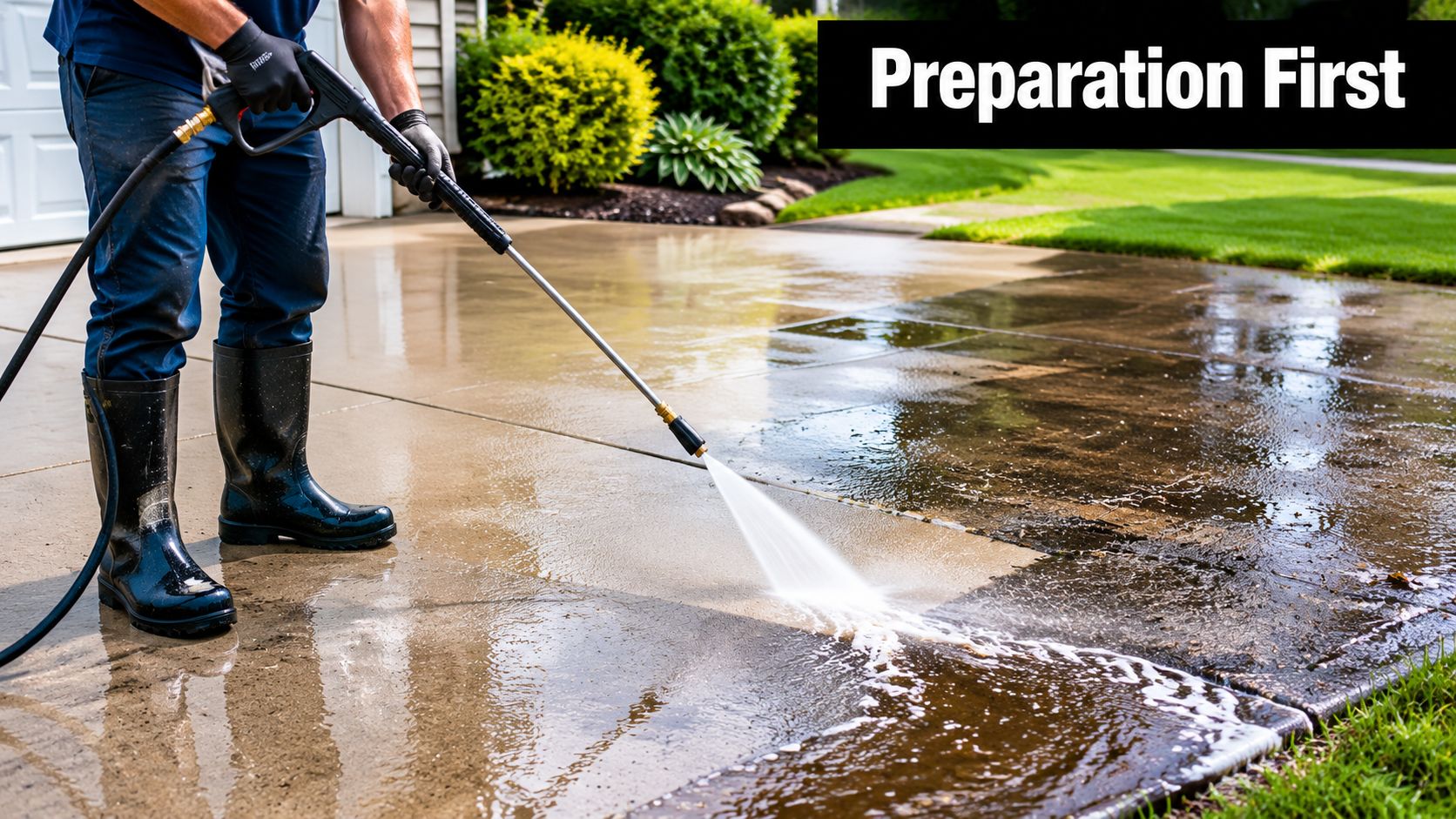
That usually means more than a quick rinse. Grit, pollen, old detergent, leaf stain, oil, and fine dust all interfere with penetration and cure. If one area repels water and another darkens right away, the slab is not ready yet.
A solid prep sequence usually looks like this:
- Sweep off loose debris and grit.
- Wash the full driveway, not just the stained areas.
- Scrub oil spots until they stop shedding water.
- Rinse well so no cleaner is left behind.
- Let the slab dry fully.
- Check again for dust, residue, and uneven absorption.
If you want a practical overview of washing methods, nozzle control, and surface cleaning expectations, this complete pressure washing guide is a useful companion read before you start.
Inspect the driveway before you spend money on sealer
This is the step homeowners skip most often.
After cleaning, walk the slab slowly and look at it like a contractor. Sealing is a good DIY project when the concrete is basically sound and the main need is protection. It is the wrong project when the driveway already has movement, drainage failure, or active surface loss.
Pay attention to these conditions:
- Cracks that are widening, offset, or running through multiple panels. Those point to movement that sealer will not stop.
- Flaking, scaling, or soft top layer concrete. Salt damage and winter moisture may already be breaking the surface apart.
- Low areas that stay wet after rain. Standing water shortens sealer life and keeps feeding freeze-thaw stress.
- Peeling old coating or patchy finish. New sealer over failing material usually gives you another uneven failure.
- Edges that are settling or slabs that are tilting toward the garage. That is a drainage and slab-performance issue, not a sealing issue.
For homeowners planning a more thorough concrete project, this guide to concrete driveway preparation gives a broader look at site readiness and why foundation-level prep habits matter even on flatwork.
A simple test helps. Spray a few sections with water. If the surface darkens evenly, prep is close. If water beads in oily patches, sits in birdbaths, or highlights loose surface paste, deal with those problems first.
Dry time matters more in this region
Concrete can look ready and still hold moisture below the surface. I see this a lot on shaded driveways, north-facing slabs, and homes with tree cover where dew hangs around well into the morning.
That is why timing matters in our region. Spring and fall are often the best sealing windows in PA, MD, DE, and NJ, but they also bring cool nights, humidity, and slow drying after washing. A slab cleaned late in the day may not be ready the next morning, even if the top looks pale and dry.
Plan prep around weather, not convenience.
If the driveway is sound, fully dry, and absorbing water consistently, sealing is usually a smart DIY job. If prep reveals settlement, major cracking, drainage problems, or surface breakdown, stop there and get the concrete evaluated before you trap those issues under a fresh coat.
How to Apply Driveway Sealer Like a Pro
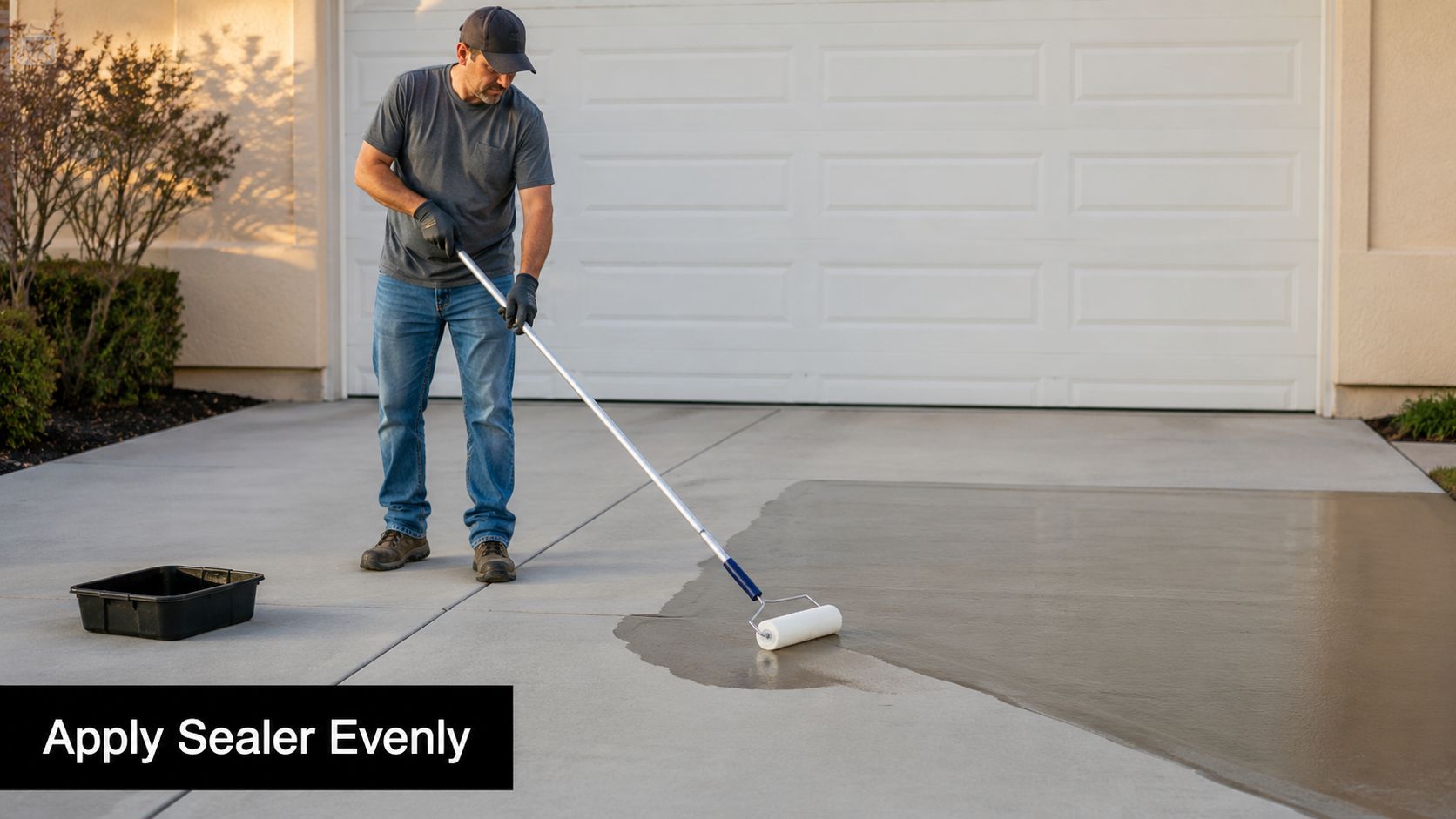
Good application is controlled, not rushed. The goal is a thin, uniform film, not a heavy wet-looking coat that sits on the surface and creates problems later.
That's why pros usually favor a hand-pump sprayer with a fan tip for coverage, then use a roller only as needed to even out excess or work material into the surface. If you try to dump too much product down at once, you're setting yourself up for streaks, puddles, and uneven cure.
Pick the right day
Application conditions matter more than many homeowners expect. For best results, apply sealer when air and concrete temperatures are between 50°F and 95°F for 24 hours, using a fan-tip sprayer for a thin, uniform film, working in sections, and applying a second coat wet-on-wet about 10 minutes after the first if needed while rolling out puddles to prevent over-application (best-practice sealer application guide).
That guidance lines up well with what works in the field. You want stable weather, no imminent rain, and enough daylight to finish while the surface is still behaving predictably. Late afternoon jobs can get risky if dew settles before the sealer has a chance to set.
A few practical rules help:
- Avoid direct hot sun if possible: It can make the product flash too quickly.
- Don't start if overnight moisture is likely to hit too soon: Dew and fog can affect the finish.
- Work when the slab temperature is cooperative: The driveway surface matters just as much as the air.
Use the right motion and spread
The biggest visual mistake is over-application. Homeowners often think heavier means stronger. With driveway sealer, heavy usually means blotchy.
Spray in manageable sections and keep your pattern consistent. Don't whip the wand around. Don't stop mid-pass and restart in the same line if you can avoid it. Aim for even wetting, not flooding.
A smooth rhythm works best:
- Spray one section with a controlled fan pattern.
- Keep a wet edge so the next pass blends into the first.
- If a porous area absorbs faster, address it immediately rather than soaking the whole slab.
- Brush or roll out puddles before they sit.
A driveway should look evenly treated, not coated like a painted floor.
If you're comparing coating-style techniques versus penetrating treatment habits, this concrete driveway painting advice offers a helpful contrast in how surface coatings differ from sealer application.
Know when a second coat helps
Some driveways are more porous than others. On those slabs, a second wet-on-wet pass can improve coverage. The important part is timing and restraint. The surface should still be in that active window where the second pass blends, not turns into a separate heavy layer.
You're not trying to create shine unless the product is specifically designed for that look. You're trying to achieve uniform protection.
If your first section looks patchy because one part of the slab absorbed quickly, don't panic. That often reflects porosity differences. What matters is whether the product is soaking in appropriately and whether you're controlling excess.
Where DIY usually goes wrong
Three patterns show up again and again:
- Too much product in one area: This causes streaking and sticky-looking spots.
- Poor section planning: That creates lap marks and uneven overlap.
- Ignoring edges and transitions: Aprons, borders, and garage-adjacent sections often get double-coated or missed.
Tape off what needs protection. Keep the sprayer pressure controlled. Stay organized. A careful homeowner can absolutely do this job well, but the technique has to be deliberate.
Curing Times and Long-Term Driveway Maintenance
A sealed driveway isn't ready the moment the surface stops looking wet. The material still needs time to cure properly, and that cure window is part of the job.
Field guidance says to keep traffic off for at least 24 hours after a properly sealed driveway, and it also notes that resealing intervals vary by product and conditions, with short-lived acrylics sometimes needing attention every 1 to 3 years while higher-performance penetrating sealers can last much longer (driveway sealer cure and maintenance benchmarks).
That waiting period matters because early foot traffic, vehicle tires, or turning wheels can interfere with the finish before it has stabilized.
What to do after application
For the first day, think protection rather than use. Keep people, pets, and vehicles off the slab. If your driveway serves as the main route in and out, plan ahead before you start the project.
After curing, maintenance gets much simpler. A sealed driveway still needs cleaning, but routine care is easier because the surface is better defended against water and common stains.
A practical maintenance routine includes:
- Regular sweeping: Grit left on the surface adds wear.
- Occasional washing: Remove salt residue, dirt, and organic buildup.
- Spot cleanup: Oil and fertilizer stains are easier to manage when caught early.
- Visual inspection: Check whether water still behaves the way it should on the surface.
How to think about resealing
The right reseal schedule isn't a date on the calendar by itself. It's a combination of product type, weather exposure, traffic, and how the driveway is performing.
In Arizona, for example, UV and heat shape the maintenance conversation differently. That's why an article on proper driveway sealing in Arizona is useful mostly as a climate contrast. In PA, NJ, MD, and DE, moisture and winter exposure usually deserve more attention than desert heat.
If you're also trying to understand the broader difference between surface dry time and full concrete cure in new flatwork, this overview of how long a concrete slab takes to cure helps separate those timelines.
Maintenance works best when you stop treating sealer like a one-time fix. It's part of a long-term protection plan.
When the driveway starts absorbing water faster, looking uneven sooner, or losing the protective behavior you expected, it's time to reassess. A good maintenance mindset catches that before visible damage gets ahead of you.
Common Mistakes and When to Call for Concrete Help
A lot of driveway sealing jobs go sideways after a good-weather weekend. The sealer goes on, the surface looks fine for a few days, and then the streaks show up, the finish turns uneven, or water starts finding the same weak spots it found before. In PA, NJ, MD, and DE, that usually comes back to one of three things: poor prep, bad timing, or using sealer to cover a problem that needs actual concrete work.
A homeowner can handle sealing well if the slab is sound and the surface conditions are right. The expensive mistakes happen when the driveway already has movement, drainage problems, or surface failure from winter exposure and deicing salts.
Mistakes that ruin an otherwise good job
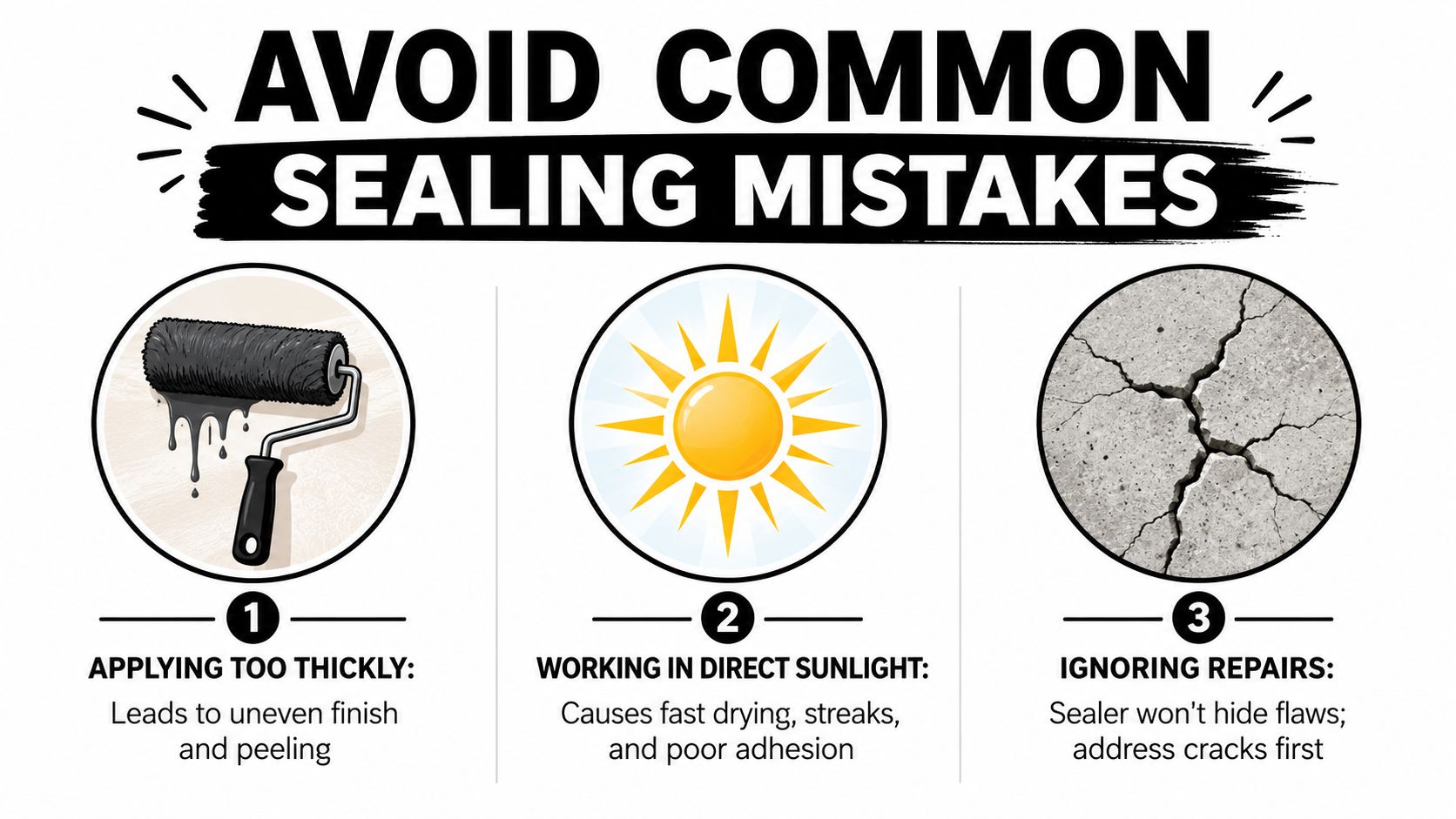
Applying too much sealer is one of the most common problems I see. Heavy coats leave puddles, roller lines, cloudy spots, and glossy patches that wear unevenly. More product does not mean more protection.
Timing causes plenty of failures too. New concrete needs a full cure before sealing, and any driveway that is still damp, dirty, or holding residue from cleaners, oil, or fertilizer will give you a poor result. As noted earlier, new concrete generally needs about 28 days to cure before sealing. On older driveways, a clean, dry surface matters just as much as the product choice.
Regional weather makes this harder than many homeowners expect. A driveway can look dry at noon and still pick up enough evening moisture, humidity, or overnight dew to interfere with the finish. That is a real issue in the Mid-Atlantic, especially in spring and fall.
Common DIY failure points include:
- Applying late in the day: Dew, fog, and falling temperatures can interfere before the sealer sets properly.
- Working without a consistent edge: Lap marks and uneven coverage show up fast on large driveways.
- Sealing over cracks or weak patches you already know about: Sealer will not stop slab movement or hold failing concrete together through winter.
- Choosing based only on appearance: A wet-look finish may look great at first and still be the wrong choice for a salt-exposed driveway in a freeze-thaw climate.
Signs you need more than sealer
A good rule is simple. If the problem involves movement, missing concrete, or water that keeps returning to the same area, sealing is no longer the main decision.
Look closely at what the driveway is doing through a full weather cycle. Hairline surface aging is one thing. Cracks that widen, sections that settle, edges that break away, or water that sits near the garage are different problems. Those point to slab movement, poor base support, drainage trouble, or surface deterioration that has already gone past basic maintenance.
Here are the situations where it makes sense to stop the DIY plan and bring in a contractor:
| What you see | What it usually means |
|---|---|
| Cracks that widen or change height | Movement in the slab or below it |
| Recurring standing water | Grading or drainage issue |
| Widespread spalling or surface breakup | Surface failure beyond simple protection |
| Sinking sections near garage or walkway | Base or subgrade concern |
| Repeated patch failures | Underlying concrete instability |
Sealer is a finishing step. If the slab is moving, settling, or breaking apart, the problem lies below the surface.
That is usually where homeowners start searching for driveway contractors near me, concrete contractors, garage foundation contractors near me, cement foundations for garage, garage footings and foundations, shed foundations near me, or gravel shed foundation contractors near me. They may start with a driveway question, but the actual fix often involves grading, excavation, base preparation, or replacement work.
The same logic applies across the property. A driveway, a shed foundation, a gazebo foundation, and a base for storage shed all depend on drainage, compaction, and proper concrete installation. Sealer helps preserve good flatwork. It does not correct bad slope, weak support, or a slab that is already failing.
For many homeowners, that is the line between a high-value DIY project and wasted effort. If the concrete is in good shape, sealing is smart maintenance. If the driveway is telling you it has drainage or structural trouble, the better investment is fixing the cause first.
If your driveway just needs protection, a careful sealing job may be the right move. If you're seeing drainage problems, slab movement, surface failure, or you're planning a new pad, slab, or driveway in Pennsylvania, Maryland, Delaware, or New Jersey, Firm Foundations can help you sort out the actual issue and build it right from the ground up. Reach out for a quote and get honest guidance on whether your project needs sealing, repair, excavation, or a full concrete solution.