
Concrete Slab Foundation Issues: A PA & MD Homeowner’s Guide


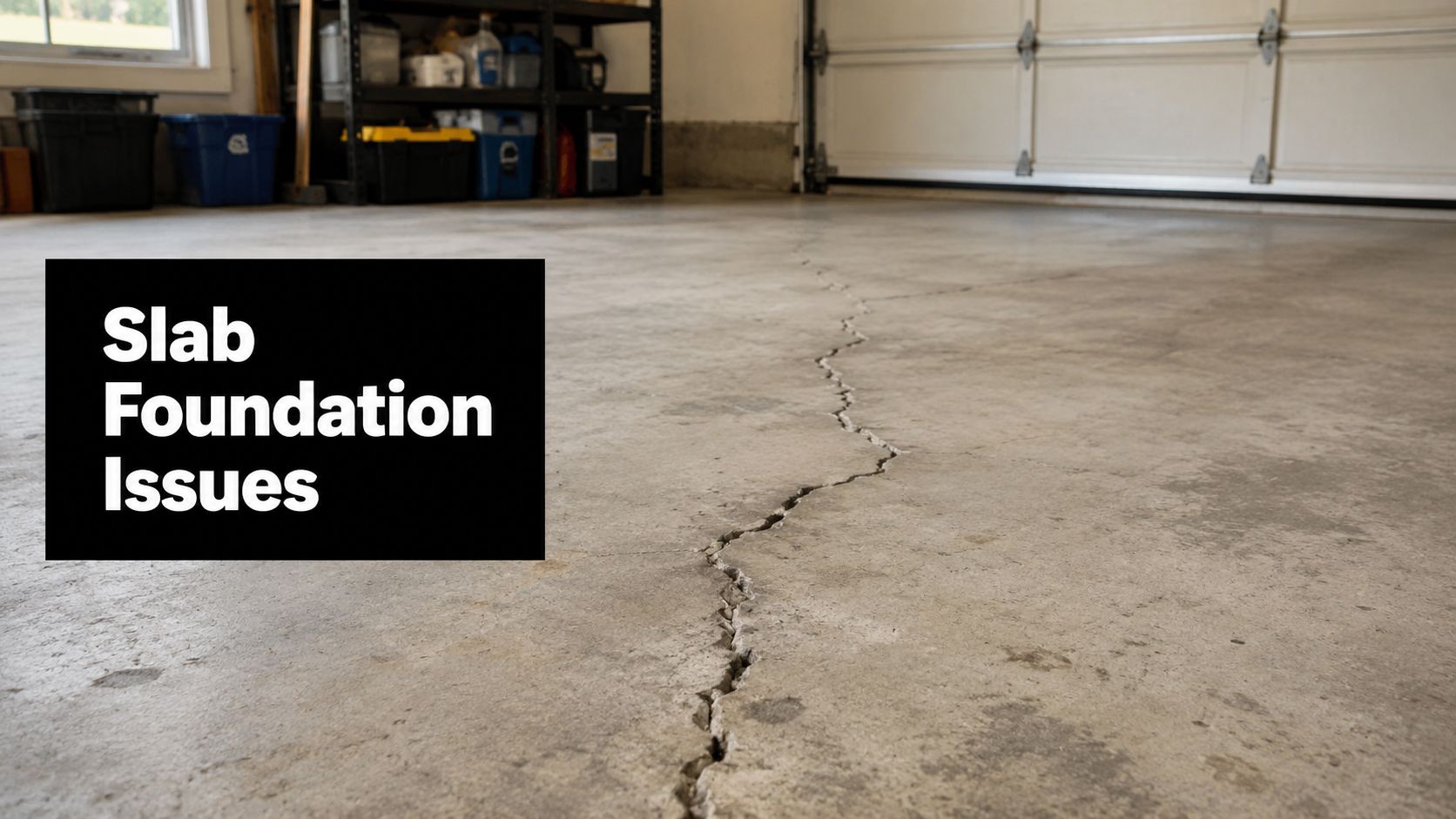
A lot of homeowners first notice concrete slab foundation issues in a quiet moment. You pull into the garage and spot a crack that wasn't there last season. You're moving lawn equipment into the shed and feel the floor dip slightly under your feet. You walk past the patio after a hard rain and see water sitting tight against the slab instead of draining away.
That's usually when the questions start. Is this normal settling, or the start of a bigger problem? Is it a shed pad issue, a garage slab issue, or a sign the soil underneath is moving? And if you search for answers online, most articles go in one of two directions. They're either written in engineer-speak or so general that they don't help you decide what to do next.
Homeowners across Pennsylvania, Maryland, Delaware, and New Jersey run into these same concerns, especially around garages, sheds, patios, and slab-on-grade structures. In this region, moisture swings, drainage problems, and inconsistent site prep can all push a slab out of plane over time. That's why a practical way to evaluate what you're seeing matters more than vague reassurance.
That Sinking Feeling Seeing a Crack in Your Concrete
You sweep out the garage, glance down, and catch a crack you know was not there last winter. Or you step into the shed and feel one corner sit just a little lower than the rest. That is usually the moment concern sets in, not because concrete always fails, but because most homeowners are left guessing about what they are looking at.
In our part of the Mid-Atlantic, that uncertainty is common. A slab can look fine for years, then start showing small changes after a wet season, a dry spell, or drainage problems around the edges. In Pennsylvania, Maryland, Delaware, and New Jersey, those shifts often tie back to moisture movement in the soil, freeze-thaw cycles, or base material that was never compacted well to begin with.
The first sign is usually simple.
A crack that keeps opening. A slab corner that drops. Water that starts collecting where it used to drain away. A door at the garage or shed that suddenly rubs, even though the framing itself has not changed. Homeowners often notice one of these symptoms before they realize the slab may be moving underneath.
What homeowners usually notice first
- A garage floor crack that seems wider than it used to be
- A shed foundation that no longer feels level
- A patio or slab edge with soil washing away from underneath
- Water pooling near the slab after rain
- A raised or sunken area that was not there before
Practical rule: Start paying attention the day you spot a crack. You do not need to panic, but you should watch for changes in width, direction, and height from one side to the other.
Cost is one reason many homeowners choose slabs for garages, sheds, patios, and slab-on-grade additions. The trade-off is that a slab only performs as well as the support below it. Good grading, proper compaction, controlled water runoff, and stable soil matter just as much as the concrete itself.
That is why homeowners often look for local shed foundation contractors, garage slab contractors, or gravel shed foundation installers after they spot a problem. The actual question is usually not about the next project. It is whether the slab they already have is still sound, and whether the site conditions underneath are working for it or against it.
Recognizing Common Concrete Slab Foundation Problems
Concrete gives warnings before a slab fully fails. The useful question is what kind of warning you are seeing, and whether it points to simple surface wear or actual movement in the slab.
Around PA, MD, DE, and NJ, I tell homeowners to focus on three things first. Is the crack getting wider. Is one side higher than the other. Is the floor still level enough that doors, equipment, or stored items sit the way they used to. Those answers usually tell you more than the crack alone.
Slab Issue Symptom Checker
| Symptom | What to Look For | Potential Severity |
|---|---|---|
| Hairline crack | Very thin crack, often straight or lightly wandering, with no height difference from one side to the other | Often minor, especially in newer construction |
| Wider crack | Crack that clearly opens up and can catch a coin edge or fingertip | More concerning, especially if growing |
| Horizontal crack | Crack line running sideways rather than a simple shrinkage pattern | Higher concern |
| Stair-step pattern | Angled, stepped cracking pattern near masonry or adjoining surfaces | Higher concern |
| Sinking section | One area of slab sits lower, furniture rocks, doors drag, or slab edge drops | Moderate to high concern |
| Heaving or raised spot | Slab crowns upward or creates a hump in the floor | Moderate to high concern |
| Surface flaking or spalling | Top layer chips, scales, or breaks away | Often surface-related, but worth checking with moisture issues |
| Moisture residue | White powdery deposits, damp spots, or recurring wet perimeter | Indicates water is involved |
Crack size matters, but movement matters more
A narrow shrinkage crack in a newer slab is often a watch item, not an emergency. A crack that opens enough to catch a coin, keeps lengthening, or shows vertical displacement deserves a closer look. Sanitred's guide to signs of foundation repair also notes that larger, actively changing cracks are more serious than small stable ones.
That is why I do not judge a slab by width alone. A small crack at a settled corner can be more important than a wider surface crack in a slab that is still flat.
What each problem usually looks like on site
Hairline settlement cracks
These are thin, usually flat, and often show up as the concrete cures and adjusts. If they stay the same size and the slab remains level, monitoring is often the right call.Uneven settlement
One part of the slab drops while another stays put. Homeowners may notice a slope, a rocking workbench, a gap at the slab edge, or a garage service door that starts rubbing. If you want a plain-language explanation of what that movement means, this guide on differential settlement in concrete slabs breaks it down well.Heaving
This is upward movement instead of settling. The floor may develop a hump or lifted ridge, often after moisture changes or winter freeze-thaw cycles affect the soil support.Surface deterioration
Flaking, scaling, and spalling usually start at the top surface. In our region, deicing salts, repeated wetting, and freeze-thaw exposure can make this worse. It may be a durability problem rather than a structural one, but recurring surface breakdown still needs attention.
One quick field rule helps. If the floor is changing shape, the problem is larger than the visible crack.
Cosmetic versus structural warning signs
Cosmetic issues change appearance. Structural issues change support, levelness, or load path.
A cosmetic crack is usually thin, flat, and stable over time. A structural warning sign is more likely to include separation, offset from one side to the other, repeated water intrusion, or a pattern that lines up with a sinking edge or lifted section. Horizontal cracks and stair-step cracking near adjoining masonry also deserve a professional look, especially in older slabs or slabs built on fill.
For homeowners in Pennsylvania, Maryland, Delaware, and New Jersey, that distinction matters because our soils and weather are hard on marginal slabs. Clay-heavy soil, wet seasons, and winter temperature swings can turn a minor slab symptom into a repair job if the support conditions underneath are already weak. Firm Foundations helps homeowners sort out that difference early, before a manageable repair turns into replacement.
What Causes Concrete Slabs to Fail
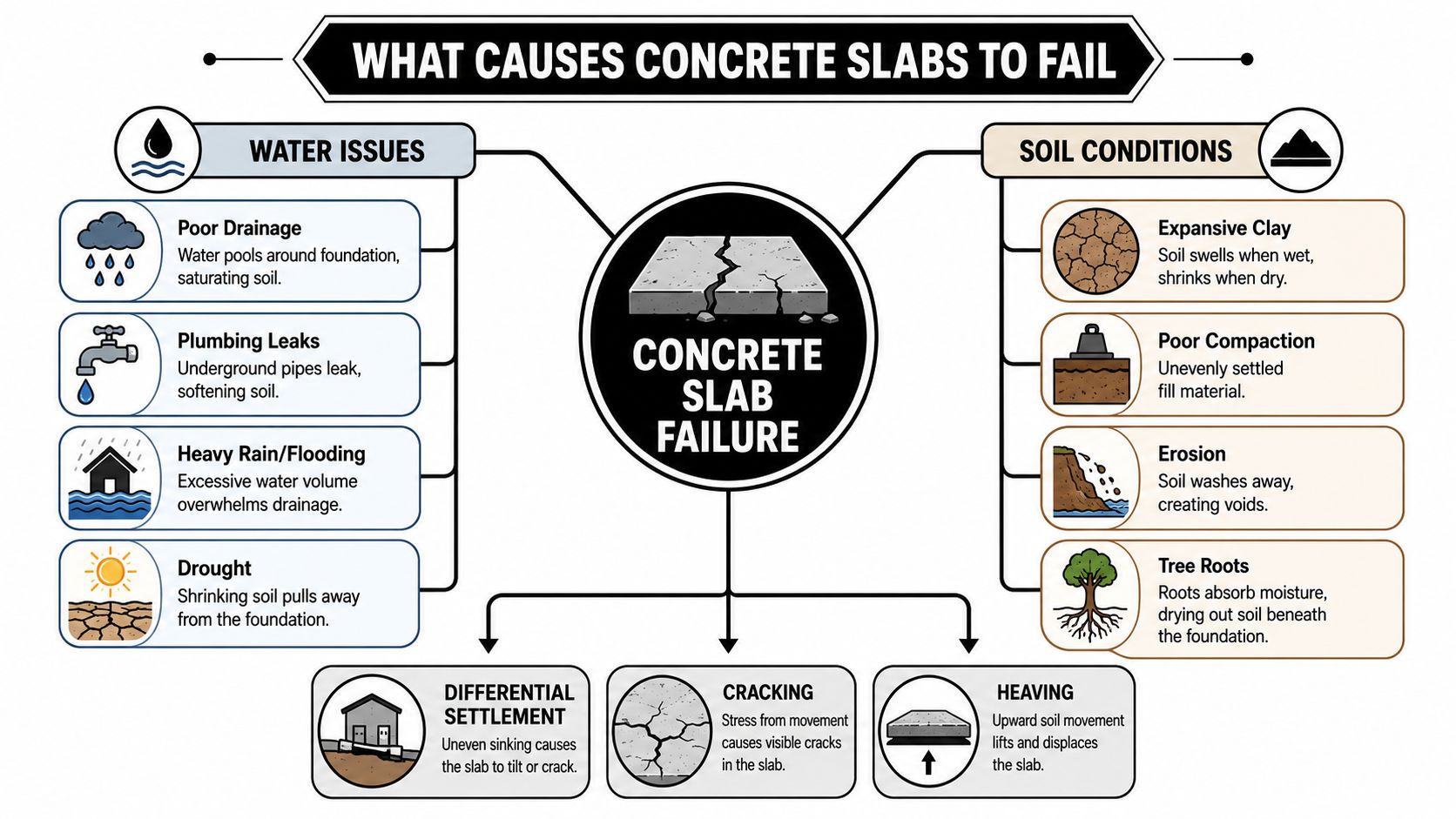
Most slab failures start below the concrete, not on top of it. Homeowners often focus on the visible crack, but the actual story is usually in the soil, the water around the structure, or the way the base was prepared before the pour.
Water changes the support under a slab
Concrete slabs on grade rely on near-surface soil for support. When that soil gets saturated, dries out unevenly, or erodes away in spots, the slab doesn't receive even bearing anymore. One edge can drop. One corner can lift. A center section can lose support and start cracking under load.
This is why drainage details matter so much around a house foundation, concrete foundation for garage, or slab for a barn shed. Overflowing gutters, short downspouts, bad grading, plumbing leaks, and repeated pooling all change the moisture content around the slab perimeter.
Soil movement is often the hidden culprit
Expansive clay soils are a primary driver of slab distress because they swell when wet and shrink when dry, creating cyclic uplift and settlement that can crack a foundation that relies on near-surface soil for support, according to Crawlspace Ninja's explanation of slab foundation problems.
In practical terms, that means the same slab can move in different seasons if the moisture pattern around it keeps changing. Some areas of PA, MD, DE, and NJ see enough wet-dry cycling to make this a recurring issue, even where homeowners don't think of their property as high-risk.
If you want a simple explanation of how uneven movement shows up across a slab, this overview of differential settlement is useful.
Site prep decides how forgiving a slab will be
A slab can only perform as well as the base underneath it. If fill is loose, if the gravel base isn't right for the application, or if compaction is inconsistent, the slab may settle unevenly even when the concrete itself looks fine at first.
That's why experienced excavation and concrete crews pay attention to:
- Subgrade compaction so the slab bears on uniform support
- Grading so water moves away instead of toward the slab
- Base material choice so a shed pad, garage slab, or gazebo foundation drains properly
- Reinforcement and thickness decisions based on intended load
Most recurring slab problems trace back to one of two failures. Water wasn't managed, or the base wasn't prepared well enough for the site.
Your Quick DIY Foundation Inspection Checklist
A homeowner doesn't need to guess blindly. You can do a safe, useful first look before calling a contractor, as long as you stick to non-invasive checks and avoid trying to pry, dig, or force anything.
Start with what you can see
Walk the entire slab slowly, inside and outside if possible. Use daylight if you can. A flashlight held low across the surface can help you spot ridges, dips, and slight displacement.
Check these first:
Crack width
Use a coin as a simple reference point. If a crack is clearly wider than 1/8 inch, it deserves closer attention. Direction matters too. Horizontal cracks and stair-step patterns are more concerning because they may indicate differential settlement, as noted by ISTA Engineers' crack warning guide.Change over time
Take photos from the same angle. If a crack is lengthening, widening, or showing edge displacement, that's more useful than a single snapshot.Floor level
Set a level on the slab in several directions. You're not trying to produce a survey. You're checking for obvious slope, heave, or a dropped section.
Look around the perimeter
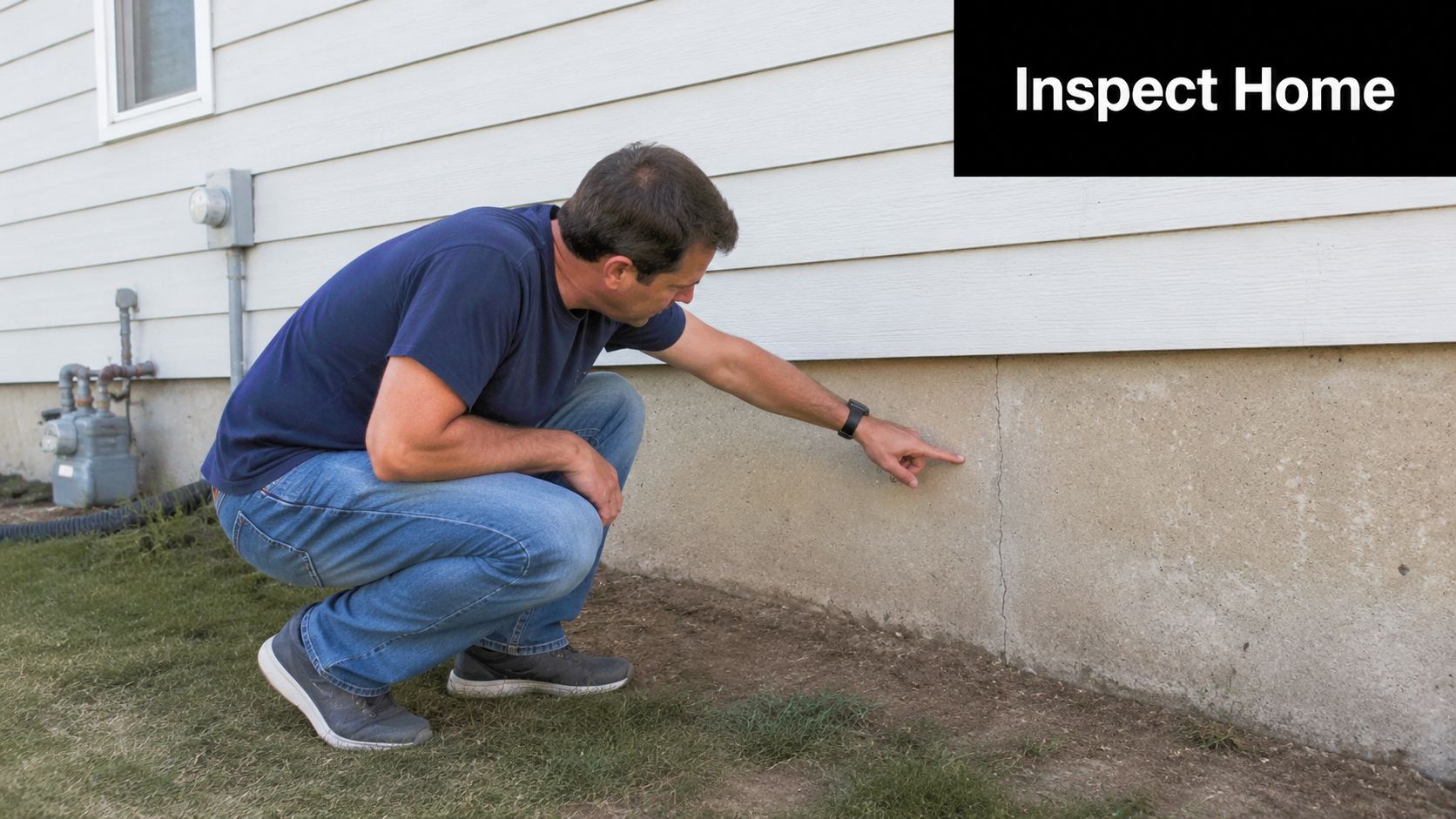
Many concrete slab foundation issues are easier to understand from outside than from inside.
- Pooling water after rain near the slab edge
- Washed-out soil or small voids at the perimeter
- Downspouts discharging too close to the structure
- Mulch, beds, or hardscape trapping water against the slab
- Visible separation between slab and adjacent steps, walkways, or walls
What to write down: where the crack is, how wide it looks, whether one side sits higher, and whether water collects nearby.
A quick visual walk-through can also help you know what questions to ask when a contractor arrives. This video gives a good general look at the inspection mindset homeowners should use before deciding on repair:
What not to do
Don't seal a moving crack just to hide it before you understand why it formed. Don't add fill soil against a slab edge without correcting drainage. And don't assume a shed foundation gravel base or older garage slab can be patched from the top if the support underneath is failing.
A good inspection gathers facts. It doesn't rush to cosmetics.
Concrete Foundation Repair and Replacement Options
The right repair depends on the failure mode. That's the part many homeowners don't hear often enough. A slab with a localized low spot needs a different fix than a slab with widespread cracking, repeated movement, or a failed base underneath.
When lifting the slab makes sense
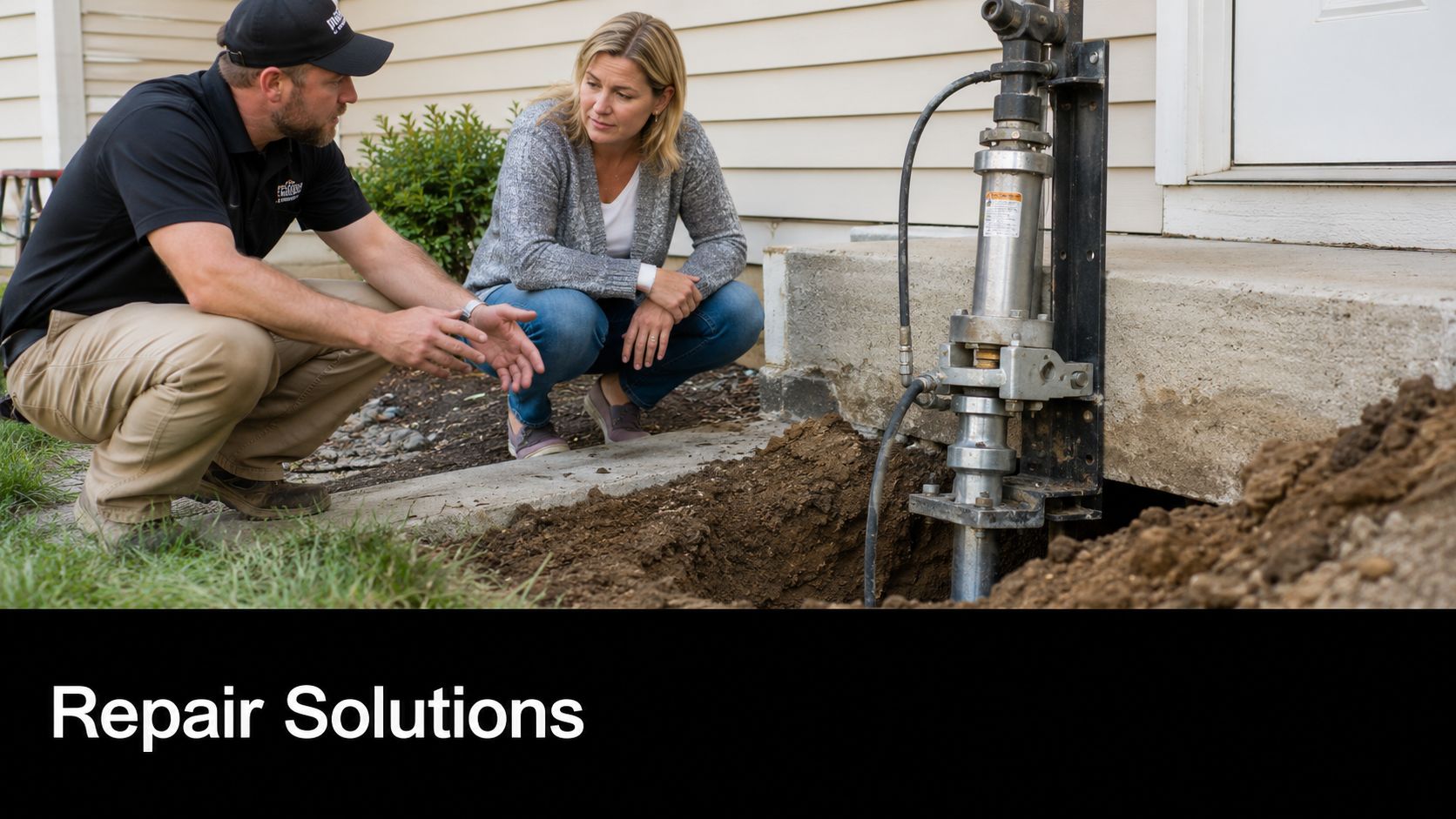
If the slab is still largely intact and the problem is localized settlement, mud jacking or slab jacking can be a practical option. The idea is straightforward. Material is introduced beneath the slab to raise and support the settled section.
This approach can work well when:
- the concrete hasn't broken into unstable sections
- the sinking is limited rather than widespread
- the underlying cause has been identified and corrected
- the slab still has enough integrity to be worth preserving
It's often considered for patios, walkways, some garage slabs, and similar flatwork where the slab itself remains usable.
When replacement is the better choice
Severe cracking or repeated movement usually points to a deeper support problem. In those cases, lifting alone may not last because the soil or base issue hasn't been solved. Expert guidance notes that mud jacking or slab jacking can fix localized settlement if the slab is intact, but severe cracking often requires full slab replacement after re-compacting the base, according to Risen Foundations on slab foundation failure causes and repair paths.
Replacement tends to make more sense when:
| Option | Best Use | Main Limitation |
|---|---|---|
| Slab jacking | Localized settlement with intact slab | Won't solve severe cracking or failed base by itself |
| Partial replacement | Isolated damaged area with stable surrounding slab | Matching and joint performance can be tricky |
| Full replacement | Broad damage, repeated movement, poor base conditions | More invasive, but often the most durable reset |
New construction is part of the repair conversation
Sometimes the best answer isn't repair. It's rebuilding the slab correctly for the actual use. That comes up often with cement foundations for garage projects, garage footings and foundations, and older outbuilding pads that were never designed for today's loads.
A proper rebuild usually starts with site prep, not concrete. The sequence matters:
- excavation to suitable grade
- stable base installation
- compaction
- formwork and reinforcement
- drainage planning
- placement and finishing appropriate to the use
A repair that ignores the reason the slab moved is usually a temporary cosmetic fix.
That's true whether you're evaluating a house foundation, a 10×10 storage shed pad, a shipping container base, or a slab for a heavier detached garage.
How to Prevent Foundation Issues in the Future
A slab usually does not fail all at once. In our region, it often starts with a moisture pattern that repeats season after season. One corner stays wet after every storm. A downspout dumps too close to the house. Summer dry spells pull moisture out of clay soils, then winter and spring bring it back. In Pennsylvania, Maryland, Delaware, and New Jersey, that cycle is what turns small slab movement into a recurring repair.
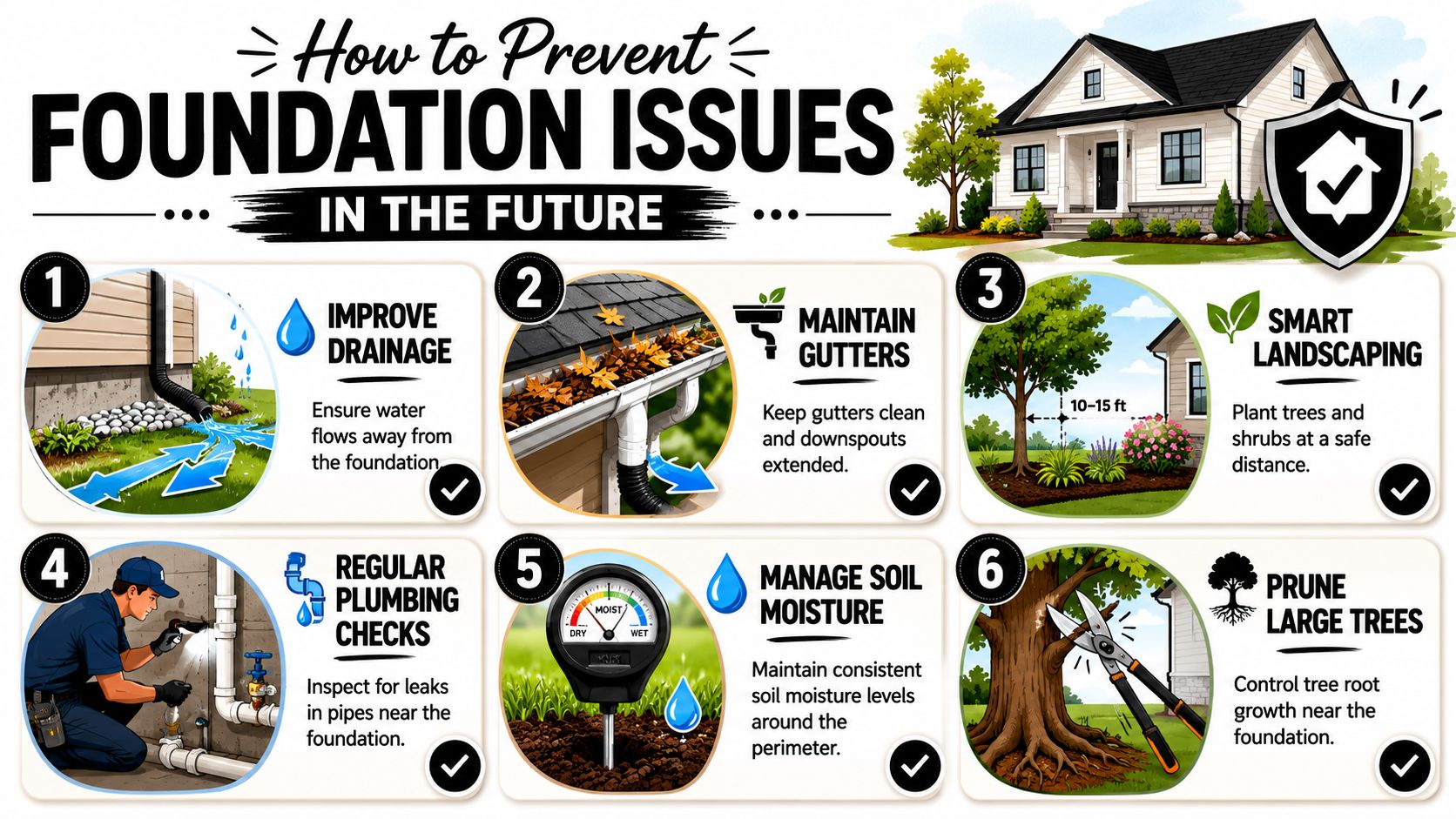
Prevention starts with consistent moisture control
The goal is simple. Keep the soil under and around the slab as stable as possible.
For most homeowners, that means paying attention to the same few trouble spots:
- Keep gutters clear so roof runoff does not pour beside the slab
- Run downspouts away from the foundation instead of letting water collect at the edge
- Maintain a slight slope away from the slab so rain drains off the surface and away from the perimeter
- Use sprinklers and hoses carefully near slab edges, especially during dry spells
- Fix plumbing leaks early before wet soil turns into settlement
A quick rule of thumb helps here. If one section of soil stays noticeably wetter or drier than the rest of the slab perimeter, that uneven condition deserves attention before the concrete starts telling the story.
Yard work and site prep affect slab performance
Mulch beds piled too high, edging that traps runoff, and roots growing close to the slab can all change how water moves across the property. I tell homeowners to look at the slab, the roof drainage, and the yard grade as one system. If one part pushes water back toward the concrete, the slab pays for it.
Homeowners planning broader exterior work can also review these 5 property risk management tips for a practical maintenance mindset.
For a closer look at crack prevention, this guide on how to prevent a concrete slab from cracking covers the basics well.
Build for the actual site, not a generic plan
A shed pad, garage slab, patio, and slab-on-grade addition do not all need the same base, thickness, reinforcement, or drainage details. That is where preventable problems start. A light-duty pad may perform fine under a small shed but fail early under a heavier structure or on poorly compacted fill.
Good prevention usually looks boring, which is a good thing. Proper excavation. Correct base material. Real compaction. Water directed away from the slab. In PA, MD, DE, and NJ, those basics matter more than any surface patch or cosmetic coating ever will.
When to Call a Foundation Contractor in PA MD DE or NJ
You walk into the garage after a hard rain and notice the same corner looks lower again. The crack you marked a few months ago has spread a little, and the old patch is already separating. That is the point where guessing stops helping.
In PA, MD, DE, and NJ, slab problems often track back to local site conditions. Expansive clay pockets, poorly compacted fill, freeze-thaw cycles, and roof runoff dumped too close to the slab can all produce the same visible symptom. A good contractor's job is to sort out which condition is driving the movement before recommending a repair.
Call for a professional inspection when the problem is changing, returning, or affecting how the slab performs. A stable hairline crack in an old patio is one thing. A crack that keeps widening, a garage slab that has dropped enough to hold water, or a shed pad that no longer supports the structure evenly deserves a site visit.
Here is what I tell homeowners to expect from a worthwhile appointment. The contractor should check elevation changes, crack pattern and width, drainage around the slab, nearby downspouts, soil conditions at the perimeter, and signs of voids or washout underneath. You should come away with a likely cause, realistic repair options, and a clear answer on whether the slab can be repaired or whether replacement makes more financial sense.
That last part matters. Some slabs need crack repair and drainage correction. Others have base failure, repeated settlement, or enough movement that patching turns into wasted money.
If you are planning exterior changes after the repair, an ai landscape design generator may help you visualize drainage-friendly layout ideas, but it should never replace an on-site foundation evaluation.
The best time to call is before cosmetic damage turns into structural expense. A careful inspection from Firm Foundations gives homeowners in Pennsylvania, Maryland, Delaware, and New Jersey practical answers, a straightforward quote, and a repair plan that fits the slab, the soil, and the property.