
What Is Differential Settlement? Expert Foundation Repair
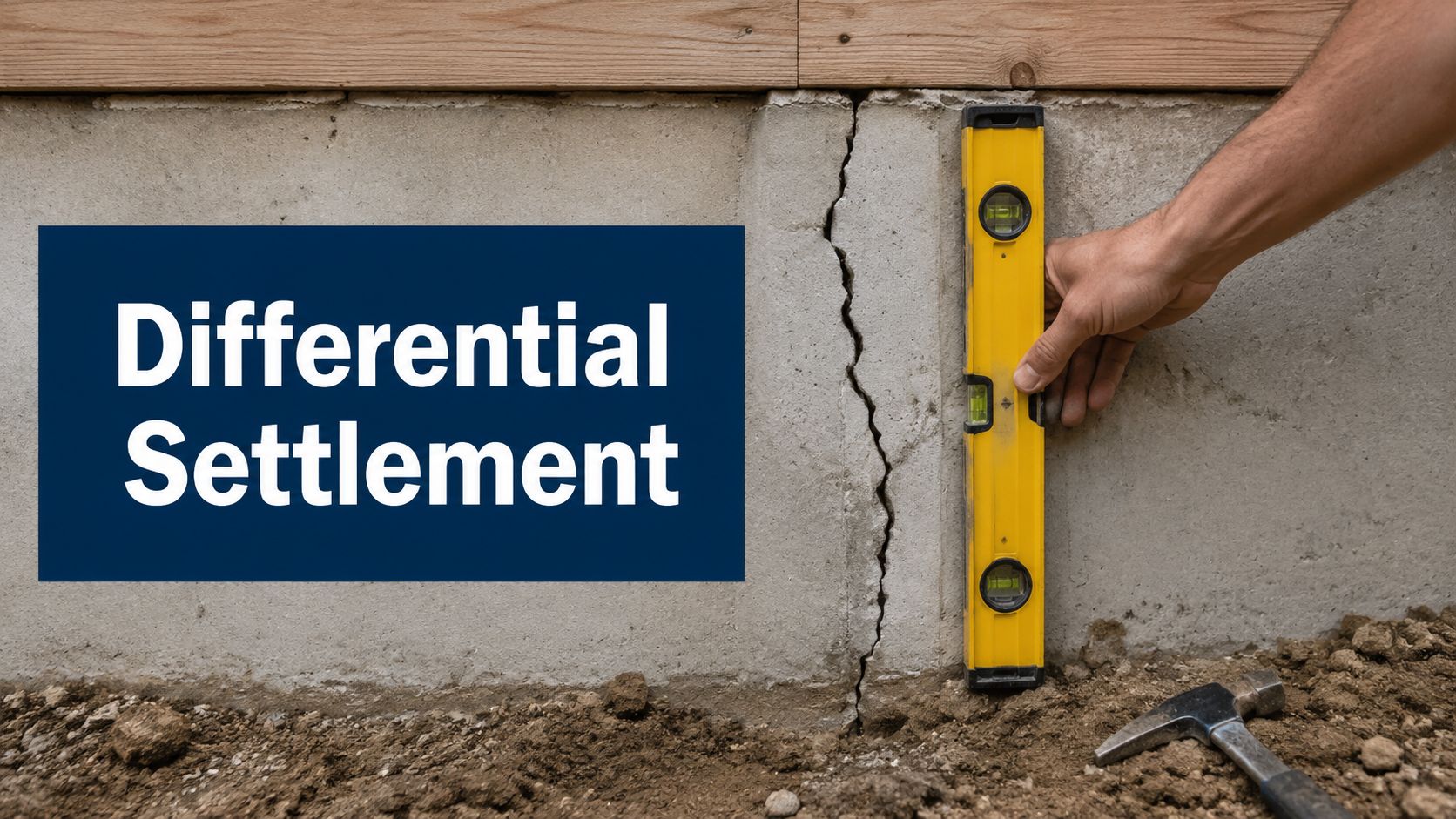
A lot of homeowners first run into this term after something small starts bothering them. A crack above a garage door. A shed door that suddenly rubs. A patio slab that used to drain fine but now holds water in one corner. In places across Pennsylvania, Maryland, Delaware, and New Jersey, that kind of movement often starts imperceptibly.
When investigating what is differential settlement, you're probably not looking for a textbook definition. You want to know whether the crack you see is cosmetic, whether it will get worse, and what kind of fix makes sense for your house, garage, shed foundation, or patio. That practical question matters, because uneven ground movement can affect everything from a small gazebo foundation to a reinforced concrete foundation for a garage.
Concerned About Cracks in Your Foundation
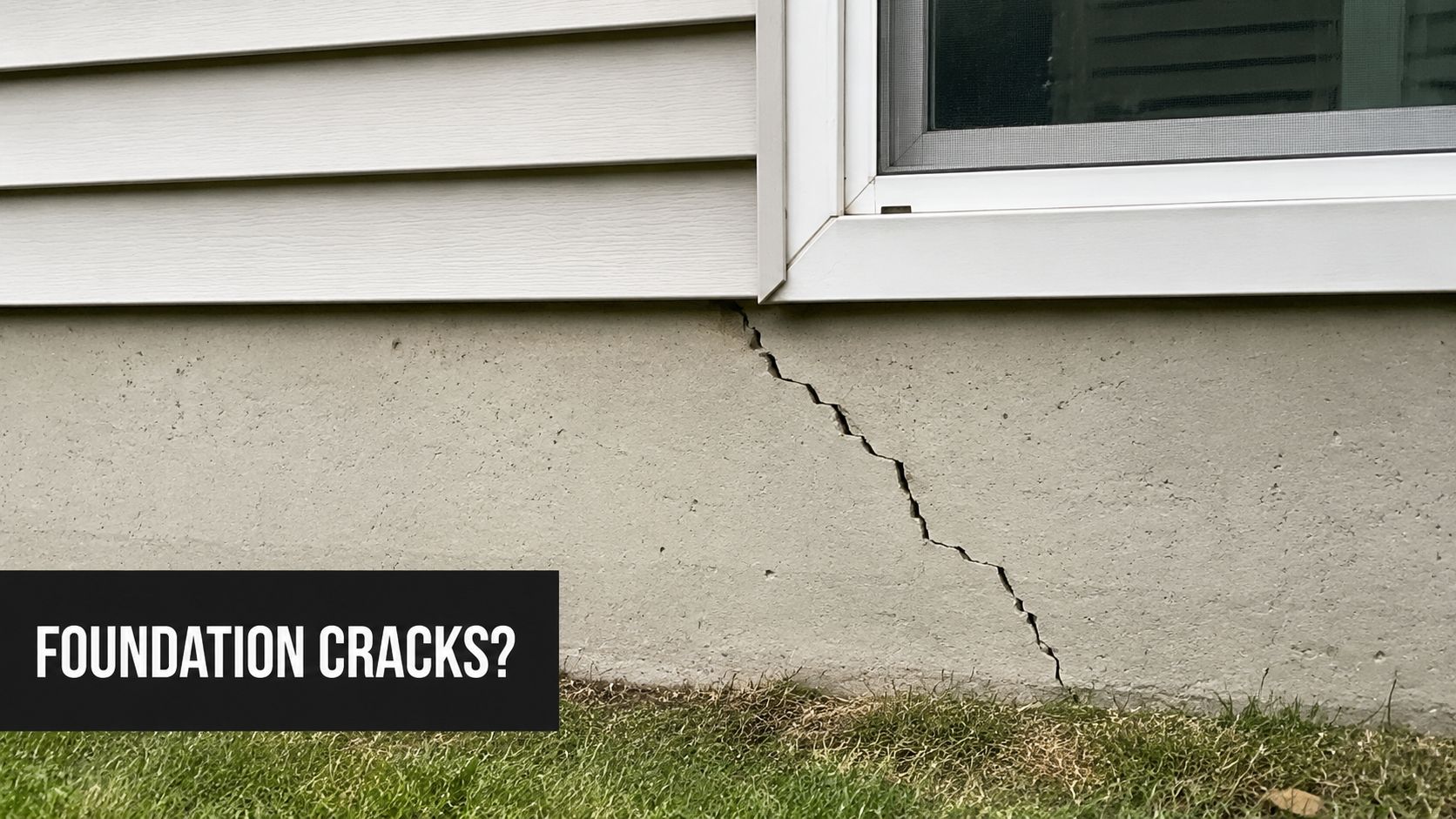
A common call starts with a simple description. A homeowner notices a diagonal crack near a window, or the side door on a detached garage doesn't latch the way it used to. In Honey Brook Township or anywhere else in the Mid-Atlantic, that kind of change gets your attention fast, especially after wet weather, dry spells, or a hard winter.
What the term actually means
Differential settlement is the uneven vertical movement of a foundation. The problem is not limited to a structure moving downward. The problem is that one part moves more than another, which creates stress in the structure itself. Ram Jack notes that this becomes a concern when movement exceeds structural tolerance, and cites a common benchmark for some structures of about 1/200, or roughly 0.5% slope or displacement ratio, which is enough for relatively small distortions to create visible damage to slabs, walls, doors, windows, and utility lines in some cases (Ram Jack on differential settlement and tolerance).
That sounds technical, but the day-to-day version is simple. If one corner of a foundation settles faster than the rest, the building has to twist to keep up. That's when drywall cracks, trim separates, and doors start telling on the structure.
Why homeowners worry, and why they should not panic
Not every crack means major structural failure. Some concrete and some finishes crack for ordinary reasons. What deserves attention is a pattern. A diagonal crack that lines up with a sticking window. A shed pad that looks level from a distance but lets the building rack out of square. A garage slab that settles enough to pull the framing out of alignment.
Practical rule: A single defect can mislead you. Several related signs usually tell the real story.
That is why homeowners often need a careful diagnosis instead of a quick opinion. The visible crack is only the symptom. The key question is what the soil and foundation are doing underneath.
What Differential Settlement Really Means for Your Foundation
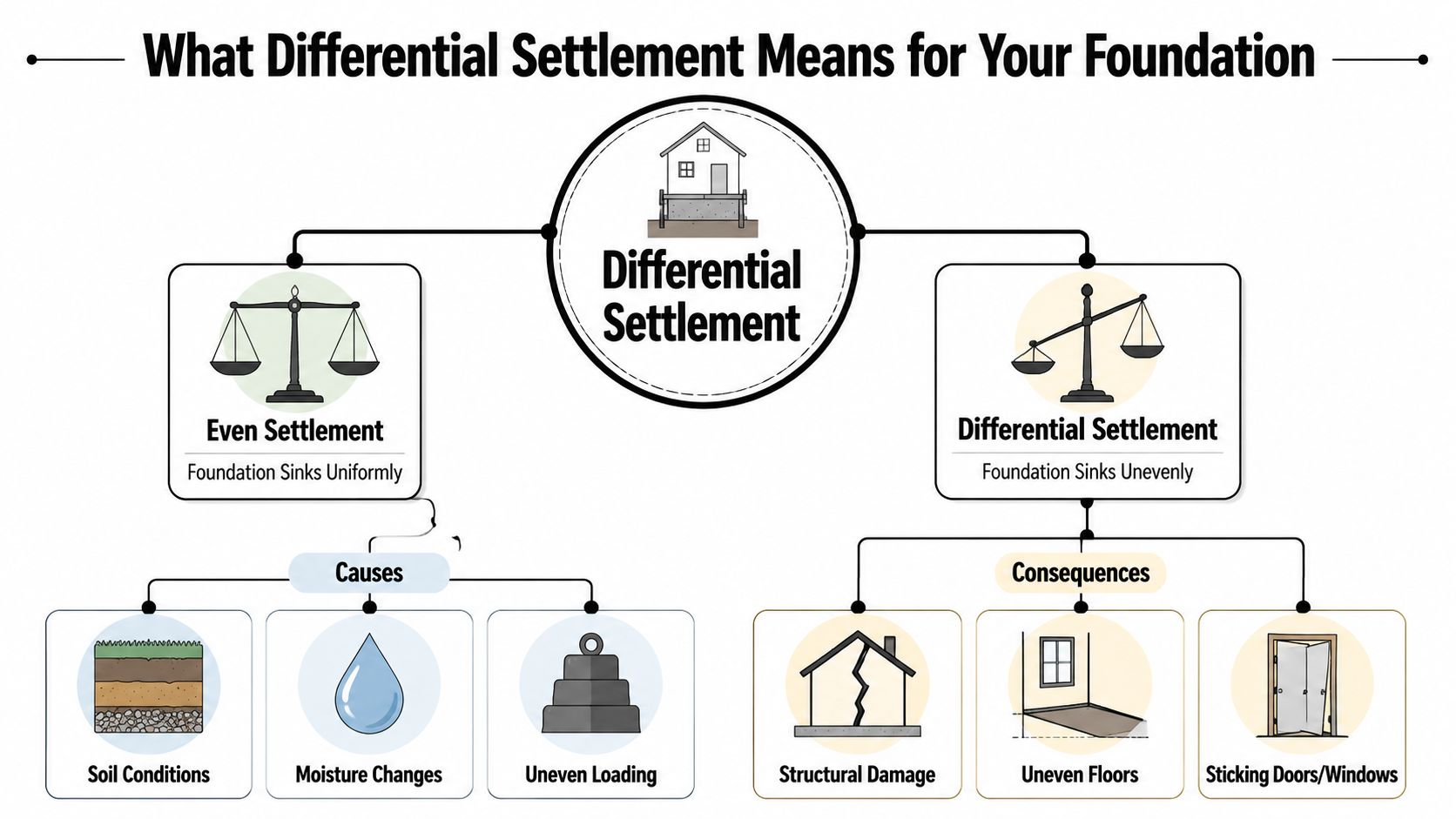
Think of a bookshelf sitting on a floor. If the whole floor drops evenly, the shelf stays level with itself. The books may sit lower, but they don't lean. If one side of the floor drops more than the other, the shelf twists and the books slide. Foundations behave the same way.
The damage comes from the difference
The most important point is that structural risk isn't just total downward movement. The risk comes from strain between adjacent points on the foundation. The engineering guidance discussed in the BSCEs Journal source explains that a stiff foundation can redistribute some load and reduce visible deformation, which is why two structures with similar overall settlement can perform very differently. The same source notes this is especially important for long structures and slab-on-grade systems, where modest non-uniform movement can still lead to cracking and misalignment (BSCEs Journal discussion of strain and foundation stiffness).
That is why a concrete foundation for garage use, a base for storage shed installation, and a house foundation don't all react the same way. Framing stiffness, footprint shape, footing spacing, and slab thickness all influence what you see on the surface.
How it shows up on different structures
A small outbuilding can make the issue obvious fast. A barn shed or 10×10 storage shed doesn't have the same structural redundancy as a large house, so uneven support often shows up first as door problems, floor bounce, or visible lean.
A larger garage slab may hide movement longer. The concrete can bridge some unevenness for a while, but once that stress reaches its limit, cracking or frame distortion follows.
Here is a practical way to understand it:
- House foundation: More structural stiffness can mask movement at first, but finishes, trim, and openings often reveal it.
- Garage footings and foundations: Vehicle loads and wide openings can make slab and framing problems more noticeable.
- Shed foundation or gazebo foundation: Smaller structures can go out of square quickly if support isn't consistent.
- Patios and walkways: They may not be structural in the same way, but uneven movement still creates trip hazards, drainage problems, and edge separation.
A foundation doesn't have to sink dramatically to cause trouble. It only has to move unevenly enough to put the structure in tension.
Common Causes in PA MD DE and NJ
Across Pennsylvania, Maryland, Delaware, and New Jersey, the same theme comes up again and again. The soil under one part of a structure is rarely identical to the soil under every other part. That variation is the starting point for many settlement problems.
Soil, moisture, and time
Tensar's geotechnical guidance points to soil variability and time-dependent consolidation as the main drivers of differential settlement. When a foundation loads the ground, vertical effective stress increases. If one area is weaker, wetter, or more poorly compacted, it compresses faster than the rest. That process can continue over time as water gradually leaves the soil pores, which is why movement may keep evolving over months or years rather than appearing all at once (Tensar on settlement, consolidation, and causes).
In local terms, that often means a backyard pad performs differently on one side than the other because the site was cut and filled, the drainage isn't balanced, or moisture conditions keep changing through the seasons.
What commonly triggers it here
The Mid-Atlantic gives homeowners several repeat offenders. Clay-rich areas can shrink during dry periods and respond differently when moisture returns. Freeze-thaw cycles can aggravate weak spots near the surface. Downspouts that dump water beside a foundation can overload one edge of a garage or shed pad while the opposite side stays relatively dry.
Common triggers include:
- Variable soil layers: Native soil on one side, fill on the other.
- Poor compaction: A frequent issue under additions, shed pads, and replaced driveway sections.
- Drainage trouble: Water pooling near one wall or slab edge.
- Leaking utilities: Slow saturation under a localized area.
- Roots and nearby excavation: Both can change support conditions around a foundation footprint.
For homeowners planning new work, understanding the ground matters just as much as choosing the slab. This guide on soil bearing capacity for foundation planning is useful because it connects site conditions to the kind of support a shed, garage, or concrete pad needs.
Why one-size-fits-all advice fails
Two cracks can look similar and come from completely different causes. One slab may need drainage correction and lift. Another may need deeper support because the weak layer extends below the reach of a simple surface fix. That is why experienced contractors focus on the site history, grading, fill conditions, and drainage pattern before recommending a repair.
Visible Signs and Structural Risks to Watch For
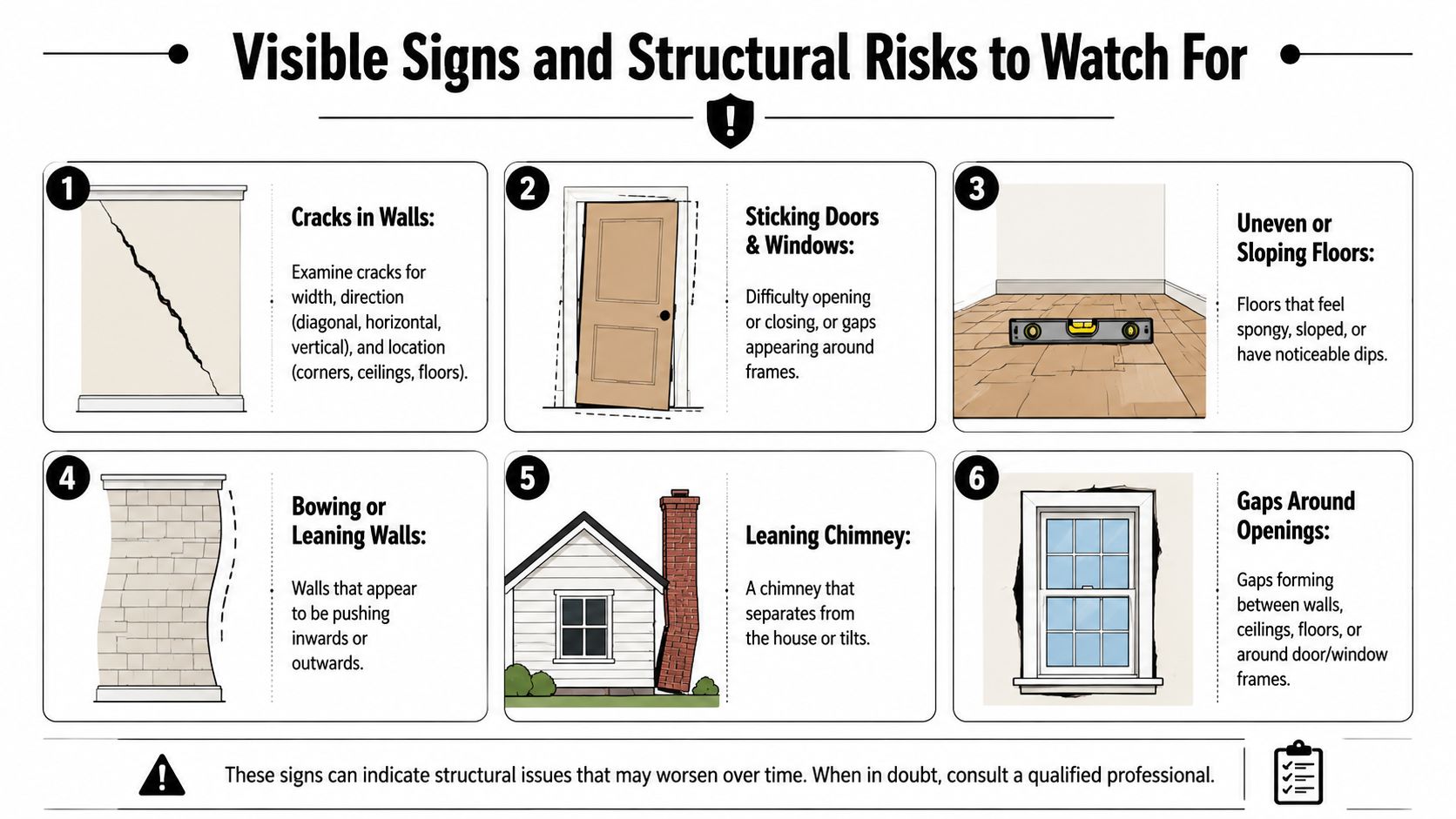
Most homeowners don't discover differential settlement by measuring the slab. They discover it when the building starts acting differently. That makes visible symptoms worth paying attention to, especially on smaller structures where problems often get dismissed too long.
The signs that deserve a closer look
ScienceDirect notes that differential settlement is often only a fraction of total settlement, commonly 25% to 75% of the total. In plain terms, a structure may not appear to be sinking dramatically overall, but localized movement under one area can still create enough tilt or cracking to cause significant problems for sheds, garages, and patios (ScienceDirect topic summary on differential settlement).
That is why the following signs matter:
- Diagonal cracks: These often raise more concern than a random hairline surface crack because they can reflect uneven movement through the wall.
- Doors that bind: If a shed door or side garage door suddenly rubs at one corner, the frame may be shifting out of square.
- Windows that won't operate smoothly: Window openings often reveal subtle distortion early.
- Sloping floors: You may feel it underfoot before you clearly see it.
- Gaps at trim or ceilings: Separation between finish materials can indicate frame movement.
- Patio or slab edge drop: Even if the structure above seems stable, this can be an early warning.
A repair discussion makes more sense once you know what the slab is doing. Homeowners dealing with visible slab movement often find this overview of concrete pad repair options helpful before they talk through the right next step.
Match the sign to the likely risk
Not every symptom carries the same weight. A crack in a patio may point to drainage and support issues. A diagonal crack paired with sticking openings and floor slope suggests the movement may be affecting the structure more directly.
The short video below gives a useful visual reference for what uneven foundation movement can look like in real life.
If a shed, garage, or house starts showing more than one symptom at the same time, it is smart to treat that as a foundation conversation, not just a cosmetic repair issue.
Your Repair Options From Underpinning to Slab Jacking
Once the cause is understood, the repair path usually gets clearer. The mistake homeowners make most often is choosing a method because it sounds familiar, not because it matches the failure mechanism.
Diagnosis comes before product choice
Vertex Engineering emphasizes a point contractors should agree with. Choosing the right fix is critical, and the repair should be based on geotechnical investigation. Remedies such as underpinning, jet grouting, and micropiles address deep soil issues, while mudjacking or polyurethane foam are suitable only in some cases. The goal is to correct the root cause, especially in the Mid-Atlantic where seasonal moisture changes can keep movement recurring if the underlying issue remains in place (Vertex Engineering on cause-based foundation remediation).
That means a garage slab, a house corner, and a settled shed pad should not all get the same answer by default.
What each method is really for
Some repairs stabilize. Some lift. Some do both to a limited extent. The distinction matters.
| Method | Best For | Process | Relative Cost |
|---|---|---|---|
| Underpinning | Foundations with deeper support problems | Extends support to more stable soil below the weak zone | Higher |
| Micropiles | Sites with access limits or deeper instability | Installs small-diameter deep supports to transfer load | Higher |
| Jet grouting | Specific soil improvement cases | Improves weak soil in place to increase support | Higher |
| Mudjacking | Certain settled slabs | Pumps grout below the slab to raise and support it | Moderate |
| Polyurethane foam injection | Certain slabs needing controlled lift | Injects expanding foam beneath slab areas | Moderate to higher |
Trade-offs homeowners should understand
Underpinning is usually the conversation when the issue is not just a sunken slab but inadequate support at depth. It can be the right answer for portions of a house foundation or garage foundation where surface-level lifting won't solve the actual problem.
Mudjacking and polyurethane foam can work well on some concrete surfaces. They are often considered for patios, walkways, some slab areas, and other situations where the slab itself is sound enough to lift. They are not magic. If the soil keeps washing out, shrinking, or consolidating, the slab can move again.
Foam has practical advantages in some situations. The verified guidance notes that it is typically more expensive but stronger, longer lasting, and less moisture-retentive than mudjacking. That doesn't automatically make it the best option. On some jobs, the right call is still to fix drainage, remove bad fill, improve support conditions, or rebuild a section entirely.
Field judgment: The cheapest lift method often becomes the most expensive choice when nobody fixes the water or soil problem that caused the settlement in the first place.
What doesn't work well
Surface patching does not solve active settlement. Caulking a crack may improve appearance, but it won't stabilize the support below. Rehanging a sticking door may buy time, but if the frame keeps moving, the problem returns. Adding more concrete on top of a weak base usually adds load to a bad situation.
For homeowners comparing garage foundation contractors near me, concrete contractors, or excavation near me, the right question is not "What can you pour?" It is "How will you determine why this moved, and what support condition has to change so it doesn't keep happening?"
Prevention The Best Foundation Repair You Never Need
The most affordable foundation problem is the one that never starts. That is why the quality of site preparation matters so much for new sheds, garages, patios, and outbuildings.
Good foundations start before the concrete truck arrives
A durable foundation build depends on excavation, grading, compaction, and water management long before concrete forms are set. If a site has soft pockets, inconsistent fill, poor runoff, or abrupt elevation changes across the footprint, those issues don't disappear after the slab cures. They get buried underneath it.
For homeowners searching shed foundations contractors near me, gravel shed foundation contractors near me, garage foundation contractors near me, or shed foundations near me, that is the difference between a pad that stays serviceable and one that starts moving after the first cycle of wet weather and drought.

What helps prevent differential settlement
The best prevention work is not flashy. It is careful.
- Proper excavation: Remove unsuitable material instead of building over it.
- Uniform subgrade preparation: Consistency under the whole footprint matters more than making one area extra hard.
- Thoughtful grading: Water should move away from the structure, not collect near one edge.
- Right foundation type: A gravel shed foundation, reinforced concrete slab, or full footing system each fits different loads and site conditions.
- Avoiding abrupt transitions: Sudden changes in foundation depth or support conditions can create weak points.
This matters for everything from a 4×8 shed with foundation support to a concrete foundation for garage construction, a base for storage shed use, a gazebo foundation, or a hot tub pad. Small structures may be simpler than a house, but they still need stable, uniform support.
Prevention also reduces related water problems
Settlement and moisture trouble often show up together. If you're sorting out drainage concerns around a basement or slab, it helps to understand the broader cost picture. This overview of the average cost of basement waterproofing is a useful planning resource because water control and foundation performance are often connected on the same property.
A well-built foundation won't fix every possible future soil change, but it does put the structure in a much stronger position. Good prep, correct grading, and the right pad or slab design are still the most reliable defense.
When to Call a Foundation Expert in Pennsylvania and Maryland
Some warning signs can wait a little while for scheduling. Others deserve faster attention. Call a foundation professional if cracks are spreading, doors and windows are getting noticeably harder to operate, floors are sloping more than they used to, or a garage, shed, or patio slab is visibly dropping on one side.
What a real assessment should include
Modern settlement evaluation is not guesswork. G3 SoilWorks notes that professionals use tools such as optical level surveys, tiltmeters, and crack gauges to measure movement accurately, allowing quantitative risk assessment and a repair recommendation based on actual conditions instead of visual assumptions alone (G3 SoilWorks on settlement monitoring tools).
That kind of assessment should answer a few plain questions:
- Is the movement active or old
- Is the issue shallow, deep, or drainage-related
- Does the structure need stabilization, lifting, or both
- Is repair practical, or is replacement of part of the slab or pad smarter
Local experience matters
Homes and outbuildings in Pennsylvania and Maryland often deal with changing moisture, mixed soil conditions, and older grading patterns that don't manage runoff well. Delaware and New Jersey properties face similar issues. The right contractor should understand how those local conditions affect shed foundations, garage footings and foundations, patios, driveways, and house foundation performance.
A good site visit should leave you with clarity. You should know what is happening, what likely caused it, and which repair options fit the actual problem without overselling a system you may not need.
If you're dealing with cracks, slab movement, or a foundation problem on a shed, garage, patio, or home in Pennsylvania, Maryland, Delaware, or New Jersey, Firm Foundations can help you sort out what's cosmetic, what's structural, and what repair or rebuild path makes the most sense. Reach out for a free quote and a straightforward evaluation from a licensed, insured foundation and excavation contractor that specializes in durable gravel pads, concrete foundations, site prep, and long-term drainage performance.