
Shipping Container Foundation Cost: Options & Free Quotes
A shipping container foundation can cost anywhere from a few hundred dollars to $12,000+, depending on the type you choose and how much site work the property needs. Gravel pads can run $300 to $1,500, pier foundations $2,000 to $6,000, and concrete slabs $5,000 to $12,000+. Therefore, beyond just the price, it's important to consider where that money goes and what kind of base makes sense for your project in Pennsylvania, Maryland, Delaware, or New Jersey.
If you're planning a container for storage, a workshop, a jobsite setup, or a converted space, you've probably already seen cost ranges online that don't line up. One article assumes a backyard storage box. Another assumes a full container home. A third barely mentions drainage, excavation, or access. That's where people get stuck.
A foundation quote only makes sense when it matches the use of the container, the condition of the site, and local realities like soil, slope, water, and permitting. In the Mid-Atlantic, those details matter. A flat site in Delaware is a different job than a wooded, sloped property in Pennsylvania or a tight-access lot in New Jersey.
Planning Your Project Starts from the Ground Up
A lot of homeowners call after buying the container first. They've got delivery scheduled, they've picked the spot, and then they realize the ground isn't as ready as they thought. Sometimes it looks level until you put a laser on it. Sometimes drainage is poor. Sometimes the truck can't get where the container needs to go without prep work first.
That's normal. Shipping containers are simple in one sense, but the base under them decides whether the doors stay square, whether water sits underneath, and whether the setup stays trouble-free.
In this region, most projects fall into one of a few categories:
- Temporary storage use: A basic container for tools, equipment, or household overflow usually points toward gravel or another simpler support system.
- Long-term utility use: A workshop, farm storage unit, or small business container often needs a more durable, better-draining base.
- Permanent conversion: If the container is being modified for regular occupancy or long-term service, the foundation usually needs to meet a much higher standard.
Practical rule: The cheapest foundation on day one isn't always the cheapest foundation after a few wet seasons.
I've seen the most confusion happen when people compare national price articles without separating storage containers from container homes. That's why local planning matters more than broad ranges. Even outside our service area, datasets like leveraging Minneapolis permit data can be useful for seeing how permit activity shapes real construction costs and timelines. The lesson applies here too. Site-specific work drives the quote.
For homeowners and small commercial owners in PA, MD, DE, and NJ, the smart move is to start with the foundation decision before delivery day is locked in. That lets you choose the right base, fix drainage issues early, and avoid paying twice for rushed prep.
Your Guide to Foundation Types and Their Costs
A 20-foot storage container behind a garage and a finished container office in southeastern Pennsylvania should not sit on the same foundation. They may look similar on delivery day, but the support requirements and long-term costs are very different. That is where generic national price ranges stop being useful.
For homeowners in PA, MD, DE, and NJ, the better question is not just, "What does a shipping container foundation cost?" It is, "Which foundation fits my soil, drainage, frost depth, use, and budget?" That is how Firm Foundations approaches these projects, and it is how you avoid paying for the wrong base twice.
This visual gives a quick side-by-side look before we get into the details.
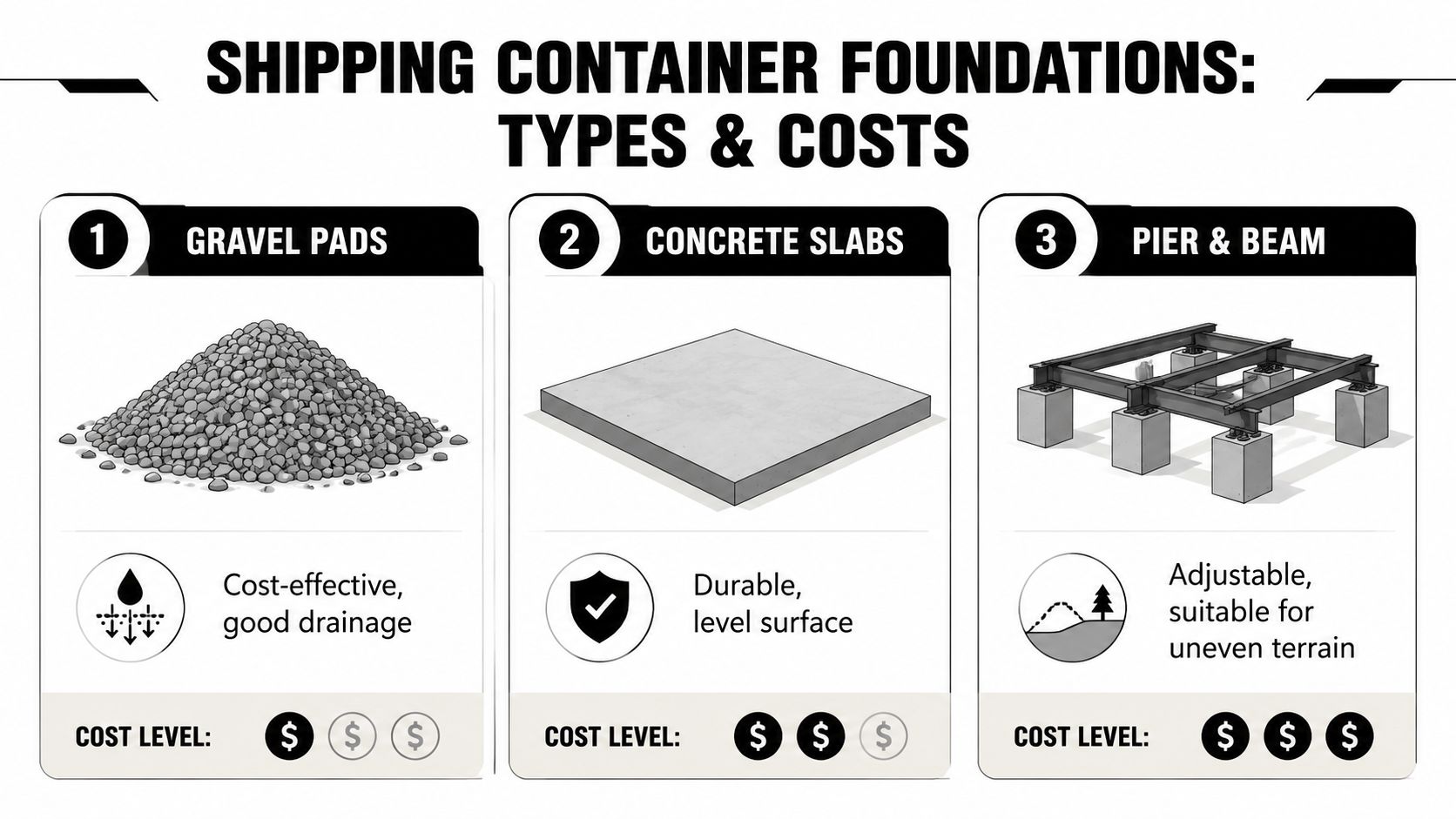
Gravel pads for simple and temporary use
A gravel pad is often the most practical choice for a storage container on a site with decent drainage. It is usually the lowest-cost option, and it can perform well if the pad is built correctly, compacted in lifts, and set up to shed water away from the container.
That last part matters.
I have seen inexpensive gravel jobs hold up fine for years, and I have seen cheap ones rut, settle, and stay wet because the site prep was rushed. The difference is usually below the stone, not in the stone itself. Subgrade condition, edge support, and drainage decide whether a gravel pad stays serviceable or turns into a rework job.
Gravel usually makes sense for:
- Seasonal or overflow storage
- Farm and equipment use
- Containers that are not being converted for occupancy
- Sites where fast installation and lower upfront cost matter most
Its limits are just as important. Gravel is not usually the right answer for a finished container home, office, or workshop where you need tighter tolerances, cleaner underfloor conditions, and stronger long-term support.
Pier foundations for selective support and tougher sites
Pier foundations can be a smart middle option, especially on sloped ground or sites where a full slab would require more excavation than the project justifies. A pier system supports the container at planned points, often near the corner castings and other engineered load paths, instead of supporting the entire footprint continuously.
That approach can save money in the right situation. It can also create problems if the design is too light for the load, the spacing is wrong, or frost movement is ignored.
This is why pier pricing varies so much from one quote to another. A basic pier layout for a storage container is one thing. An engineered pier system for a modified container with utilities, framing changes, or occupancy requirements is a different scope entirely. If you are comparing estimates, make sure you are comparing the same type of pier foundation, not just the same label.
| Foundation type | Best fit | Cost context | Main trade-off |
|---|---|---|---|
| Gravel pad | Temporary storage | Lowest-cost option on many sites | Less permanence and less control over movement |
| Pier foundation | Uneven terrain or selective support | Mid-range option, depending on pier count, depth, and reinforcement | Performance depends heavily on layout and soil conditions |
| Concrete slab | Permanent container use | Highest upfront cost in many cases | More concrete, prep, and forming work |
A homeowner reviewing shipping container foundation options should know what piers can and cannot do. They are often a good fit, but only when the container use, local code requirements, and site conditions all point in that direction.
Here's a useful walkthrough if you want to see the foundation types in action.
Concrete slabs for permanent projects
Concrete slabs cost more because they include more materials, more labor, and tighter prep standards. In return, you get a continuous, level base that usually makes the most sense for permanent container buildings, occupied spaces, and projects where long-term stability matters more than the lowest starting price.
In this region, slabs are often the safer call for container offices, studios, workshops, and home conversions. Freeze-thaw cycles, wet seasons, and soft spots in the subgrade can be unforgiving. A well-built slab helps control those risks better than a light support system.
A slab also simplifies some of the practical issues owners care about later. Floor feel is more consistent. Access is cleaner. Utilities and surrounding flatwork are often easier to coordinate. That does not mean every project needs one. It means the higher upfront cost often buys fewer surprises.
A storage container can work well on a simple base. A permanent build usually needs more support and more precision.
The trade-off goes beyond the upfront price
Too many articles treat this as a simple price chart. That is how people end up comparing a bare storage container in rural Maryland to a container conversion in New Jersey as if the foundation should cost the same.
It should not.
A lower-cost support system can be a smart decision for short-term or light-duty use. But for many projects in PA, MD, DE, and NJ, the better value comes from choosing the foundation that matches the job from day one. That may be a properly built gravel pad. It may be piers. It may be a slab. The right answer depends on how the container will be used, what the ground is like, and how much movement or maintenance you are willing to accept over time.
That is the practical cost discussion homeowners need. Not just what is cheapest to install, but what is least likely to cause settlement, drainage trouble, or re-leveling bills a few seasons from now.
Unpacking the Key Cost Drivers for Your Foundation
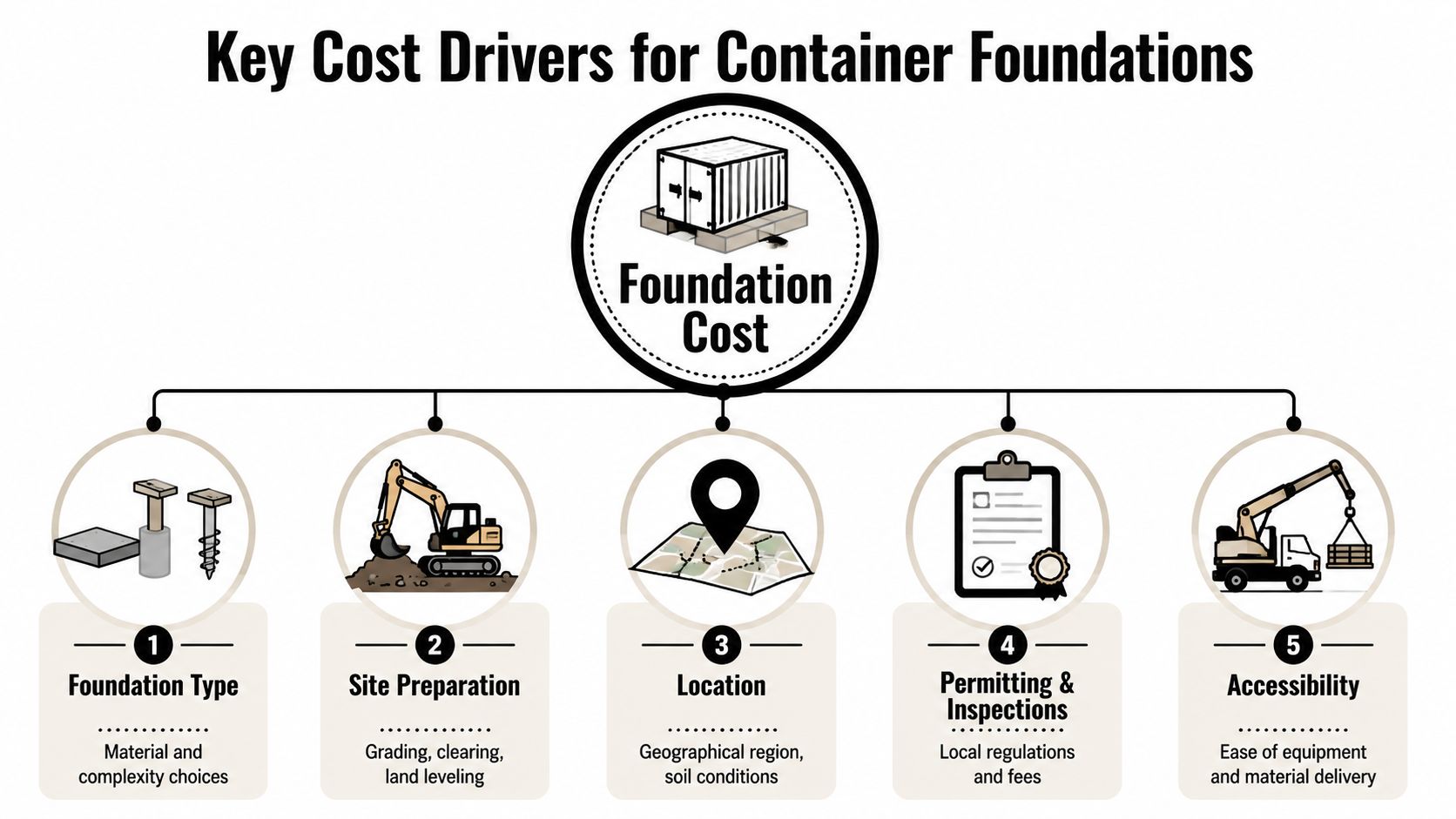
A homeowner in Pennsylvania can price the same container foundation very differently from a homeowner in New Jersey, even when the container size and foundation type match. The difference usually comes from the property itself. Soil, slope, drainage, access, and local permit requirements in PA, MD, DE, and NJ have a bigger effect on the final quote than many online price ranges admit.
Site prep is often the biggest variable
Homeowners usually focus on the visible foundation. The true cost swing often starts before we place a single pier, form, or load of stone.
An open, level area with firm ground is straightforward to build on. A wooded backyard in Maryland with a slope, soft pockets, and limited machine access is not. Clearing brush, cutting high spots, bringing in fill, compacting subgrade, and correcting grade can move a quote much faster than the foundation type alone. If you want a better sense of what drives those early numbers, review these foundation excavation cost factors.
That is why two gravel pad quotes can land far apart. One site only needs minor grading and compacted stone. The other needs excavation, imported base material, geotextile, drainage work, and extra labor just to create a stable starting point.
Drainage problems get expensive later
Water causes more shipping container foundation trouble than homeowners expect. A container may look level on install day and still develop support issues if runoff keeps washing against the pad or the soil stays saturated through wet seasons.
The warning signs are usually easy to spot before the job starts. Standing water after rain, downspouts emptying near the install area, soggy turf, and visible erosion all point to added prep. In parts of Delaware and southern New Jersey, flat sites can hold water longer than owners expect. In hilly areas of Pennsylvania and Maryland, runoff control becomes the bigger issue.
Good quotes account for drainage from the start because re-leveling a container after movement costs more than grading the site properly the first time.
Access changes labor, equipment, and risk
This is one of the least understood pricing factors. A site with a wide, straight approach is cheaper to service than a fenced yard with a narrow gate, overhead wires, septic components, and a long path to the foundation area.
Those conditions affect the size of equipment we can use, how materials get moved, and how long the crew is on site. Sometimes the foundation design stays the same, but the installation cost rises because the property is harder to work on safely and cleanly. That is common on residential lots in older parts of New Jersey and established neighborhoods around Baltimore and Philadelphia.
Intended use affects how much foundation you actually need
A container used for seasonal storage puts different demands on the ground than a container turned into a workshop, office, or long-term utility structure. Heavier loads, more frequent occupancy, utility tie-ins, and tighter tolerances usually call for more precise prep and support.
The main cost drivers usually come down to:
- Site conditions: Slope, soil strength, wet areas, and previous disturbance all affect prep.
- Access to the install area: Tight or obstructed sites increase labor and equipment time.
- Foundation type: Gravel, piers, and slabs all require different materials and installation steps.
- Local permitting and inspection requirements: These vary across municipalities in PA, MD, DE, and NJ.
- Drainage and grading corrections: Some sites need minor shaping. Others need real water management before the foundation goes in.
At Firm Foundations, we try to price these issues realistically at the quote stage. That gives homeowners a number built around the actual property, not a generic national range that falls apart once the crew sees the site.
Sample Project Estimates in Pennsylvania and Maryland
A homeowner in Chester County may need a basic pad for a storage container behind a barn. A homeowner outside Baltimore may be setting a 40-foot container that will become a workshop with power, regular foot traffic, and a permanent location. Both projects involve a shipping container. The foundation budget can still land in very different places.
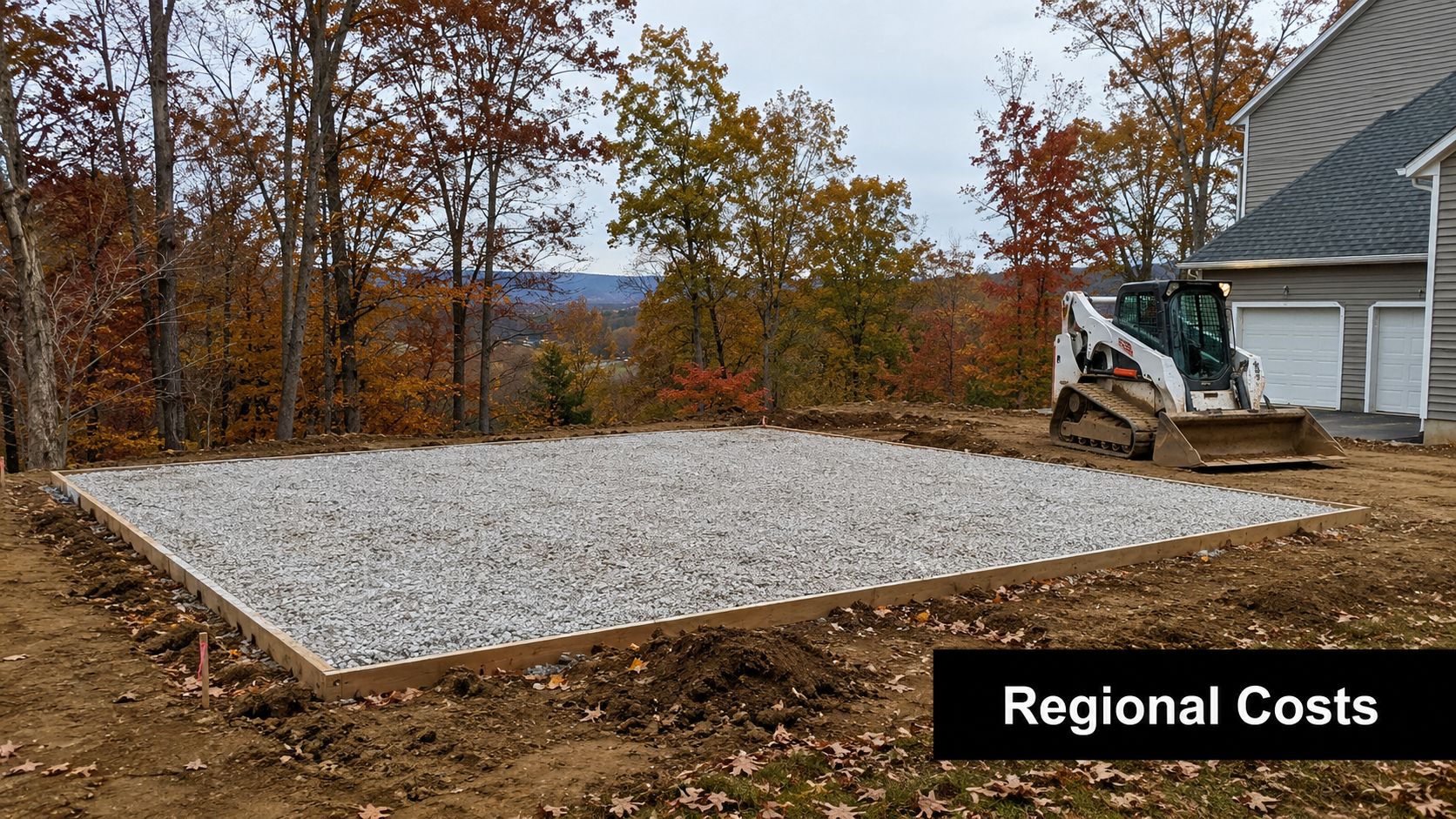
A storage container on a level site in Pennsylvania
In southeastern Pennsylvania, a common job is a container for tools, equipment, or overflow storage on a property with decent access and a fairly flat install area. That setup often supports a simpler foundation approach.
Gravel is often the practical choice here, especially if the container is staying in storage use and the site already sheds water well. It keeps costs under control and gives the container a stable, drainable base without paying for concrete the project may not need.
On jobs like this, the final number usually depends less on the container itself and more on how much site work it takes to get the base ready. A clean, open area is one price. An area that needs grading, excavation, or stone brought in over a long carry is another.
A workshop conversion near Baltimore
A different pattern shows up around Baltimore and other parts of Maryland where homeowners want a container to function more like a small building. A 40-foot container used as a workshop or utility space usually needs tighter tolerances and a foundation with less room for settlement or movement over time.
That often pushes the project toward a slab or a more engineered pier layout, depending on the site and the intended use. The upfront cost is higher than a basic storage setup, but that extra cost usually buys better long-term performance, easier utility coordination, and fewer headaches if the municipality treats the container as a permanent structure.
I tell homeowners the same thing on these jobs. The cheaper option is only cheaper if it still fits the use.
What changes the number in real life
Across Pennsylvania and Maryland, sample estimates usually swing based on four jobsite questions:
- Is the container staying in basic storage use, or will it be used like a workshop, office, or utility building?
- Does the install area already sit close to level, or will it need meaningful grading and prep?
- Can the crew and delivery equipment reach the location without extra time, matting, or smaller machines?
- Will the local township or county expect a more permanent foundation and inspection path?
A simple storage container on a forgiving site can stay fairly economical. The same container on a tighter lot, a slope, or a workshop conversion can require a foundation scope that looks completely different on the quote.
That is why regional pricing matters in PA, MD, DE, and NJ. Generic national ranges do not tell you much about an older Main Line property, a rural Lancaster County lot, or a narrow Baltimore-area backyard with limited access. A local site review does. At Firm Foundations, that is how we price the job. We look at the ground, the access, the use case, and the local requirements before putting a number in front of you.
What to Expect During Your Foundation Installation
The installation itself shouldn't feel mysterious. A solid contractor should be able to tell you what happens, what they need from you, and what could affect the schedule before work starts.
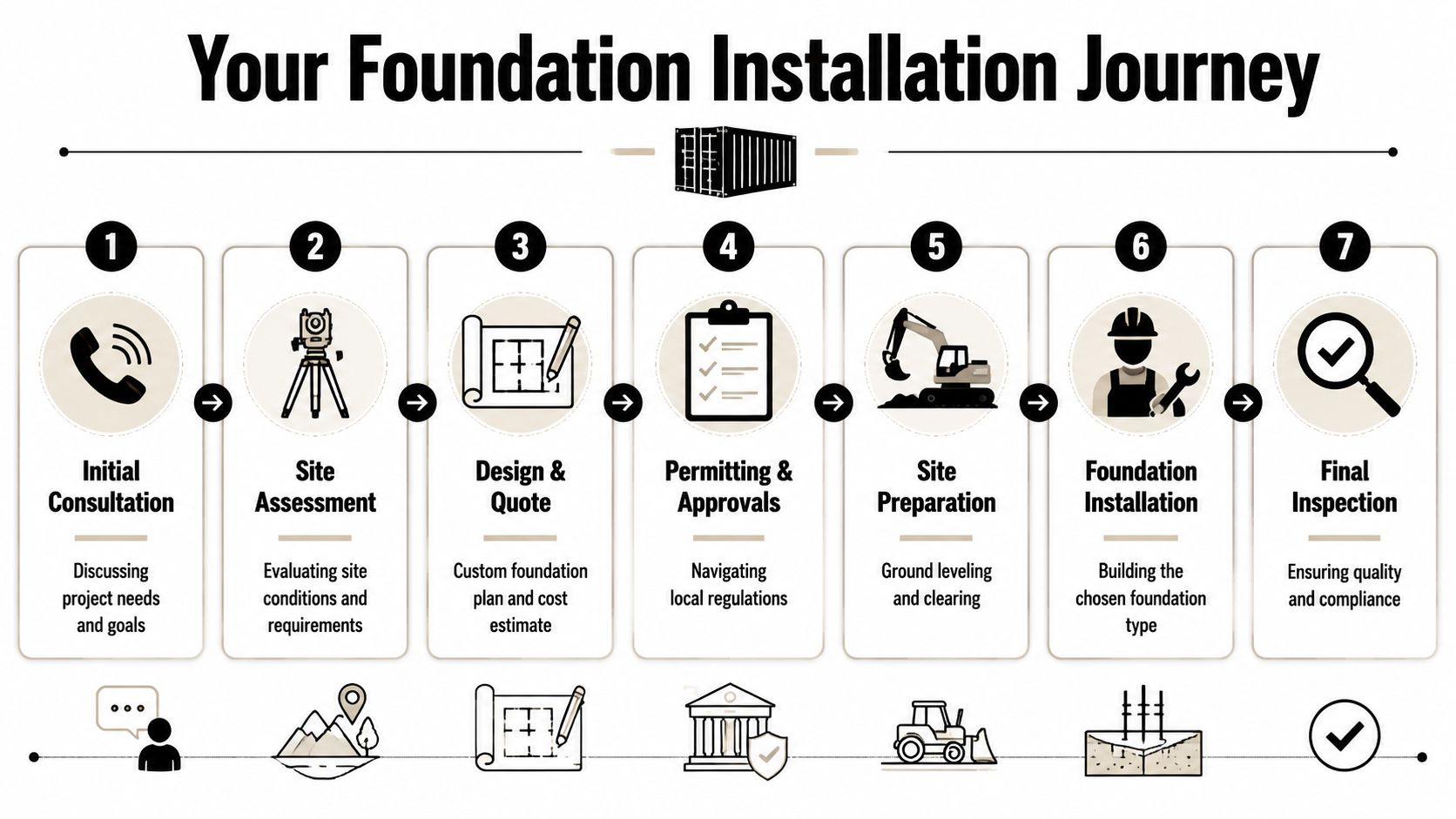
The first conversation and site review
The process usually starts with the basics. What size container are you placing, what is it being used for, and where on the property is it going? A good site review looks at grade, drainage, access, and whether the planned location makes delivery practical.
This is also where the right foundation type starts to narrow down. Some projects clearly point toward gravel. Others need concrete from the start.
Quote, scheduling, and prep
After the site review, the quote should spell out the scope. That includes the base type, excavation needs, site prep assumptions, and any items that depend on field conditions or local approvals.
For property owners comparing options, Firm Foundations handles this as a licensed and insured contractor serving PA, MD, DE, and NJ, with work that includes excavation, gravel pads, and concrete foundations for shipping containers and other structures.
Installation day looks different for gravel and concrete
A gravel pad install is usually faster and more direct. The crew prepares the area, establishes grade, places material in lifts, and compacts it to build a stable base.
A concrete install has more steps. The site still needs prep, but then the crew has to form, reinforce, pour, and finish the slab or pier system before the container is placed.
A typical flow looks like this:
- Layout and marking: The exact location and elevation are confirmed.
- Excavation and grading: Unstable or excess material is removed and the site is shaped.
- Base preparation: Gravel, sub-base, forms, or pier locations are built out.
- Installation: The selected foundation is completed.
- Final check: Elevation, level, drainage path, and readiness for delivery are reviewed.
Ask how the contractor handles water, not just how they handle concrete.
Final inspection and handoff
Before the container arrives, the finished base should be checked for level and overall readiness. On concrete jobs, timing matters because the foundation needs adequate time before it takes the load of the container.
The best installs feel uneventful because the decisions were made early. The site is ready, access is clear, and the foundation matches the actual use of the container.
Get a Foundation Built to Last with Firm Foundations
A shipping container doesn't need the most expensive foundation every time. It does need the right one. That's the difference between a container that stays level and dry, and one that starts giving you trouble after the first stretch of bad weather.
For homeowners and property owners in Pennsylvania, Maryland, Delaware, and New Jersey, the smartest approach is to match the base to the specific job. Storage use, workshop use, permanent use, drainage, access, and soil all matter. Cheap shortcuts on the front end often turn into rework, re-leveling, and moisture problems later.
If you're comparing gravel shed foundation contractors near me, garage foundation contractors near me, excavation near me, or concrete contractors for a shipping container project, it helps to work with a crew that can handle both the prep and the foundation itself. That's how you get a quote that reflects the actual site conditions instead of a guess.
If you're budgeting for a base for storage shed work, a gazebo foundation, garage footings and foundations, or a container pad, the next step is simple. Get the site looked at, get a clear quote, and build it once.
Your Shipping Container Foundation Questions Answered
Do I need a permit for a shipping container foundation
A lot of homeowners ask this after the container is already ordered. In PA, MD, DE, and NJ, that can create delays if the township wants drawings, setbacks, or inspections before any excavation starts.
Permit requirements depend on the municipality, the foundation type, and how the container will be used. A storage container sitting on a basic pad may be treated one way. A container used as a workshop, office, or other permanent structure may be treated very differently.
The practical answer is simple. Check with the local building office early, and work with a contractor who knows the regional approval process. That usually saves more time than trying to sort it out after the site work begins.
How quickly can my foundation be installed
The short answer is that site conditions usually set the schedule more than the container itself.
A straightforward gravel pad on an open, level site can often be completed quickly. A concrete slab takes longer because the crew has to excavate, form, pour, finish, and then wait for proper curing before setting the container. Piers can also move fast on the right site, but layout accuracy matters, especially if the container has to land cleanly on corner load points.
Access changes everything. If we have to bring in stone through a narrow gate, work around trees, correct drainage, or cut down a slope first, the foundation timeline gets longer. That is common on properties in this region, especially in older neighborhoods and rural lots.
My property is sloped or hard to reach. Is that a problem
Slopes, soft areas, tree lines, and tight access are routine conditions, not deal-breakers.
What matters is matching the foundation to the site and the way the container will be used. A simple pier setup may keep upfront cost down on one project. On another, a properly built gravel pad or slab is the better buy because it gives better support, drainage control, and fewer correction costs later.
That trade-off is where generic online price ranges fall short. A quote in Pennsylvania or Maryland can change fast based on machine access, cut-and-fill work, stone depth, frost considerations, and whether water needs to be moved away from the pad. Two properties with the same container can end up needing very different foundation plans.
If the site is awkward, the goal is not to force a standard answer. The goal is to build a foundation that fits the property, holds grade, and keeps the container stable.
If you need a clear quote for a shipping container pad, concrete foundations, garage footings and foundations, or excavation work in Pennsylvania, Maryland, Delaware, or New Jersey, contact Firm Foundations. You'll get straightforward guidance, practical recommendations, and a foundation plan that fits the way your container will be used.