
Expert Concrete Finishing Techniques for Durable Surfaces
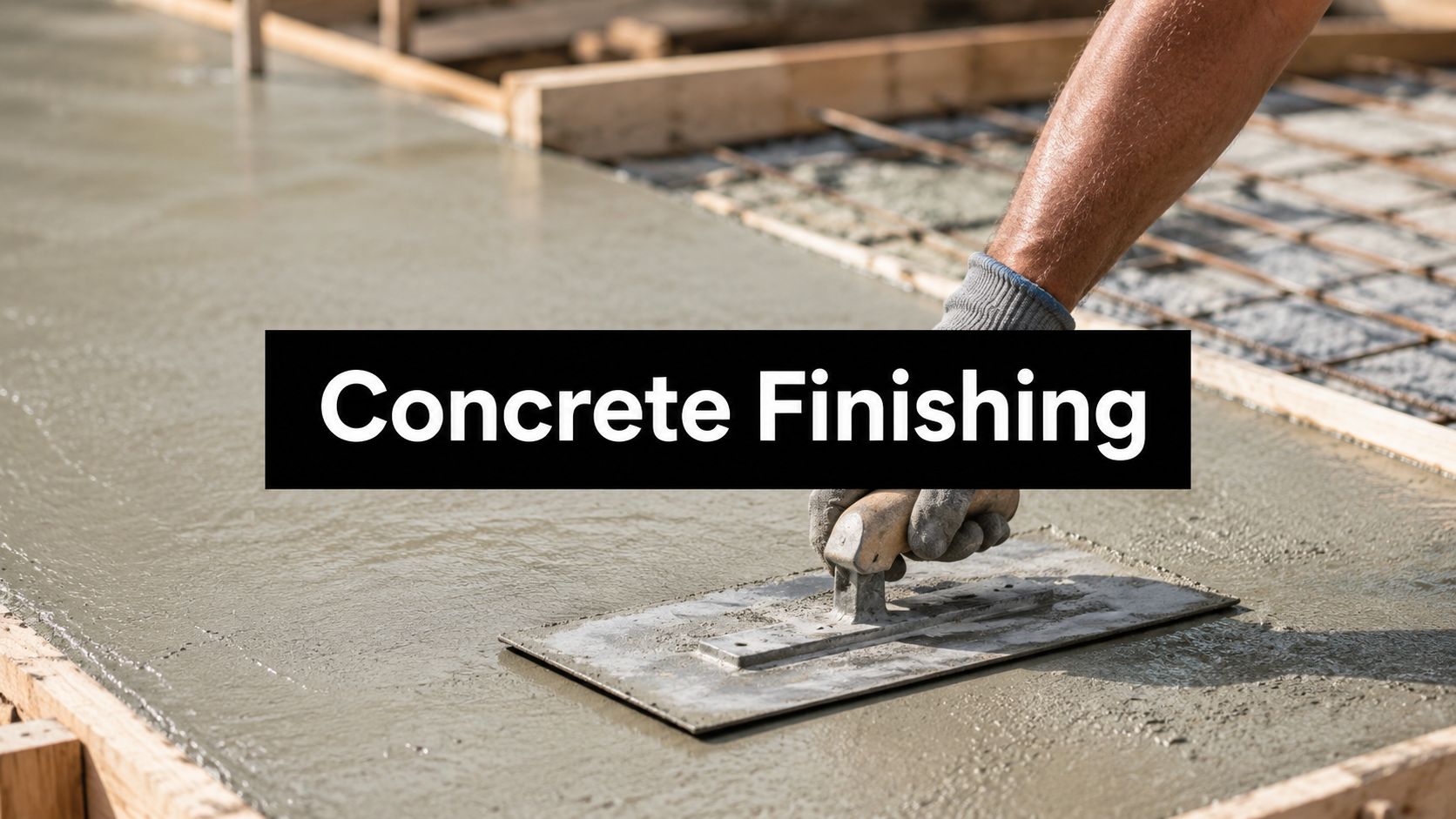
If you're planning a new shed, garage, patio, or driveway in Honey Brook Township, it's easy to focus on the structure that will sit on top. Most homeowners picture the doors, the siding, the usable space, and how the finished project will look from the driveway. What decides whether that project still looks good years from now, though, is the slab underneath it.
That's where good concrete work separates itself fast. A slab can look fine on pour day and still end up with weak edges, poor drainage, a slick surface, or premature surface damage if the finishing is rushed or done at the wrong time. For homeowners searching for shed foundations near me, garage foundation contractors near me, or reliable help with concrete foundations in Pennsylvania, Maryland, Delaware, and New Jersey, the finishing stage matters just as much as excavation, forming, and reinforcement.
Concrete finishing techniques aren't just about making fresh concrete look smooth. They control how the surface wears, how water moves off the slab, how safe it feels underfoot, and how well it holds up through seasonal weather.
Your Project Starts with a Flawless Foundation
A slab can look good the afternoon it's poured and still give you trouble the first hard winter. We see that with patios that hold water, garage floors that wear early at the edges, and shed pads that looked level at first but were finished without enough attention to slope and surface texture. For homeowners in Pennsylvania, Maryland, Delaware, and New Jersey, the finish has to match how the slab will be used and how our weather will work on it year after year.
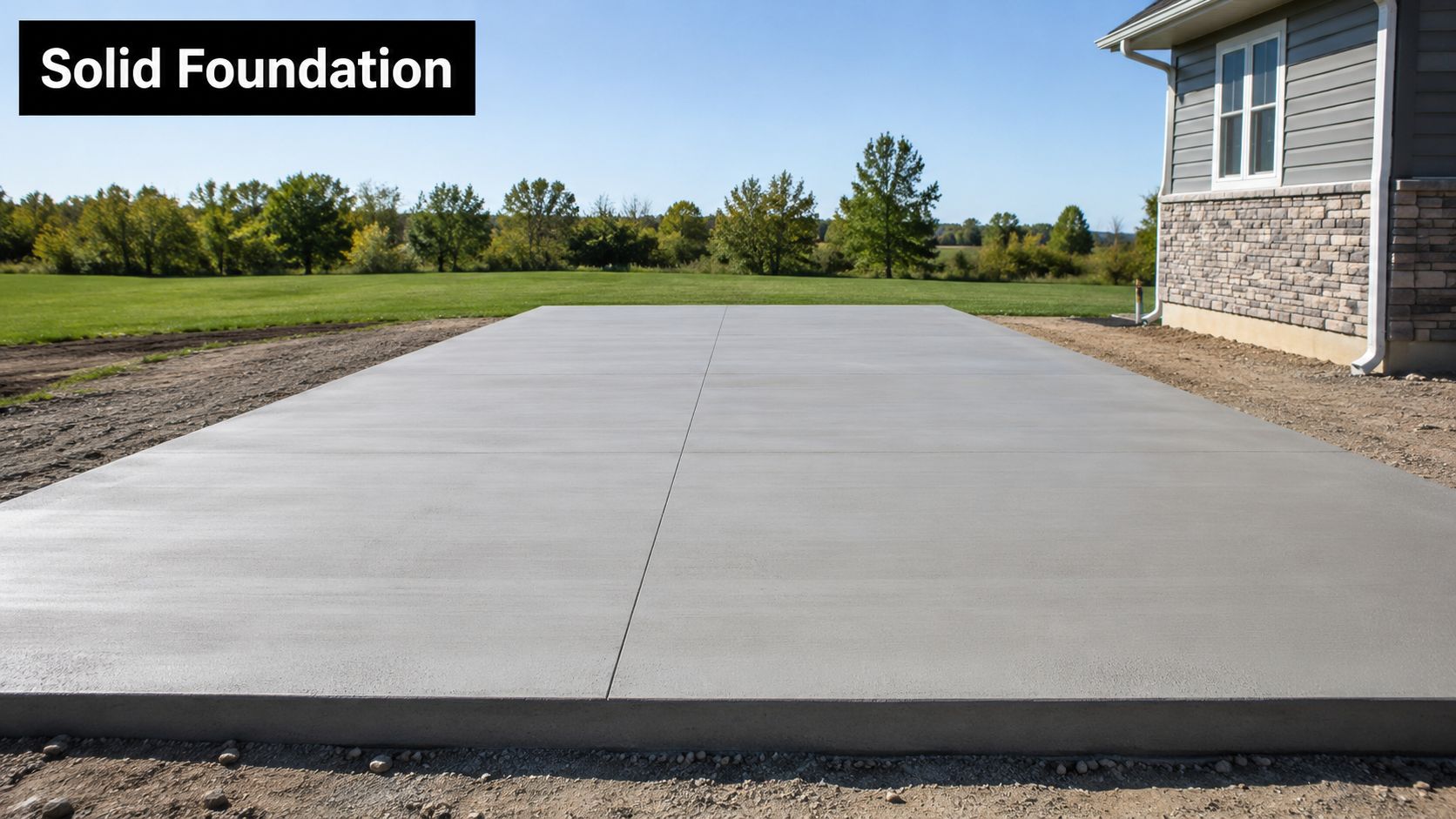
What homeowners usually notice first
Homeowners usually start with practical questions. Will the base for a storage shed fit the building correctly? Is a gazebo foundation going to sit cleanly with the patio? Does a detached garage slab have the right thickness and surface for regular vehicle use?
Those questions matter, but the finish decides a lot of what you live with after the crew leaves. A slab needs to be flat where it should be flat, pitched where it should drain, and textured for the traffic it will get. If the surface is worked at the wrong time, you can end up with dusting, weak spots, scaling, or a finish that gets slippery when it rains.
A slab is judged for years by the surface you use every day.
Why the finishing stage matters so much
Finishing is where fresh concrete becomes a usable surface. The crew is shaping grade, closing the surface, defining edges, and choosing the final texture based on the job. That choice is different for a patio than for a cement foundation for a garage, and different again for a pad that will carry a barn shed or 10×10 storage shed.
Timing matters just as much as technique. Work the slab too early and the surface can weaken because excess moisture is still affecting the top. Wait too long and the concrete tightens up, which makes it harder to cut clean edges or get the right finish without tearing the surface. Homeowners usually see the final appearance. Contractors are watching for the right moment to start each step.
In our region, that judgment matters. Freeze-thaw cycles, rain, snow, and wet leaves all put pressure on exterior slabs. A finish that looks smooth and clean on pour day may be the wrong choice for a walkway, patio, or driveway apron if it does not provide enough traction or sheds water poorly.
Where this shows up in everyday projects
Different projects call for different finishing priorities:
- Shed foundation work needs a surface that stays stable, drains properly, and does not leave water sitting along the perimeter.
- Garage footings and foundations need a finish that can handle vehicle traffic, rolling loads, and regular sweeping without premature surface wear.
- Driveways and patios usually benefit from texture that improves footing in wet or cold conditions.
- Gazebo foundation pads often need cleaner lines and a more refined look while still holding up outdoors.
That is why finishing should never be treated as the easy part of the pour. Homeowners looking for concrete contractors, driveway contractors near me, or shed foundations contractors near me should ask how the slab will be finished, when each step will happen, and why that finish makes sense for the project.
Preparing for a Perfect Pour and Finish
A quality finish starts long before a broom or trowel touches the slab. If the base moves, the forms shift, or the site holds water, the surface finish won't save the job. Good-looking concrete on weak prep work is still weak concrete.
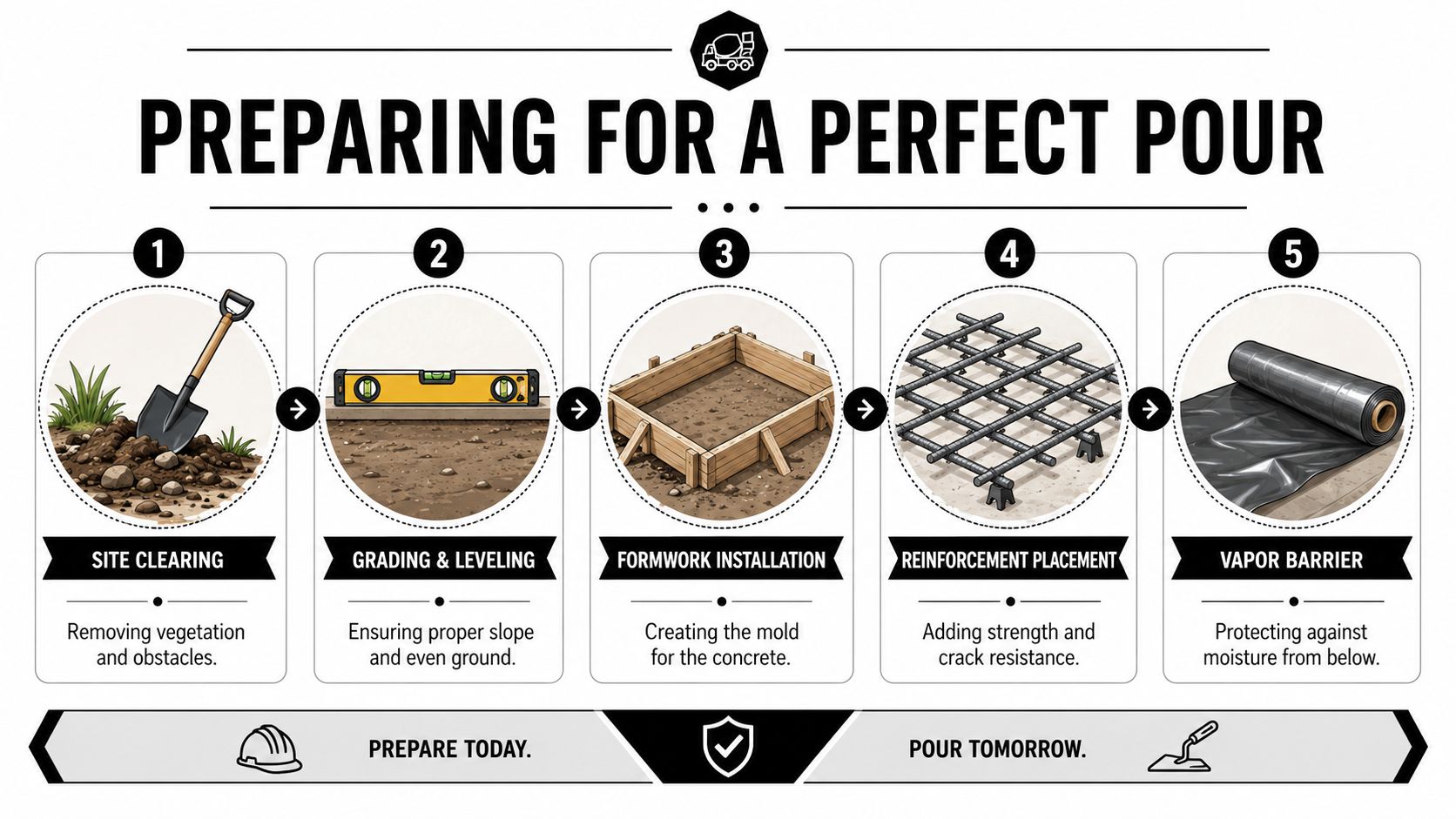
The groundwork that makes finishing possible
For a slab to finish well, the site has to be ready for it. That usually means a sequence like this:
- Clear the area so roots, topsoil, soft spots, and debris are out of the footprint.
- Establish grade so the slab drains the way it should once it's in service.
- Build and brace forms so the slab holds the intended dimensions and edge lines.
- Place reinforcement where the project requires it for strength and crack control.
- Install moisture protection when needed depending on the slab type and use.
Homeowners searching for excavation near me often think excavation ends once the dirt is removed. It doesn't. The grade has to be right, the subgrade has to be stable, and the formwork has to stay true during placement.
What good prep work looks like on site
The details vary by project, but the principles don't. A concrete foundation for garage use has different load demands than a simple shed foundation gravel base or a small pad for a playset, but all of them need a firm, predictable platform before concrete arrives.
Look for these signs of disciplined prep:
- Clean excavation lines that match the slab footprint rather than rough overdigging.
- Tight forms that don't bow when concrete pressure hits them.
- Intentional slope so water moves off patios, walkways, and driveway sections instead of sitting there.
- Reinforcement placed correctly instead of dropped in as an afterthought.
Practical rule: If the site prep looks rushed, the finish usually tells on it later.
Why standardized concrete changed the work
Concrete crews still rely on skill, but the material side of the job became more predictable over time. A major milestone came in 1913, when the first load of ready-mix concrete was delivered in Baltimore, Maryland, helping shift concrete work toward a more standardized process because crews could better predict set time and finishing windows from more consistent mixes, as noted in this history of concrete and ready-mix development.
That matters today more than most homeowners realize. Better material consistency lets crews focus on craftsmanship instead of fighting a wildly inconsistent batch. For a base for storage shed, a residential patio, or a larger garage slab, that predictability helps the finisher judge when the slab is ready for the next step.
Prep choices that affect the final surface
A homeowner usually sees the top of the slab. The top is shaped by what happens underneath.
| Prep item | Why it matters to the finish |
|---|---|
| Subgrade stability | Helps the slab stay supported and reduces movement-related problems |
| Form alignment | Keeps edges straight and clean for better appearance and durability |
| Proper slope | Supports drainage so water doesn't collect on the finished surface |
| Reinforcement layout | Supports slab performance and helps the structure work as intended |
If you're comparing options for shed foundations near me or garage foundation contractors near me, ask about site prep in detail. That answer tells you a lot about how the finishing work will go.
Mastering the Core Finishing Steps
A slab can look fine during the pour and still finish poorly if the crew misses the window for each step. That is the part homeowners usually do not see. Concrete changes fast, and good finishing is really about reading those changes at the right moment.
On jobs across Pennsylvania, Maryland, Delaware, and New Jersey, that judgment matters because temperature, wind, humidity, and sun exposure can all speed up or slow down the surface. A cool overcast day gives a crew more working time. A hot, dry afternoon can tighten that window in a hurry.
Screeding and floating
Once the concrete is placed, the first job is to strike it off to grade with a screed. That sets the slab's plane and preserves the slope needed for drainage. If that slope is off early, the rest of the finishing work cannot fix it.
After screeding, the crew uses a bull float to knock down ridges, fill low spots, and work the larger aggregate slightly below the surface. The goal is a flatter, more uniform slab without sealing the top too soon. Too much pressure or too many passes can bring up excess paste and water, which weakens the wear surface.
This is one of the trade-offs that separates professional work from rushed work. Homeowners often want the slab to look finished immediately. In reality, the crew has to improve the surface without overworking fresh concrete that still needs time to settle.
Edging and jointing
As the slab firms up, the focus shifts to the perimeter and planned crack control. Edging compacts and rounds the slab edge so it holds up better against foot traffic, lawn equipment, and everyday bumps. On a patio, walkway, or shed pad, that small detail often determines whether the edges stay clean or start chipping early.
Control joints serve a different purpose. Concrete will crack as it shrinks. Good finishing guides that crack to a planned location, where it looks intentional and does less harm to the slab's appearance.
The timing matters here too. Cut joints or tooled joints placed too early can ravel the edges. Wait too long and the slab may crack on its own before the joint does its job.
Clean edges and straight joints come from steady timing, not just steady hands.
Final texture and surface intent
The last passes shape how the slab will perform in daily use. A hand float can refine smaller areas, around corners, and along forms. A steel trowel can tighten and smooth the surface where a hard, easy-to-clean finish makes sense. A broom adds traction where slip resistance matters more than a polished look.
The right choice depends on where the slab sits and how it will be used. Exterior concrete in our region usually benefits from texture. Rain, freeze-thaw cycles, and wet leaves can turn a slick surface into a safety problem. Protected interior spaces allow for a smoother finish because traction is less of a concern.
Homeowners also ask when sealing fits into the process. Not during finishing. Sealing comes later, after the slab has cured enough for the product being used. If you want to understand that part of the investment, this guide to concrete slab sealer options and timing covers what to expect.
Why experience shows up in the details
The tools are easy to name. The harder part is knowing exactly when the slab is ready for the next pass.
A shed pad, garage slab, and house approach do not all get handled the same way. The finisher has to judge surface moisture, stiffness, weather exposure, and the final use of the slab before touching it again. Starting too early can tear the surface and trap bleed water. Starting too late can make it harder to close the slab properly and leave a rougher result than the job calls for.
That is why finishing is skilled labor, not just cleanup after the pour. At Firm Foundations, we treat this stage as the point where durability, drainage, appearance, and long-term maintenance all come together. Homeowners usually notice that difference later, when the slab still looks right and wears the way it should.
Choosing the Right Surface Finish for Your Slab
The final finish should match the job. A beautiful surface that's wrong for the location becomes a frustration fast. For homeowners across PA, MD, DE, and NJ, the biggest decision usually comes down to how the slab will be used, how exposed it is to weather, and how much traction matters.
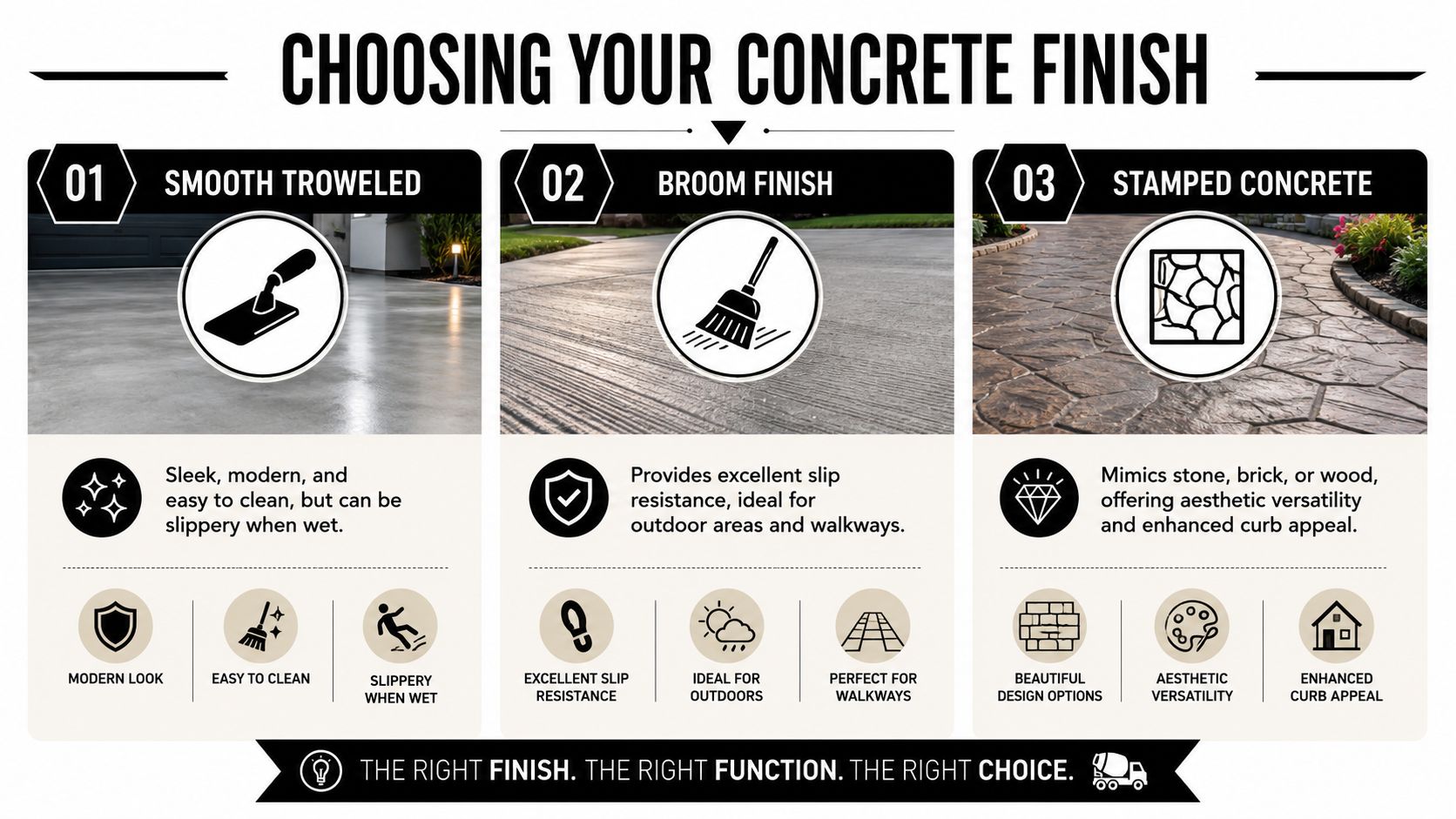
Broom finish versus smooth trowel
For exterior slabs like driveways and patios, a smoother trowel finish can be less desirable than a broom finish. Over-troweling can reduce durability and create a slippery surface when wet, which is why a light broom texture is often recommended for long-term safety and performance on outdoor slabs, as explained in this guidance on exterior concrete finishing choices.
That lines up with what works in this region. In Pennsylvania and nearby states, exterior concrete has to deal with rain, leaf debris, mud, and winter conditions. A broom finish gives you useful traction without making the slab look rough or unfinished.
A smooth trowel finish still has its place. It often makes sense for interior or more protected slab areas where easy cleaning and a sleeker appearance matter more than wet-weather grip.
A practical comparison
| Finish type | Where it usually fits | Main trade-off |
|---|---|---|
| Broom finish | Driveways, sidewalks, patios, outdoor slabs | More texture, less slick when wet |
| Smooth troweled finish | Interior slabs, covered spaces, some garage floors | Cleaner look, but less traction |
| Stamped concrete | Decorative patios and outdoor living areas | Appearance-focused and more detail-sensitive |
Before deciding on texture, it also helps to think about long-term surface protection. Homeowners comparing finish options for patios, shed pads, and driveways can get a useful overview in this guide to concrete slab sealer options.
Here's a quick visual look at common finish styles and where they tend to fit:
What works well outdoors in our region
For exterior flatwork like driveways and sidewalks, finishers should wait until the surface is firm enough to leave only a shallow impression before broom finishing. The broom should be pulled in straight, consistent passes at roughly a 45-degree angle, after edging is complete and only once the slab is free of bleed water, according to this practical broom finish guidance.
That's one reason a good broom finish looks simple but rarely is. Consistent texture takes control. If the slab is too soft, the broom tears the surface. If it's too hard, the texture becomes weak or patchy.
Matching the finish to the project
Different projects call for different priorities:
- Driveway companies near me searches usually lead to outdoor slabs where traction should rank high.
- Gazebo foundation or decorative patio work may prioritize appearance while still needing weather-ready texture.
- Concrete foundation for garage work may call for a smoother finish depending on whether the slab is enclosed or exposed.
- Shed foundation pads often benefit from a practical finish that's durable and easy to keep clean around the structure.
A smoother surface isn't automatically better. The right finish is the one that fits the use, the exposure, and the local climate.
Why Timing and Curing Are Critical for Durability
A driveway can look finished by late afternoon and still be vulnerable to damage for days after the crew packs up. Homeowners run into trouble right here. The surface looks dry, feels hard, and seems ready for foot traffic, patio furniture, or a vehicle. Concrete does not work that way.
The finishing window is short, and it shifts with the weather. In Pennsylvania and across MD, DE, and NJ, the slab can tighten up fast on a warm, windy day, then move much slower in cool, damp conditions. That is why timing is not a minor detail on the job. It affects surface strength, texture quality, and how well the slab holds up through freeze-thaw cycles.
Knowing when the slab is ready
Homeowners often ask for an exact time. There usually is not one.
A good finisher reads the slab itself. Surface moisture, temperature, sun exposure, wind, and the mix all affect when the concrete is ready for the next step. One side of a patio may be ready before the other. Edges and corners can firm up faster than the middle. A crew that works by the clock instead of the surface can close the top too early or miss the window altogether.
At Firm Foundations, we watch for consistent surface change before making the next move. The slab should support the tool properly, not smear under it, and not resist so much that the finish turns rough or uneven. That judgment is part of the trade. It is also one of the biggest reasons professionally finished concrete tends to last longer.
Weather changes the schedule
Local climate matters more than many homeowners realize. Summer heat and drying wind can pull moisture from the surface quickly, which shortens the working time and raises the risk of surface problems if the crew pushes too hard. Cooler weather can buy more time, but it also changes how the slab sets and cures.
That trade-off matters when you are choosing between speed and long-term performance. Rushing helps nobody. Waiting too long can also leave the crew fighting concrete that has already tightened past the right finishing stage.
If you want a clearer picture of what happens after placement, this guide on how long a concrete slab takes to cure lays out the timeline homeowners should expect.
Curing protects the investment
Finishing shapes the slab. Curing helps it gain the strength and wear resistance it was poured to deliver.
That means keeping the slab from drying out too fast after finishing and respecting the waiting period before regular use. A slab may look done long before it is ready for traffic, heavy loads, or sharp temperature swings. In our region, that patience matters. Freeze-thaw exposure, deicing salts, and moisture can punish a slab that never had a fair curing period.
For patios, walkways, and backyard projects, design choices also affect how the slab performs over time. Homeowners planning the larger space can pull ideas from Landscapey insights for outdoor space design, then match those plans to a finish and curing schedule that makes sense for the site.
The short version is simple. Good timing gives the surface a fair chance. Good curing protects that work after the finish is complete. That is how a slab keeps its appearance and holds up to real use, instead of looking good for one season and showing wear far too soon.
Avoid Defects and Hire a Pro You Can Trust
A lot of slab problems start on a day that seemed to go fine.
The truck leaves. The surface looks smooth. A few weeks later, the top starts dusting, edges chip, or shallow flakes show up after the first winter. In our part of Pennsylvania and across MD, DE, and NJ, that usually comes back to workmanship, timing, or a finish choice that did not match the site conditions.
How surface defects start
The sequence matters, but judgment matters just as much. Concrete has to be worked at the right stage. If a crew closes the surface too early, moisture and air can get trapped near the top. If they keep working it after it has tightened up, they can weaken the surface paste and leave the slab more prone to wear.
That is how common defects begin:
- Blistering or delamination can start when the surface is finished before it is ready.
- Dusty or weak tops often come from overworking the slab or adding water during finishing.
- Chipped edges usually trace back to weak edge work, poor support at the perimeter, or traffic before the concrete has gained enough strength.
- Cracks that stand out more than they should often point to sloppy joint layout, poor control of the pour, or finishing that did not stay consistent across the slab.
Homeowners usually see the defect. Contractors see the step that caused it.
What a homeowner should look for in a contractor
If you are comparing shed foundation contractors, gravel pad installers, or garage slab crews, ask how they make decisions during the pour. Price matters, but so does their ability to explain what they are watching for and why they would change pace on a cool, damp morning versus a hot, windy afternoon.
A reliable contractor should be able to explain:
- How the base and forms are prepared before concrete arrives
- Which finish makes sense for the way you will use the slab
- How they judge when the concrete is ready for edging, jointing, and final surface work
- What curing method they expect once finishing is complete
- How drainage is built into the slab and the surrounding grade
That last point gets overlooked. A good slab is not just a flat rectangle. It has to shed water, fit the outdoor layout, and hold up through freeze-thaw cycles and runoff patterns common in this region. If you are planning a patio, walkway, or larger yard project, broader Landscapey insights for outdoor space design can help you line up the slab location with the rest of the space.
One practical option for local foundation work
For projects in Pennsylvania, Maryland, Delaware, and New Jersey, Firm Foundations handles excavation, forms, concrete placement, and slab work for sheds, garages, patios, driveways, gazebos, and other residential foundation needs.
Homeowners hire a pro because finishing is hard to fix once the slab sets. If the subbase is soft, the slab is worked at the wrong time, or the finish does not match the use, repairs are often partial at best and expensive at worst.
The cheaper bid can turn into the costlier slab.
That is especially true for shed pads, garage foundations, patios, and driveways, where the concrete is supporting weight, taking weather, and staying in view for years. Professional finishing protects both appearance and service life, which is what you are paying for in the first place.