
Garage Floor Tiles: Your 2026 Guide to a Flawless Finish


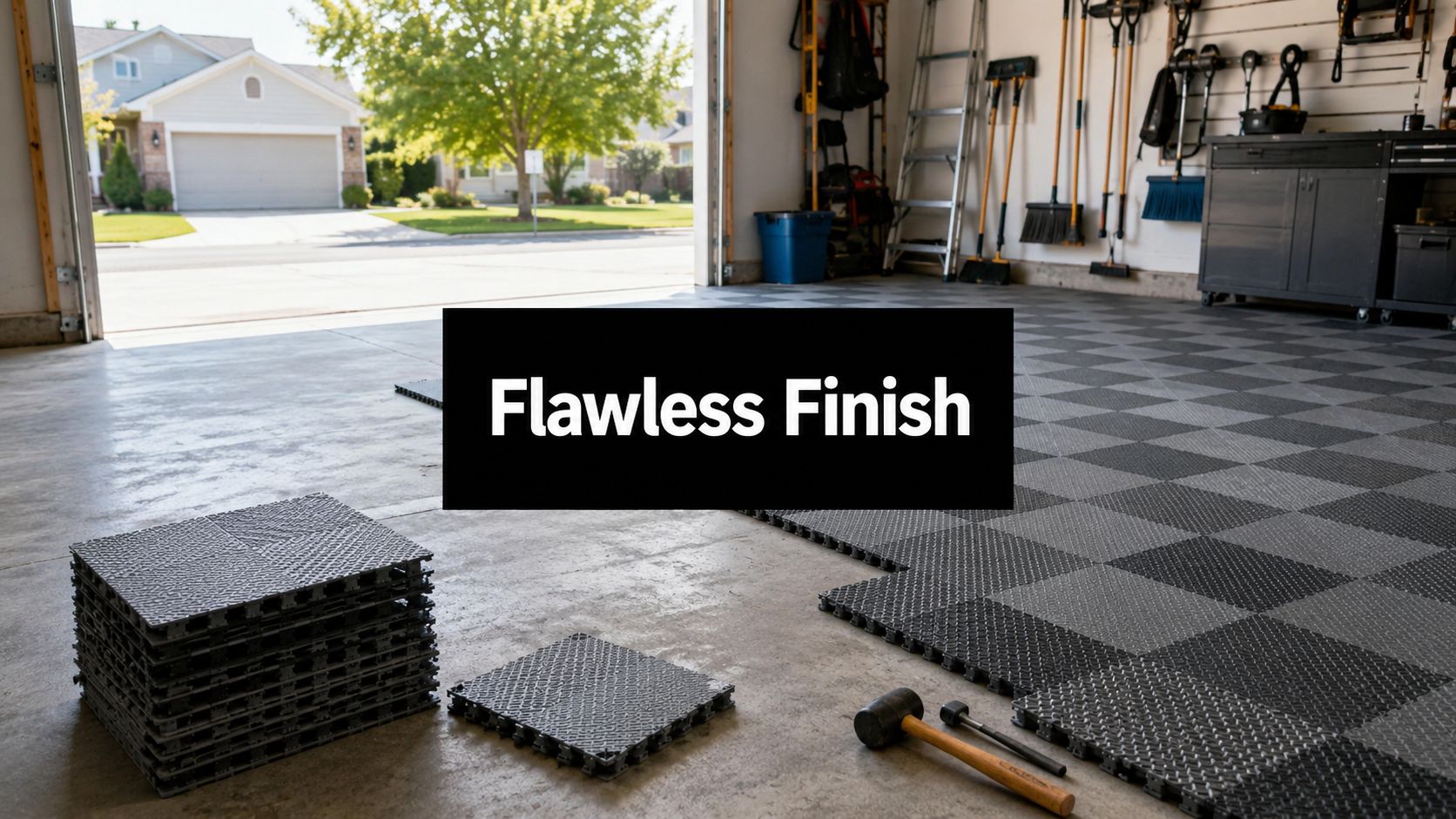
A lot of homeowners start shopping for garage floor tiles when the garage already has a problem. The slab is stained, the surface looks tired, or winter keeps dragging slush, salt, and grit inside. Tiles can absolutely improve the look and function of that space, but they don't fix a bad slab.
That's the part many flooring guides skip. In Pennsylvania, and in nearby parts of Maryland, Delaware, and New Jersey, your garage floor has to deal with moisture, temperature swings, road salt, and daily vehicle traffic. If the concrete underneath is cracked, uneven, or moving, even a high-end tile system can end up disappointing you.
At Firm Foundations, we work on the part that matters first. The concrete slab, the base prep, the drainage, and the structural support. If you're comparing garage floor tiles for an existing garage or planning a new concrete foundation for garage use, think of the tile as the finish layer, not the whole system.
Choosing the Right Garage Floor Tile for Your Home
Most homeowners start in the same place. They search for garage floor tiles, find a dozen styles that all claim to be heavy-duty, and then realize the options don't all perform the same way.
For a typical homeowner in Pennsylvania, the question isn't just what looks good. It's what works for how you use the garage. Parking daily drivers is different from storing a collector car. A workshop with rolling toolboxes and floor jacks is different from a clean storage space. Snowy winters also change the answer.
Three common tile types
The main categories most homeowners compare are rigid polypropylene, flexible PVC, and porcelain tile.
Rigid polypropylene tiles are often chosen for quick installs and patterned layouts. They're common in modular systems and can be a practical option when you want a finished look without committing to a permanent adhesive floor. They're often a fit for light to moderate vehicle use, especially when the slab is already in decent condition.
Flexible PVC tiles feel different underfoot. They tend to be quieter and more forgiving, which matters if you use the garage as a work area. Construction quality matters a lot here. High-quality PVC garage tiles are typically solid-virgin PVC and weigh about 3.5 to 5 lb each, while cheaper hollow-core versions can weigh under 1 lb and may have only a 1/16 in. wear surface, which is a known durability weak point under rolling loads and hot tires, according to ArmorGarage's garage tile construction guide.
Porcelain tile is the most traditional-looking option. It can give a garage a very clean, finished appearance, especially in premium builds. But it's less forgiving when the slab has movement, cracking, or uneven transitions. In a garage, that makes prep and installation quality far more important than the tile color.
Practical rule: Choose tile based on how the garage is used on its hardest day, not its cleanest day.
Garage floor tile comparison
| Tile Type | Pros | Cons | Best For |
|---|---|---|---|
| Rigid polypropylene | Fast modular install, many design options, good for parking areas | Can feel harder underfoot, some systems are less forgiving on imperfect slabs | Homeowners who want a DIY-friendly visual upgrade |
| Flexible PVC | More comfortable underfoot, quieter, better feel for workshops, heavier solid-core options are more substantial | Product quality varies widely, cheap hollow-core versions can disappoint | Garages that double as workspaces or hobby areas |
| Porcelain tile | Clean architectural look, strong finished appearance, good chemical resistance when installed correctly | Demands a sound slab, more cutting and layout work, less tolerant of movement | High-end garages with stable concrete and professional installation |
A good way to think about this is the same way you'd think about interior tile selection. Material, texture, cleaning needs, and room function all matter. If you want a solid primer on balancing style with function, this guide on choosing bathroom tile is useful because the decision process is similar even though the garage is a harsher environment.
What tends to work best locally
In our region, wet shoes, melting snow, road salt, and grit are part of the job. That usually pushes homeowners toward either a solid, heavy modular tile for general use or a drainage-oriented system if the garage regularly gets wet. If you're still comparing finishes more broadly, it also helps to understand how tile differs from garage floor paint options, because paint and tile solve different problems.
If you want the shortest version, it's this:
- For daily parking and simple appearance upgrades: modular systems can make sense.
- For workshop comfort and a more forgiving walking surface: solid PVC usually has advantages.
- For a polished, built-in finish: porcelain can look excellent, but only when the slab is stable enough to support it.
Prepping Your Concrete Slab for Flawless Tile Installation
A tile floor fails from the bottom first. Homeowners often blame the tile when the issue is the slab.
That's why slab prep is the one part of this job you can't fake. Dirt, oil, moisture, cracks, settlement, and surface high spots all telegraph upward. If you install over those conditions, you're not saving time. You're hiding a problem until the floor starts clicking, shifting, cracking, or trapping moisture.
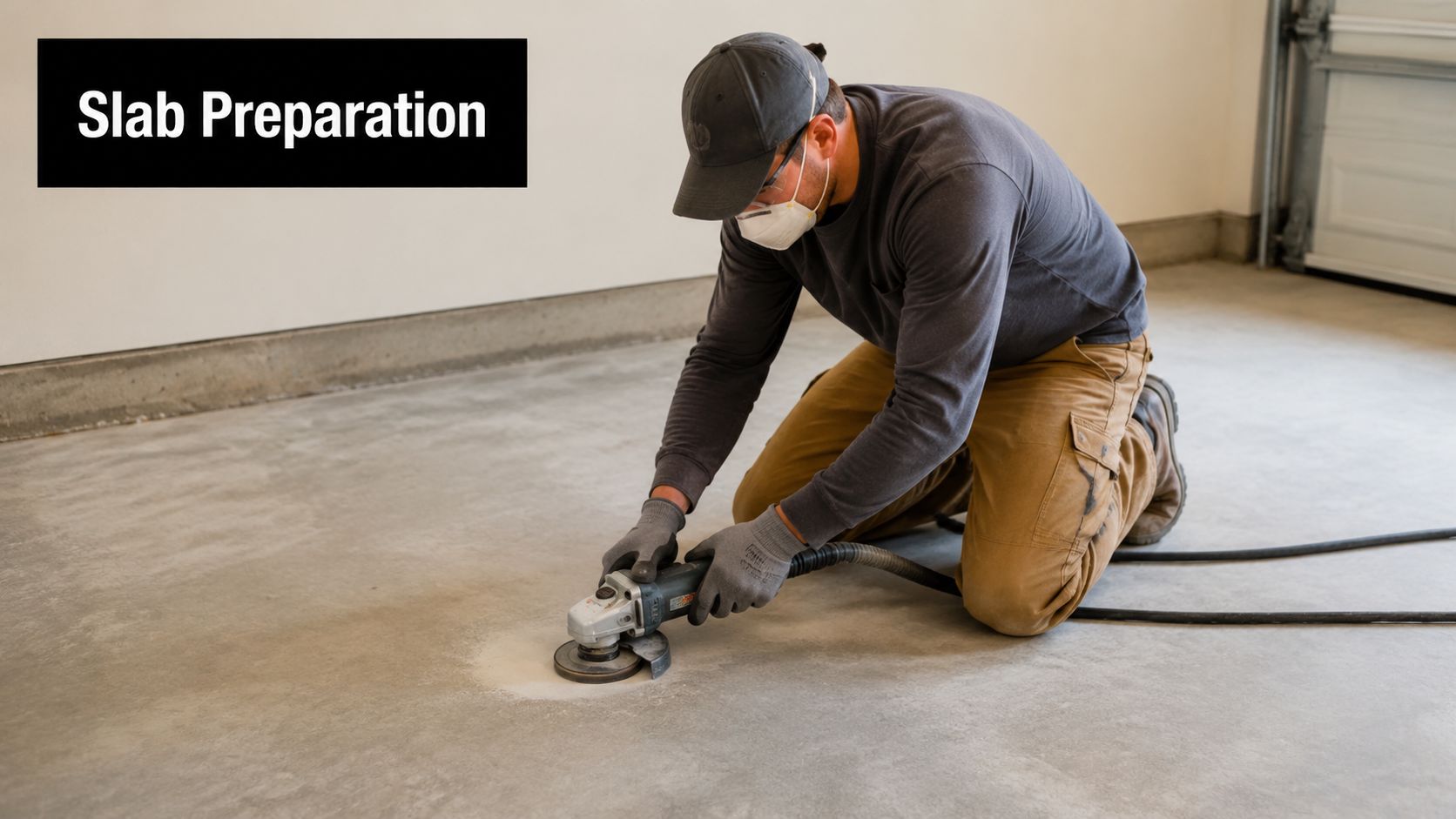
What has to be checked first
Start with the concrete itself.
Look for structural cracks, surface spalling, settled corners, and low areas that hold water. For porcelain garage tile installations, guidance specifically warns that major concrete cracks and unevenness must be corrected before installation, and it also recommends epoxy-based grout. For smaller single-car garages, 12×12 in. or smaller tile formats are often recommended to simplify layout and avoid an oversized look, as noted in Vault Garage's porcelain garage tile guidance.
Those details matter because rigid finishes don't forgive slab defects. They expose them.
If the concrete is moving, the floor covering is just coming along for the ride.
The prep steps that actually matter
Homeowners sometimes think prep means sweeping the floor and getting started. Real prep is more involved.
Deep cleaning comes first
Oil, old sealers, dust, and tire residue interfere with how tiles sit and how adhesives bond. Degreasing matters most around parking spots and near the overhead door.Moisture has to be taken seriously
Garages in Pennsylvania and nearby states often deal with seasonal dampness. Moisture rising through the slab can create trouble beneath tiles, especially at seams and edges. If water is already entering at the perimeter, tiles won't solve that root cause.Flatness matters more than homeowners expect
A floor doesn't have to be perfectly level to take tile, but it does need to be acceptably flat. High spots create rocking. Low spots create flex. Both shorten the life of the finished floor.Crack repair has to match the crack
A small, stable surface crack is different from a widening crack, a vertical displacement, or movement near the garage door opening. The second group points to slab or subbase trouble, not a cosmetic issue.
The logic is the same in any tiled assembly. If the base is wrong, the finished surface is at risk. That's why even in wet interior projects, professionals focus heavily on substrate prep and support details. This breakdown of expert advice on shower bases is a different application, but the principle is exactly the same.
When to stop and call a foundation contractor
If your garage slab is sinking, heaving, separating at joints, or cracking repeatedly, don't move ahead with tile selection yet. That's the stage where a garage foundation contractor near me search is more useful than a flooring search.
For homeowners evaluating the slab themselves, a garage floor grinder overview can help you understand one part of surface correction. But grinding only handles surface profile and minor high spots. It doesn't solve drainage failure, poor compaction, slab movement, or an undersized base.
That's the distinction that saves money. Good tile over bad concrete is still a bad floor.
Professional Installation for Interlocking and Adhesive Tiles
Once the slab is sound, installation gets a lot more predictable. At this stage, layout, cuts, edge details, and product-specific handling separate a floor that looks finished from one that looks improvised.
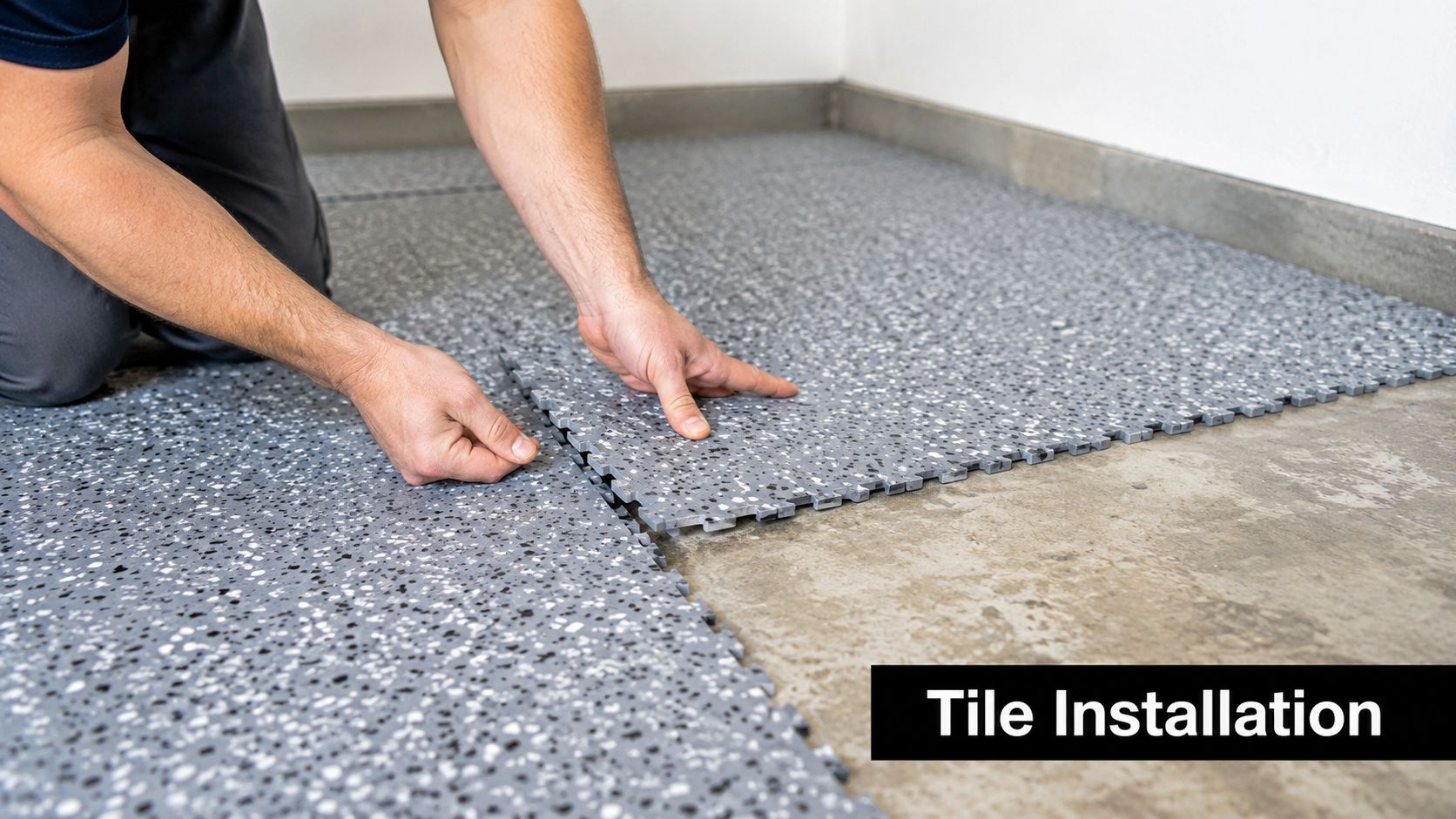
Interlocking tile installation
Interlocking systems are popular because they're modular and easier to service later. A damaged section can usually be removed and replaced without tearing up the whole floor.
The process starts with layout. Dry-plan the room first, especially if the garage has steps, posts, utility penetrations, cabinets, or a jog in the wall line. In most garages, it's worth centering the layout visually so you don't end up with a thin sliver cut running down one side.
A clean installation usually follows this order:
- Find a stable starting line near the most visible wall or garage opening.
- Work in sections so the tile field stays square.
- Check the door threshold early because that edge is where many mistakes show up.
- Cut perimeter pieces cleanly around walls, columns, and corners.
- Install edge transitions where the system needs a safer, tapered finish.
Adhesive tile installation
Adhesive systems are less forgiving, but they can produce a more permanent finished surface when the slab is properly prepared. This applies especially to porcelain and other set-in-place tile products.
With adhesive installations, spacing, bond coverage, and substrate consistency matter more than speed. You're not just placing a floating layer. You're creating a fixed assembly. Any contamination or movement below becomes a long-term problem.
Field note: In garages, the threshold area and wheel paths deserve extra attention because that's where water, grit, and concentrated traffic meet.
For homeowners who want to see an installation sequence in action, this video gives a useful visual reference:
Wet climate details most guides miss
Local conditions matter. In snowy climates, a drainage-friendly tile can be a better choice than a solid-top tile in the parking zone. Some vented systems feature 48 flow-through slots per 12×12 tile, which helps move snowmelt and water off the walking surface, as described in this flow-through garage tile product reference.
That doesn't mean vented tile is always better. It means it's often better in the right area.
Where each approach works best
- Solid-top tiles make sweeping easier and often look cleaner in workshop or storage areas.
- Flow-through tiles are more practical near garage doors, parking pads, and spaces that regularly receive slush or wash water.
- Mixed layouts can work well when homeowners want drainage in one zone and a more closed surface in another.
A local installer or slab contractor should also look at edge treatment. If the floor gains height from the tile system, tapered transition pieces at the garage door opening reduce trip risk and help the finished floor feel intentional instead of temporary.
Long-Term Maintenance and Real-World Durability
Homeowners usually ask the right question after installation. How will this hold up after years of use?
That's the correct question, because garage floor tiles don't live in a showroom. They live under tire movement, seasonal temperature changes, fallen tools, tracked-in grit, and occasional point loads from jacks, stands, compressors, and loaded cabinets. As RaceDeck notes in its discussion of real-world use questions, the true test isn't the sales pitch. It's how the system performs over time and whether drainage designs solve one cleanup issue while creating another.
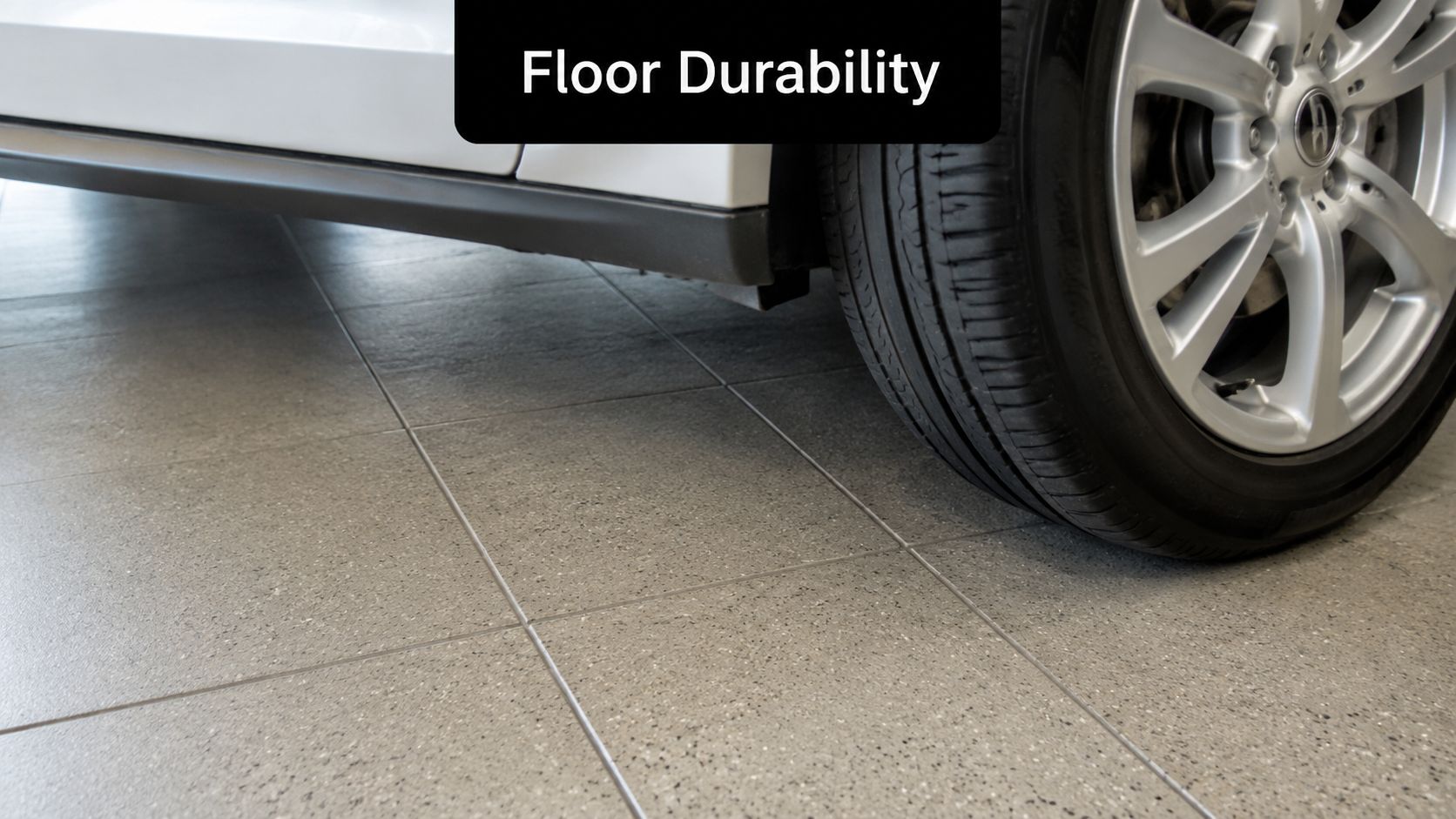
What to expect in daily use
Hot tires and rolling vehicle loads are normal conditions for a garage floor. Better tile systems are designed for that, but not every tile handles point loads equally well. A parked car spreads weight differently than a jack stand. That's why homeowners should be cautious with very light, thin, or hollow products in active work garages.
Vented tiles also come with a trade-off. They improve drainage at the surface, but dirt, salt, and fine debris can collect below or within the interlock channels. That doesn't make them a bad choice. It just means maintenance should match the tile design.
Drainage helps with water on top of the floor. It doesn't eliminate cleanup underneath the tile field.
Maintenance habits that protect the floor
A practical routine is simple:
- Sweep grit regularly so sharp debris doesn't grind into seams and walking paths.
- Rinse or mop based on tile type because solid-top and vented systems shed dirt differently.
- Lift and clean problem areas as needed near the garage door, parking spots, or workbench zones.
- Watch heavy point loads if you use jacks, stands, or very small-footprint equipment.
Porcelain tile owners should also keep grout condition on the checklist. If you want good household-scale techniques for cleaning lines without overcomplicating it, these expert DIY grout cleaning methods are a useful reference.
What durable ownership looks like
The good news is that modular floors are often repairable in sections. If one tile gets damaged, stained beyond saving, or chipped from impact, you can usually replace only that area.
The more important point is expectation. Garage floor tiles can perform well for real vehicle use, but they aren't magic. The right tile in the wrong garage setup still creates headaches. The right tile over stable concrete, with realistic cleaning habits, usually gives homeowners the result they wanted in the first place.
When Your Garage Needs More Than Just Tiles
Garage floor tiles are a finish. They are not a structural fix.
That distinction matters more today because homeowners are putting real money into garage upgrades. One market projection estimates the global garage flooring market will reach USD 25.54 billion by 2033, with North America as a major demand center, according to Coherent Market Insights' garage flooring market report. As spending rises, it becomes even more important to make sure the slab underneath deserves the investment.
Red flags you shouldn't cover up
Some garage floors don't need tile advice first. They need concrete and foundation attention first.
Watch for these warning signs:
- Deep or widening cracks that keep returning
- Heaved or sunken sections that change how the floor drains
- Separation at the garage door opening or wall line
- Persistent water entry that starts at grading, threshold, or slab elevation problems
- Soft, deteriorating surface concrete that keeps breaking down
Those aren't finish issues. They point to slab movement, drainage trouble, base failure, or structural concerns.
The bigger system under the floor
A durable garage floor starts below the surface. Subgrade prep, excavation, compaction, slab design, drainage, and edge support all influence whether the finished floor stays serviceable.
That's where garage footings and foundations, cement foundations for garage projects, and broader concrete foundations work come into the conversation. If a homeowner is searching for garage foundation contractors near me, excavation near me, or a contractor for a new garage slab in Pennsylvania, Maryland, Delaware, or New Jersey, the goal should be to fix the root condition first and then choose the finish.
For new builds, that same logic applies from day one. The slab should be designed for the use, not just poured to create a surface.
Frequently Asked Questions About Garage Floor Tiles
Homeowners across Pennsylvania ask many of the same questions once they start comparing systems and looking closely at their slab.
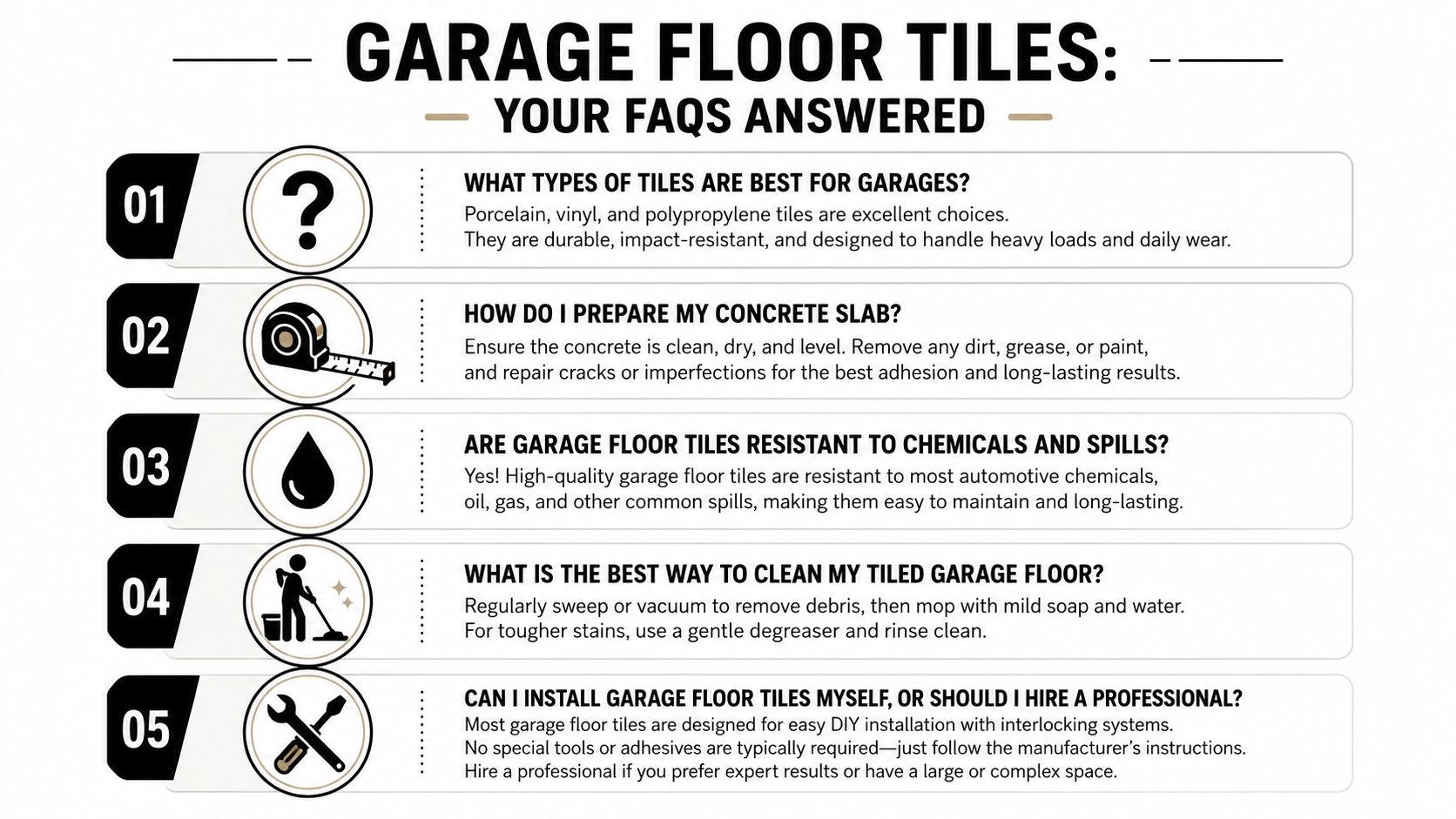
Are garage floor tiles good for daily vehicle use
Yes, many are. The caveat is that product quality and slab condition matter. A heavy, well-made tile over sound concrete is very different from a thin budget tile installed over a cracked, shifting floor.
Can tiles go over cracked concrete
Sometimes, but not blindly. Small stable surface imperfections are one thing. Structural cracks, vertical movement, or major unevenness are another. If the slab is moving, solve that problem first.
Which is better for snow and road salt
That depends on where the moisture shows up. Flow-through styles are often more practical where slush and meltwater collect, especially near the garage door. Solid-top styles are often easier to sweep and maintain in dry work areas.
Can I install garage floor tiles myself
Some modular systems are DIY-friendly. Porcelain and adhesive installations are less forgiving. Even with snap-together products, the finished result depends on the slab being clean, flat enough, and dry enough for the system you chose.
Should I tile an old garage floor or replace the slab
If the slab is basically sound, tile can be a smart finish upgrade. If the floor is heaving, settling, draining poorly, or breaking apart, replacement or structural repair is often the smarter investment. For homeowners comparing concrete contractors, foundation builds, a base for storage shed work, or a new garage slab, Firm Foundations handles excavation, slab prep, and concrete foundation work across Pennsylvania, Maryland, Delaware, and New Jersey.
If you're looking at garage floor tiles and wondering whether your slab is ready, that's the right time to get an expert opinion. Firm Foundations helps homeowners across Pennsylvania and nearby service areas evaluate existing concrete, build new garage slabs, and handle the foundation work that makes a finished floor last. If you need a quote for concrete foundations, garage footings and foundations, a cement foundation for a garage, or site prep for a new build, contact Firm Foundations and start with the part that matters most.