
Concrete Slab Insulation: Materials, Costs & Codes
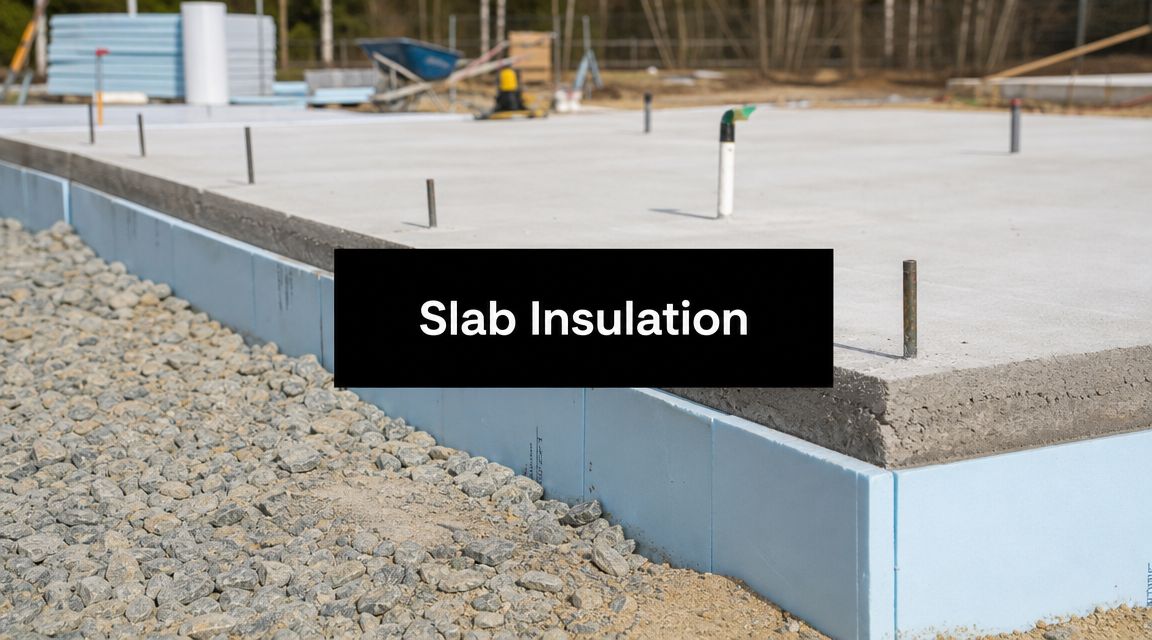
If you're planning a new garage slab in Pennsylvania, a shed pad in Maryland, or a patio and outbuilding foundation anywhere across PA, MD, DE, or NJ, it's easy to focus on the concrete itself. Most homeowners ask about thickness, reinforcement, finish, and price first. Those are important questions, but the layer below and around the slab often determines whether that foundation stays comfortable, dry, and durable.
That's where concrete slab insulation comes in. For heated spaces, it helps hold heat where you want it. For garages, sheds, and other utility structures, the decision is more project-specific, but edge treatment, moisture control, and proper detailing still matter. If you're searching for garage foundation contractors near me, shed foundations near me, or concrete contractors who understand what works in Mid-Atlantic weather, this is the part of the job you don't want guessed at.
Why Your Foundation Needs More Than Just Concrete
A lot of projects start the same way. A homeowner wants a clean new shed foundation, a larger garage footing and foundation, or a solid base for storage shed placement before the structure arrives. The plan sounds simple. Excavate, compact the base, form the slab, pour the concrete, and move on.
But concrete by itself doesn't solve heat loss, ground moisture, or slab-edge exposure. In Pennsylvania and Maryland especially, freeze-thaw cycles and damp ground conditions can turn a “simple slab” into a cold, wet, uncomfortable surface if the build-up underneath is incomplete.
What homeowners usually notice first
The first complaints rarely sound technical. They sound practical:
- Cold floors: A heated garage or workshop never feels quite warm enough.
- Dampness: Tools, boxes, or stored items feel clammy near the slab.
- Condensation issues: Seasonal moisture shows up where warm air meets cool concrete.
- Long-term movement concerns: The slab may stay intact structurally, but weak edge details often create avoidable trouble over time.
For a detached shed, insulation may not need to cover the entire slab. For a heated garage, home addition, or conditioned outbuilding, it usually deserves much more attention. The right answer depends on how you'll use the building, not just on whether it has concrete underneath it.
Practical rule: The more a slab affects daily comfort, heating cost, or interior moisture, the more important slab insulation becomes.
That's why good foundation work isn't just about pouring a flat surface. It's about building a complete system. Soil prep, stone base, vapor protection, insulation choice, edge detailing, reinforcement, and finishing all work together.
Homeowners looking for cement foundations for garage, concrete foundations, or gazebo foundation work often assume insulation is an upgrade. In many cases, it's part of protecting the investment from the start. Done right, it helps the slab perform better, especially where the edge is exposed to cold soil and changing weather. Done poorly, the slab may still look fine on day one while underperforming for years.
What Is Concrete Slab Insulation
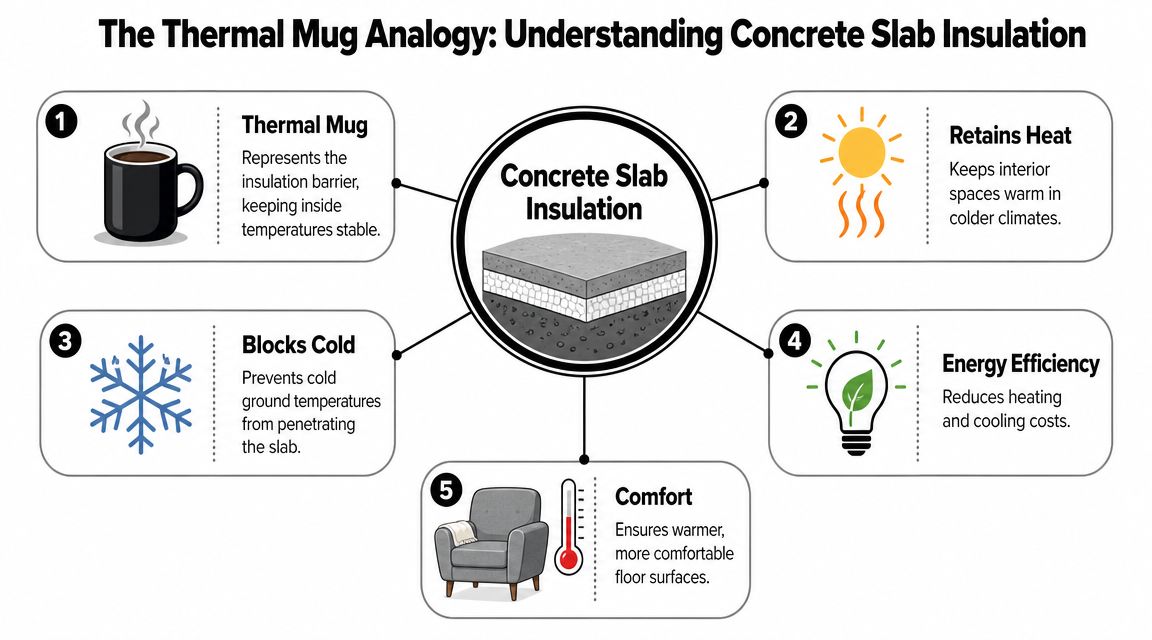
Concrete slab insulation is usually a rigid foam layer installed either under the slab, along the slab perimeter, or both. The easiest way to think about it is a thermal mug. The mug doesn't create heat. It slows unwanted heat movement. Slab insulation does the same thing for a foundation.
How it works under real conditions
In winter, the ground can pull warmth out of a slab. In summer, temperature differences and moisture movement can make an unprotected slab feel damp or “sweaty” in certain conditions. Insulation creates separation between the concrete and the surrounding ground conditions.
That matters most in spaces where people spend time. A heated garage, workshop, home addition, or finished outbuilding feels different when the slab is insulated properly. The floor is more stable in temperature, and the building envelope works more like a complete system.
A useful example comes from a remodeling project covered by Construction Dive's report on slab foundation insulation. With R-11 slab insulation, calculated heat loss dropped from 36,223 Btuh to 24,994 Btuh, and the slab's share of total heat loss fell from 26% to 7%.
What slab insulation helps prevent
Concrete slab insulation is often discussed as an energy feature, but that's only part of the story. It also supports durability and comfort.
- Heat loss through the floor: Especially important in conditioned buildings
- Cold slab surfaces: A common issue in garages and additions
- Condensation risk: Better temperature control helps reduce problem conditions
- Frost-related trouble at slab edges: Edge protection matters because the perimeter is where slabs are most vulnerable
- Uneven performance: A slab can be structurally sound but still feel uncomfortable if thermal detailing is weak
A slab doesn't have to fail structurally to disappoint you. Many problems show up first as cold floors, damp air, and a building that never feels settled.
For homeowners comparing a house foundation, a concrete foundation for garage, or a 4×8 shed with foundation, the question usually isn't “Is insulation good?” It's “Where does it belong, and is it worth it for my project?” That's the decision that makes the rest of the foundation plan easier.
Under-Slab or Perimeter Insulation Which Is Right for You
Not every slab gets insulated the same way. The two main approaches are under-slab insulation and perimeter insulation. Some projects need one. Some need both.
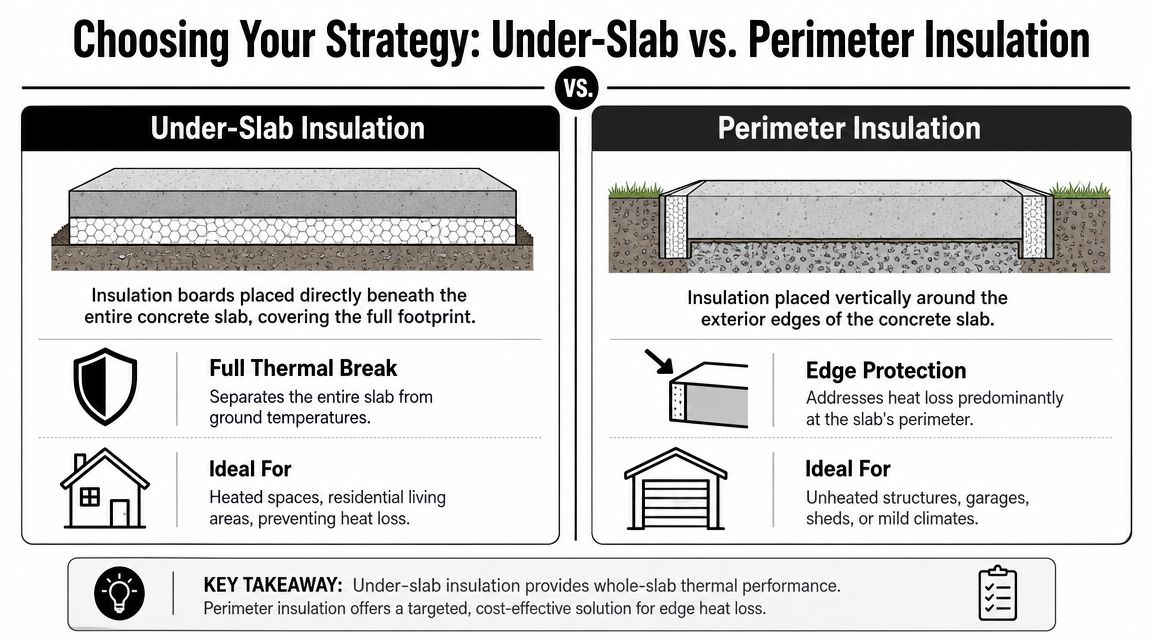
Under-slab insulation
This method places rigid foam beneath the full slab area. It creates a continuous thermal break under the concrete footprint.
It makes the most sense for:
- Heated garages and workshops
- Home additions
- Conditioned outbuildings
- Spaces where floor comfort matters
If you're planning a workspace with regular heat, under-slab insulation is usually the stronger long-term choice. It helps the whole slab behave more predictably, not just the edges.
Perimeter insulation
This method focuses on the outside edge of the slab, where heat loss is often strongest and frost exposure is most critical. For many unheated slabs, this is the minimum area that deserves careful treatment.
It's often the right fit for:
- Unheated garages
- Shed foundations
- Barn shed and utility slabs
- Gazebo foundation work
- Projects where full-area insulation may not deliver enough return
A key research finding in this slab perimeter insulation report showed that adding 600 mm of exterior perimeter insulation with an R-value of 1.0 improved concrete slab foundation performance by about 70%. The same research found that a 100 mm top gap reduced that gain by 25%. That's a practical lesson contractors should never ignore. Edge continuity matters.
What works for common local projects
Here's the way I'd frame it for homeowners in PA, MD, DE, and NJ.
| Project type | Usual insulation priority | Why |
|---|---|---|
| Heated garage | Under-slab plus perimeter | Better comfort and thermal control |
| Unheated garage | Perimeter first | Protects the most vulnerable zone |
| Shed pad | Case by case | Depends on whether the structure is heated and how it's used |
| Home addition | Under-slab plus perimeter | The slab becomes part of the living envelope |
| Patio or lightly used utility slab | Often limited insulation focus | Moisture management and base prep may matter more |
Thermal bridging is the issue behind all of this. If insulation stops short, leaves gaps, or gets interrupted at the thickened edge, cold transfers around the insulation instead of through it. That's why details matter more than many people expect.
For homeowners who want to understand how moisture layers fit into that assembly, this article on a garage floor vapor barrier gives a useful look at how the slab system works together.
A short walkthrough can also help visualize the difference in real-world assembly:
Common Materials for Insulating Your Foundation
Once you know where insulation should go, the next question is what product belongs there. For slab work, the material has to do more than insulate. It also has to handle weight, moisture exposure, and long-term contact with the concrete assembly.
The performance factors that matter most
Three things drive most material decisions.
First is R-value, which tells you the insulation's thermal resistance.
Second is compressive strength, which matters under concrete because the insulation must support the slab and whatever loads the slab carries.
Third is moisture resistance, because foundation materials sit close to damp soil conditions for the life of the structure.
Field takeaway: Under a slab, “good insulation” isn't enough. The board also has to stay stable under load.
Expert guidance in RMAX's overview of psi for under-slab insulation puts 16 psi as the bare minimum for under-slab foam, with 20–25 psi preferred as a safety margin under concrete. That's why low-strength products or the wrong board type can create trouble even if the advertised R-value looks appealing.
The common foam board options
Most residential slab projects use some form of rigid foam board. The names homeowners hear most often are EPS, XPS, and polyiso.
| Material Type | Typical R-Value (per inch) | Compressive Strength | Moisture Resistance |
|---|---|---|---|
| EPS | Varies by product | Available in under-slab grades | Good when specified correctly |
| XPS | Varies by product | Commonly used where higher load resistance is needed | Good |
| Polyiso | Varies by product | Commonly cited as meeting under-slab compressive requirements above 16 psi | Project-dependent |
Because verified product-specific R-values weren't provided here, the safest way to compare them is qualitatively. In practice, the right board is selected by matching the structural load, exposure conditions, slab design, and insulation layout. A detached shed with light use has different demands than a garage that may hold vehicles, equipment, or concentrated storage loads.
What usually works and what doesn't
For under-slab applications, rigid closed-cell foam products are the standard conversation because they can be selected for structural load capacity. A product that performs fine in a wall assembly may not belong under a slab.
What doesn't work well is treating every project the same. That's where mistakes happen:
- Low-load assumptions on a high-load slab: A garage slab carrying vehicles needs a different mindset than a storage shed.
- Choosing by R-value alone: Strong thermal performance means very little if the board deforms.
- Ignoring water exposure: Foundation assemblies live in a wet environment compared with above-grade walls.
- Using the same material at every location: Edge conditions and under-slab conditions can call for different detailing.
Matching material to project type
For a base for storage shed, the insulation strategy may be limited or even unnecessary if the structure isn't heated and moisture control is the bigger concern. For a concrete foundation for garage, structural loading and comfort usually push the conversation toward more robust under-slab planning.
For utility slabs, there's often more value in getting the subgrade prep, drainage, and slab edge right than in paying for full-area insulation that won't deliver much practical benefit. For heated spaces, full under-slab insulation is much easier to justify because the slab becomes part of the occupied environment.
That's also where a contractor's judgment matters. The material should fit the use case, not just the product sheet.
Meeting Local Codes and Climate Needs
Building code matters because slab insulation isn't just a preference issue. In many cases, it's part of meeting the required thermal boundary for the foundation assembly. That's especially relevant in Pennsylvania, Maryland, Delaware, and New Jersey, where seasonal cold, wet ground, and inspection requirements all shape how a slab should be detailed.
What code is looking for
For slab-on-grade floors with a finished surface less than 12 inches below grade, model codes require insulation to extend downward from the top of the slab on either the inside or outside of the foundation wall, according to the slab-on-grade insulation code compliance brief from PNNL. In some climate zones, below-grade insulation must continue to a prescribed depth.
That tells you something important. Code pays special attention to the slab edge because that's where the thermal boundary is easiest to break.
Why local experience matters
A national article can explain the concept, but local execution is where projects pass or fail. Inspectors, site conditions, frost exposure, drainage patterns, and use of the building all affect the final detail.
For example, a small shed slab and a heated garage slab may both be “concrete foundations,” but they won't be reviewed the same way. A homeowner searching for shed foundations contractors near me, garage foundation contractors near me, or excavation near me usually needs someone who can sort out:
- Whether the building is conditioned
- How the slab edge should be insulated
- Whether horizontal or vertical insulation detailing fits the design
- How to protect exposed insulation
- How vapor control and insulation need to work together
Moisture management is part of that discussion too. Even though it's written for a different climate, this guide for Florida homeowners on moisture barriers is still a useful plain-English reference for understanding why ground moisture control belongs in the slab assembly conversation.
Code gives you the minimum line to clear. A durable slab usually comes from combining code compliance with good site-specific detailing.
That's one reason homeowners often get conflicting advice online. One article talks about energy savings. Another talks about frost. Another focuses only on the foam board itself. In the field, those aren't separate decisions. They're one assembly, and each layer has to make sense for the project and the local climate.
Professional Installation for a Flawless Foundation
A slab can look perfect on pour day and still have avoidable problems built into it. I see that most often on small garages, shed pads, and patio slabs where the job gets treated like “just concrete.” In Pennsylvania and Maryland, the projects that hold up best are the ones where the base, moisture control, insulation, and slab placement are handled as one system.
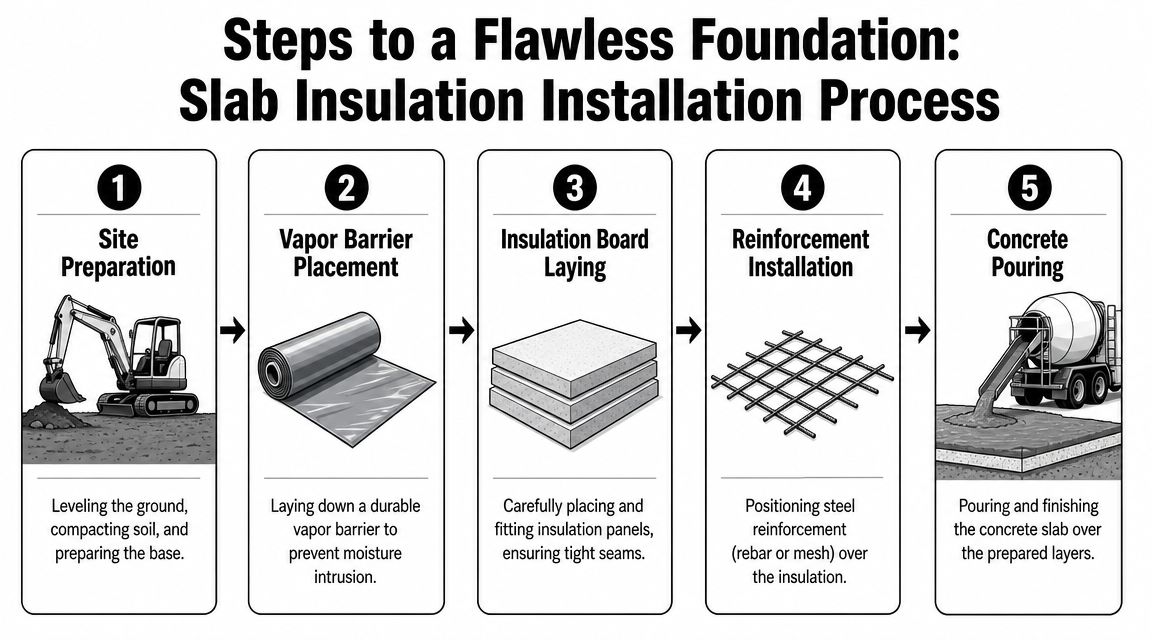
The installation sequence matters
Crews do not get many second chances once the stone base is down and the forms are set. If the subgrade is uneven, the foam rocks. If the vapor barrier gets punctured, ground moisture has a path up. If the insulation joints are loose at the slab edge, that weak spot stays with the slab for its full service life.
A clean installation usually follows this order:
- Subgrade preparation starts with proper excavation, grading, compaction, and drainage control.
- Vapor barrier placement needs full coverage, tight laps, and protection from foot traffic and reinforcement setup.
- Insulation board layout should fit tight, stay flat, and continue where the design calls for edge protection.
- Reinforcement placement has to support the slab without crushing foam or tearing the moisture layer.
- Concrete placement and finishing need to keep the assembly in place while the slab is poured, consolidated, and finished.
Forms matter here too. If you want a plain-language reference on understanding concrete formwork, that article does a good job explaining why accurate forming affects slab edges, thickness, and finish quality.
Where professional crews add value
For a homeowner deciding on a shed, garage, or patio slab, the primary question is usually whether insulation is worth doing on this specific project, and whether the crew can install it without creating other problems. That is where experience shows up in the details. Thickened edges, step-downs, door openings, anchor locations, and control joints all have to work with the insulation plan, not fight it.
Firm Foundations handles excavation, forming, and slab prep as one coordinated scope. That matters because one crew is accountable for how the base, forms, vapor barrier, insulation, and pour sequence fit together. On smaller residential projects in PA, MD, DE, and NJ, that coordination often makes the difference between a slab that just passes inspection and one that stays dry, stable, and comfortable to use.
Crack control belongs in that conversation too. This guide on how to prevent concrete slab from cracking is worth reviewing because good results start before the concrete truck shows up.
Start Your Foundation Project with Confidence
Most homeowners don't need a lecture on building science. They need a clear answer to one question. Is slab insulation worth it for this project?
The short answer is that it depends on use. STRUCTURE Magazine's discussion of right-sizing under-slab insulation makes that point well. Unheated utility slabs may prioritize moisture control and edge detailing, while heated buildings justify full under-slab insulation.
A simple checklist that keeps the decision clear
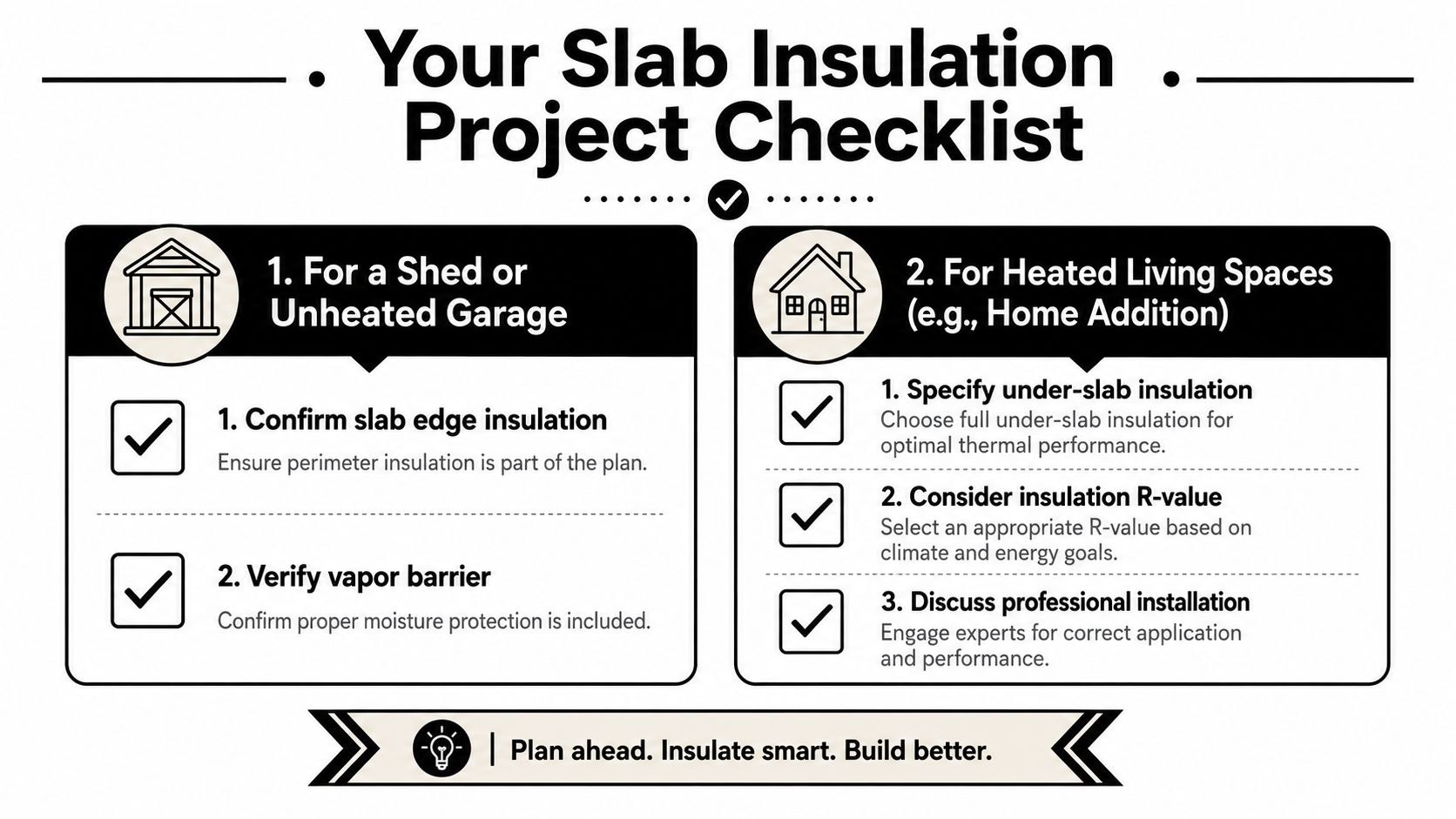
- For a shed or unheated garage: Confirm the slab edge is being handled properly and make sure a vapor barrier is part of the assembly.
- For a heated garage, workshop, or addition: Plan for under-slab insulation along with perimeter insulation so the slab performs as part of the conditioned space.
- For any slab: Ask how the insulation transitions at the edge, how the moisture layer is protected, and whether the selected foam is rated for the load.
The right slab isn't the one with the most insulation. It's the one designed for how you'll actually use the building.
If you're comparing options for a shed foundation gravel base, a concrete foundation for garage, a 10×10 storage shed, or a larger home-related project in PA, MD, DE, or NJ, matching the slab system to the use case is what protects your budget and your building.
If you're planning a new shed pad, garage slab, patio foundation, or house-related concrete work in Pennsylvania, Maryland, Delaware, or New Jersey, Firm Foundations can help you sort out the right slab insulation strategy before the pour. Reach out for a free quote and get a foundation plan built around your site, your structure, and how you'll use it.