
Concrete Slab Thickness for House: Key Factors for 2026
A typical concrete slab for a house is 6 to 8 inches thick. That’s the baseline most homeowners should start with, but the right slab thickness changes with soil, load, frost exposure, and local code requirements.
If you’re planning a house, garage, shed, or gazebo in Pennsylvania, Maryland, Delaware, or New Jersey, this is usually the point where the project starts to feel more serious. Blueprints look manageable until you hit the word foundation, and then the questions pile up fast. How thick does the slab need to be? What works for a shed versus a full house foundation? What happens if the ground holds water, shifts in winter, or doesn’t compact well?
Those are the right questions to ask.
Foundation work isn’t where guesswork pays off. The slab under a home has to do a different job than the base for a storage shed, a detached garage, or a patio. In this region, frost, mixed soil conditions, drainage, and township permit requirements all matter. A slab that looks fine on pour day can still become a problem later if the thickness, reinforcement, and base prep weren’t matched to the site.
This guide is written from a contractor’s perspective. It focuses on what holds up in the field, what fails, and why local conditions in PA, MD, DE, and NJ change the answer.
Planning Your Foundation in PA, MD, DE, or NJ?
A lot of homeowners start in the same place. They’ve picked the building size, talked through the layout, maybe even chosen finishes, and then the foundation becomes the sticking point. The structure feels exciting. The slab feels intimidating.
That hesitation makes sense. Once concrete is in the ground, changing it isn’t simple. If the slab is undersized, poorly prepared, or wrong for the soil, you don’t just get cosmetic issues. You can end up with cracking, uneven settlement, door problems, moisture trouble, and expensive rework under a structure that’s already built.
Why this region changes the conversation
In PA, MD, DE, and NJ, one-size-fits-all advice often falls short. A site in inland Pennsylvania with frost concerns and heavier clay behaves differently than a coastal or lower-drainage site in Delaware. Parts of New Jersey bring their own mix of seasonal movement and permit scrutiny. Maryland sites can vary widely depending on grade, fill history, and drainage patterns.
Practical rule: The slab design has to fit the ground it’s going on, not just the building sitting above it.
That’s why experienced contractors don’t answer slab questions by throwing out a single number and calling it done. They look at what’s being built, what the site is doing, and what local inspectors will require before the first truck arrives.
What homeowners usually need to know first
Our readers aren’t asking for engineering theory. They want clear answers to practical questions:
- House foundation: Is this slab thick enough to carry the structure long term?
- Garage foundation: Will it handle vehicles, wall loads, and daily use without premature cracking?
- Shed foundation: Is concrete necessary, or will a gravel shed foundation make more sense?
- Permit concerns: Will the township accept the plan as built?
- Site prep: Has the ground been excavated, graded, and compacted properly?
If you’re comparing options for a house foundation, garage footings and foundations, or even a base for storage shed projects, those decisions should be made together, not separately. Thickness, reinforcement, drainage, and excavation all work as one system.
Typical Concrete Thickness for Houses Garages and Sheds
The easiest way to think about slab thickness is to compare it to footwear. A sneaker works for a sidewalk. A work boot handles more load and abuse. A climbing boot is built for serious support. Concrete works the same way. The heavier the job, the stronger and thicker the slab needs to be.
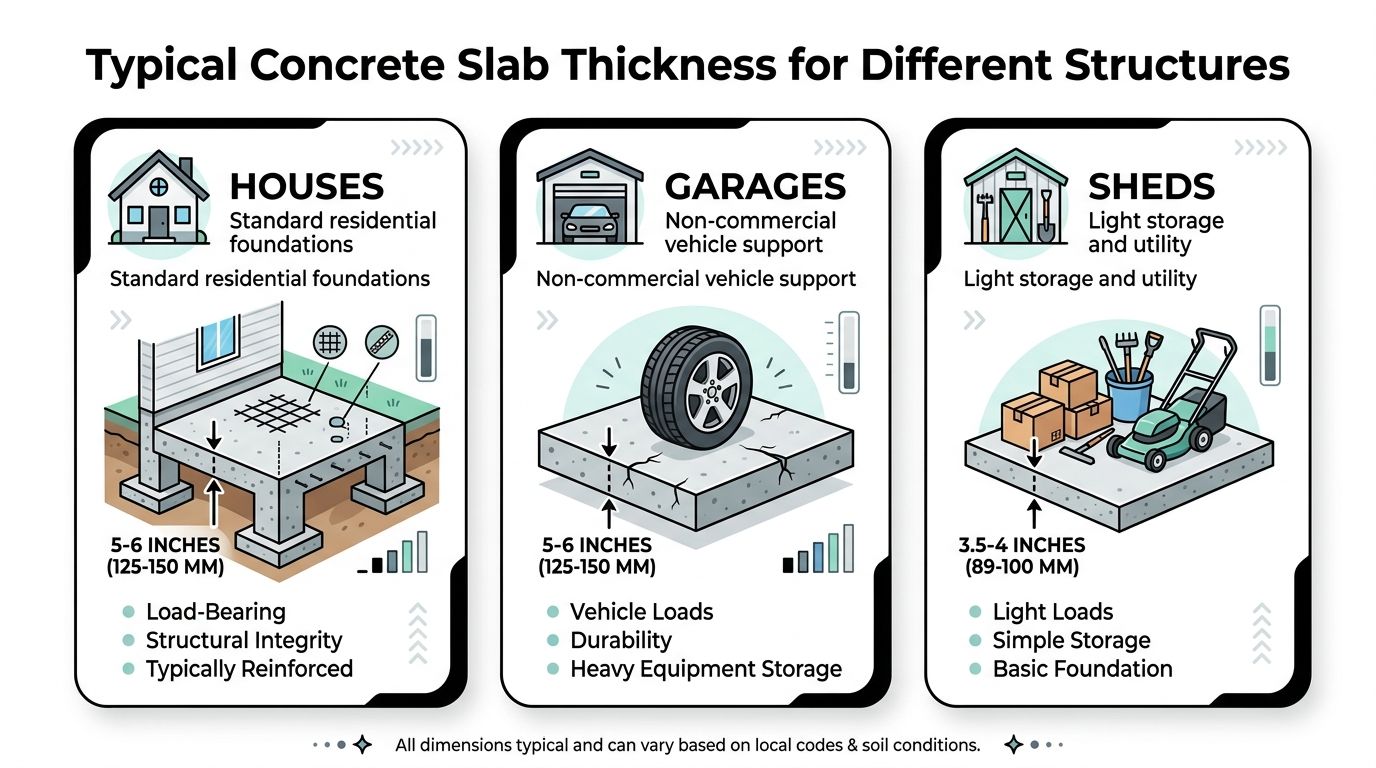
For slab-on-grade house foundations, widely cited residential guidance places the typical thickness at 6 to 8 inches, while patios and sidewalks are commonly 4 inches and light-use driveways about 4 to 5 inches. The reason is simple. A house slab carries the structural load of the building, not just foot traffic or vehicle weight, so builders generally specify a thicker section for long-term stability and reduced settlement risk, as noted in residential slab thickness guidance from Sensible Concrete.
A simple comparison that helps
Here’s the practical breakdown most homeowners need:
| Structure | Typical use | Common thickness guidance |
|---|---|---|
| Small shed or light utility slab | Light storage and basic utility use | Often closer to patio-level construction if loads are light |
| Garage slab | Vehicle support and wall loads | Usually more substantial than a patio, often with thickened edges |
| House slab | Full residential structural support | 6 to 8 inches is a common baseline |
That’s why a shed foundation and a house foundation should never be treated as interchangeable. A small barn shed, a 10×10 storage shed, or a gazebo foundation may perform well on a properly built gravel pad or a lighter slab. A home won’t.
For garage projects, homeowners often search for garage foundation contractors near me and assume the slab should match a driveway. It usually shouldn’t. A garage slab has to support the parked load, the walls around it, and the repeated stress of vehicles turning in and out. If you’re comparing options for a detached or attached garage, this guide on garage foundation contractors near me and concrete thickness in PA is a useful local reference.
What works and what doesn’t
A thin slab works when the use is light and the base is right.
A thin slab does not work when homeowners try to stretch a shed standard into a garage standard, or a garage standard into a house foundation. That’s where trouble starts.
A house slab isn’t just a floor. It’s part of the structure’s load path.
If you’re budgeting a project in PA, MD, DE, or NJ, the smart move is to separate the structure types clearly. Concrete foundations for houses need one level of design. Cement foundations for garage projects need another. A base for storage shed work may be different again.
What Really Determines Your Slab’s Thickness
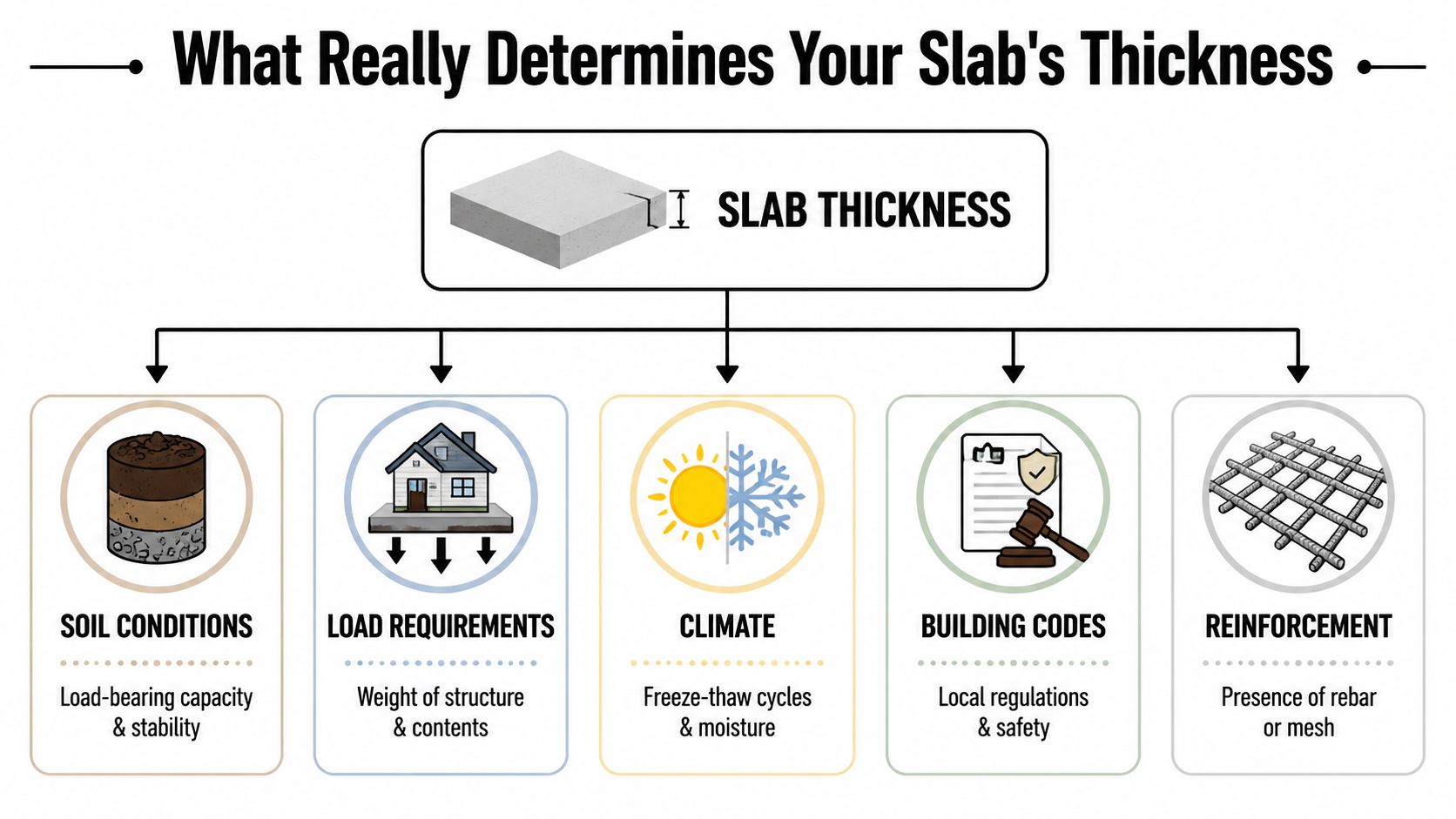
Concrete thickness isn’t picked by preference. It’s driven by conditions on the ground and demands above it.
For house slab foundations, reinforced residential practice commonly lands in the 8 to 10 inch range for structural house foundations, especially where the slab is carrying the building load rather than serving only as a floor surface. This thicker approach is typically paired with steel rebar and, in cold or freeze-thaw regions, design features such as frost-depth footings and moisture control because load, soil conditions, and exposure push the thickness upward, as explained in reinforced house slab guidance from Groupe Bellemare.
Load changes everything
A slab under a house handles a very different job than a slab under a playset or a 4×8 shed with foundation blocks. Walls, roof systems, interior finishes, cabinetry, appliances, and daily living loads all transfer weight into the slab system.
That’s why the phrase concrete slab thickness for house can’t be answered responsibly without knowing the structure. If the slab is structural, the build often moves beyond baseline residential thickness and into reinforced practice with more demanding details.
Soil decides whether the slab stays where it belongs
In this region, soil can make or break a foundation. Expansive clay, soft fill, wet areas, and poorly compacted subgrade all increase movement risk. A slab can be poured beautifully and still fail if the ground underneath wasn’t prepared correctly.
That’s also why compaction matters so much. If you want a practical overview of what contractors are trying to achieve before the pour, this page on soil compaction and why it matters under foundations gives helpful background.
A good slab on bad ground is still a bad foundation.
Frost and moisture are local realities
PA and NJ homeowners run into this often. Winter ground movement isn’t a minor issue. If frost affects the supporting soils and the foundation system wasn’t designed for it, the slab can lift, shift, and crack. Moisture makes that worse by weakening support and creating expansion and contraction cycles.
Local experience matters more than generic online advice. The same slab detail won’t behave the same way on every site.
Here’s a useful field checklist contractors use when deciding whether the slab design needs to be stronger:
- Structure weight: A full house puts far more demand on the slab than a shed foundation kit or a gazebo foundation.
- Soil stability: Fill material, clay content, and drainage conditions can force thicker construction and better reinforcement.
- Freeze-thaw exposure: Colder sites need details that protect the foundation from movement.
- Water management: Surface runoff, roof drainage, and groundwater all affect long-term slab performance.
A short visual walkthrough can help if you want to see these principles in action.
Reinforcement is part of the answer, not a shortcut
Rebar helps concrete handle stress. It doesn’t excuse poor thickness, poor base prep, or poor drainage. Some homeowners hear “reinforced slab” and assume that means the slab can be thinner without consequences. That’s not how lasting foundations are built.
Reinforcement works best when it’s part of a complete system. Proper excavation, compacted base, correct slab thickness, moisture management, and steel placed where it belongs. Remove one piece, and the whole assembly gets weaker.
Navigating Local Building Codes and Permits
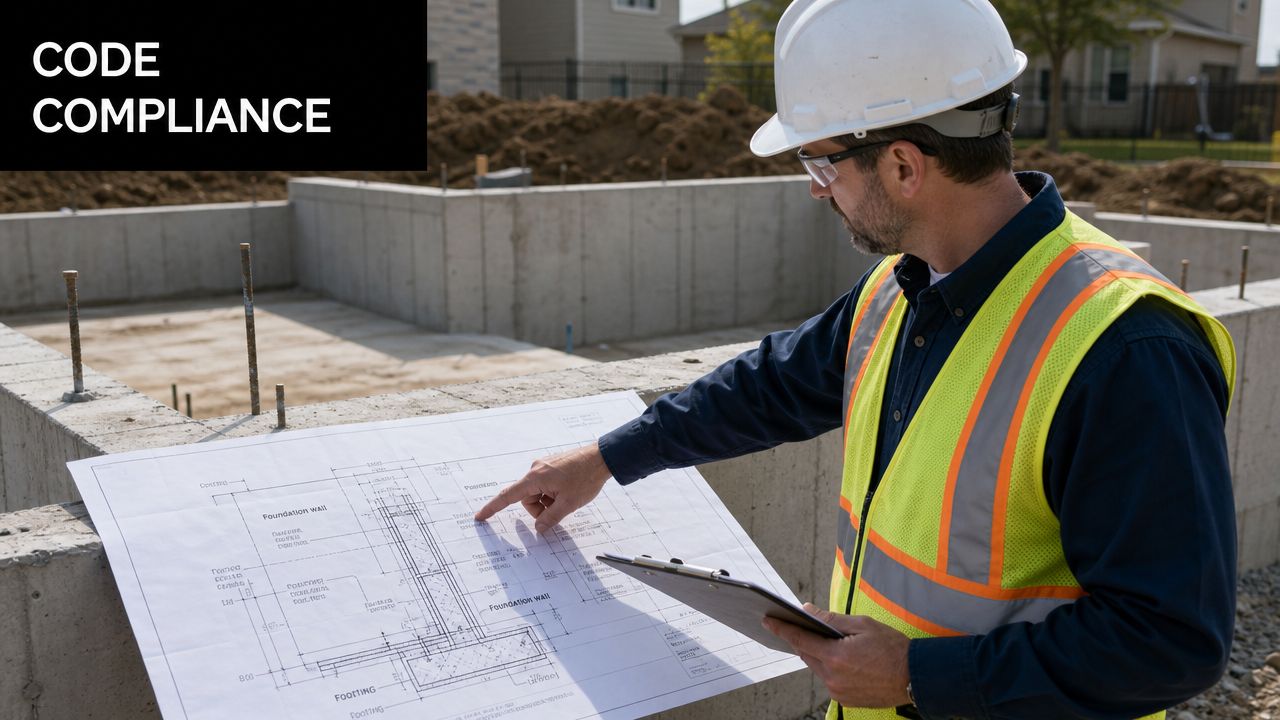
A foundation that “looks fine” isn’t enough. In PA, MD, DE, and NJ, local building departments care about code compliance, approved plans, footing details, inspections, and site-specific requirements. They should.
That’s especially important for homeowners building houses, detached garages, and larger outbuildings. Code isn’t there to make your project harder. It’s there to keep you from inheriting structural and resale problems later.
Why local review matters
Townships and municipalities don’t all handle permits exactly the same way. One area may focus heavily on setbacks and drainage. Another may pay closer attention to footing depth, reinforcement details, or inspection timing. In places like Honey Brook Township, homeowners can run into delays because the plan submitted doesn’t match what the township expects to see.
That’s where people get tripped up. They search for concrete contractors, driveway contractors near me, or excavation near me, get a low quote, and assume permits are routine. But routine work still needs to match local requirements.
Common permit issues homeowners underestimate
Some of the most common problems aren’t dramatic. They’re paperwork and sequencing mistakes.
- Unclear scope: The permit says one thing, but the contractor builds another.
- Missing foundation details: Slab thickness, reinforcement, or footing information isn’t documented clearly enough.
- Inspection timing problems: Work moves ahead before the required inspection happens.
- Drainage oversight: The site plan doesn’t show how water will move away from the slab.
- Use mismatch: A slab intended for light storage gets used for heavier structural or vehicle loads.
Hiring a contractor who knows local permit flow saves time, but more importantly, it prevents avoidable corrections after concrete is already in place.
Codes also protect resale value
This gets overlooked until a homeowner tries to sell. Unpermitted or questionable foundation work can trigger concerns during buyer inspections. Even if the slab hasn’t visibly failed, undocumented work raises questions about safety, drainage, frost protection, and structural adequacy.
For house foundations, garage footings and foundations, and larger concrete forms, compliance isn’t optional. It’s part of building something that lasts and can be defended later. The cleanest projects are the ones where the foundation plan, the permit, the inspection record, and the finished work all line up.
Costly Concrete Foundation Mistakes We Help You Avoid
The cheapest foundation price often becomes the most expensive foundation decision.
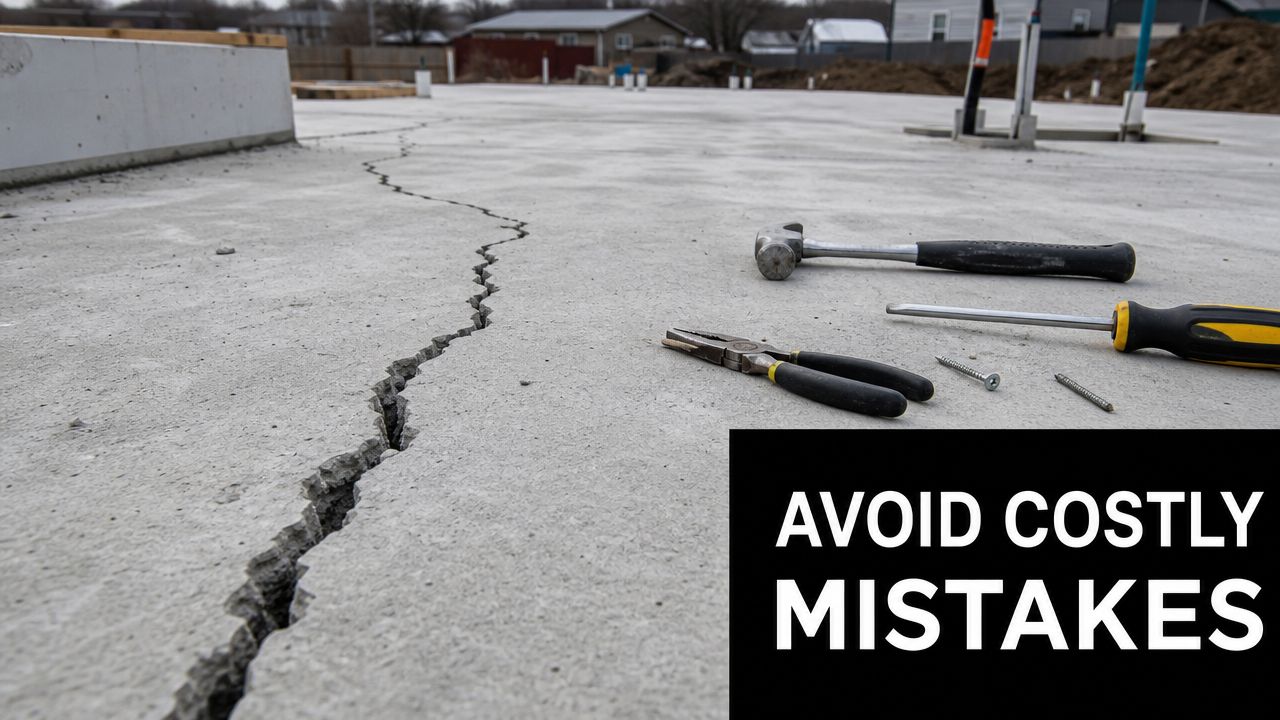
Most slab failures don’t start with one dramatic mistake. They start with a series of shortcuts. The excavation is rushed. The base isn’t compacted enough. Reinforcement sits in the wrong place. Water control is treated like an afterthought. Then the slab gets blamed when the underlying issue was the process.
Mistake one is building on poorly prepared ground
This is the one that causes the most lingering problems. If the subgrade is soft, wet, uneven, or loosely compacted, the slab may settle inconsistently. That can show up as cracks, sloping, stuck doors, or visible edge separation.
A lot of homeowners assume concrete is strong enough to bridge bad prep. It isn’t. Concrete needs support from below.
Mistake two is choosing slab details by price instead of use
This happens all the time with garages and outbuildings. Someone prices a slab as if it’s only for light storage, then the owner parks vehicles on it, stores heavy equipment, or builds a larger structure than originally discussed. The foundation was never matched to the actual load.
That’s also why leak and moisture issues can become more serious than people expect. Once water starts moving under or through slab areas, the damage doesn’t stay isolated. Homeowners dealing with slab-related moisture concerns may also need to understand the role of addressing underground leaks before those issues undermine surrounding areas.
Bad drainage turns small foundation flaws into big ones.
Mistake three is poor reinforcement placement
Rebar can’t do its job if it’s misplaced, unsupported, or treated like a box-checking exercise. The same goes for joint planning and edge support. These details aren’t glamorous, but they matter in the finished slab.
Here’s what experienced crews watch closely during a pour:
- Base condition: Stable, compacted, and ready before forms are set
- Form accuracy: Lines, elevations, and edge dimensions checked before concrete arrives
- Reinforcement position: Steel placed where the design intends it to work
- Drainage planning: Grade and runoff managed before the slab traps water
- Use case alignment: House foundation, garage slab, or shed foundation built for the actual load
The long-term cost of fixing foundation defects is usually far worse than paying for proper preparation upfront. Cracks can sometimes be patched. Settlement, recurring moisture, and structural movement are much harder to hide and much harder to solve.
Start Your Project with a Trusted Foundation Contractor
Foundation work goes smoother when the next step is clear. Most homeowners don’t need more theory at this point. They need a straightforward way to move from questions to a buildable plan.
What to do next
Start with the actual structure and the actual site. A house foundation, a concrete foundation for garage use, and a gravel or concrete shed foundation all ask different things of the ground. The right contractor should look at those differences before talking about final thickness, forms, or pour day.
A simple process usually works best:
- Request a quote for your house foundation, garage slab, gazebo foundation, or shed foundation.
- Schedule a site assessment so the contractor can evaluate access, grade, soil behavior, drainage, and intended use.
- Review a clear proposal that explains the scope, preparation, and foundation type without vague allowances.
What a good quote should tell you
A useful proposal doesn’t just give a price. It should help you understand what you’re paying for.
Look for clarity around:
- Site preparation: Excavation, grading, and base work
- Foundation type: Gravel pad, slab, thickened edges, or other structural details
- Intended use: Whether the slab is for a house, garage, barn shed, hot tub, shipping container, or another structure
- Drainage approach: How water will be moved away from the finished foundation
- Project scope: What’s included, what isn’t, and what permit coordination may be required
The best foundation projects feel boring in the right way. The site is prepared correctly, the pour goes as planned, and nothing surprises you later.
Why this decision matters
The foundation is the one part of the project everything else depends on. Rooflines, framing, doors, finishes, and long-term performance all start there. If you get the slab right, the rest of the build has a fair chance to go right too.
If you’re comparing concrete contractors in PA, MD, DE, or NJ, focus on who understands local soils, frost concerns, drainage, and intended building use. That’s what protects the structure long after the forms are stripped.
Frequently Asked Questions About Foundations
Do I really need a concrete slab for my shed?
Not always. For many smaller sheds, a properly built gravel pad is a better fit than concrete. It drains well, can be more forgiving for lighter structures, and often matches what shed builders want for installation. That’s why many homeowners search for gravel shed foundation contractors near me instead of defaulting to concrete.
Concrete usually makes more sense when the shed is larger, heavier, used for equipment, or expected to function more like a workshop than simple storage. The right answer depends on size, use, access, and site drainage.
How deep should footings be for a garage in Pennsylvania?
The exact depth is set by local code and site conditions, so it shouldn’t be guessed. In Pennsylvania, frost concerns are a major reason garage footings and foundations need careful review. If the footing system doesn’t account for frost exposure, movement can show up seasonally and damage the slab above.
For detached garages, this is one of the first items worth confirming with your contractor and local building department before work starts. It’s much easier to build to code up front than correct it after inspection.
Can you pour a new foundation in the winter?
Yes, in many cases you can, but winter pours require tighter control. Ground conditions, temperature, curing protection, moisture, and scheduling all need closer attention. The concrete itself is only part of the equation. Excavation, subgrade condition, and protection after the pour matter just as much.
Winter foundation work can go well when the crew plans for the weather instead of trying to outrun it. Homeowners shouldn’t assume every contractor handles cold-weather work with the same level of care.
If you need a shed pad, garage slab, house foundation, or excavation work in Pennsylvania, Maryland, Delaware, or New Jersey, Firm Foundations is built for exactly that kind of work. The team handles site prep, grading, drainage-minded foundation planning, and durable concrete or gravel foundation builds with a clear quoting process and no guesswork. Reach out for a free quote and get a foundation plan that fits your structure, your site, and your local code requirements.