
Garage Floor Lift: Foundation Requirements for PA & MD Homes
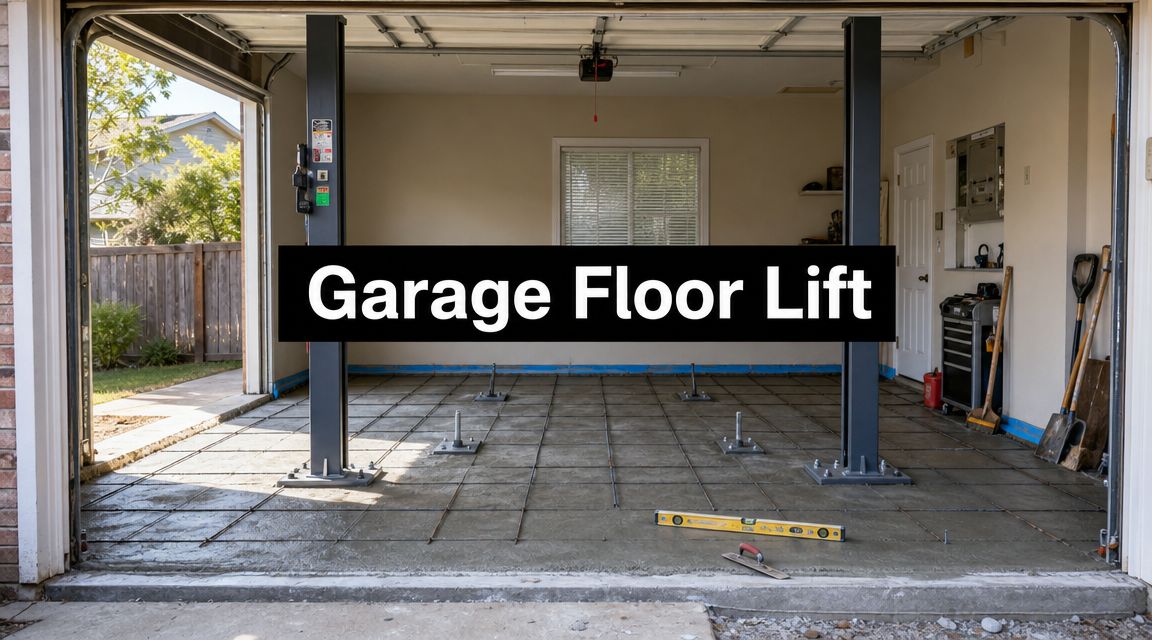
You've found the lift you want. Maybe it's a two-post for real maintenance access, or a four-post so you can stack vehicles and finally get your garage back. Then the uncomfortable question shows up late in the process. Can your current garage floor support it?
That's where many homeowners in Pennsylvania, Maryland, Delaware, and New Jersey get tripped up. They assume the main issue is overhead clearance, door tracks, or where the power unit will sit. In practice, the first hard stop is often the slab under your tires, not the lift you picked.
A garage floor lift puts serious force into a small area of concrete. If the slab is thin, weak, uneven, cracked, or poorly reinforced, the install can go from exciting to risky fast. That's why the safest approach is foundation first. Before anyone drills anchors or unloads steel posts, the floor has to prove it belongs in the plan.
Planning a Car Lift Start with Your Garage Foundation
A common scenario goes like this. A homeowner has the garage cleaned out, the lift model chosen, and a plan for one car above another or easier brake and suspension work below. Then the installer asks about slab thickness, reinforcement, and floor condition, and suddenly nobody is talking about lift color or accessories anymore.
That shift is warranted. Many homeowners assume a lift is mainly a clearance problem, when in reality slab condition and thickness are the primary decision points. Guidance on uneven or thin slabs also notes that the right fix may be a new reinforced pad, not just thicker shims, especially for two-post lifts where load is highly concentrated, as explained in this industry discussion of lift installs on less-than-ideal floors.
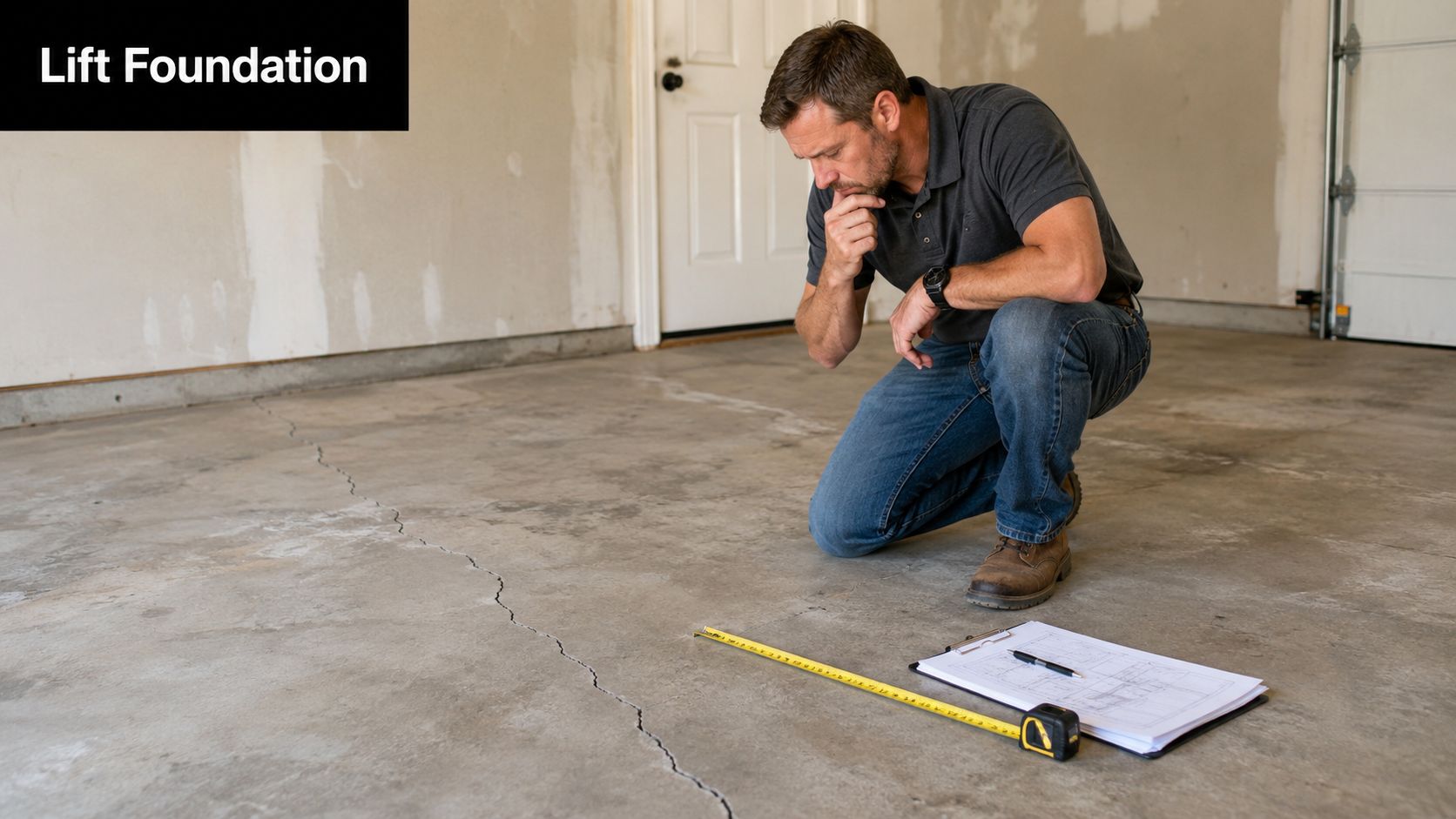
What catches homeowners off guard
Most residential garage slabs were poured for parked vehicles and light daily use. A lift changes the load pattern. Instead of weight being spread naturally through tires, the slab has to handle concentrated forces at posts, anchor points, and base plates.
That's why a floor that “looks fine” can still be the weak link. Surface appearance matters, but hidden conditions matter more. Old repairs, thin edges, soft subgrade, and unverified concrete strength can all change whether a garage floor lift is a solid plan or a liability.
A lift install should start the same way any good structural project starts. Verify what's under you before you build on it.
Why the foundation-first approach works
A good slab gives the installer a level, dependable surface and gives the homeowner peace of mind. It also protects the investment in the lift itself. Nobody wants to pay for equipment, delivery, and setup only to stop because the anchors can't safely go into the floor.
For readers comparing lift mechanisms and shop equipment, Wilcox Door Service expertise is a useful reference point for how lifting systems are designed around stable support and controlled movement. The same logic applies in a garage. The lifting equipment only performs safely when the base supporting it is right.
In practical terms, that means the garage foundation deserves first priority. If the slab is questionable, solving that early is almost always cleaner and cheaper than trying to work around a bad floor later.
Understanding Garage Slab Strength and Lift Requirements
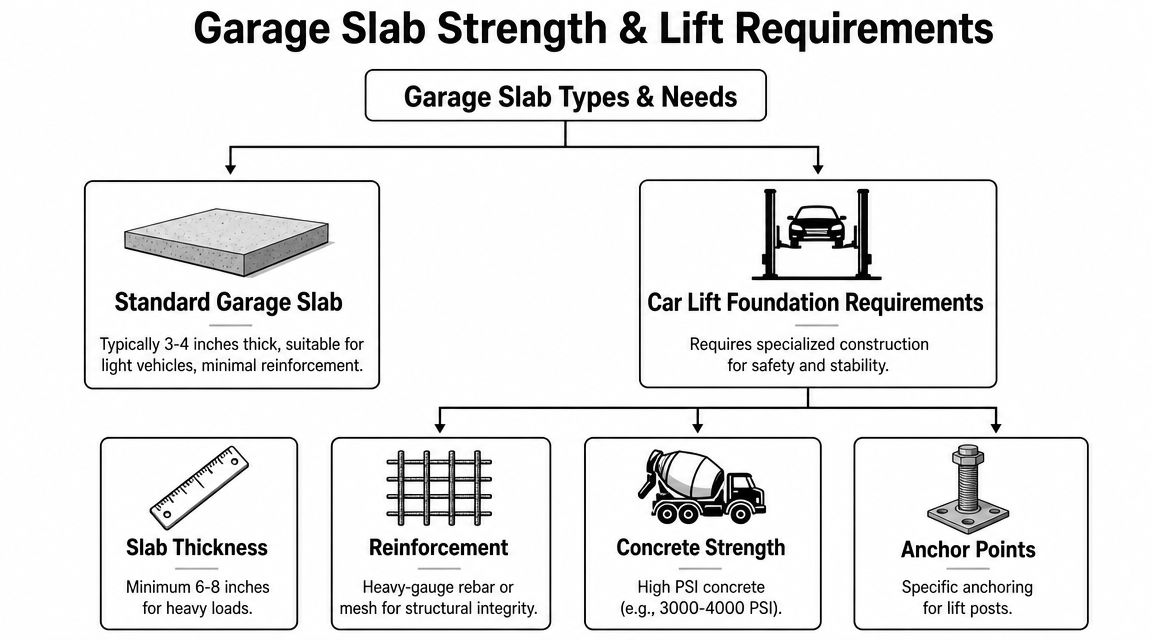
A car lift changes the job your slab has to do. Parking spreads load through four tires across a broad area. A lift concentrates that force at posts, base plates, and anchors, and the slab has to resist compression, cracking, and movement at those specific points.
That is why slab thickness by itself is never enough.
For home lifts in the common 7,000 to 10,000 lb range, manufacturers often call for a minimum slab thickness and minimum concrete strength, along with height and layout clearances that have to be checked before installation. One published reference on garage lift requirements lays out those baseline numbers. They are a starting point, not a substitute for verifying the floor you have.
What PSI actually tells you
PSI measures compressive strength. In plain terms, it tells you how much load the concrete can take before it crushes.
For a lift, that matters because the slab is dealing with concentrated pressure, not just the static weight of a parked vehicle. The anchors also create localized stress around each drilled hole. If the concrete is weak, thin, poorly cured, or unsupported below, the problem usually shows up as cracking around the base, anchor failure, or slab movement that keeps the lift from staying true.
Strength on paper also does not fix poor support underneath. A good mix placed over weak, shifting subgrade still gives you a bad foundation.
Why two-post lifts demand more from the slab
Two-post lifts usually put the highest demands on a garage floor because most of the load is carried at two column locations. That creates higher stress at each base plate and greater pull on the anchors as the vehicle rises.
BendPak spells that out in its concrete floor requirements for lift installations, including slab thickness, compressive strength, and reinforcement requirements that vary by model. That should tell any homeowner the same thing it tells installers. Lift safety starts below the posts.
If the slab was poured years ago and nobody can confirm thickness, PSI, reinforcement, or subgrade prep, the safe answer is not to guess. It is to verify the slab or replace it with one built for the load.
Four-post lifts are more forgiving, but the floor still matters
A four-post lift spreads weight across more contact points, so it is often easier on the slab than a two-post system. It still needs a floor that is sound, level, and properly built. Weak concrete, edge deterioration, or settlement can still create trouble during installation and use.
For homeowners planning a new slab, the concrete mix, reinforcement, finish, and curing method all affect how well that floor performs long term. This guide on the best concrete for garage floor applications is a useful reference if you are sorting through those decisions before a lift goes in.
The real requirement
A lift needs more than concrete. It needs a slab with known thickness, known strength, reinforcement where it belongs, and stable support below it.
That is the foundation-first approach. It avoids expensive guessing, protects the lift investment, and gives you a floor that is built for the load instead of merely hoping it can handle it.
How to Tell if Your Concrete Floor Is Strong Enough
You can learn a lot from a careful walk through your garage. You won't get a full engineering answer from a visual check alone, but you can spot warning signs that say the floor needs professional evaluation before anyone talks installation.
Start with the visible surface
Look for conditions that suggest movement, weakness, or poor bond at the surface:
- Wide or active cracks that show separation, height difference, or continued movement
- Spalling and flaking where the top layer is breaking loose
- Settlement near walls or door openings where the slab appears to dip
- Moisture staining or chronic dampness that may point to drainage issues under or around the slab
- Old patchwork that tells you the floor has already had trouble
Hairline shrinkage marks aren't always a deal breaker. Cracks with displacement are a different story. If one side sits higher than the other, the slab isn't just cosmetically cracked. It has moved.
Check level and flatness
A lift needs more than enough strength. It also needs a floor that isn't badly sloped or uneven. Set a long straightedge or level across different parts of the bay and look for rocking, gaps, or obvious fall. Pay close attention where the posts or runways would sit.
A garage built to shed water toward the door may be fine for parking, but not fine for a lift. Installers can shim within limits, but shims are not a substitute for a bad slab.
If the floor needs too much correction, the issue has moved from installation to structure.
What you can't confirm by eye
The big unknowns are usually the ones that matter most. You often can't tell slab thickness, reinforcement type, concrete strength, or sub-base quality just by looking at the surface. Older garages are especially tricky because records may be missing and the slab may have been altered over time.
When homeowners want a stronger answer before committing to a garage floor lift, this overview of concrete thickness for garage slab projects helps frame what should be verified. In the field, a definitive evaluation often includes checking plans if they exist, taking measurements, and in some cases core drilling to confirm thickness and reinforcement.
When to stop guessing
If the floor shows movement, major cracking, unevenness, or unknown construction, don't let anyone sell you confidence based on a glance. A lift can wait. A failed slab repair after installation is much harder to fix than doing the floor correctly first.
Garage Floor Repair vs Replacement for a Car Lift
Once a slab is found to be inadequate, homeowners usually ask the same question. Can this be repaired, or does it need to be replaced? The honest answer is that repairs have their place, but a car lift is not a forgiving application.
For patios, sidewalks, and general garage use, leveling or patching can be reasonable. For a garage floor lift, the standard is higher because the slab becomes part of the safety system. If the concrete can't reliably support anchors, resist concentrated loading, and stay stable over time, the repair hasn't solved the underlying problem.
Three common paths homeowners consider
The first is slab jacking or poly lifting. That can raise settled concrete and improve levelness. It does not turn weak, thin, or poorly reinforced concrete into a purpose-built lift foundation.
The second is patching or resurfacing. This helps appearance and can address isolated surface damage. It does not add meaningful structural depth where a lift needs it.
The third is full replacement. That means removing the inadequate slab, preparing the base correctly, placing proper reinforcement, and pouring new concrete built for the intended load. For lift support, that's usually the cleanest answer.
Comparing Garage Floor Solutions for a Car Lift
| Solution | Best For | Suitability for Lifts | Durability | Typical Cost |
|---|---|---|---|---|
| Slab jacking or poly lifting | Correcting settled concrete that is otherwise structurally sound | Limited. May improve levelness but does not reliably solve thin slab, weak concrete, or poor reinforcement issues | Moderate when underlying slab is sound | Varies by slab size, access, and extent of settlement |
| Patching or resurfacing | Surface blemishes, minor spalling, cosmetic improvement | Poor for lift support if structural concerns exist below the surface | Short to moderate depending on slab condition and traffic | Usually lower upfront than replacement |
| Full slab replacement | Garages with unknown slab specs, structural cracks, thin concrete, poor drainage, or planned lift installation | Best option for a purpose-built garage floor lift foundation | High when sub-base, reinforcement, and concrete are built correctly | Higher upfront, but better aligned with long-term lift use |
Why repairs often fall short
Repairs tend to address symptoms. A low corner gets raised. A rough surface gets skimmed. A crack gets filled. None of that guarantees that the slab below the repair can take concentrated post loading year after year.
That matters most with two-post lifts. When force is concentrated at two column locations, the slab and reinforcement have to act predictably. If the existing floor is thin in one spot, lacks reinforcement, or has hidden voids underneath, repairs can leave too much uncertainty.
When replacement is the better decision
Replacement makes sense when the slab thickness is unknown, the concrete is deteriorated, the floor is out of level beyond what installation can reasonably absorb, or there are signs of settlement and drainage trouble. It also makes sense when you want the garage arranged around the lift from the start instead of trying to squeeze the lift into a slab that was never designed for it.
A new slab also gives you layout control. Post locations, bay spacing, approach path, and future vehicle choices can all be considered before the pour. That's a better way to build than drilling into a questionable slab and hoping it cooperates.
For lift projects, replacement isn't overkill. It's often the first option that actually solves the whole problem.
The long-term view
A garage floor lift changes how you use the building. It turns storage space into working space. If that's the plan, the floor should match the job. A sound replacement slab may cost more upfront, but it avoids stacking expensive equipment on top of unknown concrete.
That's why contractors who build concrete foundations for garages, shop additions, and equipment pads usually favor a purpose-built slab over trying to rescue a floor that was never intended for this use. For a safety-critical install, reliability beats improvisation.
Our Process for Building Your New Garage Foundation
A lift project usually feels real when the old floor comes out. Once the slab is opened up, the unknowns stop being guesses. Soft fill, water movement, shallow edges, and inconsistent thickness show up fast. That is why we start with the foundation, not the lift brochure.
The work starts below finished floor level
If an existing slab is in the way, we remove it and clean the site down to material we can evaluate. That step matters because a new pour is only as good as the ground under it. Weak subgrade, buried debris, wet pockets, or poorly compacted fill can all shorten the life of a lift slab.
That hidden work decides whether the floor stays stable under load.
Sub-base, layout, and steel set the slab up to succeed
After excavation, the base is graded to the right depth and compacted. If drainage support is needed, we install stone to help the slab bear evenly and shed moisture. Then we set forms for the exact slab dimensions, elevations, and bay layout so the finished floor fits the lift plan instead of forcing compromises later.
Reinforcement is part of the structure, not an upgrade. Lift manufacturers often call for specific slab details around anchor loads, including rebar size and spacing, and those requirements need to be matched before concrete is ordered. Guessing here creates problems that are expensive to fix once the slab has cured.
The safest lift slab is the one built to known conditions, with known thickness, known steel, and known support underneath.
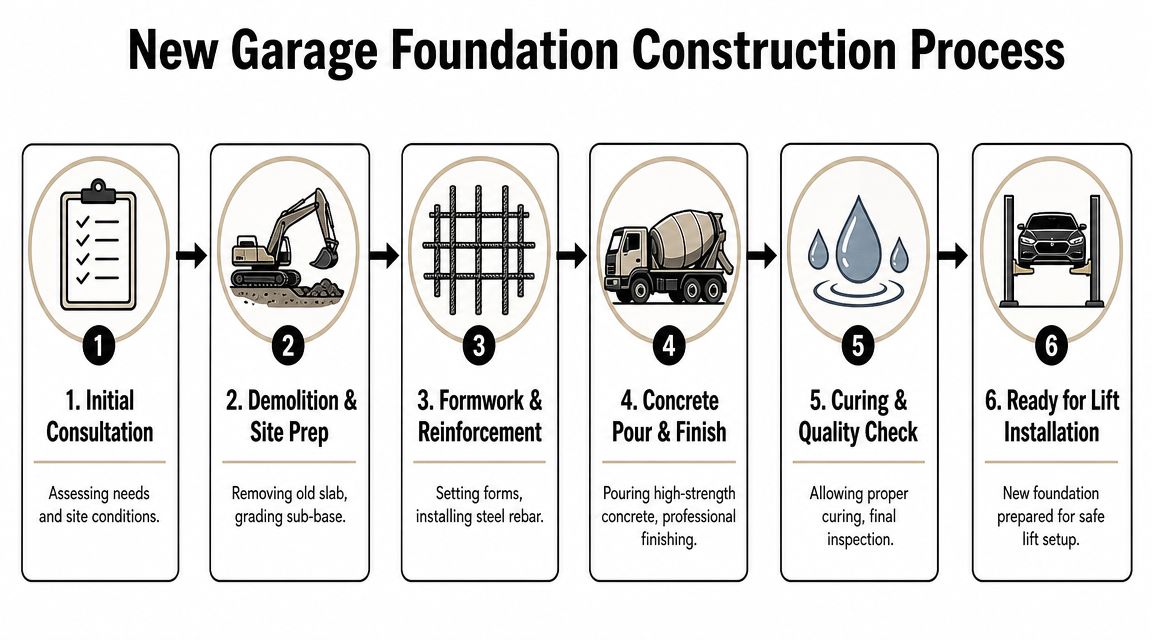
Our field process usually follows this order:
- Demolition and removal. Break out inadequate concrete and expose actual site conditions.
- Excavation and grading. Cut to proper depth and establish a stable footprint.
- Sub-base preparation. Compact the base and correct drainage or soft spots.
- Forms and reinforcement. Set slab boundaries and install steel to the planned pattern.
- Concrete placement and finishing. Place, consolidate, and finish for garage use and lift installation.
- Curing and readiness review. Protect the slab and wait until it has gained the strength needed for anchors and service loads.
A short visual can help homeowners understand what proper slab construction looks like in practice:
The pour gets attention, but the details around it matter just as much
Concrete placement has to be controlled. So does finishing. A floor that is too slick can create traction issues. A floor that is too rough can hold dirt, wear harder, and make the bay less usable. The right finish depends on how the garage will be used, where the lift sits, and how vehicles will enter, park, and be serviced.
Curing also needs patience. Concrete gains strength over time. Drilling and anchoring too early can weaken the slab before the lift ever sees a vehicle.
Why we usually recommend a purpose-built slab for lift projects
Homeowners often ask if an older floor can be strengthened enough to make it work. Sometimes parts of it can be patched or thickened, but that still leaves unanswered questions about the rest of the slab and the support below it. For a lift, uncertainty is the problem.
A new garage foundation gives a clean starting point. The thickness is known. The reinforcement is known. The sub-base is prepared for the load. The layout can be built around the lift from day one. That approach costs more than a patch, but it removes the guesswork that causes failures later.
Important Factors Beyond the Concrete Itself
A strong slab alone doesn't guarantee a smooth project. The garage has to work as a system.
Drainage and freeze-thaw exposure
In PA, MD, DE, and NJ, water is hard on concrete when drainage is poor. If runoff collects around the slab edge or water moves under the floor, the sub-base can soften and the slab can settle or heave through seasonal cycles. Good grading and drainage planning protect the concrete foundation long after the pour.
Permits and local approval
Some municipalities want permits for structural concrete work or lift installation. Others care about electrical work, changes to garage use, or setbacks if the building is being altered. It's better to check early than find out late that the project needed approvals.
Ceiling height and usable space
A perfect slab won't fix a bad overhead plan. The Garage Equipment Association recommends at least an 11-foot ceiling for a standard four-post lift and 6 to 10 inches of concrete depth, while noting that the 4-inch minimum sometimes cited by manufacturers is often insufficient because of forces at the floor bolts, according to the Garage Equipment Association's four-post lift guidance.
That's only part of the clearance story. Real-world use also depends on door tracks, openers, lighting, ramp height, and whether you can still comfortably enter, exit, and work around the vehicles after the lift is installed.
Your Garage Floor Lift Questions Answered
Can't I just pour more concrete over my existing slab
Usually, no. A topping slab doesn't automatically bond and perform like a single structural slab. If the original floor below is weak, cracked, moving, or poorly supported, the new layer is riding on a bad foundation. For lift support, that's the wrong place to cut corners.
How long after a new pour can the lift be installed
Concrete needs time to cure properly. The common benchmark for full strength is 28 days. Exact timing should still follow the slab design and the lift manufacturer's installation guidance, but the main point is simple. Don't rush anchor drilling into fresh concrete.
What if my garage floor is uneven
Minor variation can sometimes be handled during installation, but an uneven floor may point to a deeper structural problem. If the slab is out of plane because of settlement, soft soil, or poor drainage, grinding or shimming alone won't address the underlying issue. That's when replacement or a new reinforced pad becomes the better solution.
Are two-post and four-post lifts hard on the floor in the same way
No. They load the slab differently. Two-post lifts concentrate force at the columns and tend to be less forgiving. Four-post lifts spread load more broadly, but they still rely on a sound slab and proper anchoring details where required.
For homeowners who like understanding the machinery side of lifting systems, MA Hydraulics' guide to double acting cylinders is a helpful technical reference. It won't design your slab, but it does explain why lift systems depend on controlled force and stable support at every point in the system.
What does a new garage foundation cost in this region
Cost depends on the size of the slab, demolition needs, excavation depth, reinforcement, access to the site, drainage corrections, and local permit requirements. A simple replacement in an open garage is different from a tight-access job with poor subgrade or added site work. The best way to price it is with an on-site quote based on actual conditions, not a rough online guess.
Get a Rock-Solid Foundation for Your Dream Garage
A lift install usually feels like the finish line. In practice, the slab is the starting point. If the floor is weak, thin, or built on poor support, the safest move is often to stop planning around the lift and build the garage foundation for the load it will carry.
Homeowners in Pennsylvania, Maryland, Delaware, and New Jersey who need a garage foundation contractor should start with the slab, not the showroom brochure. A purpose-built garage foundation gives your garage a real chance to perform the way you expect, with stable support under the posts, reliable anchoring, and fewer surprises after installation.
Firm Foundations helps homeowners build garage slabs and footings for real-world use, including car lifts, vehicle storage, and heavier shop setups. As a licensed and insured contractor serving PA, MD, DE, and NJ, Firm Foundations handles garage foundations, shed foundations, gravel bases, driveway slabs, gazebo foundations, and site-prep and excavation work with structural performance in mind. Reach out for a free quote and get a garage foundation built for the equipment you plan to use.