
Garage Floor Insulation: Boost Your Home Comfort
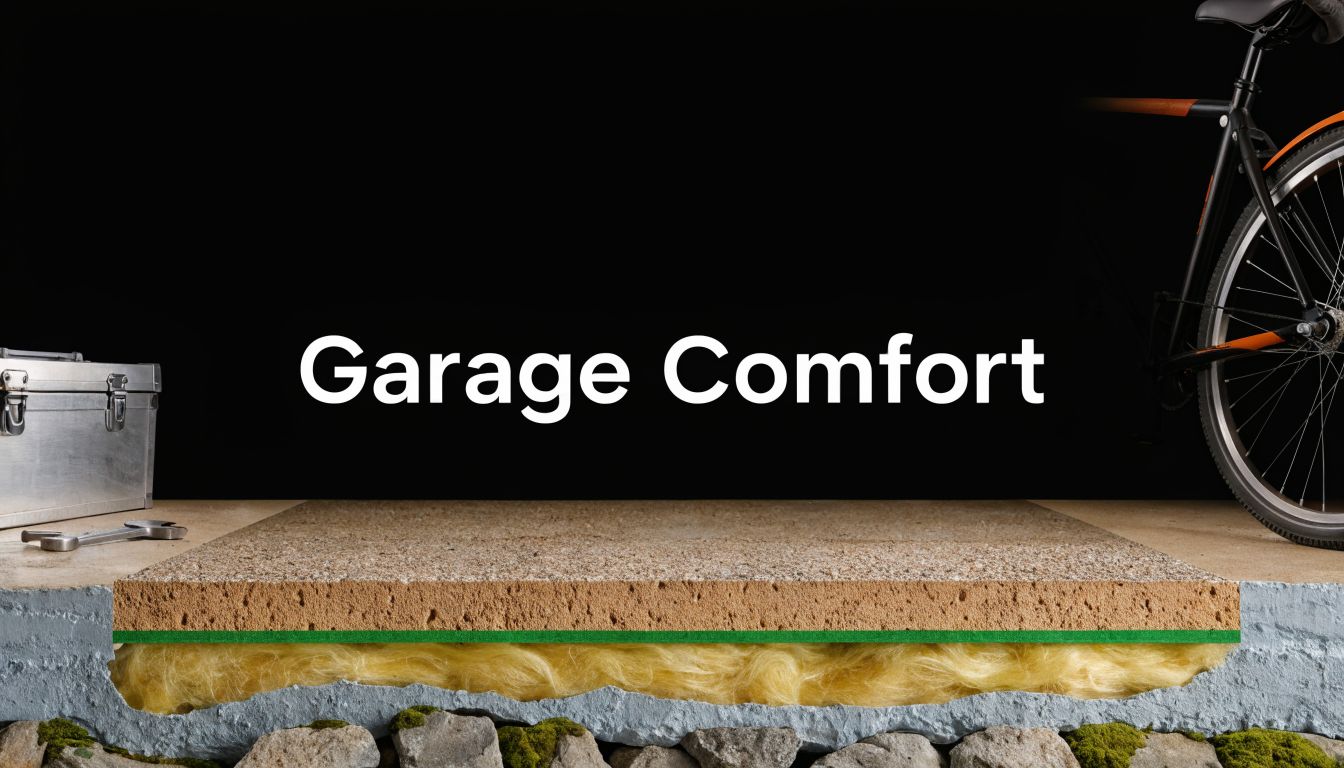
A lot of homeowners across Pennsylvania, Maryland, Delaware, and New Jersey start looking into garage floor insulation after the same frustrating pattern. The garage stays cold long after the house warms up, the floor feels damp in spring, tools pick up surface rust, and any room above the garage never seems as comfortable as the rest of the house.
That usually leads to a common question. Is the problem the garage door, the walls, or the concrete itself?
In many cases, the slab is a big part of it. Concrete is durable, but it also transfers heat and ground moisture when the foundation system isn't planned correctly. That's why garage floor insulation works best when it's treated as part of the foundation build, not as a finish upgrade after the concrete is already in place. The same thinking applies to other projects homeowners search for, from garage foundation contractors near me to shed foundations near me, base for storage shed work, and full concrete foundations tied to excavation and drainage.
If you're sorting through ideas for a more usable garage, practical homeowner garage comfort tips can help you think through the whole space, not just the slab. But the foundation is where the long-term result starts.
Your Guide to a Warmer, Drier Garage
A typical Mid-Atlantic garage goes through a lot in one year. Winter cold settles into the slab. Spring moisture works up from the ground. Summer humidity hits a cool concrete surface and condensation starts showing up where homeowners least expect it.
That's why garage floor insulation isn't just about comfort. It's about making the garage more usable and protecting what sits on that slab every day, from vehicles and workbenches to storage shelves and finished rooms above.
What homeowners usually notice first
Individuals don't call the problem “slab heat loss.” They describe symptoms:
- Cold floor underfoot even when the garage air doesn't feel terrible
- Dampness and condensation around stored items or along the slab edge
- A garage workshop that never feels comfortable in winter
- Cold rooms above the garage that are harder to heat
- Musty smells or rust on tools after seasonal weather swings
Those complaints point back to the same basic issue. If the slab and perimeter aren't detailed correctly, the garage never really separates itself from the cold ground and seasonal moisture.
Practical rule: A garage becomes more comfortable when the slab, slab edge, wall connection, and moisture layer work together. Insulation alone won't fix a poorly prepared foundation.
Why the foundation matters most
For a new build, the best time to handle garage floor insulation is before the pour. That's when the gravel base, vapor retarder, slab edge details, concrete forms, and insulation layout can all be coordinated as one system.
For an existing garage, the options are narrower, but there are still good ways to improve performance. The right path depends on whether the garage is heated, whether there's living space above, and whether you're willing to give up a little floor height for a retrofit system.
Homeowners often spend a lot of time comparing finishes. Epoxy, tile, mat systems, and sealers all have their place. But if the slab is still pulling cold and moisture from below, the finish doesn't solve the underlying problem.
Why Insulate Your Garage Foundation in PA, MD, DE & NJ
A homeowner in Pennsylvania calls after the first hard freeze because the bedroom over the garage is cold again, even though the rest of the house feels fine. In many of those cases, the problem is not the furnace. It starts at the slab edge, the perimeter connection, and the way the concrete foundation was built.

That matters across PA, MD, DE, and NJ because garages in the Mid-Atlantic deal with freeze-thaw movement, humid summer air, cold soil temperatures, and frequent wet periods in spring and fall. Concrete handles load well, but it also transfers temperature. If the slab and perimeter are left uninsulated, the foundation can keep pulling heat out of the garage and any connected living space.
From a foundation contractor's standpoint, insulation belongs in the same conversation as base prep, vapor control, reinforcement, drainage, and the concrete pour itself. It is part of the slab system. Treated that way, it helps the garage stay more stable through the seasons and reduces the stress that temperature swings put on the space.
Why homeowners notice the benefit beyond the garage
Comfort is usually what gets attention first. A garage with a properly insulated foundation feels less severe in winter and less damp during seasonal swings.
The bigger benefit is how that foundation affects the rest of the house. Attached garages can influence floor temperature in adjacent rooms, and garages with finished rooms above often telegraph slab and perimeter problems upward. Cold floors, condensation near stored items, and uneven temperatures often trace back to missing insulation or poor slab-edge detailing.
Proper foundation insulation can help with:
- More stable temperatures in attached areas where the garage shares walls or floor systems with the house
- Better protection for rooms above the garage that tend to lose heat through the structure below
- Lower risk of condensation around the slab edge during humid weather and temperature swings
- Better long-term performance from the slab assembly when insulation, vapor control, and concrete details are installed as one system
That last point gets missed all the time.
A garage slab is not just a flat piece of concrete. It is the finished surface of a foundation assembly. If the layers below it are wrong, the slab can stay cold, hold moisture, and make the whole garage harder to use.
Why slab-edge insulation deserves special attention
In the field, the perimeter is often where significant heat loss shows up. The slab edge sits closer to exterior temperatures, and that transition between footing, slab, apron, and wall connection is where poor detailing creates trouble.
That is why we look closely at edge conditions on new garage foundations in New Jersey, Delaware, Maryland, and Pennsylvania. Under-slab insulation has value, but perimeter insulation and a clean thermal break at the edge often do the heavy lifting. The exact layout depends on whether the garage is attached, heated, supporting living space above, or paired with exterior concrete that can conduct cold back into the slab.
This walkthrough gives a useful visual overview of the issue:
Cold transfer and moisture problems often show up outside the garage first. Homeowners notice them in the room above, along the shared wall, or in the condition of the slab itself.
A better foundation makes the garage more usable
Many homeowners are not trying to turn the garage into finished living space. They want it to store tools without rusting them out, support a workbench without feeling raw all winter, and stop affecting the rooms around it.
That is a reasonable goal. A garage foundation that includes insulation in the original slab design, or in a realistic retrofit plan, gives the space a steadier baseline. At Firm Foundations, that is how we approach garage projects across PA, MD, DE, and NJ. Start with the foundation assembly, get the layers right, and the garage performs better for years.
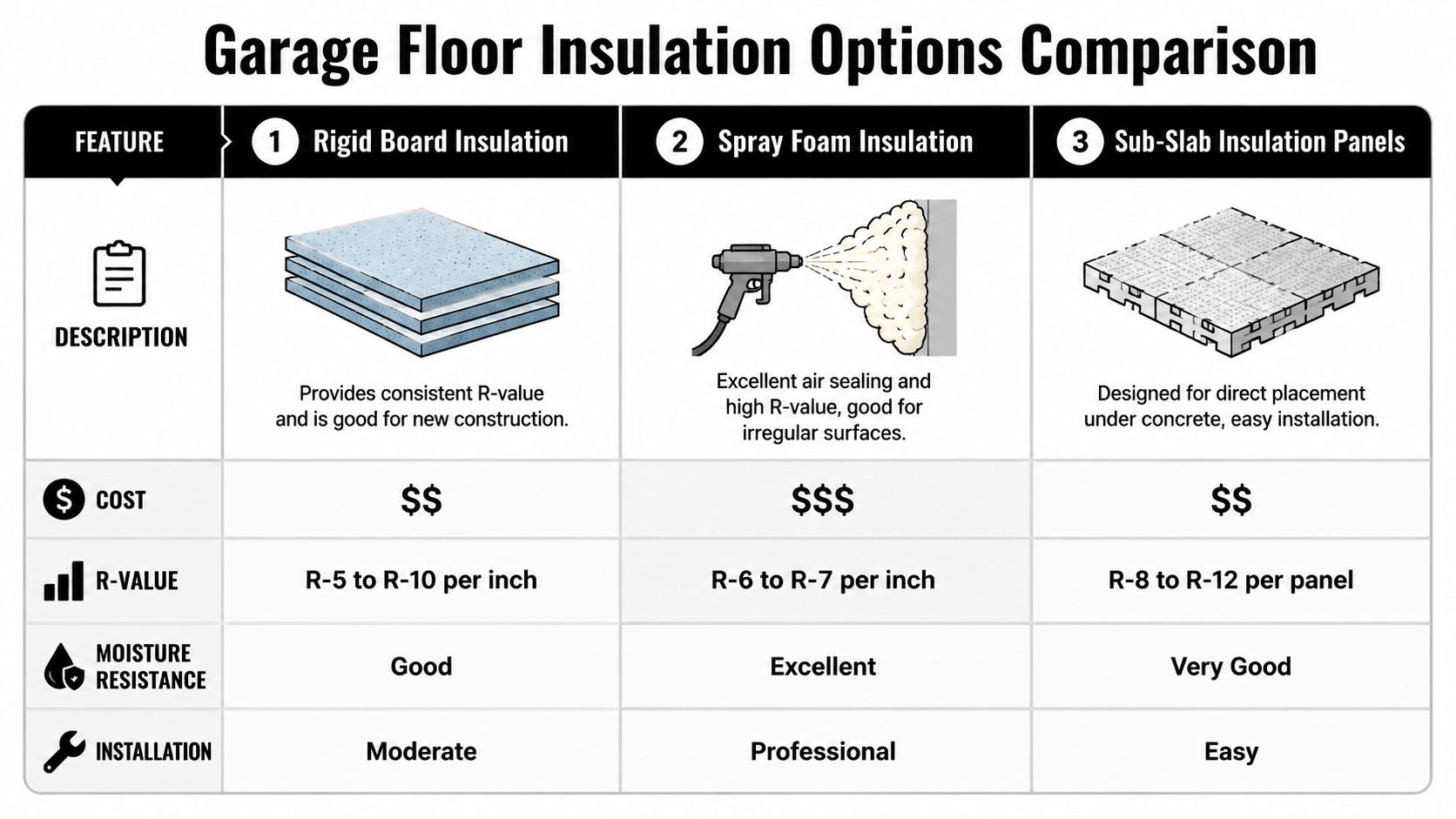
Comparing Your Garage Floor Insulation Options
Garage floor insulation has to match the foundation assembly. The right choice depends on when the work happens, how the garage will be used, and what the slab can realistically support without creating new problems at the doors, walls, or adjacent concrete.
Best option for new construction
On a new build, the best insulation plan is usually the one built into the slab package before the concrete truck arrives. In practical terms, that often means a prepared stone base, a continuous vapor retarder, and rigid foam placed under the slab, at the slab edge, or both. The exact layout depends on the garage design and whether the slab connects to exterior walks, aprons, or footings that can carry cold into the floor.
For many garages, rigid foam board is the standard choice because it can handle slab loads when the product is rated for below-slab use. A common setup uses about 2 inches of foam for an R-10 layer, but product type, compressive strength, and placement matter more than copying a generic detail from the internet. XPS is common. In some projects, high-density EPS is also a good fit. The better choice depends on load requirements, moisture conditions, local code expectations, and budget.
What matters most on site is continuity. Tight joints, protected slab edges, and clean separation from exterior concrete do more for real performance than a thicker board installed with gaps.
What works well
- Load-rated rigid foam under a new slab where full underslab insulation makes sense
- Perimeter insulation at slab edges where heat loss is concentrated
- A complete foundation assembly with base prep, vapor control, insulation, and concrete detailing planned together
What causes problems
- Foam not rated for slab loads
- Gaps at edges, control points, or penetrations
- Treating insulation as a standalone product choice instead of part of the concrete foundation design
Practical retrofit options for existing garages
Existing garages are different. If the slab is already poured, true underslab insulation usually means demolition and replacement. For many homeowners, that only makes sense when the slab is cracked, poorly drained, settling, or being rebuilt anyway.
The usual retrofit path is an insulated layer installed over the existing concrete. Floating subfloor panels can make a workshop or hobby space feel better underfoot, but they also raise the finished floor. That affects garage door clearance, steps into the house, thresholds, and sometimes the pitch needed to keep water out. In a vehicle bay, those height changes can turn a simple insulation upgrade into a full rework of the space.
Spray foam has a place, but usually at the perimeter and transition areas. It helps seal irregular gaps near rim areas, slab edges, and framed connections. It is not the first choice for the full garage floor surface where you need a flat, durable base.
Side-by-side view
| Option | Best fit | Main upside | Main trade-off |
|---|---|---|---|
| Underslab rigid foam | New slab construction | Built into the foundation from day one | Requires planning before the pour |
| Perimeter slab insulation | New builds and selective upgrades | Targets common heat-loss areas at the slab edge | Does not insulate the full slab field |
| Floating insulated subfloor | Existing garage retrofit | Improves comfort without removing the slab | Raises floor height and affects clearances |
| Spray foam at transitions | Edges, rim areas, irregular connections | Seals awkward spots well | Works as a supporting detail, not a full floor system |
Field observation: The best results come from simple assemblies installed correctly. Good grading, solid base prep, a continuous moisture layer, and insulation placed where the foundation needs it will outperform a patchwork retrofit that ignores the slab edge and drainage details.
How to choose without overbuilding
A basic parking garage does not need the same insulation plan as a heated shop or a garage under finished living space. That is where foundation-level planning matters. The slab, footings, perimeter, vapor control, and concrete layout all have to work together.
At Firm Foundations, we look at garage insulation the same way we look at the rest of the build in PA, MD, DE, and NJ. Start with the site conditions and the concrete foundation. Then choose the insulation approach that fits the structure, the use of the space, and the long-term durability of the slab.
Choosing the Best R-Value for Your Garage Foundation
Most homeowners hear “R-value” and know higher is better, but that doesn't tell them what to install. In simple terms, R-value measures resistance to heat flow. The right target depends on your climate, whether the garage is conditioned, and whether the floor is part of the home's thermal envelope.

What the Mid-Atlantic climate usually requires
In our region, IECC Climate Zones 4 to 5 often require floor insulation of R-19 to R-30 for conditioned spaces. For garages with radiant heat, R-10 underslab insulation is typically mandatory, based on the garage insulation code summary in this regional energy-code overview.
That means the target changes based on use. A basic detached garage used for parking may not need the same floor assembly as a heated garage shop or a garage with finished living space above it.
Match the R-value to how the garage is used
Use this as a practical guide when planning garage footings and foundations:
Simple vehicle storage garage
Focus on slab edge performance, moisture control, and overall foundation detailing. Full underslab insulation may not be necessary if the space is unheated, but perimeter treatment can still make sense.Attached garage affecting rooms inside the home
Pay closer attention to the thermal break where the garage meets the house. If the garage contributes to comfort problems in adjacent areas, insulation becomes a much higher priority.Heated workshop or radiant-heated garage
For these applications, underslab insulation matters most. If heat is going into the slab, the assembly needs to be designed so that energy stays in the space rather than bleeding into the ground.
Don't chase numbers without checking the assembly
A higher R-value on paper doesn't always produce a better result in the field. If the slab edge is exposed, the vapor layer is poorly installed, or the insulation gets interrupted by bad detailing, the assembly underperforms.
The right R-value is the one that matches the garage's actual use and is installed as a continuous system from base prep through final pour.
That's why insulation planning should happen alongside excavation, concrete forms, drainage, and slab thickness decisions, not after them. A garage foundation should be designed as one working assembly.
Preventing Moisture Damage Under Your Garage Floor
A lot of garage floor insulation advice skips the part that causes many failures. Moisture.
In humid regions like ours, moisture from the ground can drive insulation failure, promote mold, and lead to structural damage. A proper vapor retarder is essential, as noted in this garage floor moisture discussion from InSoFast.

Vapor barrier versus vapor retarder
Homeowners often use those terms interchangeably, but the jobsite conversation is more specific. What matters is having a continuous moisture-control layer under the slab system so water vapor from the ground doesn't move into the concrete and the materials above it.
In practical garage slab work, that usually means the moisture layer is installed over the prepared gravel base and under the insulation or slab assembly, depending on the detail being used. The key isn't the label. The key is continuity.
What moisture does to a garage floor system
When the slab and insulation system aren't protected from ground moisture, several problems show up over time:
- Insulation performance drops because the assembly isn't staying in the dry conditions it was designed for
- Condensation becomes more likely when humid air meets a cool slab surface
- Mold and musty odors can develop in adjacent finish materials or stored contents
- The slab stays harder to manage if you later add coatings, mats, or a finished floor
If you want to monitor suspicious dampness inside a garage or nearby finished space, this Onsite Pro Restoration guide for homeowners gives a useful explanation of what moisture meter readings mean.
What good prep looks like
The moisture layer only works when the foundation prep is right. That includes stable excavation, a properly prepared gravel base, clean transitions at edges and penetrations, and a slab detail that doesn't leave easy paths for vapor intrusion.
A sealer also has its place after the slab is cured. If you're comparing finish protection options, a quality concrete slab sealer for garage floors can help protect the surface, but it should never be treated as a substitute for below-slab moisture control.
Moisture control belongs under the slab, not just on top of it.
The common mistake
The biggest mistake is treating moisture management like a finishing step. It isn't. It belongs in the same planning conversation as excavation, reinforcement, gravel placement, and concrete thickness. If that part is rushed, even good insulation materials can disappoint.
Insulating a New Concrete Foundation vs an Existing Garage
The difference between a new build and a retrofit is simple. New construction lets you solve the problem where it starts. An existing garage forces you to work around what's already there.
That doesn't mean one is worthwhile and the other isn't. It means the strategy has to fit the project.
New garage slabs have the clear advantage
If you're building a concrete foundation for garage use from scratch, insulation can be integrated into the sequence instead of added as a compromise. The excavation is already open. The subgrade is being prepared. The gravel base is going in. Concrete forms are being set. That's the ideal time to place the moisture layer and insulation where they belong.
For new garages, the process is usually straightforward:
- Excavate and prepare the subgrade so the slab has proper support and drainage.
- Install and compact the gravel base for a stable platform.
- Place the vapor retarder and insulation detail according to the design.
- Set forms and reinforcement so the slab can be poured without disturbing the assembly.
- Pour and finish the concrete with edge details that protect the thermal break.
This approach usually delivers the best thermal result with the least disruption.
Existing garages require trade-offs
Retrofitting an existing slab is more selective. If you don't want to demolish the slab, the practical route is usually to build on top of it with an insulated floor system.
That can work well for garages becoming hobby spaces, home gyms, or seasonal workshops. But it comes with questions that new builds avoid. Will the overhead door still clear? What happens at the entry door to the house? Does the step height change? Will cabinets, lifts, or heavy storage still fit the way you want?
Honest expectations make better projects
Some existing garages are good retrofit candidates. Some aren't.
A retrofit succeeds when the insulation plan respects floor height, drainage, door operation, and how the garage is actually used day to day.
That's why homeowners comparing concrete contractors, excavation near me, and garage foundation contractors near me should look beyond the pour itself. The best result comes from planning the slab, moisture control, drainage, and insulation as one coordinated system, whether the garage is new or already built.
Garage Floor Insulation Costs and Why to Hire a Pro
A garage slab is one of the few parts of a home that is hard to correct after the concrete cures. If the insulation, vapor control, base, and slab edge details are wrong, the repair usually involves demolition, door adjustments, or living with a floor that never performs the way it should.
That is why cost should be judged against the full assembly, not just the insulation boards.
On a new garage foundation, the added cost for insulation is usually reasonable compared with the price of excavation, stone, concrete, reinforcement, and finish work already in the job. On an existing garage, costs can climb faster because floor height, door clearance, and transitions into the house often need to be addressed at the same time. The real question is not just "What does insulation cost?" It is "What will it take to build a slab system that stays dry, supports the load, and performs for years?"
Where the return comes from
The return is different from one garage to the next. A detached storage garage may see modest energy benefit. A garage under living space, attached to the house, or used as a workshop usually has more to gain because the slab affects comfort and heat loss beyond the garage itself.
One published analysis from Trusscore, in its garage insulation cost and performance article, estimated fast payback in some situations. Those figures depend heavily on climate, garage size, insulation scope, and energy prices, so they should be treated as an example, not a universal promise. The practical takeaway is simpler. When a cold slab is tied into the rest of the foundation, insulation can improve comfort, reduce condensation risk, and help the whole space behave more predictably.
Why DIY projects miss the mark
Homeowners can buy rigid foam. The hard part is building an assembly that works after trucks roll in, concrete gets placed, and seasons change.
In the field, the usual problems are coordination problems. The stone base may be close to level but not compacted evenly enough to support the insulation. The vapor retarder may be installed, then torn by foot traffic, reinforcement chairs, or shifting during the pour. The insulation itself may have the right R-value but not the compressive strength for the slab and vehicle load. At the perimeter, one missed edge detail can create a cold joint that defeats the thermal break and invites moisture trouble.
None of that looks dramatic on pour day. It shows up later.
That is why experienced foundation crews treat insulation as part of the slab system. Site prep, grading, drainage, vapor control, insulation, reinforcement, and concrete placement all affect each other. If different steps are handled in isolation, small errors stack up.
Professional work protects the whole project
A good installer does more than place foam under concrete. The crew should verify subgrade conditions, confirm the drainage plan, protect the vapor layer during setup, and keep the insulation layout intact while forms, steel, and concrete go in. That foundation-level coordination is what gives underslab insulation a fair chance to do its job.
It also matters if the garage is part of a larger property improvement. We often see garage slabs tied into pad work, driveway grades, shed areas, or drainage corrections around the site. In those cases, one contractor looking at the entire foundation and water-management plan usually gets a better long-term result than piecing the work out trade by trade.
If you want to understand the parts involved before asking for pricing, this garage floor foundation kit overview gives a useful picture of how the assembly goes together.
Bottom line: Garage floor insulation performs best when it is planned with the foundation, moisture control, and concrete work from the start.
For homeowners in PA, MD, DE, and NJ, the right answer depends on garage use, slab condition, drainage, and how the foundation is built. Firm Foundations helps sort that out with a clear site-specific plan, so the finished garage is warmer, drier, and built to last.
If you're planning a new garage slab, upgrading an older garage, or comparing options for a shed, barn, patio, or Firm Foundations project, the best next step is a clear site-specific quote. Their team serves Pennsylvania, Maryland, Delaware, and New Jersey with excavation, gravel pads, and concrete foundation work built for drainage, durability, and long-term performance. Reach out for a free, no-obligation estimate and get a garage floor plan that works from the ground up.