
The Best Concrete for Garage Floor: Expert Choices


A lot of homeowners start the same way. They’re planning a new garage, thinking about storage, parking, maybe a workshop bench, and then the concrete questions start piling up. How thick should the slab be? What PSI mix makes sense? Is wire mesh enough? What keeps the floor from cracking after a wet Pennsylvania spring or a Maryland winter full of road salt?
Those are the right questions to ask early, because a garage floor isn’t just a flat surface you park on. It’s part of a foundation system. If the slab, base, drainage, and moisture control aren’t built for Mid-Atlantic conditions, the floor can start showing problems long before the garage itself feels “old.”
Homeowners in Honey Brook Township and across Pennsylvania, Maryland, Delaware, and New Jersey deal with a mix of freeze-thaw weather, humidity, wet seasons, and shifting soils. A generic answer from a national article usually misses what matters on real job sites here. The best concrete for garage floor projects in this region has to be chosen with those local conditions in mind.
Your Garage Deserves More Than Just Concrete
Pull into a garage after a February storm in Pennsylvania or Maryland and the slab takes a beating. Snow melt drips off the car, road salt gets ground into the surface, and any weak spot in the floor starts showing up fast. A garage slab that looks fine on pour day can turn into cracking, spalling, or settlement a few winters later if it was built like a basic flatwork job instead of part of the foundation.

That matters more in the Mid-Atlantic than many homeowners expect. In PA, MD, DE, and NJ, garage floors deal with freeze-thaw cycles, wet springs, summer humidity, and de-icing chemicals. The concrete has to resist more than vehicle weight. It has to resist water getting in, freezing, expanding, and breaking the surface apart.
Homeowners usually ask practical questions, not lab questions. Will the floor crack down the middle? Will the front edge sink where the tires roll in every day? Will moisture keep the space damp? Will salt and oil stain or eat up the surface? Will this floor last, or will it need expensive patching and coating work in a few years?
Those are the right concerns.
A durable garage slab starts with good judgment before the pour ever happens. The right builder looks at drainage around the pad, the bearing conditions under the slab, how water will move through the site, and whether the planned use calls for more than a bare-minimum residential slab. That is especially true for larger detached garages, workshops, or structures built from expert 24×24 garage blueprints, where storage loads and vehicle use often exceed what a light slab handles well over time.
In our work at Firm Foundations, the biggest problems usually trace back to corners cut early. The slab may have been placed neatly and finished smooth, but the base was thin, the vapor control was skipped, the thickness was not matched to the use, or water was allowed to sit at the perimeter. Homeowners see the crack. The actual cause is often underneath it.
For Mid-Atlantic garages, the goal is simple. Build a floor that stays stable through wet seasons, handles vehicle traffic without breaking down at the door opening, and holds up against salt and seasonal temperature swings. That takes the right slab system, not just concrete in a rectangle.
The Anatomy of a Perfect Garage Floor Slab
A garage floor in Pennsylvania or Maryland has to do more than hold a car. It has to stay flat through wet springs, freeze-thaw winters, road salt, and years of tire traffic at the door opening. A slab that looks fine on pour day can still fail early if the layers underneath it were rushed or skipped.
Start with the soil, not the concrete
The slab only performs as well as the ground below it. If the subgrade is soft, wet, full of organics, or unevenly compacted, the concrete ends up spanning weak spots. That is when you start seeing settlement cracks, low corners, and movement at the front edge.
In the Mid-Atlantic, this matters even more because soil moisture swings are common. One season is saturated, the next is dry, and clay-heavy areas can shrink and swell enough to stress a slab from below. On questionable sites, basic evaluation and correction up front costs far less than replacing a broken floor later.
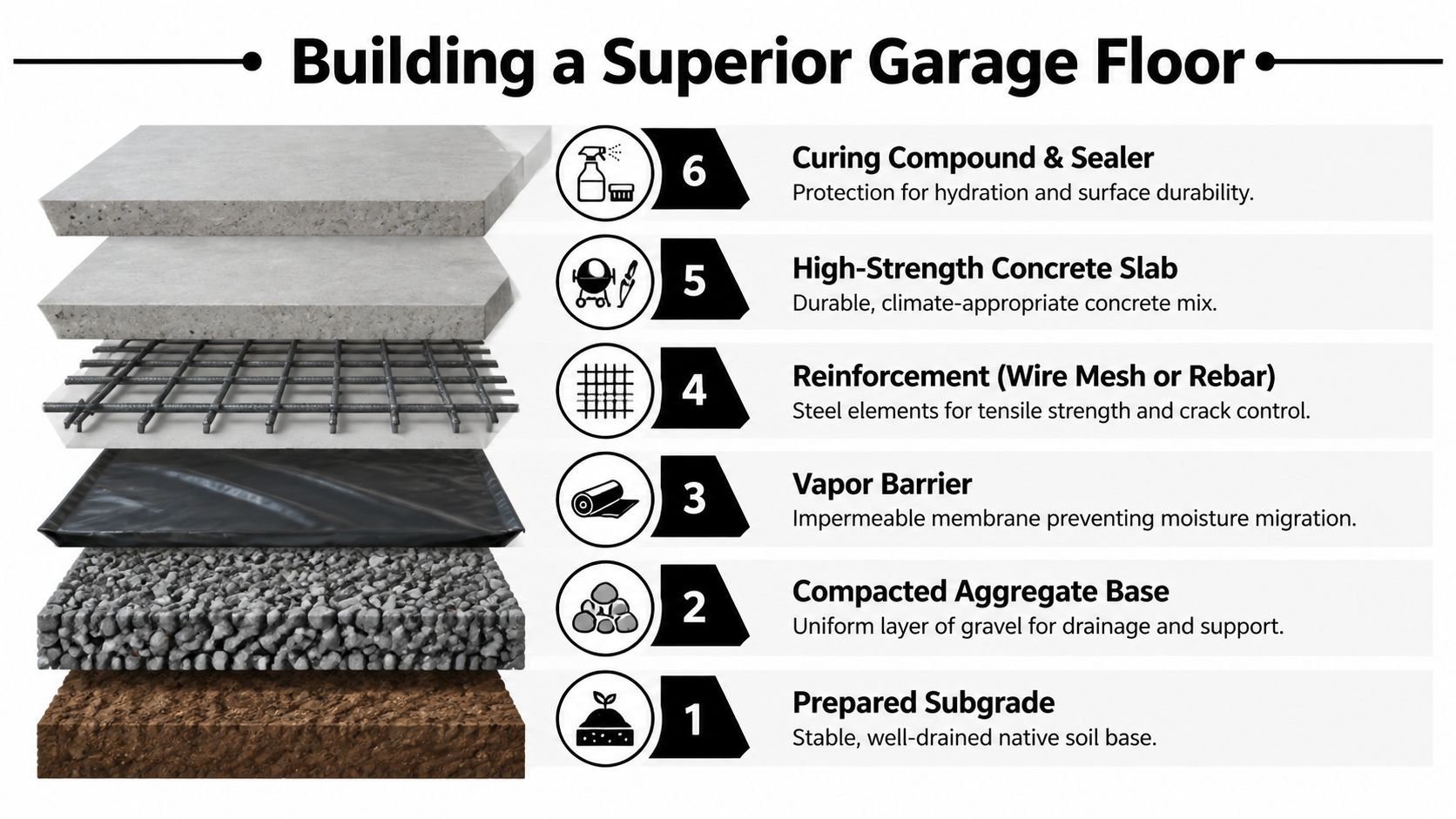
The six layers that matter
A garage slab that lasts is a system. From the bottom up, each layer has a job.
Prepared subgrade
Strip out topsoil, roots, and any soft material. Shape the grade, correct weak pockets, and compact it properly so the slab bears evenly.Compacted aggregate base
A dense stone base helps spread loads and improves drainage under the slab. In our region, that matters because trapped water under a garage floor contributes to heaving, settlement, and edge breakdown during freeze-thaw cycles.Vapor barrier
Concrete absorbs and passes moisture. A vapor barrier helps keep ground moisture from migrating into the slab and garage, which protects coatings, stored items, and the overall dryness of the space.Reinforcement
Reinforcement helps the slab hold together when concrete shrinks and moves under normal stress. It does not fix a poor base, but it does improve crack control when the rest of the system is right.Concrete slab
The slab thickness and mix have to match how the garage will be used. Parking a sedan is different from parking a heavy pickup, storing a tractor, or loading one side with tools and equipment.Curing and surface protection
Fresh concrete needs time and moisture control to gain strength properly. If curing is rushed, the surface is more likely to dust, scale, or wear early, especially where winter salt gets tracked in.
A garage floor usually fails from below or at the edges long before the homeowner notices a visible crack.
Thickness is not the place to cut corners
For a typical residential garage, a 4-inch slab is common. It works well when the base is properly compacted, the drainage is right, and the loads are residential. The mistake is assuming thickness alone solves everything.
I have seen 4-inch slabs perform well for years, and I have seen 4-inch slabs crack early because the base was thin, the soil stayed wet, or the apron transition let the front edge take repeated impact. On larger detached garages, workshop spaces, or buildings planned from expert 24×24 garage blueprints, it often makes sense to review expected loads before settling on a standard slab detail.
The right question is not “What is the minimum?” It is “What will hold up on this site, with this use, in this climate?”
Planning the slab before the pour
Good slab work starts before concrete trucks are scheduled. Layout affects where tires turn, where water leaves the building, how the garage door opening meets the apron, and whether repeated wheel loads hit the same spots every day.
That front edge deserves special attention in the Mid-Atlantic. It sees water, deicing salts, freeze-thaw stress, and impact from vehicles crossing in and out. If the base support and slab detail are weak there, the breakdown usually starts there too.
A perfect garage slab is not fancy. It is well supported, properly drained, thick enough for the job, and cured with patience. That is what keeps it serviceable for the long haul.
Choosing the Best Concrete Mix Design for Durability
A garage floor in Pennsylvania or Maryland can look good the day it is poured and still start wearing out early if the mix was chosen like an afterthought. Around here, the slab has to deal with wet tires, snowmelt, road salt, oil drips, and repeated freeze-thaw cycles. The mix design needs to match that job.
What PSI means for a homeowner
PSI is the compressive strength the concrete is expected to reach after curing. For a garage floor, that matters because stronger concrete usually handles wheel loads, stored materials, and daily use better over time. It is only one part of the picture, though. A higher PSI number does not make up for excess water in the mix, poor finishing, or weak curing.
For many residential garages in the Mid-Atlantic, a properly batched 3500 PSI mix is a sound starting point. It gives good durability for normal vehicle traffic without paying for strength you may never use. If the garage will see heavier trucks, a workshop setup, or concentrated point loads, then it makes sense to review both the mix and the slab detail together, including garage slab thickness recommendations for different uses.
Why the aggregate and water content matter
For the Mid-Atlantic, the primary issue is water.
Water gets into the concrete, temperatures drop, and that moisture expands. Add deicing salts at the garage entrance and the front tire path often becomes the first trouble spot. That is why I pay close attention to aggregate choice and to keeping the mix from getting too wet on pour day.
Crushed aggregate usually gives the slab a better internal structure than round stone for this kind of work. Low-permeability concrete also matters because dense concrete slows down water and contaminant intrusion. In plain terms, a tighter mix helps the slab resist scaling, surface wear, and internal damage through repeated winters.
Practical rule: A garage floor should be designed to limit water entry, not just carry the weight of the car.
Fibermesh and what it actually does
For standard residential garages, fiber-reinforced concrete is a suitable option, according to this garage slab specification overview. That lines up with what works in the field. Fibermesh helps control small shrinkage cracks across the slab surface, which is useful on everyday garage floors.
It does not replace good site prep. It does not replace proper jointing. And it does not turn a lightly built slab into one that can handle heavier service.
If the garage will carry more than normal household vehicles, reinforcement needs to be looked at with the slab design as a whole, not chosen as a shortcut.
Standard mix vs. upgraded mix
Some homeowners ask for a higher PSI mix because it sounds safer. Sometimes that is the right call. Sometimes it just adds cost without fixing the failure points that matter most in this region.
| Feature | 3500 PSI (Standard) | 4500 PSI (Premium) |
|---|---|---|
| Typical residential fit | A practical choice for many garages with good base prep, drainage, jointing, and curing | Better suited to tougher use, higher loads, or a more conservative spec |
| Mid-Atlantic durability | Performs well when the concrete is dense and the slab is protected from excess moisture intrusion | Can add margin, but only if the rest of the slab system is built to the same standard |
| Cost decision | Usually the better value for standard household use | Higher upfront cost, with the payoff depending on actual use and exposure |
| Long-term benefit | Strong baseline when paired with good workmanship | Best reserved for cases with a clear reason to upgrade |
That trade-off matters. In a Mid-Atlantic garage, many expensive failures start because water got in, salts stayed on the surface, or the slab was cured poorly. They do not start because the owner chose 3500 PSI instead of 4500 PSI.
What usually makes sense in this region
For a typical residential garage in PA or MD, a durable mix specification often includes:
- A properly batched 3500 PSI mix
- Crushed aggregate suited to local exposure conditions
- Fibermesh for shrinkage crack control
- Low permeability
- A slab design matched to actual vehicle loads and storage use
- A curing and surface protection plan that is followed on site
Firm Foundations helps homeowners sort out those choices based on the property, the soil conditions, and how the garage will be used. That is what keeps a slab from becoming a repair project a few winters later.
Reinforcement and Climate-Specific Slab Design
Concrete is strong in compression, but it still needs help managing tension, movement, and stress. That’s where reinforcement and slab design come in. In the Mid-Atlantic, those choices need to account for more than vehicle weight. Moisture and site conditions are just as important.
Comparing common reinforcement options
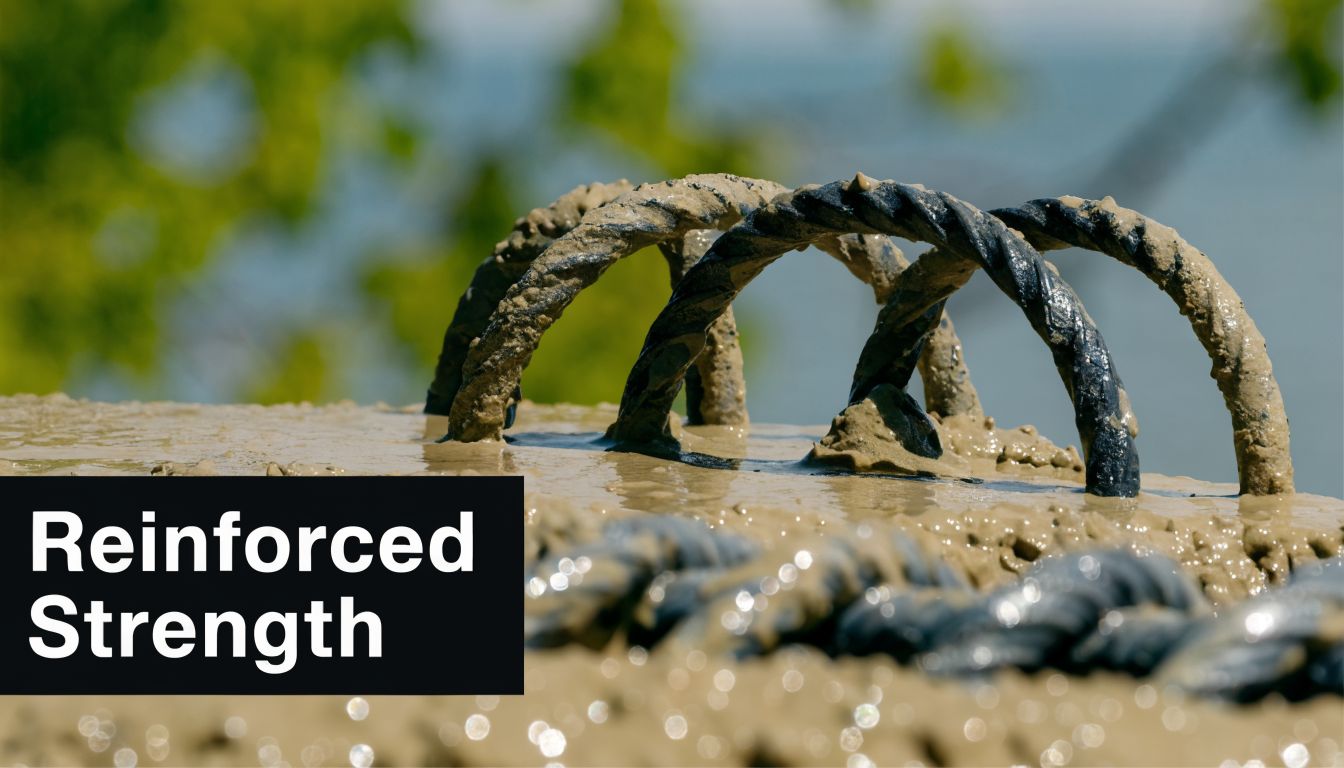
Homeowners often hear three terms together: fiber, wire mesh, and rebar. They are not interchangeable.
Fibermesh
Fibermesh is mixed throughout the concrete. It helps control fine surface cracking across the slab and is often a practical choice for residential garages. It works well when the slab is properly designed and the loads are typical for household vehicles.
Wire mesh
Wire mesh adds a steel grid within the slab. It helps hold concrete pieces together after cracking occurs. It can be useful, but only if it’s placed correctly. Mesh that ends up sitting too low or too high in the slab won’t do what it’s supposed to do.
Rebar
Rebar is the heavier structural option. It makes more sense where loads are greater, where slab design is more demanding, or where site-specific conditions call for added strength. For heavier trucks, equipment, or more demanding garage footings and foundations, rebar may be part of the right answer.
The real Mid-Atlantic issue is water
A lot of online advice focuses only on PSI and reinforcement. That’s too narrow for this region. In the Mid-Atlantic, which sees 40-50 inches of annual rainfall, managing subsurface water and using a lower water-cement ratio are as critical as PSI strength for long-term durability, according to this regional climate note.
That affects several design decisions:
- Slope away from the structure so water doesn’t collect near the garage or house foundation
- Drainage around the slab so runoff and groundwater don’t stay trapped
- Base preparation that supports drainage instead of holding moisture
- A tighter mix design that limits permeability
Water under a slab is often a bigger long-term threat than the weight on top of it.
Is four inches always enough
For many homes, a standard slab thickness works well. But “enough” depends on use. A family sedan and storage shelving are very different from a heavier pickup, workshop equipment, or repeated point loads.
If you’re comparing use cases and want a practical reference on slab sizing, this guide on concrete thickness for garage slab is a helpful starting point. The key is making sure slab thickness, reinforcement, and base prep all work together. One strong detail can’t compensate for two weak ones.
Control joints and layout decisions
Even a well-built slab can crack. Concrete naturally shrinks as it cures. The goal is to control where that movement shows up. Proper control joints create planned weak points so random cracking is less likely to run across the full floor.
Good joint layout should reflect the shape of the slab, door openings, and areas that will see repeated traffic. That’s especially important on larger garages and multi-bay layouts. For homeowners searching for garage foundation contractors near me or concrete foundation for garage services, this is one of the easiest ways to tell whether a contractor is thinking ahead or just pricing a pour.
Common Garage Floor Problems and Long-Term Maintenance
A Mid-Atlantic garage floor usually shows trouble after a winter or two, not the week after the pour. In Pennsylvania and Maryland, I see the same pattern over and over. Road salt gets tracked in, snow melt sits near the overhead door, and freeze-thaw cycles start working on any weak spot in the surface. What starts as a little flaking or a small crack can turn into scaling, pitting, or edge settlement that costs real money to repair.

The most common problems homeowners see
Surface flaking and spalling
This is one of the most common complaints in our region. The surface starts popping or peeling after repeated exposure to moisture, deicing salts, and winter temperature swings. If the slab was finished too wet, cured poorly, or left unsealed, that top layer breaks down faster.
Near the garage door is usually the first place it shows up.
Cracking
Concrete cracks. The important question is what kind of crack you have. A tight shrinkage crack that stays flat is very different from a crack that widens, holds water, or has one side higher than the other.
In PA, MD, DE, and NJ, seasonal moisture changes in the soil can make those bigger cracks worse over time. Water gets in, freezes, expands, and keeps stressing the slab.
Dusting
A dusty garage floor is often a weak surface, not just a cleaning issue. Poor curing, over-finishing, and surface wear can leave the top of the slab soft enough to shed fine powder. That dust gets tracked into the house and makes paint or coatings less likely to bond well later.
Higher PSI helps, but it is not a cure-all
Homeowners often ask whether paying for a stronger mix always saves money in the long run. Sometimes it does. Sometimes the better return comes from a balanced slab design, good curing, and surface protection instead of chasing the highest PSI on paper.
For a standard residential garage, the right choice depends on how the space will be used, how much winter moisture it will see, and whether the floor will be maintained. A stronger mix can give you better wear resistance and lower permeability, but it will not make up for water sitting on the slab year after year or salt being left in place all winter.
That is the primary trade-off.
A homeowner parking two daily drivers has different needs than someone storing a heavy truck, toolbox, and mower in a garage that stays damp near the entry. Strength matters. So does exposure.
A maintenance routine that actually extends slab life
Good maintenance is simple. The key is doing it before surface damage becomes structural damage.
- Rinse off winter salt: Salt left on the slab keeps pulling moisture into the surface and speeds up scaling.
- Clean spills early: Oil, fertilizer, and automotive chemicals can stain the floor and weaken some coatings.
- Watch where water collects: Ponding near the overhead door or along one wall usually points to a slope or drainage issue.
- Keep the surface protected: A good sealer or coating helps limit water intrusion and makes cleanup easier.
- Check cracks twice a year: Spring and fall are good times to see whether a crack stayed stable or started moving.
If you want more practical guidance, this article on how to prevent concrete slab from cracking covers the habits that reduce long-term damage.
I tell homeowners to treat moisture and salt as maintenance issues, not appearance issues. That mindset saves floors.
Professional coatings can help, especially in garages that see regular wet traffic in winter. Polyurethane and similar systems usually hold up better than basic floor paint because they resist water, chemicals, and tire wear more effectively. The coating still needs a clean, sound slab underneath. A failing surface should be repaired before it is covered.
Here’s a useful visual if you’re thinking about surface protection and maintenance practices:
When to call a contractor
Some problems should be checked early, before a repair turns into replacement.
Call a contractor if you notice:
- Cracks with height difference from one side to the other
- Repeated moisture at the same area
- Surface breakdown near the overhead door
- Settlement along slab edges
- Water moving toward the garage instead of away from it
If you are evaluating contractors, use the same kind of screening process homeowners use with other exterior trades. This checklist of essential questions before hiring a roofer is about roofing, but the logic applies here too. Ask direct questions, get clear answers, and make sure the contractor can explain why the problem started, not just how they plan to patch it.
Hiring the Right Garage Foundation Contractor in PA MD DE or NJ
The difference between a durable slab and a short-lived one usually comes down to decisions made before the pour. That’s why choosing the contractor matters as much as choosing the mix.
Homeowners looking for garage foundation contractors near me, shed foundations near me, garage footings and foundations, or concrete contractors should focus less on who gives the shortest answer and more on who explains the full system clearly.
What to ask before you hire anyone
A good contractor should be able to answer practical questions without dodging them.
Licensing and insurance
This is basic, but it still needs to be confirmed. A contractor working on structural concrete and excavation should be properly insured and operating legitimately in your area.
Site prep process
Ask exactly how they handle stripping, excavation, grading, and compaction. If the answer is vague, that’s a warning sign. A slab is only as dependable as the prep underneath it.
Drainage and moisture plan
For Pennsylvania and Maryland work, this is critical. Ask how they’ll manage runoff, subsurface water, and grading around the slab. If they only want to talk about PSI, you’re not getting the full picture.
Reinforcement and thickness recommendations
They should explain why they’re recommending a certain slab thickness and reinforcement type for your actual use. A garage for household parking is different from a barn shed, workshop, or heavier storage setup.
Quote clarity
A proper quote should spell out what’s included. Excavation, base prep, forms, reinforcement, concrete specification, finishing, and final grading should not feel hidden.
Hiring a contractor without asking process questions is a lot like hiring a roofer without asking how they handle underlayment, flashing, and ventilation.
That’s why homeowner checklists from related trades can still be useful. These essential questions before hiring a roofer are a good example of how to think through contractor vetting in a practical way. The trade is different, but the mindset is the same. Ask about process, materials, protection, and accountability.
What separates a dependable foundation crew
A reliable garage slab contractor usually does a few things consistently:
- They inspect the site carefully instead of quoting from a photo alone.
- They talk about drainage early instead of treating it like an afterthought.
- They explain trade-offs clearly between standard and heavier-duty approaches.
- They understand more than one type of foundation work, whether that’s a base for storage shed, a gazebo foundation, a shed foundation, or a full garage slab.
- They don’t oversell one-size-fits-all answers for every property.
This matters for local SEO-style searches too. Someone looking for gravel shed foundation contractors near me, cement foundations for garage, or foundation builds may need different solutions depending on soil, water, elevation, and intended use. A contractor should be able to separate those cases instead of forcing them into the same bid template.
Why local experience matters in PA and MD
A slab in a dry, stable region can get away with details that won’t age well here. Pennsylvania and Maryland jobs often involve wetter soil conditions, freeze-thaw exposure, and drainage concerns that need to be addressed upfront. Delaware and New Jersey add their own site variables, especially around moisture and seasonal movement.
That’s why local experience isn’t just a marketing point. It affects excavation decisions, gravel base prep, slab design, and how the finished grade works with the rest of the property.
If you’re hiring for a garage, shed pad, driveway approach, or house foundation support work, ask the contractor to explain what they’d do differently on your site if the ground is soft, wet, or sloped. A good answer tells you a lot.
The standard you should expect
You should expect a contractor to:
- Show up ready to evaluate the site
- Give a transparent quote
- Explain the foundation type that fits the structure
- Discuss drainage in plain language
- Build for long-term durability, not just fast completion
That standard applies whether you need a 10×10 storage shed pad, a 4×8 shed with foundation, a garage slab, or supporting excavation for larger residential work.
If you’re planning a garage slab, shed pad, driveway, or other foundation project in Pennsylvania, Maryland, Delaware, or New Jersey, Firm Foundations provides free quotes, clear specifications, and site-focused recommendations so you can choose the right base, reinforcement, and concrete approach before work begins.