
Hurricane Anchors For Sheds: Ultimate Protection Guide
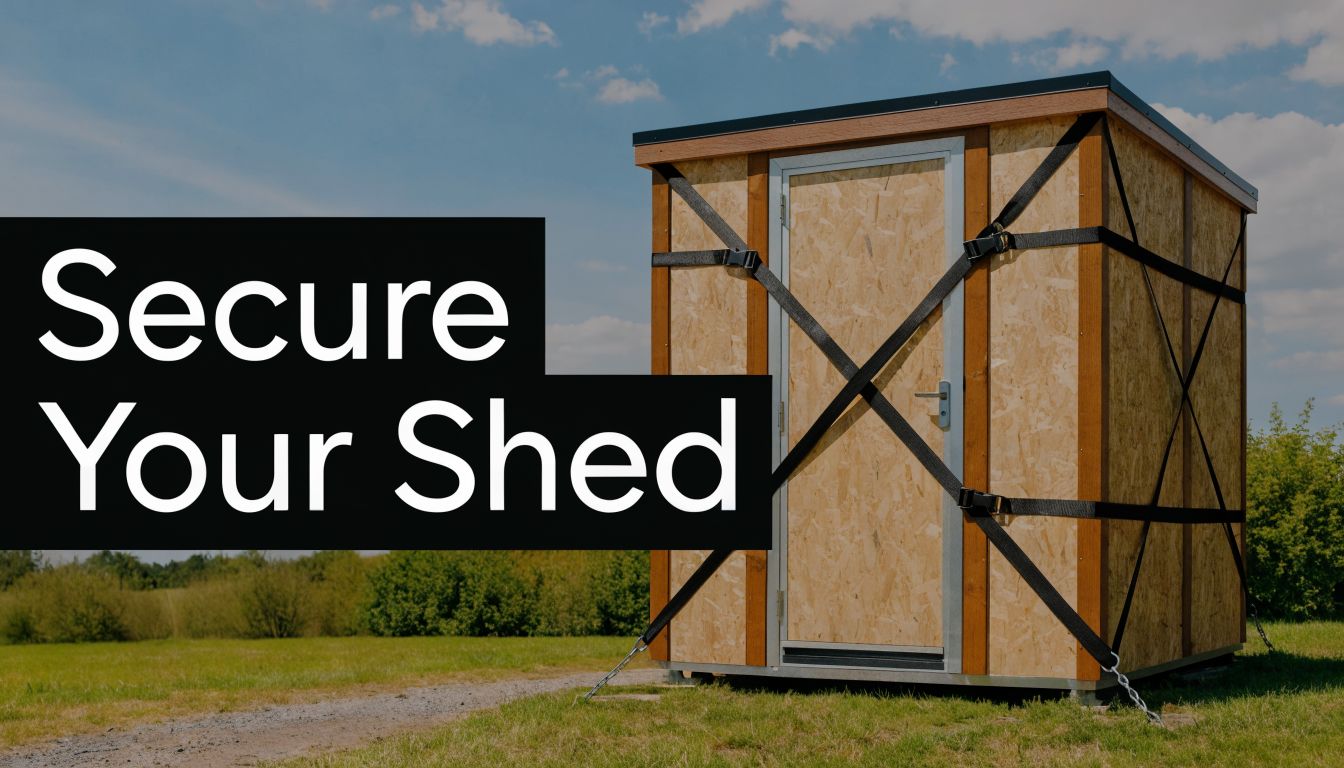
Storm warnings change how homeowners look at a backyard shed. The same building that holds a mower, tools, seasonal furniture, or a riding tractor can suddenly feel exposed when a Nor'easter tracks up the coast or tropical storm remnants push inland through Pennsylvania, Maryland, Delaware, and New Jersey.
In the Mid-Atlantic, the mistake is assuming hurricane anchors for sheds only matter in coastal Florida. They don't. A shed can rack, slide, tip, or lift when wind finds a weak base, loose connection, or poor anchor choice. By the time the weather turns, there isn't much room to fix it.
A lot of damage starts with simple oversights. The shed sits on an uneven base for storage shed use. The owner buys a light anchor kit without matching it to the soil. The straps get attached to trim instead of the structural runners. Then a serious wind event exposes every shortcut at once.
Protecting Your Shed from Mid-Atlantic Storms
The storm doesn't need a Florida landfall to create shed problems in our region. In PA, MD, DE, and NJ, wind issues often show up during long-duration coastal storms, saturated fall ground, winter systems, or the leftovers of a southern hurricane pushing north. Homeowners in places like Honey Brook Township often worry about the roof first, but the bigger issue is usually movement at ground level.
Once the ground softens and gusts start working on the walls, a shed becomes a lever. If it isn't tied into a stable shed foundation, the structure starts shifting a little at a time. Doors go out of square. Skids creep. Corners lift. Hardware loosens. Those are warning signs, not cosmetic annoyances.
A shed doesn't have to blow away to fail. If it shifts enough to twist the frame, you've already got a serious problem.
That matters because many backyard structures in the Mid-Atlantic aren't on engineered slabs. They're set on blocks, shallow gravel, or thin pads that were never meant to resist repeated uplift and lateral force. For a homeowner, that means the conversation about protection has to start before the next storm watch goes up.
The good news is that a secure setup is straightforward when the whole system works together. Site prep, drainage, pad construction, anchor selection, and proper tie-in all matter. Whether you're planning a small 10×10 storage shed, a larger barn shed, or a workshop, the right approach protects the building and everything inside it.
A Secure Shed Starts with a Solid Foundation
Anchors get most of the attention, but they only work as well as the surface they're installed into. If the pad settles, washes, or shifts, the best hardware in the world won't save the shed. That's why anyone searching for shed foundation contractors near me, gravel shed foundation contractors near me, or shed foundations near me should treat the base as the first real storm-protection decision.
A proper foundation does three jobs at once. It supports weight, manages water, and gives your anchor system something reliable to resist against. Skip any one of those, and the tie-down system gets weaker before the first strap is tightened.

Why the pad matters before the anchor
A shed on loose fill or an unlevel surface rarely stays where it was put. Water moves through the site, the base loses support, and the shed starts to rock or settle. Once that happens, anchor tension changes. One corner gets overloaded while another goes slack.
That is why excavation, grading, and drainage are part of the anchoring conversation. A useful outside reference on this point is this guide to proper site preparation and foundation setting, which does a good job showing how leveling and load distribution affect long-term stability.
Before anyone debates augers versus wedge anchors, the site should answer a few plain questions:
- Is the area level enough: A shed needs a flat bearing surface so weight transfers evenly into the base.
- Does water drain away: Standing water weakens soils and shortens the life of both wood framing and steel hardware.
- Is the subgrade compact and predictable: Soft spots turn a good-looking pad into a moving target.
Gravel pad versus concrete slab
For many sheds in PA, MD, DE, and NJ, a professionally built shed foundation gravel base is a strong solution. Gravel drains well, can be sized precisely to the structure, and works with several ground-anchor systems. It's often the right choice for standard prefab sheds, especially when owners want a clean installation without pouring a full slab.
Concrete is the heavier-duty option. A reinforced slab gives you the most direct path to mechanical anchors and can make sense for larger sheds, workshop buildings, garages, or structures that carry concentrated loads. If you're also planning a concrete foundation for garage, cement foundations for garage, or garage footings and foundations, the slab discussion becomes even more important because those buildings ask much more from the base.
Practical rule: Match the foundation to the building first, then match the anchors to the foundation.
Here's the trade-off in simple terms:
| Foundation Type | Best Fit | Strengths | Watchouts |
|---|---|---|---|
| Gravel pad | Standard storage sheds, many prefab buildings, sites where drainage is critical | Good drainage, adaptable, works well for many shed layouts | Needs proper excavation, compaction, and edge control |
| Concrete slab | Heavier sheds, workshops, garage-style buildings, high-load use | Strong attachment surface, excellent for mechanical anchors | Higher commitment, requires careful forming and finish work |
A lot of homeowners start with the shed and only later think about the base. That's backwards. If you're still choosing structure size, layout, or use, these plans for an outdoor shed are a helpful way to think through how intended use affects foundation needs.
What homeowners usually miss
The biggest misses aren't dramatic. They are ordinary shortcuts.
- Too little stone: A thin layer of gravel isn't the same as a built pad.
- No edge definition: Stone spreads, especially with runoff and foot traffic.
- Bad drainage around the site: Water sits along the perimeter and weakens the support zone.
- Wrong base for the building: A light garden shed and a loaded workshop don't demand the same foundation builds.
If you're planning a 4×8 shed with foundation, a 10×10 storage shed, a gazebo foundation, or even a barn shed, the lesson is the same. Hurricane anchors for sheds are part of a system. The base is the system's first structural component, not an afterthought.
Choosing the Right Hurricane Anchors for Your Shed Foundation
Once the foundation is right, anchor selection gets much easier. The wrong choice usually comes from treating all sheds and all sites the same. They aren't. Soil conditions, foundation type, shed weight, and how the frame is built all affect what hardware makes sense.
One source on wind-rated outbuildings notes that hurricane-rated sheds engineered with 160 mph wind ratings can endure 3-second gusts up to that speed, surpassing Category 5 hurricane thresholds, and that many regions demand sheds resist at least 150 mph winds. The same source points to options such as ground augers, hurricane clips, concrete blocks, auger-style tie-downs, and earth drive anchors with ratchet straps for sandy conditions in a discussion of wind-rated shed systems at South Country Sheds. For Mid-Atlantic homeowners, the takeaway isn't to copy coastal details blindly. It's to take anchoring seriously before a storm exposes a weak setup.
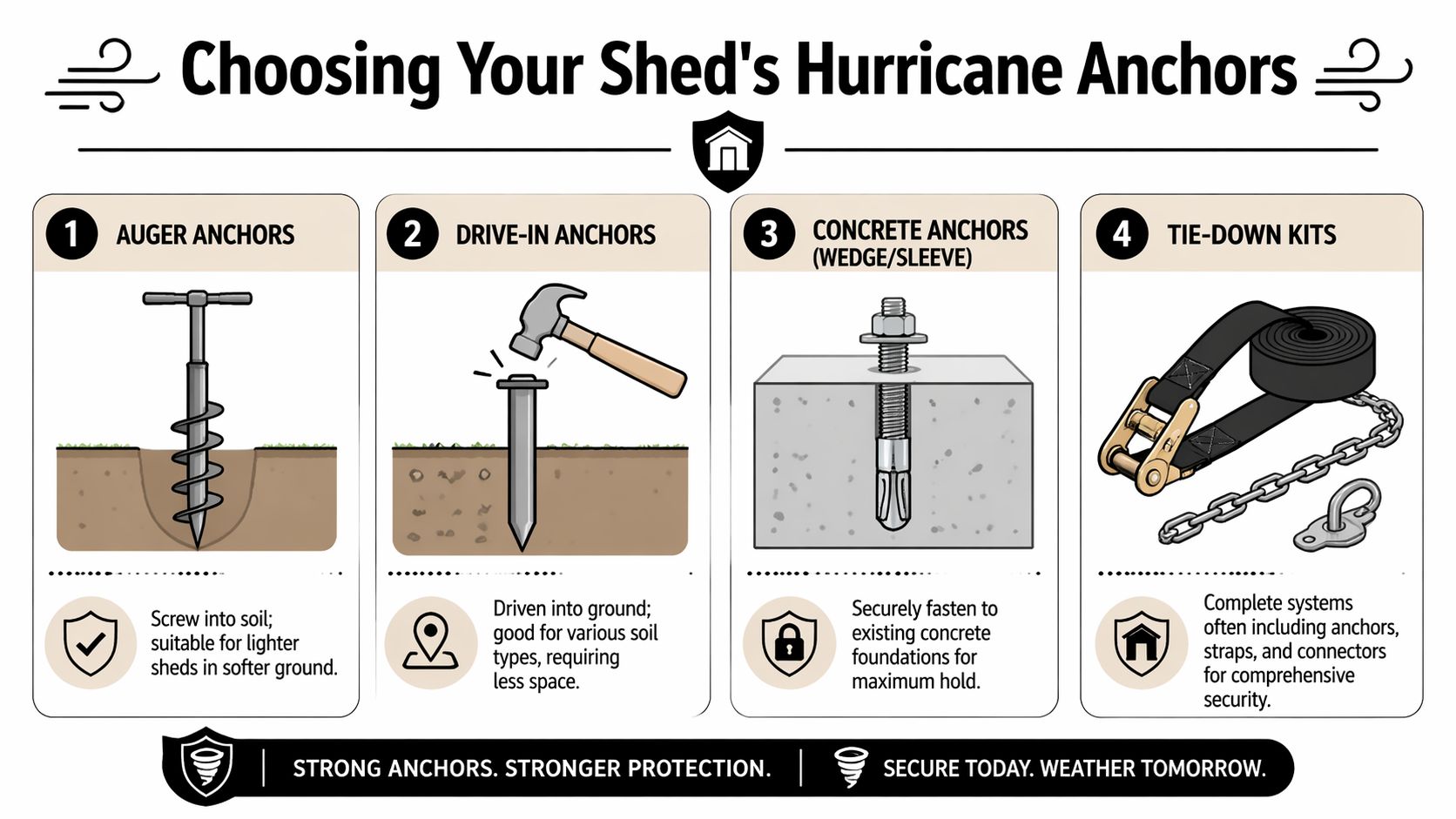
The main anchor categories
Ground augers are the familiar corkscrew-style anchors. They install into soil beside the shed and connect back with straps or cable. They fit many gravel pad installations because they don't require a slab. Their success depends on soil quality, depth, angle, and correct connection to the shed frame.
Concrete anchors are for slabs and other concrete foundations. These include wedge and sleeve-style fasteners that mechanically lock into drilled concrete. When the slab is built correctly, this is usually the most confidence-inspiring attachment method for a shed or garage-type structure.
Tie-down kits are systems rather than a single part. They often include anchors, straps, clips, or tensioning hardware. Some are solid. Some are light-duty retail packages dressed up with marketing language. The kit matters less than the rated parts, the installation method, and what the system is fastened to.
Drive-in anchors sit in a complicated middle ground. On paper, they look simple. In practice, they vary a lot by soil and quality. Some are used in tougher ground where augers are less practical, but performance depends heavily on the exact product and site conditions.
Shed Anchor Comparison by Foundation Type
| Anchor Type | Best For Foundation | Ideal Soil/Surface | Pros | Cons |
|---|---|---|---|---|
| Auger anchors | Gravel pad and soil-based installs | Softer to mixed soil | Common, accessible, works well when angled and tensioned correctly | Can struggle in poor or saturated soil |
| Drive-in anchors | Some soil installs where augers are impractical | Firm ground, depending on product | Faster install in some conditions | Performance varies widely, easy to misuse |
| Concrete wedge or sleeve anchors | Concrete foundations | Sound concrete slab | Strong mechanical connection, clean load path | Requires slab and proper drilling |
| Tie-down kits | Supplemental system for sheds already matched to a base | Depends on included anchor type | Convenient package approach | Quality ranges from robust to flimsy |
Match the anchor to the base, not the store shelf
For a shed on a gravel pad, the anchor usually needs to resist movement through the surrounding soil while the pad handles drainage and support. That often leads homeowners toward augers or heavier earth-anchor systems.
For a shed on a slab, use hardware meant for concrete. This sounds obvious, but plenty of people try to improvise with generic brackets or undersized fasteners. A concrete foundation deserves a true concrete anchor system, not a patchwork fix.
The connection point matters too. The anchor isn't securing siding. It should tie into the structural base, skid, runner, or floor framing. If the load path ends at trim, thin sheet material, or decorative skirting, the system is only pretending to be anchored.
Good anchoring isn't about having more metal in the ground. It's about creating a reliable load path from the soil or slab into the structural frame of the shed.
A practical note on surrounding components
Homeowners sometimes focus only on the anchor head and forget that adjacent materials affect performance. Brackets, straps, post bases, and even nearby retaining details all need to suit outdoor exposure and structural use. If you want a simple visual reference for strong support members used in exterior work, these steel posts offer a useful comparison point for the kind of heavy-duty component thinking that separates durable installations from light-duty ones.
If you're in Honey Brook Township or elsewhere in the region trying to choose between a gravel shed foundation and a slab, the right question isn't "Which anchor is best?" It's "Which anchor is best for this exact foundation, on this exact site, for this exact shed?"
A Step-by-Step Guide to Installing Shed Anchors
A good installation looks orderly before any hardware goes in. The layout is planned, the base is confirmed, and the structural tie-in points are identified. Rushing this part creates most of the failures people later blame on the anchor itself.
One published guide notes that a wind speed of 130 mph can exert approximately 2,100 pounds of horizontal force on an 8'x8' shed, and recommends auger-style anchors positioned at a 45° angle every 4 feet along the perimeter. The same source says high-quality driven anchors can hold over 1,000 pounds, while optimal targets aim for 1,500 pounds per anchor in the right setup, which is a useful benchmark for understanding why layout and installation quality matter so much in storm prep according to Smart Sheds.
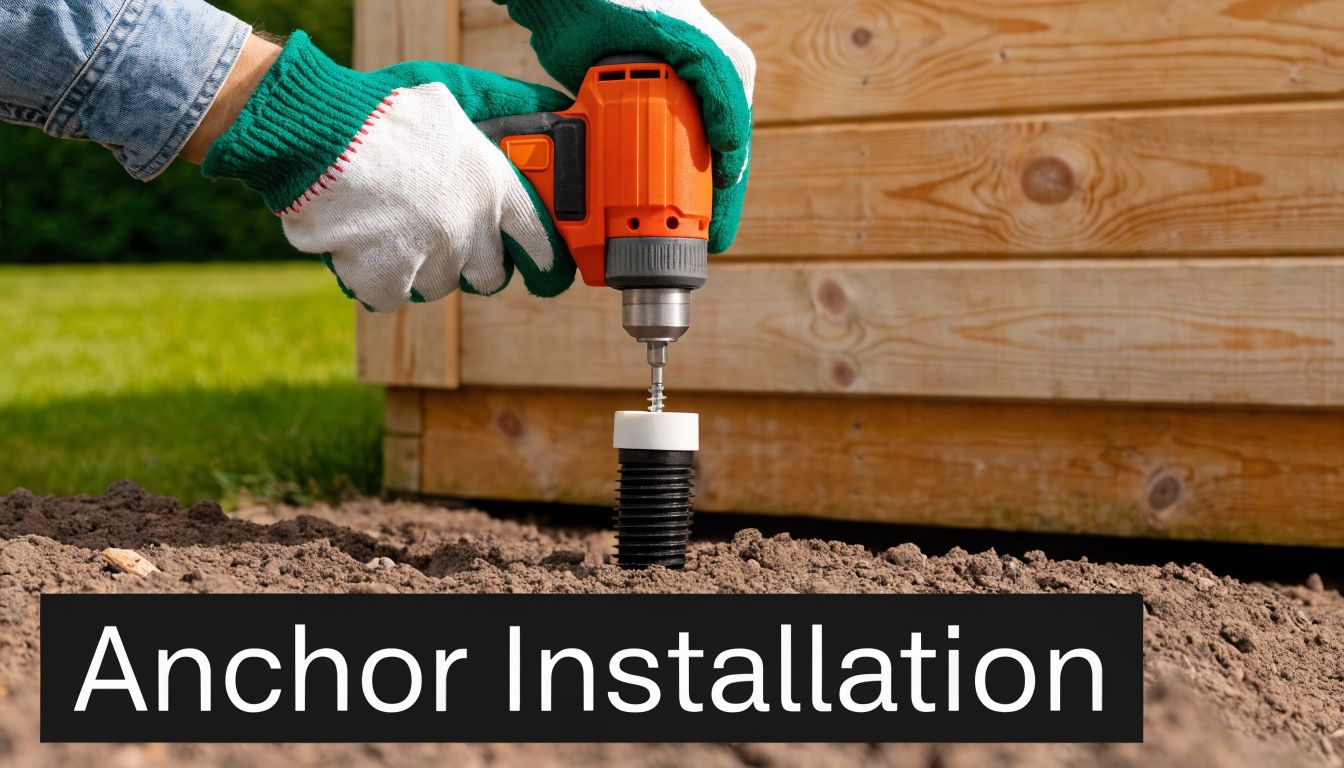
Start by marking the real load path
Before installation, locate the shed's structural base members. On many prefab sheds, that means the skids, runners, or floor joists. Those are the parts that need to receive the anchor load. Mark them clearly so each anchor location corresponds to structure, not just convenient open space.
Then mark the outside anchor positions. A balanced pattern matters more than a random handful of anchors placed wherever the installer can reach. You want the resistance distributed around the building so one side doesn't take the full hit.
For soil-based systems, many installers use a perimeter layout with corners reinforced and intermediate anchors spaced consistently. For slab installs, mark locations where drilled anchors can land in sound concrete while aligning with the shed's structural members.
Set angle, depth, and alignment carefully
The angle is one of the details homeowners often skip. When an auger-style anchor is installed at the right angle, it resists uplift more effectively than a rushed, nearly vertical install. If the anchor wanders, stops shallow, or ends up crooked, its real holding ability drops.
A few field habits help:
- Check for obstructions first: Rocks, buried roots, and construction debris can deflect the anchor path.
- Install with control: Don't force the anchor in a way that tears up the surrounding soil.
- Keep the angle consistent: Random angles make tensioning harder and load sharing worse.
- Watch the corner locations: Corners usually see the most aggressive movement.
If the shed base isn't worth connecting to, stop and fix that first. Anchors don't repair a weak frame.
Connect to the frame, not the skin
This is the detail that separates a real installation from a cosmetic one. The strap, cable, or bracket must connect to the structural frame. Fastening to siding, fascia, trim, or lightweight skirting gives wind a weak link to tear through.
For wood-framed sheds, that usually means bolts, heavy connectors, or structural fasteners through the base member. For metal buildings, it means using the manufacturer's structural attachment points and compatible hardware. Every part of the chain matters: anchor, connector, fastener, and frame.
If you're dealing with a slab and want a straightforward overview of drilled fastening methods, this practical guide to anchoring posts to concrete is a useful reference for the basic mechanics of concrete attachment.
Tension the system evenly
After the anchors and connectors are installed, bring the system into tension gradually. Don't crank one strap tight and leave the others loose. That twists the building and loads one corner too aggressively.
Instead, work around the shed in sequence. Bring each point into firm tension, then recheck the whole pattern. The goal is restraint without distortion.
A visual walkthrough can help homeowners understand the process before they decide whether to DIY or bring in a pro.
Recheck after the first weather cycle
The job isn't done the minute the hardware is in place. After the first hard rain, freeze-thaw shift, or strong wind event, inspect the system again. Soil settles. Straps relax. Hardware may need retensioning.
A smart post-install checklist looks like this:
- Inspect the frame connection and make sure fasteners haven't loosened.
- Verify anchor position and look for tilt, pull-up, or disturbed soil.
- Check strap condition for fraying, rust, or abrasion.
- Confirm the shed stayed square by testing door operation and corner alignment.
- Look at drainage around the base because water problems often show up after installation, not before.
Done right, hurricane anchors for sheds don't just sit there waiting for a storm. They stay integrated with a base and frame system that remains stable season after season.
Common Mistakes and Local Wind Code Considerations
The Mid-Atlantic has its own failure pattern. Wind arrives after heavy rain, ground conditions change quickly, and sheds that looked fine in dry weather start moving when the soil softens. That's why local judgment matters just as much as the hardware package.
Codes also vary by municipality, structure type, and exact location. Homeowners should always check local requirements before building or modifying a shed foundation, a gazebo foundation, or a garage slab. Code minimums matter, but they aren't a substitute for good construction judgment.

Cheap anchor kits often fail for predictable reasons
Many homeowners face a common pitfall. They buy a low-cost kit at a big-box store, install it in a hurry, and assume any anchor is better than none. Sometimes that is technically true. It still isn't a good standard for protecting a major purchase.
A reported post-storm analysis tied to saturated Mid-Atlantic soils found a 40% uplift failure rate for non-engineered ties, and independent testing discussed alongside it showed some cheap bullet or drive-in anchors failing at 865 lbs, while wedge anchors in a concrete slab can resist 1500+ lbs per point according to the test discussion summarized in this anchor failure and comparison video. That gap is exactly why bargain hardware can become expensive hardware after one bad storm.
The mistakes seen most often
Some errors come from poor products. Others come from using decent products the wrong way.
- Using the wrong anchor for the soil: Wet clay, loose fill, sandy spots, and rocky ground all behave differently.
- Treating a gravel surface like a foundation: Loose stone alone doesn't replace proper excavation and pad construction.
- Spacing anchors too loosely: Large gaps create long unsupported sections where the shed can rack or lift.
- Ignoring the connection point: Straps attached to siding or trim don't protect the structure.
- Skipping maintenance: Tension changes over time, especially after weather cycles.
- Assuming bigger sheds are automatically safer: More surface area can mean more wind load if the structure isn't secured properly.
Minimum compliance and real-world durability are not always the same thing. Storm performance usually depends on the details that don't show in a product photo.
Local conditions in PA, MD, DE, and NJ
Regional weather creates a tough mix for outbuildings. One season brings hard, dry ground. The next brings prolonged saturation. Freeze-thaw movement can loosen what looked solid in late summer. Coastal influence in Delaware and New Jersey can change exposure conditions, while inland Pennsylvania and Maryland often combine gusty storms with rolling or uneven sites.
That means local best practice usually includes:
| Local Condition | What It Changes | Better Response |
|---|---|---|
| Saturated soil | Reduces pullout resistance | Use a system matched to wet-ground conditions or slab attachment |
| Uneven grade | Introduces racking and drainage issues | Correct grading and build a true pad before anchoring |
| Rocky ground | Complicates auger installation | Consider alternative anchor types or concrete-based attachment |
| Larger structures | Increases demand on the load path | Upgrade both the foundation and the connection details |
Homeowners looking for garage foundation contractors near me, concrete contractors, excavation near me, or a durable base for storage shed are often solving the same core problem. They need a structure that won't move when the weather gets serious. The answer is rarely the cheapest kit on the shelf.
When to Call a Foundation Contractor in PA and NJ
Some shed projects are reasonable DIY jobs. Others aren't. If the site is sloped, the soil stays wet, the building is oversized, or you're stepping up from a small shed to a workshop, garage, or barn shed, it's smart to involve a contractor before you buy anchors.
A professional should also be your first call when the shed needs more than tie-downs. If the site needs excavation, grading, drainage correction, a gravel pad, or a concrete slab, anchoring is only one part of the job. The foundational work begins with creating a stable platform that won't shift under load.
Situations where DIY gets risky
DIY usually stops being practical when one or more of these conditions show up:
- The ground isn't level and the shed needs meaningful cut, fill, or compaction.
- The soil is rocky or inconsistent and standard anchor installation becomes guesswork.
- The structure is large or heavily loaded and behaves more like a garage than a garden shed.
- You need a slab or serious pad construction instead of simple block support.
- You want the option to add future structures such as a gazebo, hot tub pad, or concrete foundation for garage use nearby.
For homeowners weighing options, this related guide on how to anchor a shed is a helpful companion resource. It pairs well with the bigger lesson here, which is that anchoring only works when the base and frame are ready for it.
Think system, not accessory
If you're searching terms like shed foundation, garage footings and foundations, concrete foundations, driveway contractors near me, or gravel shed foundation contractors near me, you're already thinking in the right direction. Wind protection isn't just about hardware. It's about the full assembly under and around the structure.
That is especially true across Pennsylvania and New Jersey, where site conditions can change fast and storm exposure varies a lot from property to property. The right contractor doesn't just install a pad. They help make sure the pad, drainage, structure, and anchor method belong together.
Frequently Asked Questions About Shed Anchoring
Can I use the same anchoring approach for a gazebo foundation or playset
Sometimes, but not automatically. The idea is similar because the structure still needs a stable base and a dependable connection to that base. The details change based on shape, weight, framing, and how wind moves through or around the structure.
How often should I inspect hurricane anchors for sheds
Inspect them at least after major storms, after heavy wet periods, and whenever you notice the shed door sticking or the base looking out of level. You're checking for loose tension, rust, disturbed soil, cracked concrete, and any sign that the shed has shifted.
Can I move a shed later if it has been properly anchored
Yes, but moving it usually means disconnecting and then reinstalling the anchoring system correctly at the new site. If the new location has different soil or a different foundation, the same anchors may not be the right choice.
Is a gravel pad enough, or do I need concrete
Both can work. The right answer depends on the shed size, how you use it, site drainage, and whether you need a stronger attachment surface for heavier-duty hardware. A light storage shed and a workshop don't ask the same thing from the foundation.
If you want the shed done right from the ground up, Firm Foundations can help with site prep, excavation, gravel pads, and concrete foundations across Pennsylvania, Maryland, Delaware, and New Jersey. Get a free quote and make sure your shed, garage, gazebo, or barn starts with a base built for real weather, not just fair-weather installation.