
Building a Gravel Driveway Cost: Building a Gravel Driveway
TL;DR: A gravel driveway typically runs $1 to $3 per square foot, and some sources place installed costs as high as $4 per square foot when labor and materials are included. Nationally, typical projects land around $600 to $1,800, with a 3-car driveway at $720 to $2,200 depending on size and conditions, but the only way to know your real building a gravel driveway cost in PA, MD, DE, or NJ is with a site-specific quote.
You might be dealing with a driveway that turns muddy after every rain, sheds gravel into the lawn, or doesn't exist yet where you need one. That usually sends homeowners into a search for building a gravel driveway cost, and the answers online can feel all over the map.
The problem is that gravel driveway pricing only looks simple from a distance. Once you factor in slope, drainage, base prep, truck access, and the kind of stone that holds up in Mid-Atlantic weather, the price can shift fast.
Planning Your New Driveway in PA, MD, DE or NJ
A homeowner in southeastern Pennsylvania might need a clean parking area beside a garage. A rural property owner in Maryland may need a longer lane that stays passable after storms. A family in Delaware may just want to stop tracking mud into the house. The surface issue looks different from property to property, but the question underneath is the same. What will it cost to build it correctly the first time?
That answer rarely comes from a quick online calculator. A short, flat driveway on stable ground is one thing. A sloped entrance with soft spots, runoff, and old pavement to remove is another.
What homeowners usually run into first
It's common to start by comparing a few broad numbers and trying to reverse-engineer their own project. That’s understandable, but it misses the field realities that shape a driveway in Pennsylvania, Maryland, Delaware, and New Jersey.
A few of the biggest local variables include:
- Existing ground conditions that determine whether simple spreading will work or whether excavation is needed
- Drainage patterns that may require reshaping the drive so water moves off instead of washing stone away
- Access for trucks and equipment which affects how easily material can be delivered and placed
- Transition points where the driveway meets a road, garage, shed pad, or parking apron
A gravel driveway doesn’t fail because gravel is a bad material. It fails because the ground underneath wasn’t prepared for traffic and water.
For homeowners planning broader site work, driveway pricing also connects to grading and excavation decisions elsewhere on the property. If you’re looking at a full site refresh, this guide to residential excavation services near me helps show how the prep side affects the final result.
Why local evaluation matters
A gravel driveway has to fit the property, not the other way around. In the Mid-Atlantic, you’ll see clay-heavy soils in some areas, softer shoulders in others, and plenty of sites where runoff becomes the main long-term problem. That’s why two driveways with similar dimensions can have very different scopes.
Good planning starts with walking the site, checking grades, and identifying where the money needs to go. Sometimes that means a straightforward install. Sometimes it means solving the drainage issue before a single load of gravel gets spread.
Breaking Down the Average Gravel Driveway Cost
Homeowners in PA, MD, DE, and NJ usually start with a simple question: what does a gravel driveway cost before site work starts adding complexity?
As noted earlier, national pricing sources put basic gravel driveway installs on the lower end of driveway options, with rough budget ranges often discussed by square foot. That helps with early planning, but local quoting in the Mid-Atlantic is driven by field conditions, hauling distance, and how much base work the property needs before stone goes down.
At Firm Foundations, we treat the average as a rough budgeting tool, not a job price. A flat, accessible driveway in southern Pennsylvania may be fairly straightforward. A similar-sized drive in central Maryland with soft subgrade, runoff issues, or tight truck access can price very differently.
Cost by square footage
Square footage still matters because it gives homeowners a quick way to frame the size of the job.
| Driveway Size | Approx. Square Footage | Estimated Cost Range |
|---|---|---|
| 1-car driveway | 12 x 25 feet | $300 to $900 |
| 2-car driveway | 24 x 24 feet | $600 to $1,800 |
| 3-car driveway | 30 x 24 feet | $720 to $2,200 |
These are broad starting ranges based on commonly cited national averages referenced earlier. They are useful for first-pass budgeting, especially if you are comparing gravel to asphalt or concrete, but they do not capture the local conditions that often control the final number.
What Mid-Atlantic homeowners should expect
In this region, freight and material availability can shift pricing from one county to the next. Quarry access is different in southeastern Pennsylvania than it is in parts of New Jersey. Delaware sites with limited access or lower-lying grades often need more shaping and edge control. Rural Maryland projects may require longer haul routes, which affects delivered stone cost before any machine work begins.
That is why two 600 square foot driveways can land in very different price ranges.
A simple refresh with minor grading and a new top layer of gravel is one type of job. A full build with excavation, geotextile fabric, base stone, compaction, and finish gravel is another.
Per-square-foot pricing in practical terms
Broad per-square-foot pricing works best on sites with decent drainage, stable ground, and easy truck access. Once deeper excavation, imported base material, or reshaping for runoff enters the scope, installed pricing climbs because the labor and equipment time climb with it.
On actual Mid-Atlantic projects, the biggest gap between a rough online estimate and a contractor quote usually comes from prep. Homeowners often expect to pay for gravel. They end up paying for excavation, grading, compaction, and the extra stone required to build a driveway that does not rut after one wet season.
Average cost versus real project cost
Averages help set expectations. Site conditions set the contract price.
For example, a short rectangular driveway on stable ground may stay close to a basic budget range if the existing base is usable. A longer driveway with a soft shoulder, standing water near the garage, or a low area that needs fill can require substantially more work even if the finished dimensions look ordinary on paper.
That trade-off matters more than the average itself. Spending less up front on a thin layer of gravel often leads to faster washout, potholes, and repeat stone deliveries. Spending more on base prep usually lowers maintenance and keeps the driveway usable in freeze-thaw cycles common across PA, MD, DE, and NJ.
Material and labor do not rise at the same pace
Stone cost is only one part of the budget. Labor, trucking, machine time, and disposal can move faster than material pricing, especially on sites where crews cannot dump, spread, and compact efficiently.
We see this regularly on properties where the driveway also has to support heavier use, such as parking near a garage, a shed area, or utility access. In those cases, the cost of building a proper base is often what determines whether the driveway holds up.
Key Factors That Determine Your Final Driveway Price
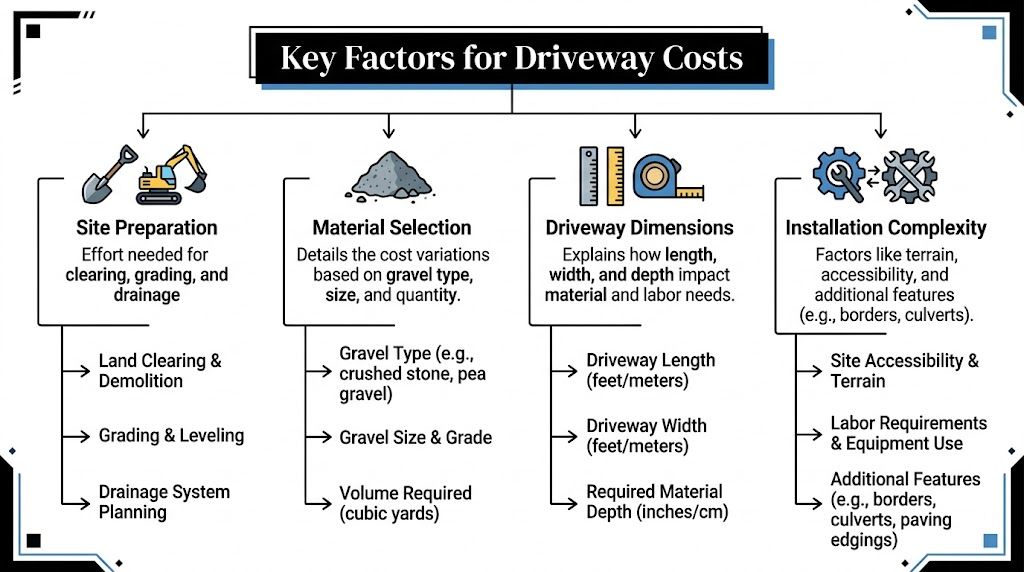
Most of the swing in building a gravel driveway cost comes from what has to happen before the finish gravel goes down. Homeowners often focus on stone color or driveway size, but the biggest pricing shifts usually come from labor, subgrade condition, and installation difficulty.
Site preparation drives the price more than most people expect
According to Houzz’s gravel driveway cost overview, ground clearing can add $200 to $500 or more, and leveling and grading can cost $1,500 to $2,000 or more, especially on sloped sites. That same source also notes that removing existing pavement can run $700 to $2,000, and transporting, pouring, and smoothing gravel typically costs $120 to $240.
Those numbers explain why a driveway that looks modest on paper can still become labor-heavy. If the site needs trees, brush, stumps, rocks, or broken pavement removed first, the gravel portion becomes only one part of the project.
Grading decides whether the driveway lasts
Grading isn’t cosmetic. It’s structural. A driveway that looks level to the eye can still hold water, wash out edges, or rut under tires if the subgrade wasn’t shaped correctly.
For sloped or uneven lots, crews often spend more time with the excavator, skid steer, and compaction equipment than homeowners expect. That’s not extra padding in the quote. It’s the work that keeps the driveway from turning into a recurring maintenance problem.
If water stays on the driveway, the driveway won’t stay in place.
Clearing and demolition can change the scope quickly
Many properties already have something in the way. It may be an old asphalt strip, a failing stone drive, a tree line too close to the edge, or stumps buried where the new parking area needs to go.
That kind of prep work can include:
- Brush and obstacle clearing when the driveway route is new or being widened
- Stump removal if roots would interfere with excavation and compaction
- Old surface removal where existing pavement or unstable material must come out
- Subgrade correction if soft spots need to be cut out and rebuilt
Houzz also notes that professional land clearing for longer roads or driveways costs about $400 per hour, and stump removal ranges from $2 to $6 per inch of diameter or $80 to $250 per stump. Those are the kinds of details that never show up in a generic driveway calculator but matter immediately on site.
Driveway dimensions affect more than stone quantity
Length and width obviously affect material needs, but dimensions also affect truck movement, grading time, and how much edge management is needed. A compact parking area near the street installs differently from a long lane that winds around the house or climbs toward a barn shed.
Depth matters too, even when homeowners don’t think about it directly. If the site calls for a stronger base because the ground is weak or traffic is heavier, the project may require more excavation and more compacted aggregate before the top layer is placed.
Installation complexity shows up in the details
Two driveways can have the same square footage and very different labor hours. The difference usually comes from practical complications:
- Tight access that makes truck unloading or machine movement slower
- Steep transitions at the road or garage
- Drainage features such as shaping runoff away from buildings
- Borders and clean edges for appearance and stone retention
- Coordination with nearby structures like a shed foundation, garage footings and foundations, or patio area
One documented residential project cited by Houzz required 16 to 18 gravel deliveries coordinated simultaneously from multiple suppliers to complete the installation in a single day. That example is useful because it shows how complexity affects labor and logistics, not just stone quantity.
Permits and municipal requirements can add steps
Permit requirements vary by township, borough, county, and road frontage. A homeowner may not need anything beyond normal site work, or they may need approval if the driveway entrance changes, drainage ties into a roadside ditch, or the project affects runoff.
The cost impact here isn’t always a permit fee. Sometimes it’s the added design, scheduling, and coordination. If there’s a culvert issue, entrance apron concern, or township grading requirement, the driveway plan needs to account for it early.
What works and what usually doesn’t
A durable driveway usually comes from a straightforward set of decisions:
- Strip out weak or unstable material.
- Build a shaped base that sheds water.
- Compact in stages.
- Use gravel that matches the traffic and the site.
What usually doesn’t work is trying to solve a base problem by dumping more top stone on it. Homeowners do this all the time. It freshens the look for a while, but it doesn’t correct rutting, soft spots, edge failure, or drainage.
That’s why quotes can vary so much. The price isn’t only for gravel. It’s for the work required to make the gravel stay where it belongs.
Choosing Your Gravel What to Know About Materials
Material choice changes both the upfront cost and the amount of maintenance a driveway will need later. Some stone looks attractive on day one but moves too easily under tires. Other stone may look more utilitarian yet performs better over time.
Price range by gravel type
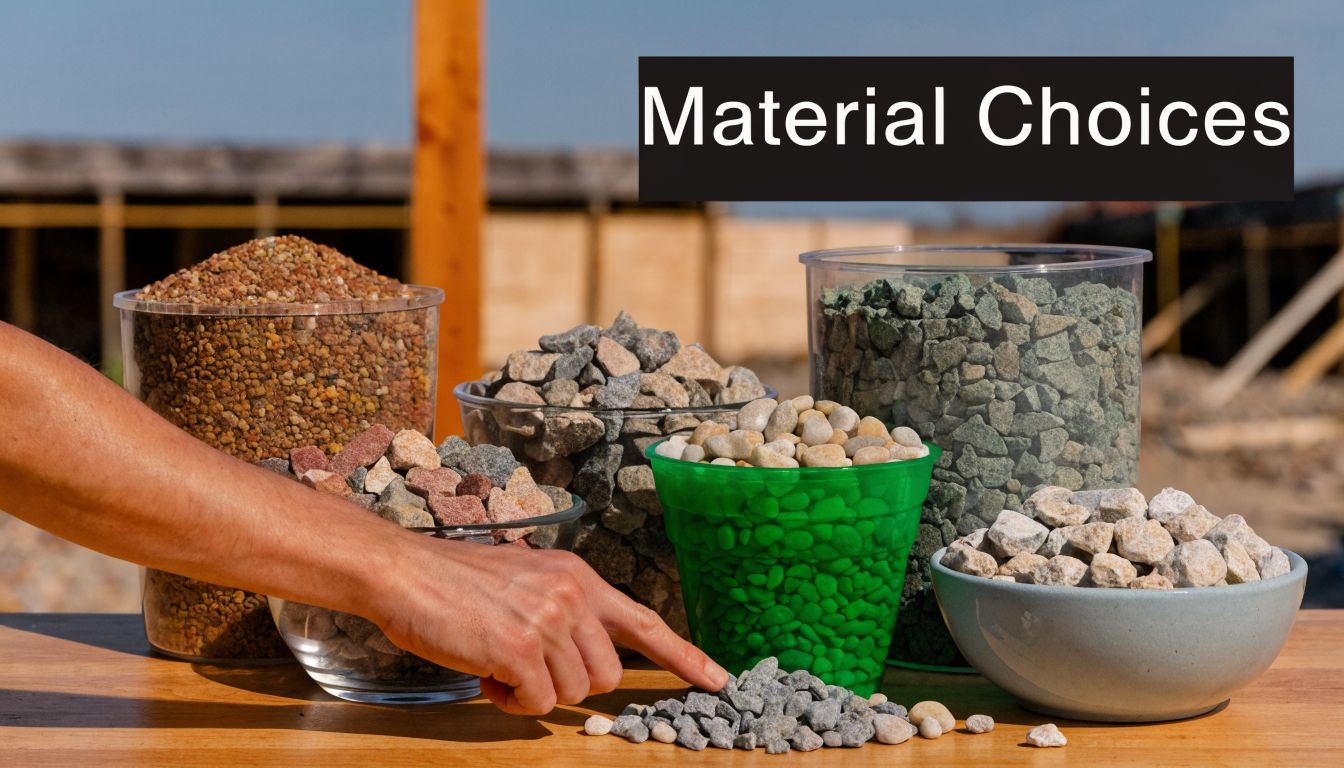
According to Angi’s gravel driveway pricing guide, Item #4 crushed stone costs $10 to $25 per ton, while marble chips can cost $85 to $400 per ton. The same source places crushed granite at $25 to $50 per ton, crushed limestone at $30 to $40 per ton, and river rock at $35 to $50 per ton.
That spread is wide enough to matter. A homeowner choosing stone by appearance alone can end up paying premium material prices for a surface that needs more upkeep.
Angular stone usually performs better for driveways
The practical distinction is shape. Angular aggregates such as crushed limestone and crushed granite lock together better than rounded materials. That tighter compaction helps the surface resist displacement under normal vehicle traffic.
Rounded materials like river rock and pea gravel can work in decorative settings, but they often shift more under tires. On active driveways, that movement can show up as loose edges, migration into lawns, and a surface that never feels fully settled.
Field advice: If the driveway has to carry daily traffic, favor stone that compacts and stays put over stone that only looks polished in a sample pile.
Comparing common choices
| Material type | Cost range | Typical strength | Practical note |
|---|---|---|---|
| Item #4 crushed stone | $10 to $25 per ton | Budget-friendly | Good for cost-conscious installs |
| Crushed granite | $25 to $50 per ton | Strong compaction | Often a solid balance of look and durability |
| Crushed limestone | $30 to $40 per ton | Strong compaction | Angular shape helps resist movement |
| River rock | $35 to $50 per ton | More decorative | Rounded shape tends to move more |
| Marble chips | $85 to $400 per ton | Premium appearance | Higher-end choice with a much higher material price |
These numbers come from the Angi source above.
If you want a broader homeowner-friendly reference on surface choices, this guide to the best gravel for driveways is a useful comparison read.
Best value depends on the use, not just the price tag
For a driveway, a shed foundation gravel base, or a gravel pad beneath a 10×10 storage shed, the right material is the one that matches the load and the maintenance expectations. A decorative rounded stone may look appealing near a gazebo foundation or decorative border. A compactable angular stone is usually the safer choice where repeated wheel traffic matters.
That’s why the cheapest material isn’t always the lowest-cost decision over time. If the stone shifts easily, you’ll fight washouts, raking, and top-offs more often. Paying more upfront for a better-performing aggregate can make sense when the goal is a surface that behaves well season after season.
DIY Installation vs Hiring Firm Foundations
A gravel driveway looks simple when you watch stone being spread. The part homeowners don’t see is the sequence underneath it. Marking grade, excavating to the right depth, shaping for drainage, compacting in lifts, and managing truck deliveries is where the job is won or lost.
What DIY usually involves
Homeowners who take this on themselves often underestimate the logistics more than the labor. The job typically means coordinating gravel deliveries, arranging equipment, moving material with a skid steer or similar machine, and compacting the base thoroughly enough that it won’t rut right away.
There’s also the issue of timing. If the trucks arrive before the site is ready, material can end up dumped where it’s hard to move efficiently. If the grading is slightly off, the finished driveway may look acceptable for a few weeks and then start showing the mistake after the first hard rain.
The hidden problems with a self-installed driveway
A DIY driveway can work on a very forgiving site. Flat ground, easy access, and clean existing soil make the odds better. But the failures tend to show up in familiar ways:
- Water channels down the center because the grade wasn’t shaped correctly
- Tires push gravel aside because the base wasn’t compacted enough
- Soft spots return because weak soil was covered instead of removed
- Edges unravel because the layout wasn’t contained or finished cleanly
Those aren’t cosmetic issues. They usually mean the driveway needs corrective work, not just a touch-up.
Most driveway callbacks trace back to base preparation, not to the final layer of stone.
What a professional install changes
Professional installation brings control to the parts of the project that homeowners usually can’t easily replicate. That includes reading the site, deciding where to cut and fill, choosing material suited to the traffic, and using the right equipment sequence.
It also removes the guesswork from coordination. A crew that handles driveway work regularly knows how to stage deliveries, keep machines moving, and leave a surface that drains properly from day one.
Why this matters for more than just driveways
On many properties, the driveway ties into other site improvements. Maybe it feeds a new garage foundation, a concrete foundation for garage, or access to a barn shed. Maybe the same project includes a shed foundation, concrete forms, or general foundation builds.
When the grade is off at the driveway, those nearby elements can be affected too. Water follows the low points. A poorly planned driveway can create runoff problems around a garage slab, a house foundation, or a gravel pad serving a storage building.
The practical choice
DIY makes the most sense when the site is simple, the homeowner has equipment access, and the margin for error is high. Hiring a professional makes more sense when the driveway needs to last, connect cleanly to other structures, and perform well through changing weather.
The cheapest route on paper isn’t always the least expensive outcome. Correcting drainage, rebuilding failed sections, or importing more stone after a rushed install can erase the initial savings quickly.
Sample Gravel Driveway Budgets in PA and MD
A homeowner in Chester County calls us after getting two gravel driveway prices that are nowhere close. The drive looks straightforward from the road, but one contractor priced a basic stone refresh and the other priced a full rebuild with grading and base repair. That gap is common in PA and MD, and it usually comes down to what the site requires.
Standard 2-car driveway in Chester County, Pennsylvania
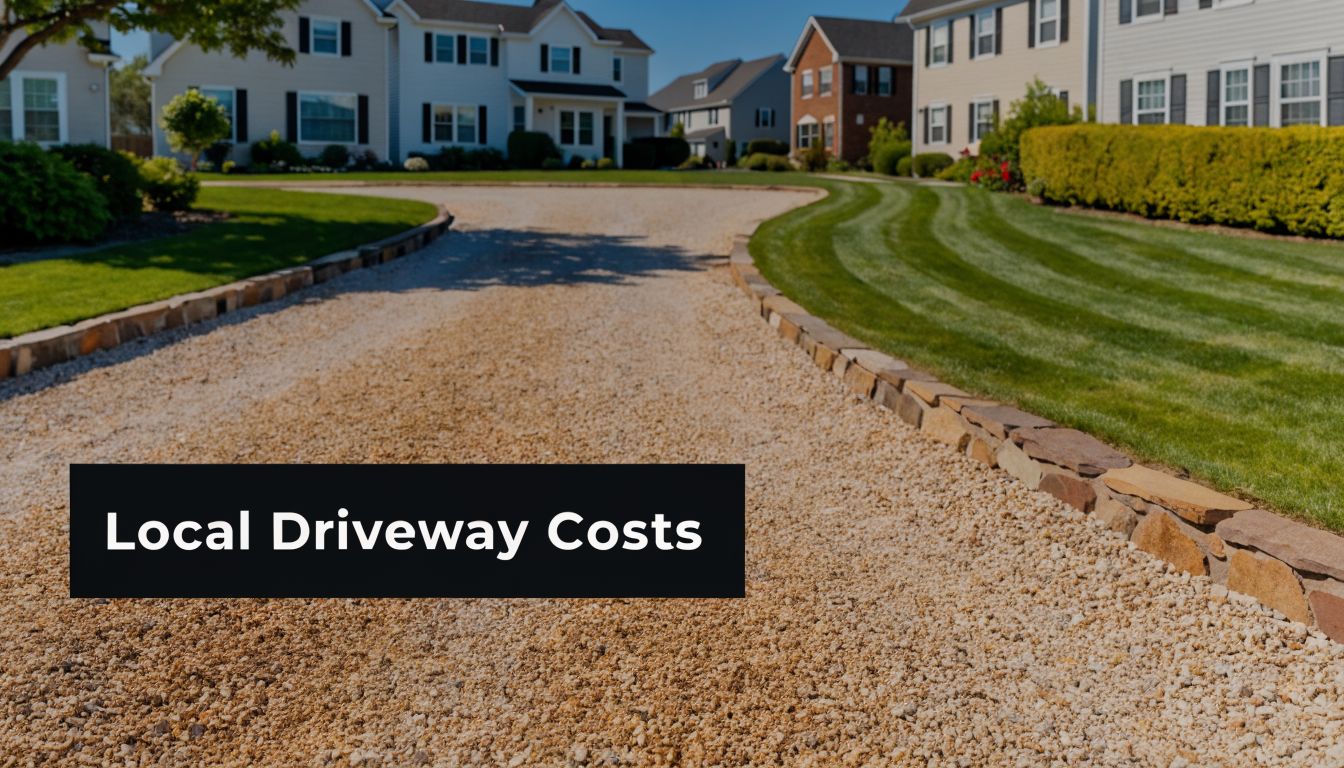
A typical suburban job in southeastern Pennsylvania might be a 2-car driveway or parking area beside a garage. If the existing footprint is usable and access is easy, the budget often stays reasonable. If the old drive has sunk edges, soft spots, or poor drainage near the house, the price changes fast because the work shifts from topping off stone to correcting the base.
On projects like this, the final number usually hinges on a few local conditions:
- Existing base condition. A stable base can save a lot of labor. A failed base means excavation, reshaping, and more stone.
- Tight access near the home. Fences, garages, and landscaping slow down equipment and handwork becomes part of the job.
- Drainage at the garage or roadside. Even a short driveway can need swales, culvert tie-ins, or edge support to keep water from washing stone away.
- Finish stone choice. Clean crushed stone, crusher run, and decorative gravel do not price out the same and they do not perform the same either.
In Chester County, a simple install and a proper rebuild may look similar when finished. The difference is underneath, and that is where the money goes.
Longer rural driveway in Frederick County, Maryland
A rural Maryland driveway usually brings more variables. Length adds stone and trucking costs, but slope and runoff are often the bigger issue. We see this on properties where the drive climbs from the road or crosses ground that stays wet after a storm.
A Frederick County budget often increases for reasons that do not show up on a simple size chart:
- Longer haul routes on the property increase machine time and delivery coordination
- Steeper grades require shaping that sheds water off the drive instead of channeling it down the wheel tracks
- Soft subgrade areas need undercutting or extra base material before finish stone goes down
- Turnarounds and parking areas add width, which adds cost quickly even if the driveway length stays the same
Here’s a short look at the kind of process homeowners often want to see before making a decision:
Real-world budget ranges from local job types
For planning purposes, these are the kinds of budget conversations we have with homeowners in PA and MD:
- Basic refresh on an existing short driveway. Lower cost if the shape is still good and the job only needs fresh top stone and light grading.
- Standard suburban rebuild. Mid-range cost when the driveway needs regrading, base repair, and a new finish layer.
- Long rural install or major repair. Higher cost when truck access is harder, the driveway is sloped, or drainage control is part of the scope.
That is why two driveways with similar square footage can price very differently. One may need two stone deliveries and a final grade. Another may need excavation, geotextile fabric, several lifts of base, and more time shaping the crown and edges.
Homeowners also ask what costs show up after installation. Weed growth, washboarding, and stone migration are common maintenance issues, especially on lightly built driveways. If you are comparing options for long-term upkeep, this guide on maintaining your gravel driveway for longevity is useful. If an older driveway already has growth coming through the surface, this article on how to remove weeds from gravel can help.
Why one local estimate can be much higher than another
In the Mid-Atlantic, the lot decides the work. Freeze-thaw cycles, clay-heavy soils, runoff from wooded lots, and narrow suburban access all show up in real pricing. A low quote may be perfectly fair for a light refresh. It is not the same scope as a quote that includes excavation, base correction, and drainage work.
The best estimate is specific. It should explain the stone being used, the prep included, the thickness being installed, and whether the price covers repairing the structure below the surface or only dressing up the top.
Your Next Steps for a Lasting Gravel Driveway
If you’ve been trying to pin down building a gravel driveway cost, the main thing to remember is that the driveway isn’t just a layer of stone. It’s a small sitework project. The shape of the ground, the path of water, the type of gravel, and the quality of the base all decide whether the surface stays clean and stable.
For long-term upkeep, homeowners often ask about weeds, ruts, and top-layer cleanup. A practical outside resource on how to remove weeds from gravel can help if your existing drive already needs attention. For ongoing care after installation, these maintaining your gravel driveway essential tips for longevity are worth reviewing too.
What to do before requesting a quote
A homeowner gets the most useful quote by being ready with a few basics:
- Know the use whether it’s daily parking, access to a garage, or support for outbuildings
- Note drainage issues such as standing water, washouts, or muddy spots
- Identify related work like excavation, a shed pad, or nearby concrete foundations
- Think about finish priorities whether you care most about appearance, low maintenance, or both
A good quote should leave you with a clear scope, not confusion. If you’re in Pennsylvania, Maryland, Delaware, or New Jersey, the smartest next move is a free, no-obligation site assessment so the driveway can be priced around your actual property rather than a generic online average.
Frequently Asked Questions About Gravel Driveways
How long does a gravel driveway project usually take
That depends on the site, access, weather, and whether prep work comes first. A straightforward residential driveway can move quickly once equipment and material are scheduled. If the property needs clearing, grading correction, or demolition before stone goes down, the schedule gets longer.
Does a gravel driveway need maintenance
Yes. Gravel is durable, but it isn’t maintenance-free. Most owners should expect occasional raking, touch-up grading, and adding stone in areas that see repeated traffic or runoff. A driveway that was built on a solid, well-drained base is usually easier to maintain than one that was laid over weak ground.
Is gravel a good option for a sloped property
It can be, but only if the slope is addressed properly during installation. On sloped sites, drainage and compaction matter more than appearance. The wrong stone or a poorly shaped base can let water pull material downhill. A well-built gravel driveway on a slope needs careful grading and the right aggregate, not just extra loads of stone.
What’s the difference between a gravel driveway and a gravel shed foundation
A driveway is built for repeated vehicle movement across a travel path. A gravel shed foundation is built to provide a stable, level bearing surface under a structure. The materials can overlap, but the purpose is different. A driveway has to handle turning tires and runoff along its full length. A shed foundation gravel base is focused on support, drainage, and long-term stability under one footprint.
Can a gravel driveway work alongside other foundation projects
Absolutely. Many properties combine driveway work with a garage foundation, cement foundations for garage, a house foundation addition, or access to a new prefab building. It’s often smart to plan these improvements together so the grades, drainage, and equipment access are coordinated from the start.
Should I choose gravel or concrete for my site
That depends on use, appearance goals, and the condition of the property. Gravel can be a strong choice when you want a practical surface with flexibility and lower upfront cost. Concrete foundations and hard surfaces make more sense where a rigid finished slab is needed. On some sites, the best result is a combination, such as a gravel drive leading to a garage slab or shed pad.
If you’re planning a driveway, shed pad, garage slab, or excavation project in Pennsylvania, Maryland, Delaware, or New Jersey, Firm Foundations can help you sort out the scope before you commit. Request a free quote and get a clear, site-specific plan built around drainage, durability, and long-term performance.