
Playhouses and sheds: Expert Foundations for Playhouses & Sh
You’ve picked out the shed, or you’re finally ready to build that backyard playhouse your kids have been asking for. The layout is exciting. The paint color is fun. The delivery date feels close.
Then the practical question shows up. What is it going to sit on?
That’s where many playhouses and sheds go wrong in Pennsylvania, Maryland, Delaware, and New Jersey. Homeowners focus on the structure they can see. The project's lifespan depends on the work below it. If the base shifts, holds water, or wasn’t built for local soil and freeze-thaw conditions, the problems show up fast. Doors stop closing right. Floors go soft. Corners settle. Moisture starts working its way into framing.
A good-looking shed on a poor base is still a poor installation. A simple playhouse is no different. If children are climbing, jumping, and running in and out of it, the structure needs stable support from day one.
Why Your Shed's Base is Crucial in PA, MD, DE & NJ
A lot of homeowners start in the same place. They want a clean backyard upgrade in Honey Brook Township or another nearby community. Maybe it’s a storage shed to clear out the garage. Maybe it’s a playhouse that gives the kids their own space. Either way, the structure feels like the project.
The base is the part people underestimate.
Grass is not a foundation. Loose topsoil is not a foundation. A few concrete blocks set wherever the grade happens to be level enough is not a long-term foundation. Those shortcuts usually look acceptable at first. They rarely stay that way.
What fails first
The first issues are usually small:
- Doors start rubbing: The structure settles unevenly and the opening moves out of square.
- Water sits under the floor: That trapped moisture leads to rot, mold, and soft framing.
- Corners dip: Weight stops being distributed evenly, especially after wet weather and winter freezing.
- The structure leans slightly: Even a small shift can turn into a larger repair later.
In this region, those risks are higher because the weather works the base hard. Wet springs, humid summers, and winter freeze-thaw cycles all test the prep work under a shed foundation.
Playhouses need real support too
People sometimes assume a playhouse can sit on a lighter setup because it’s “just for kids.” That’s a mistake. The history of playgrounds shows how long child safety and structural stability have mattered, from German “sand gardens” in 1885 to organized playground construction in the United States by 1906. Today, a standard backyard playset can exert over 5,000 lbs of dynamic load, and a professionally installed gravel or concrete foundation can reduce instability risks by 70-90% according to the history of playgrounds and modern safety context.
Practical rule: If a structure will carry weight, movement, and weather, it deserves a real base.
What works in the Mid-Atlantic
A base that lasts usually starts with excavation, removal of organic material, proper grading, compaction, and the right foundation type for the structure and the site.
That matters whether you’re looking for shed foundations near me, a base for storage shed, a gazebo foundation, or even planning a future concrete foundation for garage. The same principle applies. The structure only performs as well as the ground prep underneath it.
For homeowners in PA, MD, DE, and NJ, local experience matters. Soil conditions, slope, drainage, and township requirements all affect what will work and what will fail.
Choosing the Right Foundation for Your Playhouse or Shed
The shed market has become a serious investment category. The U.S. market for sheds and outdoor storage reached $14.2 billion, and 20-30% of unprofessional installations suffer from settling issues, which is why the base matters so much when protecting the structure long term, according to Freedonia’s sheds and outdoor storage industry data.
That doesn’t mean every project needs the same foundation. A small barn shed on a flat yard has different needs than a heavy prefab garage or a playhouse on a sloped lot in Pennsylvania.
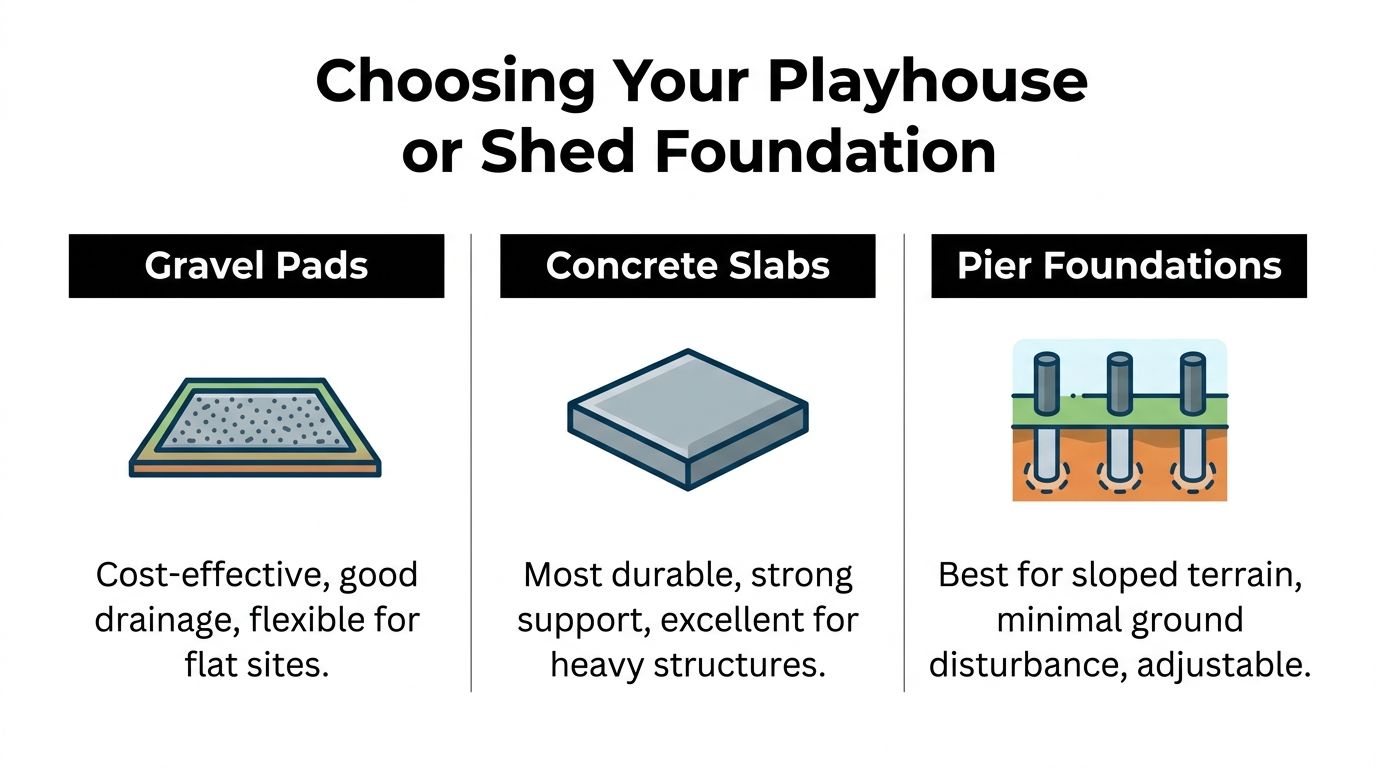
Gravel pads
For many playhouses and sheds, a shed foundation gravel base is the most balanced option.
A properly built gravel pad drains well, supports the skids or floor system evenly, and can be sized to the structure without overbuilding the project. It’s often the right fit for standard storage sheds, many prefab units, and backyard playhouses on reasonably level ground.
What gravel does well:
- Handles drainage better: Water moves through the stone instead of pooling against the structure.
- Works well with shed skids: That makes it a common choice for prefab shed installations.
- Keeps the project flexible: It’s practical for homeowners who want solid support without turning the whole footprint into finished concrete.
What gravel doesn’t do well is hide bad prep. If the excavation is shallow, the base is out of level, or the stone isn’t compacted correctly, the pad can still move.
For homeowners comparing options for play equipment too, this page on playset foundation options gives a useful look at where gravel support makes sense.
Concrete slabs
A concrete slab is usually the right call when the structure is heavier, the floor load is higher, or the owner wants a more permanent finished surface.
This is often the better route for larger sheds, workshops, garages, structures that will hold equipment, or projects where people want a clean surface for storage, rolling tools, or future use changes. Homeowners searching for concrete foundations, garage footings and foundations, or cement foundations for garage are usually already in slab territory.
A slab can be a strong answer when:
| Foundation type | Best fit | Main advantage | Trade-off |
|---|---|---|---|
| Gravel pad | Standard sheds and many playhouses | Drainage and value | Needs precise compaction |
| Concrete slab | Heavy sheds, workshops, garages | Strong long-term support | Less forgiving if site prep is poor |
| Pier foundation | Sloped or uneven sites | Adapts to terrain | Must be laid out carefully |
If you’re sorting through details like concrete slab thickness for a shed, it helps to review slab design before deciding whether your project needs a simple pad or a reinforced build.
Pier foundations
Pier foundations have a place, especially on challenging sites.
If the yard drops off, access is tight, or the owner wants to limit disturbance across a section of the property, piers can be a smart solution. They’re often considered when a gravel pad would require too much cut and fill, or when a slab would be impractical because of the slope.
That said, piers require disciplined layout. If spacing, depth, or alignment are off, the support points won’t work together the way they should.
On sloped lots, the wrong foundation choice creates problems before the structure is even delivered.
How to decide
The right answer usually comes down to four questions:
How heavy is the structure?
A lightweight playhouse and a garage are not asking the ground to do the same job.How wet is the site?
Drainage conditions should push the decision, not just appearance.Is the yard level or sloped?
Slope changes cost, complexity, and foundation design.Will the structure’s use change later?
Today’s playhouse can become tomorrow’s office, workshop, or storage building.
A lot of “shed foundations contractors near me” searches happen after someone realizes the structure they bought needs more than a quick drop-in install. That realization usually comes at the right time if it happens before delivery.
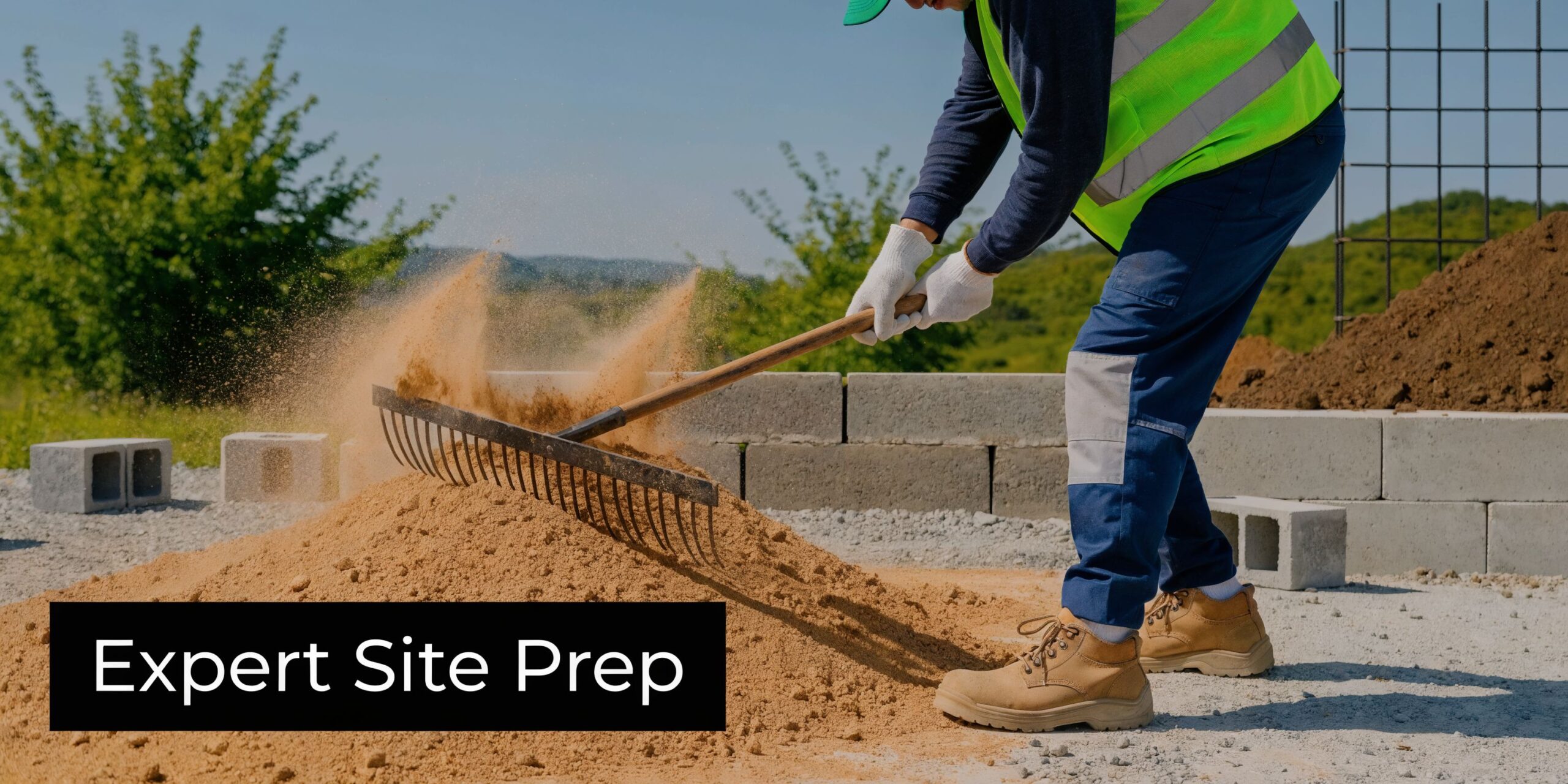
Expert Site Preparation and Excavation for Lasting Support
Foundation work starts before gravel is spread or concrete is poured. The longest-lasting playhouses and sheds usually come from boring, precise prep.
That means choosing the right location, cutting out organic soil, shaping the sub-base, and making sure the final support matches the structure’s load and the property’s grade.
Start with location, not convenience
Homeowners often pick a spot based on what looks open from the patio or what seems easiest for delivery. That’s understandable, but the best location for a structure is usually the spot that gives it the best long-term support.
Three things matter early:
- Access: Can equipment reach the site without tearing up the whole yard?
- Grade: Is the area already close to workable, or will it require extensive correction?
- Drainage pattern: Does water already move through that part of the property?
A spot that looks flat in summer can still be a poor choice if it collects runoff after storms.
Why excavation is non-negotiable
Topsoil is full of organic material. It shifts, compresses, and holds moisture. That’s fine for growing grass. It’s not fine under a shed foundation.
A common challenge in Pennsylvania and New Jersey is sloped terrain. Improperly prepared bases on those sites fail 30% faster, and skipping professional excavation can lead to 20-40% higher repair costs within five years because of settling and structural stress, according to this analysis of sloped-site shed and playhouse foundation failures.
That’s why excavation matters so much. It strips away the unstable layer and gets the project down to material that can support the load.
A level-looking site and a stable site are not the same thing.
Load matters more than most people think
A storage shed used for bikes and seasonal bins has one load profile. A workshop with riding equipment, tools, and shelving has another. A playhouse adds motion. Kids don’t use a structure like stored lawn furniture uses a structure.
That’s why the base can’t be picked by size alone. A 10×10 storage shed, a larger barn shed, and a compact playhouse may all need different prep depths, edge treatment, or support plans depending on weight and use.
Working on uneven ground
Sloped sites don’t automatically require concrete. Flat sites don’t automatically mean gravel is enough.
The point is to match the build to the property. Sometimes that means cut and fill with a compacted pad. Sometimes it means a slab after excavation and grading. Sometimes it means a pier system to avoid overexcavating one side of the yard.
Before any job starts, it’s worth thinking through basic risk assessments for construction so site access, equipment movement, utilities, and grade conditions are considered early rather than on install day.
What good prep usually includes
A reliable site-prep process often looks like this:
Layout the footprint carefully
Mark the actual structure area, not just an estimate.Excavate organic material
Remove topsoil, roots, and soft spots until the base material is suitable.Correct the grade
Shape the sub-base so the finished foundation can sit level and drain correctly.Compact in stages
Good prep comes from controlled lifts, not one quick pass at the end.
Here’s a useful visual of what proper ground prep and leveling look like in practice:
Homeowners looking for excavation near me, concrete contractors, or garage foundation contractors near me often need this stage more than they realize. The visible foundation gets the credit. The excavation underneath is what makes it hold.
Mastering Drainage and Grading for a Dry Foundation
Most foundation failures don’t start with dramatic collapse. They start with water.
Water softens the soil under the base. Water sits against wood framing. Water freezes, expands, and lifts sections that were stable a few weeks earlier. In PA, MD, DE, and NJ, that cycle repeats often enough that drainage isn’t an upgrade. It’s part of the foundation itself.
What proper grading actually means
Good grading sends water away from the structure on purpose. It doesn’t hope the yard will “probably drain.” It creates a path so runoff leaves the pad instead of moving under it.
For shed and playhouse foundations, longevity exceeds 95% when proper drainage is established, including a slope of at least 1/4 inch per foot away from the structure. That same source notes that proper gravel compaction helps prevent the settling failures that affect 25% of poorly installed bases, according to this guide on playhouse and shed foundation drainage and compaction.
That single detail changes a lot. Water that leaves the structure quickly does less damage. Water that lingers creates a chain of problems.
Why gravel often outperforms hard surfaces alone
Concrete has its place, especially under heavier buildings. But drainage still has to be built around it. A slab that sits in a low spot can still end up with water problems around edges, entrances, and adjacent framing.
Compacted gravel has one major advantage. It allows water to move through the base instead of trapping it on the surface. When paired with proper grading and separation from the underlying soil, it creates a stable, drainable platform.
A few drainage habits matter more than decorative extras:
- Keep the finished grade moving away: The pad should never become the low point of the yard.
- Use compacted stone, not loose fill: Loose material shifts and traps voids.
- Protect the base from soil migration: Separation layers help keep the stone working as intended.
- Watch roof runoff: Downspouts and splash areas should not empty at the pad edge.
The hidden enemy under the pad
One of the most common issues is soil pumping up into the base over time. The stone starts mixing with soft subgrade, drainage slows down, and the pad loses consistency. That’s where geotextile separation can make a real difference on many sites.
For homeowners planning both the structure and the surrounding hardscape, these gravel driveway drainage solutions are helpful because the same water-management principles often apply to shed pads and nearby access areas.
Water doesn’t need a dramatic storm to cause damage. A slow pattern of poor runoff does enough on its own.
What doesn’t work
A few common shortcuts almost always create trouble later:
| Problem shortcut | What happens later |
|---|---|
| Setting on low ground | Water collects under and around the base |
| Skipping finish grading | The pad may be level, but runoff still reaches it |
| Using whatever stone is available | Inconsistent material compacts poorly |
| Ignoring surrounding drainage | Nearby runoff undermines the foundation edge |
Homeowners usually call after seeing symptoms like soft ground, splashback, mildew smell, or visible movement. The better time to solve drainage is before the structure arrives.
Navigating Shed and Playhouse Permits in the Mid-Atlantic
Permits frustrate people because the rules aren’t the same from one township to the next. A shed that seems simple to the homeowner may fall into a different category once square footage, setbacks, and foundation type are considered.
That’s especially true across Pennsylvania, Maryland, Delaware, and New Jersey, where local zoning and code enforcement can vary sharply by municipality.
When a playhouse or shed starts counting as an accessory structure
In suburban townships across PA and NJ, wooden playhouses or sheds over 120 sq ft are often reclassified as accessory structures. That can trigger requirements for permanent foundations, setbacks, and frost-depth compliance, and following those rules can reduce related insurance claims by an estimated 35%, according to this overview of permit and code issues for backyard structures.
That’s the point where a casual backyard project becomes a code issue.
The questions to ask before delivery
Call your township or local building office before the structure is installed. Ask about:
- Setback rules: How far the structure must sit from property lines, easements, or other buildings.
- Foundation expectations: Whether skids are acceptable or a permanent base is required.
- Frost requirements: Whether footings or support points must extend to local frost depth.
- Stormwater or lot coverage: Some properties have restrictions that affect placement.
If you’re searching for shed foundations contractors near me or garage footings and foundations, permit questions should come up early, not after the shed is already in the yard.
Why code compliance matters beyond the permit itself
It’s easy to think of permits as paperwork. They matter for practical reasons too.
A compliant project is usually easier to insure, easier to document, and easier to explain when the property is sold. If the structure is large enough to be considered permanent, the foundation becomes part of that conversation.
The cheapest foundation can become the most expensive option if the township rejects it or the structure has to be moved.
A simple approach that keeps projects moving
Use this order:
- Confirm the structure size
- Check local setbacks
- Ask what foundation type is acceptable
- Schedule the site work to match those requirements
That order saves time. It also helps avoid rebuilding work that could have been done correctly the first time.
The Firm Foundations Process From Quote to Completion
Most homeowners don’t want a complicated construction experience. They want clear answers, solid work, and a finished pad or slab that’s ready when the shed or playhouse arrives.
That process usually feels a lot better when each step is visible and predictable.

It starts with the structure and the site
The first useful conversation is usually simple. What are you putting on the pad, where is it going, and what does the yard look like?
That’s when the important details come out. Is the area sloped. Does the shed builder require a certain size margin. Will the structure be delivered on skids. Is the project a gravel pad, a slab, or a heavier garage foundation.
The quote should match the real job
A good quote accounts for more than just square footage. For homeowners comparing gravel shed foundation contractors, it should reflect excavation needs, grade correction, access, and the foundation type that fits the project.
For homeowners comparing gravel shed foundation contractors near me, shed foundation, or concrete foundations, that clarity matters because low numbers often leave out the hard part of the job. The hard part is usually the ground work.
Scheduling and prep
Once the job is approved, the site gets scheduled around weather, access, and delivery timing.
At this point, communication matters as much as equipment. The homeowner should know what needs to be moved, how access will work, and what to expect before the crew arrives. That’s especially important when coordinating with a prefab dealer or installer.
Firm Foundations handles this type of work across Pennsylvania, Maryland, Delaware, and New Jersey, including gravel pads, concrete foundations, and excavation for backyard structures, garages, gazebos, and similar projects.
Installation day should look organized
The actual work should not feel improvised.
A clean process usually includes:
- Verified layout before digging
- Excavation to remove unsuitable material
- Base prep and compaction
- Final grading and finish work
- Cleanup that leaves the site ready for delivery
Some homeowners also need related work at the same time, such as access improvements, nearby pad expansion, or coordination with driveway contractors near me or driveway companies near me if equipment access is part of a larger property project.
Final walkthrough
The last step is simple. Check the finished foundation against the planned footprint, elevation, and readiness for the structure.
That’s when the customer should be able to see a level, intentional result, not just a pile of stone or a slab that “looks close enough.” Good foundation work is quiet work. It doesn’t need a sales pitch once it’s built correctly.
Frequently Asked Questions About Shed Foundations
How long does shed foundation installation take
It depends on the size of the structure, site access, weather, and how much excavation is needed. A flat, open site moves much faster than a backyard with slope, soft ground, or limited equipment access. The main variable is usually site preparation, not the final surface itself.
Can you build a shed foundation on top of an old concrete patio
Sometimes, but only if the existing patio is structurally sound, properly located, and suitable for the shed’s size and use. Many old patios were poured for light recreational use, not for supporting a shed, workshop, or playhouse over time. Cracking, poor drainage, or the wrong elevation can turn an old slab into a bad starting point.
What maintenance does a gravel shed pad need
A well-built gravel pad is fairly low-maintenance, but it still needs occasional attention. Keep runoff from washing onto it. Watch for edge erosion, low spots, or nearby downspouts that dump water at the pad. If stone gets displaced over time, touch-up material and minor regrading can keep the base performing the way it should.
If you’re planning a shed, playhouse, garage slab, or another backyard structure in Pennsylvania, Maryland, Delaware, or New Jersey, start with the part that determines whether it lasts. Firm Foundations provides quotes for gravel pads, concrete foundations, and excavation work built around real site conditions, local code considerations, and long-term drainage.