
How Long Does a Concrete Slab Take to Cure?
A new slab always creates the same question. The forms are gone, the surface looks finished, and now you want to know when you can walk on it, park on it, or set your shed on it without causing damage.
That question matters whether you searched for shed foundations near me, garage foundation contractors near me, or a base for storage shed in Pennsylvania, Maryland, Delaware, or New Jersey. A concrete slab can look ready long before it is ready.
Most problems start when someone treats fresh concrete like it needs to dry. That is not how concrete gains strength. If you rush a new patio, driveway, shed foundation, or cement foundation for garage use, the slab can lose strength right when it should be building it.
Your New Concrete Slab Is Poured Now What
Homeowners call with the same mix of excitement and concern. The slab for the new barn shed, gazebo foundation, or garage is finally in place, but the next steps feel unclear. Can you walk on it tomorrow? Can the shed installer come this week? Can a vehicle go on it over the weekend?
The answer is that concrete needs time, and different kinds of use require different waiting periods.
A fresh slab changes quickly in the first few days, but that does not mean it is ready for full service. The surface may feel hard early, yet the inside develops strength. That is why timing matters so much for concrete foundations, garage footings and foundations, and any slab that will carry weight.
What homeowners usually want to do too soon
Some of the most common early-use mistakes look harmless at first:
- Walking heavy traffic across it: One careful trip is different from repeated use by people carrying tools, framing lumber, or equipment.
- Scheduling installers too early: A shed crew, garage framing crew, or hot tub delivery can overload a slab before it is ready.
- Driving on it because it looks finished: Appearance is misleading. A slab can look complete while remaining vulnerable.
- Covering it with flooring or finishes too soon: Surface dryness is not the same thing as full readiness.
For local projects, this comes up all the time with a shed foundation, a concrete foundation for garage work, or even a simple patio. Homeowners want to keep the schedule moving. That makes sense. A few extra days of patience can protect years of performance.
The first thing to understand
The biggest misconception: People say concrete is “drying,” when the more important process is curing.
Drying is water leaving the slab. Curing is the internal chemical process that builds strength. If you mix those up, you can make a bad decision about when to load the slab.
If a new slab will support a structure, treat curing time as part of the build, not dead time between steps.
That is especially true in the Mid-Atlantic. Weather in Pennsylvania, Maryland, Delaware, and New Jersey can shift quickly, and that affects how a slab behaves during the early curing window. A warm summer pour and a cold winter pour do not follow the same practical schedule, even if the general rule sounds the same.
The Science of Curing and Why It's Not Just Drying
Concrete does not harden the way spilled water disappears from a driveway. It hardens because cement reacts with water. That reaction is called hydration, and it is what gives the slab its strength.

A simple way to think about it is this. Baking bread and letting bread go stale are not the same thing. One creates the finished structure. The other is just moisture leaving. Concrete works similarly. Curing builds strength. Drying removes moisture.
What curing does
When a slab is poured, the cement and water begin reacting. That reaction continues over time and gradually increases strength. According to Perma-Pier’s concrete curing timeline, a slab reaches 15% cured after 24 hours, 40% at 72 hours, 65% after 1 week, and 99% at 30 days.
That progression explains why fresh concrete can fool people. It may be firm enough to stand on, but it is nowhere near full strength early.
Drying follows a different path. The same source notes that drying can take about 28 days per inch of slab thickness, which matters when someone wants to apply flooring or trap moisture under another material. For a slab under a garage, storage building, or enclosed structure, that difference is important.
Why this matters for real projects
If you are building a concrete foundation for garage use, a gazebo foundation, or a slab for a 10×10 storage shed, the slab needs enough internal strength before it takes weight. A slab that dries on top too fast can remain weak underneath.
That is where good curing practice protects the job. Contractors try to control moisture loss so the chemical reaction can keep doing its work.
A short visual helps make the process easier to understand.
The mistake that causes trouble
The biggest error is judging the slab by touch or color.
- Looks dry: That tells you the surface changed.
- Feels hard: That does not mean it can handle full loads.
- Edges seem solid: The middle may gain strength.
- Schedule feels tight: The slab does not care about the calendar if the cure has been rushed.
A slab that cures well will outlast one that was rushed, even if both looked the same on day two.
For homeowners comparing a shed foundation gravel base to a concrete pad, this is a key distinction. A gravel foundation is ready for use immediately once compacted and graded properly. Concrete asks for patience up front in exchange for a rigid, durable surface later.
Concrete Strength Milestones Your Week by Week Guide
If you are asking how long does a concrete slab take to cure, a useful answer is not one date. It is a sequence of milestones.
The industry benchmark is 28 days. According to Evenson Concrete’s curing timeline, concrete typically allows light foot traffic at 24 to 48 hours, reaches approximately 70% strength at 7 days, and reaches 90% to 100% of design compressive strength at 28 days. That is the point when heavy loads are generally appropriate.
What those milestones mean on the job
A homeowner does not think in compressive strength. A homeowner thinks in terms of use. Can I step on it? Can the shed be delivered? Can I park on it?
Here is the practical version.
| Time Elapsed | Approximate Strength | Safe Activities |
|---|---|---|
| 24 to 48 hours | Early set only | Light foot traffic, careful inspection, no heavy materials or equipment |
| 72 hours | Still developing | Very limited use, continue protecting the surface |
| 7 days | Approximately 70% strength | Form removal in many cases, some light loads, cautious progress on follow-up work |
| 28 days | 90% to 100% of design strength | Heavy loads, vehicles, and full service for most slab applications |
A realistic homeowner timeline
For a patio or walkway, light foot traffic may be reasonable after the early set period. For a concrete foundation for garage, cement foundations for garage, or a reinforced slab that will carry a structure, the schedule should be conservative.
A shed installer placing a building on a new slab is not the same as one person stepping across it. Concentrated loads, anchors, ladders, and equipment all change the risk.
For garage work, slab design also matters. Thickness, reinforcement, and expected loads all play a role. If you are comparing uses and design needs, this guide on concrete thickness for garage slab is useful for planning the build correctly.
What not to rush
Many slab failures do not come from bad concrete. They come from good concrete used too soon.
Avoid these common timing mistakes:
- Parking a vehicle early: Passenger vehicles are a meaningful load.
- Setting a prefabricated structure too soon: The slab may support it visually, but not safely.
- Bringing in heavy equipment: Point loads from machinery can damage an undercured surface.
- Sealing immediately after finishing: Coatings need the slab to be ready, not merely hard on top.
The safest question is not “Can it handle this?” It is “Does this slab need more curing time before I ask it to work?”
For homeowners searching for garage foundation contractors near me, driveway contractors near me, or concrete contractors in the Mid-Atlantic, a clear loading timeline is one of the most important parts of the job. The slab should fit the structure, and the schedule should fit the cure.
Key Factors That Speed Up or Slow Down Curing
A slab does not cure in a vacuum. The same mix can behave differently from one week to the next, depending on site conditions and weather.
That is why a universal answer can only take you so far. On actual projects, curing speed depends on a handful of factors working together.
Temperature changes the pace
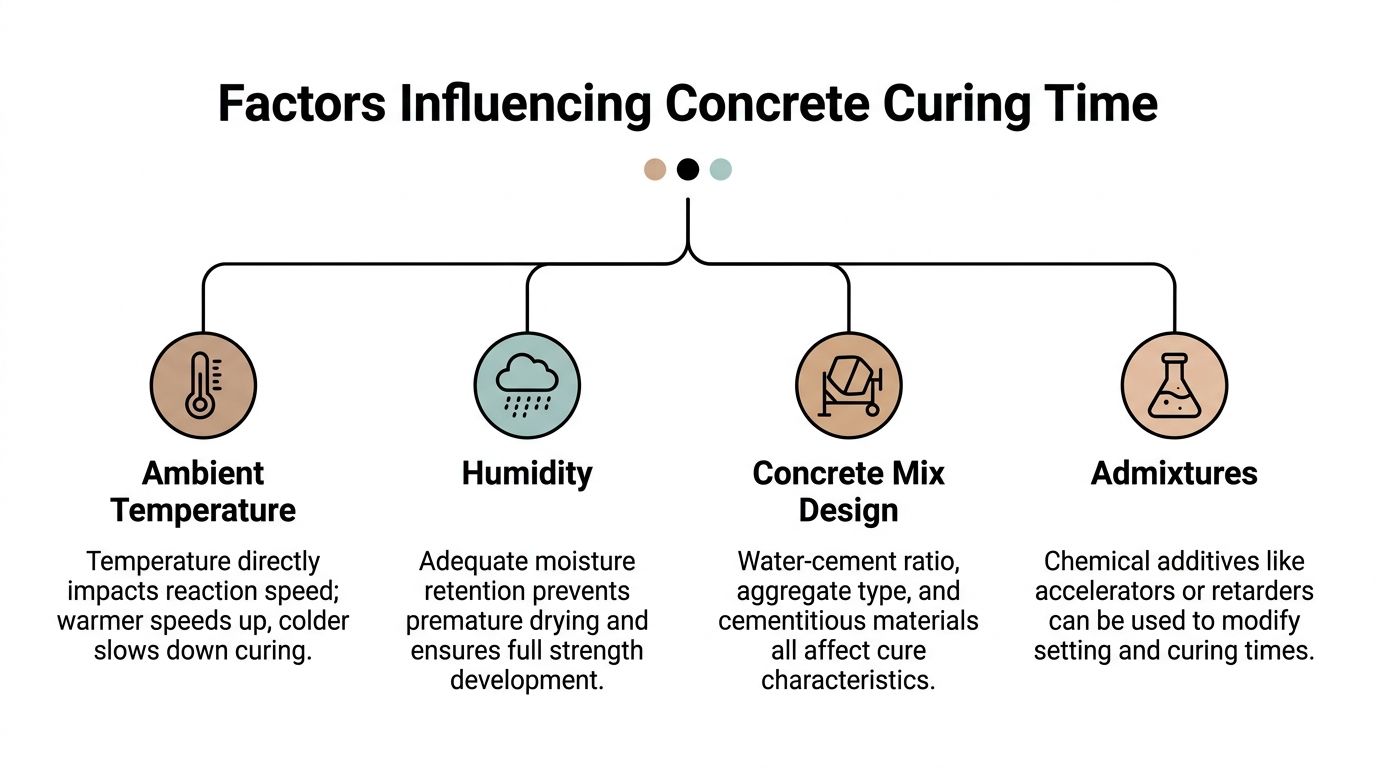
Temperature is one of the biggest variables. Warm conditions can speed the chemical reaction. Cold conditions slow it down.
That sounds simple, but the trade-off matters. Fast strength gain is not always better if the surface loses moisture too quickly. Slow curing is not always bad if the slab stays protected and develops properly.
Moisture retention matters beyond common perception
Concrete needs moisture during curing. If sun, wind, or low humidity pull water out too fast, the slab can develop surface problems and weaker early performance.
Homeowners confuse a slab that looks “dry” with one that is curing well. Those are not the same thing.
A few site conditions raise the risk:
- Open, windy lots: Air movement can pull moisture from the surface quickly.
- Direct summer sun: Surface conditions can change faster than expected.
- Exposed edges: Thin edges react faster than the body of the slab.
- Uncovered pours: Without protection, weather has full control.
Mix design and admixtures also matter
Not every slab is poured from the same recipe. The water-cement ratio, aggregate blend, cementitious materials, and any admixtures all affect how the slab sets and cures.
For homeowners, the practical takeaway is straightforward. A slab for a house foundation, a base for storage shed, or a shipping container pad should be designed for the use, not treated as a generic pour.
Some contractors use admixtures to help manage site conditions. Those can support scheduling and workability, but they do not replace proper curing practice after the pour.
Thickness changes the behavior
Thicker sections retain heat and moisture differently than thinner sections. A broad slab for a garage behaves differently from a thinner flatwork area or a smaller pad under a playset or gazebo.
That is one reason a true answer to how long does a concrete slab take to cure should be tied to the slab itself, not a generic rule pulled from a search result.
Good scheduling starts before the pour. You need the right slab design, the right weather window, and a plan to protect the concrete after finishing.
For homeowners comparing gravel shed foundation contractors near me with concrete contractors, this is part of the trade-off. Gravel bases are often more forgiving from a scheduling standpoint. Concrete can provide a more rigid finished surface, but only if the curing conditions are managed correctly.
How Firm Foundations Ensures a Perfect Cure Every Time
Good concrete work does not end when the finishing tools leave the slab. The curing phase is part of the craftsmanship.
Crews that care about long-term performance treat fresh concrete like a surface that still needs protection. That means planning for moisture retention, weather exposure, and job sequencing from the start.

What professional curing looks like
For slab work, reliable crews use practical methods that fit the conditions on site.
- Curing compounds: A liquid membrane-forming curing compound helps hold moisture in the slab after finishing.
- Plastic sheeting: This can reduce rapid moisture loss in exposed conditions.
- Water misting: On some jobs, controlled moisture helps the slab avoid drying too quickly.
- Weather protection: Hot wind, direct sun, and cold snaps all need a response, not a guess.
Each method has a purpose. The goal is not to baby the slab for no reason. The goal is to help the concrete develop the strength it was designed to achieve.
Why site prep matters to curing too
Curing starts after placement, but the results depend on what happened before the truck arrived.
A slab poured over poorly prepared ground is at a disadvantage. Uneven support, bad drainage, and weak subgrade conditions can create stress that no curing method can fix later. That is why site work and curing belong in the same conversation.
If you want to understand how grading, excavation, and base prep affect the finished slab, this resource on site preparation for concrete slab lays out the essentials.
What works and what does not
What works is simple, disciplined jobsite behavior. Protect the slab. Control moisture loss. Keep loads off it until the curing window matches the intended use.
What does not work is relying on appearance, hoping the weather cooperates, or telling a homeowner the slab is “basically ready” because the surface hardened.
A durable shed foundation, driveway, or garage slab comes from doing ordinary things well. The quality is in the details people never notice, until those details are skipped.
The best concrete jobs look uneventful after the pour. That is a good sign. It usually means the curing plan was handled correctly.
Curing Concrete in Pennsylvania and Mid-Atlantic Weather
Mid-Atlantic weather changes the answer more than most online guides admit. A slab poured in July does not behave like one poured in January, even if both follow the same general curing principles.
That matters for homeowners planning a shed foundation, garage footings and foundations, patio slab, or concrete pad in Pennsylvania, Maryland, Delaware, and New Jersey.
Summer pours move faster but need more control
In hot temperatures, concrete can reach near-final strength in about 20 days, while in cold temperatures it can take 45 days or longer, according to Wotai Chem’s overview of curing in different climates. That single fact explains why season matters so much.
Summer pours gain strength faster, but fast is not automatically safe. Heat, direct sun, and wind can dry the surface too quickly. That creates a mismatch between the top of the slab and the body underneath.
For a homeowner, the risk shows up as surface cracking, dusting, or a slab that looked fine at first and then aged poorly.
Winter pours demand patience
Cold weather slows hydration. In a Pennsylvania winter or during a cold stretch in New Jersey, Maryland, or Delaware, curing takes longer and protection becomes more important.
Unrealistic scheduling causes trouble. Homeowners may be trying to line up a prefab shed delivery, garage framing, or a contractor for follow-up work. If the weather has slowed the cure, that date may need to move.
A winter slab can be a good slab. It needs the right handling.
Spring and fall are the trickiest seasons
Spring and fall bring the conditions that fool people most. The air may feel mild, but overnight temperatures, rain, and shifting humidity can change curing conditions fast.
For that reason, local planning should account for:
- Temperature swings: Warm afternoons and cold nights can slow progress in ways the surface does not reveal.
- Rain risk: Fresh concrete needs protection from poorly timed weather.
- Wind exposure: Open rural properties can dry faster than sheltered suburban lots.
- Installation scheduling: Shed crews and other trades need realistic dates, not optimistic ones.
What homeowners should ask before a pour
If you are hiring for concrete foundations, garage foundation contractors near me, or excavation near me, ask about weather planning, not solely price and availability.
Useful questions include:
- How will the crew protect the slab if the forecast changes?
- Will the loading schedule change based on season?
- How is moisture being managed after the pour?
- What is the expected installation window for my structure?
In the Mid-Atlantic, the right curing timeline is seasonal. The safest answer comes from current site conditions, not a one-size-fits-all promise.
That local judgment is where experience shows up. The Mid-Atlantic is not climate-agnostic. A slab that performs well for years started with a crew that respected that fact.
Frequently Asked Questions About New Concrete Slabs
Homeowners have a few practical questions after the slab is in place. These are the ones that come up most often.
When can I seal or paint a new concrete slab
Wait until the slab is ready for that kind of finish. A new slab may look dry on top long before it has released enough moisture for coatings or sealers. If you rush that step, you can trap moisture and create adhesion problems.
For garage floors and enclosed spaces, patience matters even more.
Is it normal to see small hairline cracks
Small hairline cracks can happen in concrete. Some are cosmetic and some point to shrinkage or curing conditions that were less than ideal.
What matters is the pattern, location, and severity. A few light surface marks are different from movement, spreading cracks, or edges breaking down. If you see changes that concern you, have the slab inspected by a contractor who understands slab performance.
What is the difference between a concrete slab and a gravel shed foundation
A concrete slab creates a rigid, continuous surface. A gravel shed foundation is a compacted base that supports the structure differently and allows a faster installation schedule because there is no curing period.
For many sheds, gravel is an excellent choice. For other projects, a concrete slab makes more sense because of the intended use, finished floor needs, or load requirements. The right answer depends on the structure, the site, and how you plan to use it.
Can rain ruin a fresh slab
Rain can be a problem if it hits at the wrong time and the slab is not protected. Light weather later in the process is different from an early downpour on a fresh surface.
This is one reason weather monitoring matters for local slab work in Pennsylvania, Maryland, Delaware, and New Jersey.
Should I choose concrete blocks, a shed foundation kit, gravel, or a slab
That depends on the building and site. Shed foundation blocks or a shed foundation kit may be appropriate for some smaller applications, while a compacted gravel base or full slab is better for others.
If the site has drainage issues, slope, soft ground, or heavier loads, the foundation decision should be based on performance, not convenience alone.
Lay the Groundwork for Success with Firm Foundations
A fresh slab can fool people. It looks clean, hard, and ready to go, especially a day or two after the pour. In practice, the waiting period is part of the job, and respecting it is what protects the slab you paid for.
The accurate answer to how long does a concrete slab take to cure depends on use, weather, and workmanship during the first several days. Foot traffic usually comes first. Vehicles, stored equipment, and full service loads need more time. Push that schedule too fast, and you risk surface wear, early cracking, or edges that break down before the slab has had a fair chance to gain strength.
That timeline gets more complicated across Pennsylvania, Maryland, Delaware, and New Jersey. A slab poured during a humid Mid-Atlantic summer behaves differently than one placed in a cold spring rain or during a dry fall week. We plan around those conditions because curing is tied to temperature, moisture retention, and protection during the early stages, not solely the calendar.
Some homeowners are also thinking beyond curing alone. If energy performance is part of the project, it is worth reviewing insulating concrete slabs before you finalize the build details for a garage or other slab-based structure.
Good slab work is a system. Site prep, base compaction, drainage, forming, reinforcement, placement, and curing all have to work together. Getting those details right is what separates a temporary fix from a permanent foundation.
If you want a shed pad, garage slab, patio, barn shed foundation, or driveway built to hold up over time, choose a crew that treats curing with the same care as excavation and the pour itself.
If you need a shed pad, reinforced garage slab, concrete foundation, or excavation work in Pennsylvania, Maryland, Delaware, or New Jersey, contact Firm Foundations for a free quote. We build durable foundations with the site prep, drainage planning, and curing discipline that help your project start right and last.