
Concrete Deck Foundations in PA: A Homeowner’s Guide
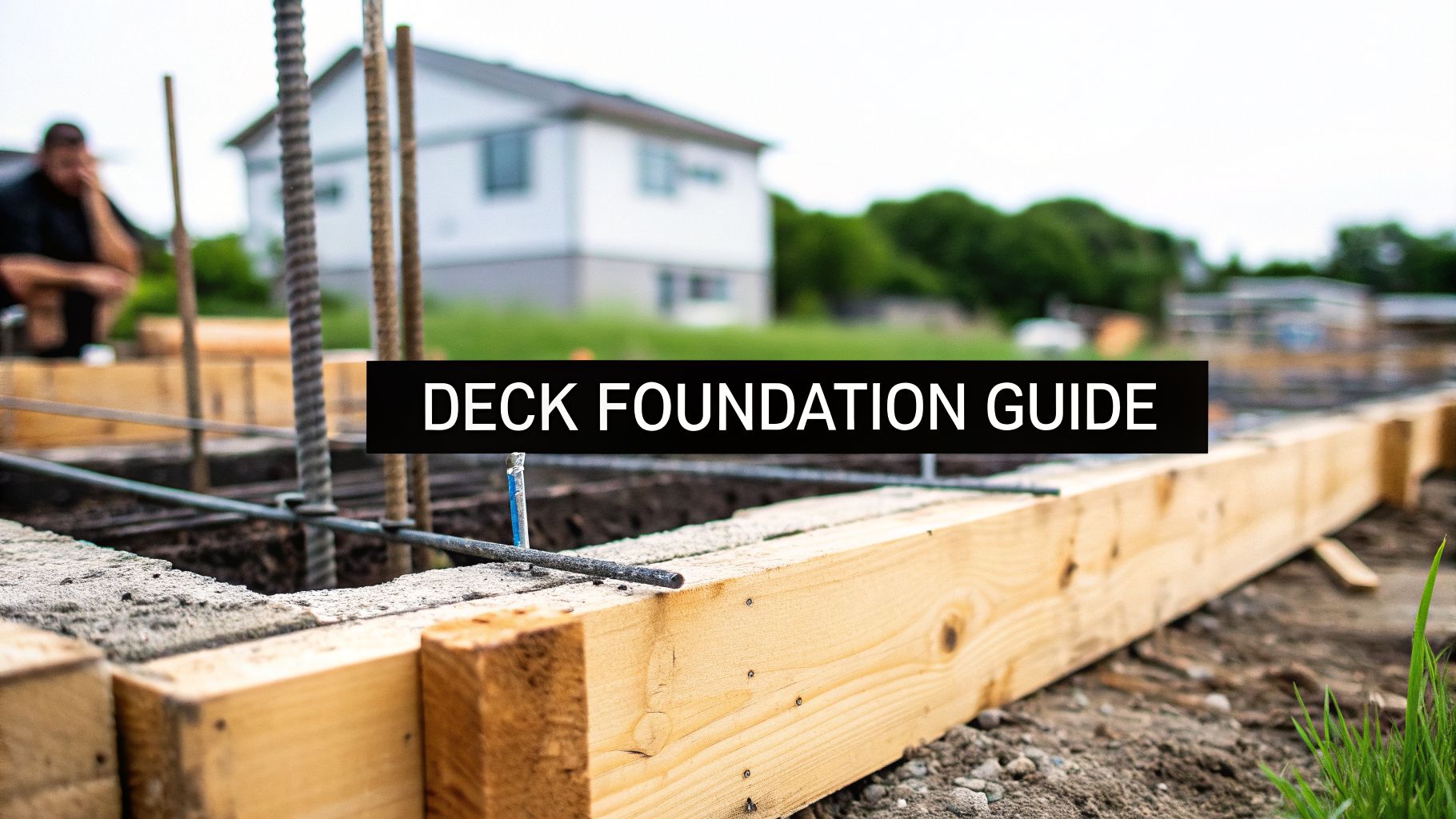
When you're dreaming up a new deck for your home in Pennsylvania, it's easy to get caught up thinking about the decking material, the railing style, or where you'll put the grill. But the single most important part of your new outdoor space lies hidden beneath the surface: the concrete deck foundation. It's the literal bedrock that supports everything else, ensuring your deck is safe, stable, and ready for decades of family fun.
Why Your Deck's Foundation Is Everything

The success of your entire outdoor living area really does rest on what's holding it up. Think of it just like the foundation of your house—a weak or poorly installed base will inevitably cause expensive and dangerous problems down the road. As the go-to garage foundation contractors near me for homeowners in Pennsylvania, we’ve seen firsthand what happens when this crucial step isn't given the attention it deserves.
A professionally installed deck foundation from Firm Foundations is your best defense against the common issues that plague decks across our region, including Pennsylvania, Maryland, Delaware, and New Jersey. Without that solid base, you’re setting yourself up for sagging boards, wobbly railings, and even total structural failure over time.
The Importance of a Professional Installation
Investing in a quality foundation from day one prevents a mountain of future headaches and, most importantly, protects your family. It’s not just a matter of mixing some concrete. It’s about understanding the soil, the load, and the unique challenges of our local climate. One of the biggest threats to any structure around here is frost heave—the powerful upward force of soil as it freezes and expands.
An improperly set foundation can shift, lift, and crack due to frost heave, compromising the entire deck structure. As your local construction experts, our team ensures footings are dug below the local frost line, providing a stable anchor that won't budge with the seasons.
Starting with a strong, properly set base is the secret to a beautiful, long-lasting deck your family can enjoy for years. Here’s what a professionally built foundation really gives you:
- Lasting Safety: A solid, code-compliant foundation ensures your deck can safely handle the weight of people, heavy furniture, and winter snow loads without risk.
- Structural Longevity: By preventing the ground movement and settling that causes damage, a proper concrete foundation protects your investment and dramatically extends the life of your deck.
- Peace of Mind: Knowing your deck is built on a solid footing by trusted, local experts means you can relax and enjoy your outdoor space without a second thought.
From a simple gazebo foundation to the more complex garage footings and foundations needed for bigger structures, our entire process is built around delivering absolute reliability. As a community-focused company serving homeowners throughout Pennsylvania and neighboring states, we are committed to laying the groundwork for your project's success. Let us help you build on solid ground.
Choosing The Right Foundation For Your Project

Picking the right type of concrete deck foundation is one of the biggest decisions you’ll make for your outdoor project. Just like you wouldn't put the same tires on a sports car and a heavy-duty truck, the foundation needs to match the job. The best base really depends on the project's size, your property's terrain, and how you plan to use the space.
As your local shed foundations contractors near me serving Pennsylvania and the surrounding states, we want you to feel confident in your choice. Let's walk through the most common options in plain English so you know exactly what’s best for your needs, whether it's a new deck, a gazebo foundation, or the perfect base for a storage shed.
Poured Concrete Piers And Footings
Think of poured concrete piers as the sturdy stilts that will hold your deck up. The process involves digging deep, cylindrical holes—well below the frost line—and filling them with concrete. Before the concrete sets, we place a metal bracket in the top, which is what will eventually anchor your deck's support posts.
This approach is perfect for elevated decks, especially on sloped or uneven ground where a flat slab just isn't an option. Piers give you incredibly strong, targeted support points that transfer the deck's entire weight deep into stable soil, preventing any shifting over time.
Poured piers are the go-to solution for creating a strong, level deck on a hillside. By adjusting the height of each support post, our team can create a perfectly flat deck surface, even if the ground beneath it is far from level.
This system is also the standard for other raised structures, making sure everything from a multi-level deck to a small hunting cabin is anchored securely for the long haul.
Concrete Pads Or Monolithic Slabs
Now, let's say you're dreaming of a ground-level patio or a solid floor for a garage. In that situation, a monolithic concrete slab is usually the way to go. This type of foundation is basically one large, single sheet of reinforced concrete poured all at once, creating a solid, level, and continuous surface.
To build one, our crew prepares the site by excavating the area, laying down a gravel base for good drainage, and building a perimeter form. We then lay steel rebar or wire mesh inside the form to give the concrete tensile strength before we pour. The final result is a seamless, durable floor that’s ready for just about anything.
This makes it the perfect solution for:
- Ground-Level Patios: It gives you a clean, stable surface for outdoor furniture and entertaining.
- Shed Foundations: A slab offers a tough base for a storage shed, keeping it dry and stable. A well-built slab is critical for a 10×10 storage shed or any larger structure.
- Garage Foundations: For garage footings and foundations, a monolithic slab provides the strength needed to support vehicles and heavy equipment.
Comparing Your Foundation Options
To help you find the best fit for your deck project in the PA, MD, DE, and NJ region, here’s a quick comparison of the most common foundation types.
| Foundation Type | Best For | Pros | Cons |
|---|---|---|---|
| Poured Concrete Piers | Elevated decks, sloped or uneven ground, and structures needing deep support. | Excellent stability on hillsides, minimal site disturbance, cost-effective for raised decks. | Not suitable for ground-level surfaces, requires precise layout and depth. |
| Monolithic Slab | Ground-level decks, patios, shed bases, and garage floors. | Creates a solid, continuous, and durable surface; excellent for heavy loads. | Requires significant excavation and site prep, can be more expensive, not ideal for sloped terrain. |
Making the right decision starts with understanding the trade-offs. While piers are fantastic for getting height on uneven ground, slabs provide unmatched surface stability for projects built at ground level.
The best choice always comes down to the specific demands of your structure and your property. As your dedicated foundation contractors near me in Pennsylvania, Firm Foundations is here to guide you. We’ll assess your site, listen to your plans, and recommend the ideal concrete foundation that ensures safety, longevity, and a perfect outcome for your project.
How Ancient Innovations Shape Modern Foundations

When we pour a concrete deck foundation for your new project in Pennsylvania, Maryland, Delaware, or New Jersey, we're building on thousands of years of human ingenuity. It's a story that connects ancient empires to your modern backyard, and understanding this history shows exactly why concrete is still the most reliable material for any structure meant to last.
This journey starts much earlier than you might think. The roots of concrete deck foundations can be traced all the way back to Nabataean traders around 6500 BC. These resourceful builders created a crude cement that hardened underwater, allowing them to build cisterns and homes in the harsh desert.
Later, the Romans took this idea and ran with it. By 600 BC, they were perfecting their own mix—opus caementicium—a blend of volcanic ash, lime, and seawater. It was so effective that by 200 BC, this early concrete was used in over 90% of Roman construction, from the Pantheon's massive dome to the aqueducts that still stand today. Though the knowledge faded after Rome's fall, it was eventually rediscovered, paving the way for the invention of Portland cement in 1824 and the post-war housing boom, where concrete foundations helped build over 13 million new homes between 1945 and 1955. You can read more about the deep history of concrete foundations and their evolution.
From Ancient Rome to Your Garage Foundation
Those same principles that let Roman structures survive for millennia are what we apply to your project. The Romans knew that a solid base was everything. They achieved it by using the right materials to create a solid, immovable mass.
When our team builds garage footings and foundations or a simple base for a shed, we’re tapping into that same time-tested wisdom. We're not just pouring concrete; we are engineering a base designed to resist pressure, distribute weight, and stand strong against the elements for decades.
Just as Roman engineers chose specific aggregates for incredible strength, our crews at Firm Foundations select the precise concrete mix and reinforcement needed for your project and our unique regional climate.
Portland Cement: The Modern Game-Changer
The real leap forward came in the 19th century with the invention of Portland cement. It was named for its resemblance to a popular building stone quarried on the Isle of Portland in England, and it offered something ancient concrete couldn't: consistency.
For the first time, builders had a standardized, mass-produced binder that delivered reliable strength and curing times. This innovation made projects like concrete foundations for homes and driveways scalable, affordable, and predictable.
This very consistency is what allows us to guarantee the quality of every shed foundation we install. Whether we're in downtown Philadelphia or rural Maryland, we know our materials will perform exactly as expected, providing a solid base for your investment.
Built on a Legacy of Strength
Every time we pour cement foundations for a garage or craft a sturdy gazebo foundation, we’re continuing a legacy stretching back thousands of years. The techniques have evolved and the materials are perfected, but the core idea is unchanged: a strong foundation is the key to endurance.
At Firm Foundations, we combine this ancient wisdom with modern, local expertise. We understand the soil conditions, the frost lines in our states, and the building codes that keep your project safe. We're committed to delivering a foundation that not only meets today's standards but is worthy of its long and impressive history.
Understanding Local Building Codes And Frost Lines
Trying to make sense of local building codes can feel like a real headache, but this is exactly where bringing in true local professionals makes a world of difference. When you're building any kind of foundation in Pennsylvania, Maryland, Delaware, or New Jersey, there's one rule that is absolutely non-negotiable: you must build below the frost line.
Grasping this concept is crucial for the long-term stability of your investment. It’s not just a friendly suggestion from contractors; it's a strict requirement baked into our local building codes for a very important reason.
The Power Of Frost Heave
The ground beneath our feet isn't static, especially during the harsh winters we get here in the Northeast. When moisture in the soil freezes, it expands with incredible force in a process called frost heave. This expansion can lift, shift, and crack anything in its path, from a simple fence post to an entire foundation.
Imagine a giant hydraulic jack pushing up from underneath your deck—that's the kind of power we're talking about. If your deck footings are too shallow, they get shoved upward every single winter and then settle back down unevenly when spring arrives. This cycle of movement will quickly lead to a warped, unstable, and unsafe deck.
Digging Deep For Lasting Stability
To stop frost heave in its tracks, the bottom of your foundation footings must be placed deep in the ground, below the point where the soil ever freezes. We call this depth the frost line. By anchoring the foundation in soil that stays unfrozen all year, we give it a solid, immovable base that's completely immune to all that seasonal ground movement.
Local municipalities set the required footing depth based on historical climate data for the area. In our service areas, this usually means:
- Pennsylvania: Frost line depths range from 30 to 42 inches.
- Maryland: Depths are generally around 30 inches.
- Delaware: The required depth is typically 30 inches.
- New Jersey: Frost lines vary from 30 to 36 inches depending on the region.
As experienced local foundation contractors, we know the exact requirements for your specific town. We don't guess—we build to the precise code to guarantee your foundation for a deck, shed, or garage is built to last.
Managing Permits And Inspections For You
Building codes also mean dealing with permits and inspections. For many homeowners, this is the most stressful part of the whole project. At Firm Foundations, we handle all of it for you, making sure every part of your project is fully compliant and completely hassle-free.
A correctly permitted and inspected project is your assurance that the work was done right. We see it as a partnership between us, you, and the local building officials to ensure your family's safety and protect your property value.
Our team takes charge of the entire process, from submitting the initial permit applications to scheduling and meeting the inspector on-site. This commitment to doing things by the book gives you total confidence that your new concrete deck foundation is safe, legal, and expertly constructed. We lay the groundwork for your success, both literally and figuratively.
Our Foundation Process From Start To Finish
It’s one thing to talk about building a solid foundation, but it’s another to see it happen. We’ve dialed in our process over the years to be as transparent and efficient as possible, because you deserve to know exactly how your project comes together.
Here’s a step-by-step look at how the experienced crews at Firm Foundations build the durable concrete deck foundations that homeowners rely on across Pennsylvania, Maryland, Delaware, and New Jersey.
Whether we're pouring a simple base for a storage shed or setting up massive cement foundations for a garage, every single project gets the same level of attention and precision. It all kicks off with understanding what you need and what your property can handle.
Site Assessment and Preparation
The first thing we do—always—is a detailed site assessment. Our team walks your property to pinpoint the best spot, check for any headaches like underground utility lines or potential drainage problems, and lock in the specs for your project. A quality foundation starts right here, with smart planning.
With the plan set, our excavation crew gets to work. We carefully clear and level the site, making sure we create the right grade so water flows away from your new foundation, not toward it. If you need excavation or are looking for reliable driveway contractors near me, our team has the heavy equipment and expertise for the job. You can dive deeper into this crucial first step with our guide on how to level ground for a concrete slab.
Forming and Reinforcement
Once the ground is prepped, we build the concrete forms. Think of these as the mold that will shape your foundation. We build this framework meticulously to ensure the final slab or footings are perfectly square, completely level, and sized to the exact dimensions needed for your structure.
Then comes the muscle. Inside these forms, we lay down a grid of steel rebar or wire mesh. This reinforcement is the hidden strength of your foundation. It provides the tensile strength needed to stop cracking under the pressure of heavy loads or shifting ground. For long-lasting garage footings and foundations, this is a non-negotiable step.
A little history—after World War II, the demand for fast, affordable housing exploded, leading to a 1,200% jump in residential construction between 1944 and 1950. This boom made monolithic slab foundations popular because they were up to 40% cheaper and twice as fast to install. Today’s concrete, with compressive strengths of 4,000-5,000 PSI, builds on that legacy, offering even more durability to handle our region’s 50+ freeze-thaw cycles each year. You can explore the evolution of concrete foundations on jeffdumasconcreteconstruction.com to see how these historical shifts still influence our work.
The Concrete Pour and Finishing
This is the moment it all comes together. We pour a high-strength concrete mix, and our crew expertly spreads and levels it to create a smooth, solid surface. They work quickly to make sure the concrete is perfectly settled within the forms, pushing out any air pockets that could create weak spots.
This is also where we ensure our footings are set safely below the frost line to prevent any shifting during the winter.

As you can see, the footing has to sit deep in stable, unfrozen ground. Finally, we apply the finish you want—maybe a broom finish for extra grip or a smooth trowel finish for a clean look. The new foundation is then left to cure, gaining the incredible strength it needs to support your deck, garage, or shed for decades.
So, you've done your homework. You know what goes into a solid concrete foundation, from frost lines to rebar. Now comes the most critical decision: who will you trust to build it?
This is where the rubber meets the road—or rather, where the concrete meets the ground. For homeowners across Pennsylvania, Maryland, Delaware, and New Jersey, that trusted "who" has consistently been Firm Foundations.
We're not just another crew of concrete contractors. We're your neighbors. We understand the tricky clay soil in parts of PA, the sandy ground near the Jersey Shore, and the specific frost-depth requirements for each county because this is our backyard. Our reputation isn't just poured into concrete; it's built on years of straightforward advice and quality work that speaks for itself.
Your Local Experts in Foundation Construction
When you search for "shed foundations contractors near me" or "garage foundation contractors near me," you're really looking for reliability. You want someone who shows up, does the job right, and stands behind their work. That’s been our promise since day one.
We’ve poured thousands of foundations in that time—everything from simple gravel pads for a new barn shed to intricate reinforced concrete foundations for custom-built garages. That deep, hands-on experience means we’ve seen it all, allowing us to spot potential issues long before they become costly problems for you.
It's why leading shed builders like Sheds Unlimited count on us. They know our foundations provide a stable, long-lasting base that can handle our region’s demanding weather, from heavy snow loads to summer deluges.
"At Firm Foundations, we combine deep local expertise with a straightforward process. Our goal is to give you total peace of mind, knowing your investment is built on a foundation that’s engineered for safety, durability, and complete code compliance."
A Commitment to Craftsmanship and Transparency
We believe you should know exactly what you're paying for, period. Our entire process is built on clarity. It all starts with a free, no-strings-attached quote that breaks down every single part of the job. No surprises, no hidden fees.
From there, we handle it all. We take care of the site prep, the careful excavation, laying the steel reinforcement, and pouring high-strength concrete. Our crews are obsessed with the details that make or break a foundation:
- Proper Site Grading: We make sure water flows away from your foundation, not toward it. This is non-negotiable for preventing future moisture headaches.
- Correct Reinforcement: We use the right amount and grade of steel rebar to give your concrete foundation for a garage or deck the muscle it needs to last a lifetime.
- Code Compliance: Every footing is dug below the local frost line. We also manage the permits and inspections, so you don't have to navigate that maze yourself.
Choosing Firm Foundations means you're not just hiring a contractor; you're partnering with a team that treats your project like our own. We build every shed foundation, driveway, and patio to the same standard we’d demand for our own homes.
The next step is simple. Reach out today for your free quote, and let's get the groundwork laid for a successful project.
Your Top Questions About Deck Foundations Answered
When you're planning a new deck or shed, you're bound to have questions. It’s a big project! As the go-to foundation experts in Pennsylvania, Maryland, Delaware, and New Jersey, we've pretty much heard them all.
Let's dig into some of the most common questions homeowners ask us about concrete deck foundations.
How Deep Do My Deck Footings Need To Be?
This is a critical one. In our region (PA, MD, DE, and NJ), every footing has to be installed below the local frost line. Why? Because it prevents the ground from shifting and heaving your deck during the winter freeze-thaw cycle, which can cause serious damage.
That depth is typically between 30 to 48 inches, but it varies from county to county. As your local foundation contractors, we know the exact code for your specific town, and we guarantee every footing we pour meets or exceeds it. That’s how you get a foundation that’s truly stable for the long haul.
Can I Use A Concrete Slab Instead Of Footings?
Absolutely. A solid concrete slab is a fantastic choice for certain projects. It's often the best route for ground-level decks, patios, or when you need an unshakable base for a storage shed.
A slab gives you strong, even support across the entire footprint and a clean, finished surface right from the start. Our team at Firm Foundations can take a look at your property and your plans to help you decide whether a slab or traditional footings is the right move.
What Is The Best Foundation For A Shed?
The "best" foundation really hinges on a few things: the shed's size, what you plan to use it for, and your budget.
For smaller, lighter sheds, a professionally installed gravel shed foundation is often a great solution. It provides excellent drainage and a very stable platform. But for something bigger, like a 10×10 storage shed, a workshop, or a structure that will function as a barn shed, you'll want to step up to a permanent concrete foundation.
Whether it's a full slab or concrete footings, these concrete foundations deliver unmatched strength and a perfectly level base that will protect your investment for decades to come.
How Much Does A Concrete Deck Foundation Cost?
Several key factors drive the final price tag. The biggest ones are the foundation type (piers vs. a full slab), the overall size of the structure, your property's soil conditions, and the footing depth required by your local code.
For instance, a project on a steep slope that requires deep, complex footings will naturally cost more than a simple, flat slab on level ground. The only way to get a truly accurate number is to have an expert assess the site. We provide free, detailed estimates so you know exactly what to expect—no surprises.
Ready to lay the groundwork for your project? The team at Firm Foundations is here to offer the expert advice and quality work your investment deserves. Build with confidence from the ground up.
Get Your Free Quote at https://shedpads.com!