
Your Guide to Garage and Shed Foundations in Pennsylvania
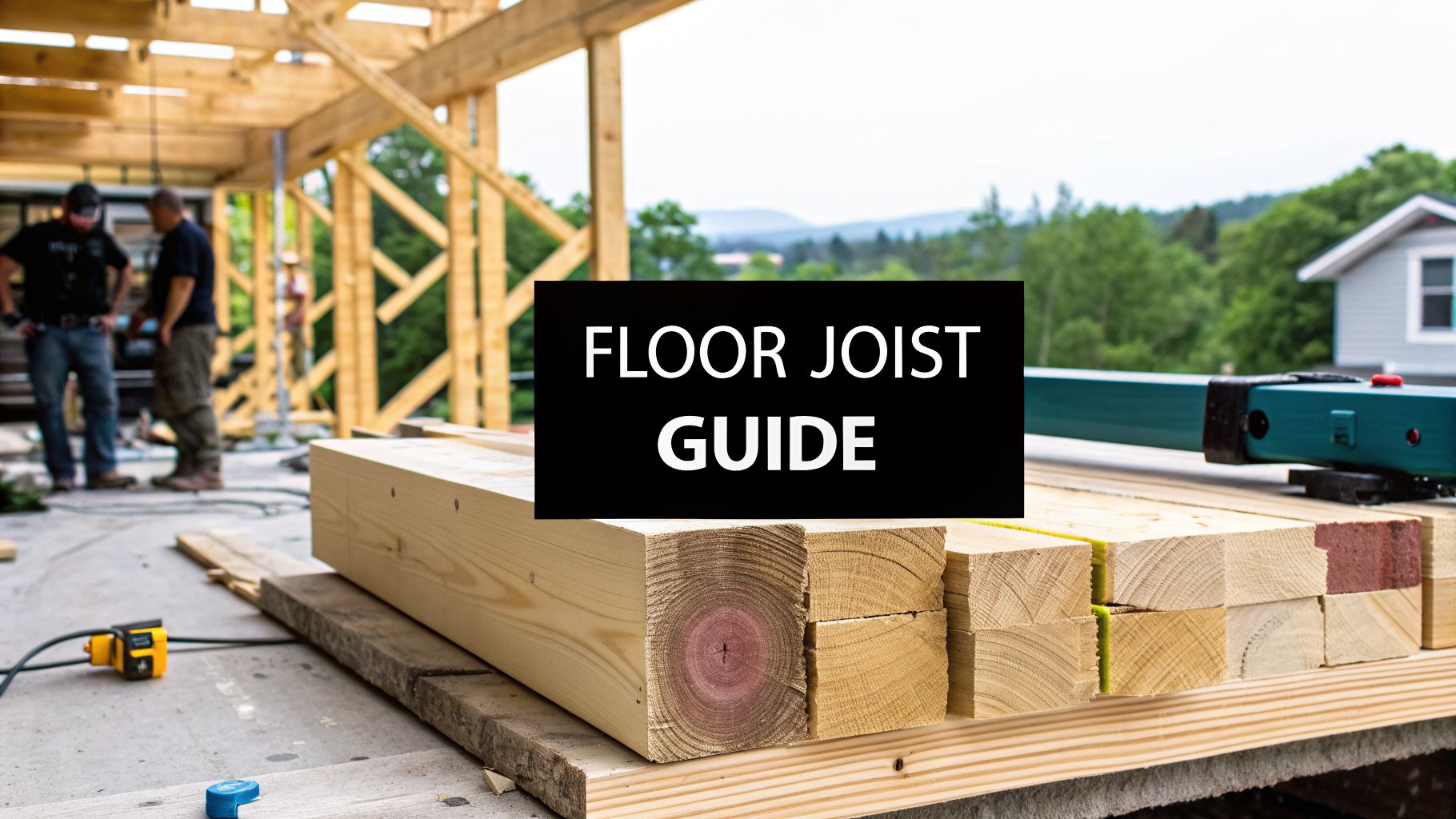
Planning a new shed or garage in Pennsylvania? Choosing the right foundation and floor structure is one of the most important decisions you'll make. It’s a choice that goes far beyond just picking some lumber. The foundation and floor joists are the absolute backbone of your structure, providing all the strength it needs to last for decades. At Firm Foundations, we help homeowners like you get this part right, so you can avoid the sagging floors and structural issues that plague poorly built projects.
Choosing the Right Floor Joists for Your Project

Floor joists are the horizontal beams that create the framework supporting everything—the subfloor, your heavy tool chest, your vehicle, and anyone walking across it. They are engineered to carry the constant "dead load" (the physical weight of the structure itself) and the variable "live load" (all the stuff you put inside it).
The type of joist you select directly determines how solid your floor feels underfoot and how well it holds up over time. A weak or improperly spaced joist system is a common cause of bouncing, sagging, and that telltale creak. That’s why we always start by understanding the different types of joists for floors, whether we're laying a simple base for a storage shed or building a heavy-duty garage foundation in Pennsylvania.
The Connection Between Joists and Foundations
A high-performance floor system starts from the ground up, long before the first piece of lumber is laid. Here at Firm Foundations, we know that the strength of a floor depends entirely on the integrity of the pad it’s built on. The foundation and the floor joists must work together as one cohesive unit.
For homeowners across Pennsylvania, Maryland, Delaware, and New Jersey, this connection is critical. Our regional climate throws a lot at a building, and a poorly prepared base can lead to moisture damage and shifting. That kind of movement will compromise even the strongest, most expensive floor joists you can buy.
A proper foundation is what gives your floor system a fighting chance:
- A Gravel Shed Foundation: As your local gravel shed foundation contractors, we create a perfectly level surface, but its most important job is providing excellent drainage. This is what keeps moisture away from your wood joists, protecting them from the rot and decay that can destroy a floor.
- A Concrete Foundation for a Garage: When a structure needs to handle serious weight like cars, trucks, or heavy equipment, a reinforced concrete slab provides uncompromising strength. It creates a solid, immovable platform that ensures your joists—and the entire floor—remain stable for decades.
Thinking through the whole system, including details like the proper direction to lay wood floors based on joists, is essential for long-term durability. As your local garage foundation contractors near me, we make sure that groundwork is flawless, setting your entire project up for success from day one.
The Classic Choice: Solid Sawn Lumber Joists

When you picture traditional home construction, you’re almost certainly thinking of solid sawn lumber joists. These are the classic 2x8s, 2x10s, and 2x12s that have served as the structural backbone for countless homes, garages, and sheds across Pennsylvania and Maryland for generations.
Cut directly from logs, they represent the original, time-tested approach to framing a floor. Their biggest draw is often their immediate availability and a lower upfront material cost, making them a go-to for straightforward projects where budget is a key factor. Think of a simple base for a storage shed or a small barn shed—this is where solid lumber really shines.
However, anyone building in the humid, four-season climate of our local Pennsylvania area needs to understand their natural limitations. After all, solid wood is a natural material, and it will always react to the environment around it.
The Challenge of Wood and Moisture
The main drawback of solid lumber is its relationship with moisture. Over time, as humidity levels rise and fall, the wood can shrink, twist, or warp. This movement is the number one culprit behind the squeaky, uneven floors that can drive a homeowner crazy.
This is precisely why a high-quality foundation isn’t just a good idea—it's absolutely critical for the longevity of a building. At Firm Foundations, we constantly emphasize proper site preparation for this very reason.
- A well-drained gravel shed foundation lifts the entire structure, allowing air to circulate and water to drain away, keeping those joists dry.
- A professionally installed and sealed concrete foundation for a garage creates a permanent barrier against moisture seeping up from the ground.
Protecting these joists from water is the key to preventing headaches down the road. As your trusted local concrete contractors, we believe your foundation is the first and best line of defense, ensuring your investment remains stable for years to come.
Span Limitations and Structural Integrity
Solid sawn lumber also has its limits when it comes to span—the distance it can stretch without needing a supporting beam or wall underneath. They are perfectly strong for smaller structures like a 10×10 storage shed, but they struggle with the wide, open-concept layouts popular in modern homes and buildings. A typical two-car garage, for instance, requires a long, clear span that often pushes beyond what traditional 2x10s can handle safely and effectively.
Even with the rise of newer engineered materials, solid lumber still supports an estimated 40-50% of legacy residential floors. Historical data shows that while a 2×10 Douglas Fir joist was a common choice, post-installation shrinkage rates of 5-10% are responsible for nearly 70% of all homeowner complaints about floor squeaks. Though solid lumber costs 15-20% less upfront, it often means using larger, heavier boards, which adds to material weight and labor. For those interested in market trends, you can find more details about the I-joist market and its growth here.
It’s all about a trade-off between cost and performance. For smaller-scale projects with modest spans, like a shed foundation, solid lumber is still a very practical and economical choice. As you plan for larger or more complex structures, however, its limitations become clear. You can learn more about standard spans in our guide to 2 x 6 floor joist span details. At Firm Foundations, we make sure the cement foundations for garage projects are engineered to support any floor system, providing the unwavering strength your build deserves.
The Modern Standard Engineered I-Joists

If traditional lumber is the old classic, then engineered I-joists are the high-performance modern standard you see in most new construction. As one of the most popular types of joists for floors, they represent a smarter way to build, delivering more strength with less material.
The concept is simple but brilliant. Think of a steel I-beam, but built from wood composites. This "I" shape is incredibly efficient, giving the joist enormous strength and rigidity. The real-world benefit? It can span much longer distances than standard lumber without needing extra support.
This is a game-changer for anyone wanting a large garage, workshop, or shed. For homeowners in Pennsylvania and Maryland dreaming of a wide-open, uninterrupted floor space for their house foundation or garage, I-joists are almost always the best path forward.
The Advantage of Dimensional Stability
The single greatest benefit for a homeowner is their dimensional stability. Solid wood has natural character, but that includes imperfections that can cause problems later. I-joists are manufactured to be perfectly straight and uniform—and they’re designed to stay that way.
This consistency means they don't twist, warp, or shrink like traditional lumber often does as it ages. For you, that translates into no more annoying floor squeaks, bounces, or dips developing over time. The floor feels solid from day one and stays that way.
A stable, silent floor is a hallmark of quality construction. Our team at Firm Foundations wants you to have a structure you can trust, and engineered I-joists help ensure a peaceful and solid feel underfoot for the life of your building.
Because they are so light, they're also much easier and faster for a crew to install. This efficiency helps keep the building process on schedule, which is why we and other shed foundations contractors near me prefer them for projects that demand long-term precision.
Performance and Market Growth
The construction industry has taken notice. The global I-joist market is estimated at USD 2.77 billion and is projected to climb to USD 4.30 billion by 2032. Unlike solid sawn lumber, I-joists provide a superior strength-to-weight ratio and can span up to 30 feet or more without intermediate supports.
They also reduce floor deflection—that bouncy feeling—by up to 50% compared to standard 2x10s. You can discover more insights about the growing I-joist market and its technical advantages. This makes them perfect for the open-concept garages that sit on the sturdy shed foundation gravel base that Firm Foundations prepares.
This level of performance is exactly why they are the go-to choice for modern garage footings and foundations. When you need a floor that will support the weight of cars and equipment without sagging, I-joists provide the structural integrity you can count on.
Comparing Joist Options For Your Project
To put it all into perspective, here's a direct comparison of the two main types of joists for floors you might consider for a project here in our Pennsylvania service area. This should help clarify which one is right for your build.
Solid Lumber vs Engineered I-Joists
| Feature | Solid Sawn Lumber | Engineered I-Joists |
|---|---|---|
| Stability | Prone to warping, twisting, and shrinking over time. | Exceptionally stable; resists warping and shrinking. |
| Consistency | Varies from piece to piece; may have crowns or knots. | Perfectly uniform and straight, ensuring a level surface. |
| Span | Limited; best for shorter distances. | Can span long distances for open-concept designs. |
| Weight | Heavy and can be difficult to handle. | Lightweight, making installation faster and easier. |
| Long-Term Issues | Can lead to squeaky or bouncy floors. | Virtually eliminates floor squeaks and bounciness. |
| Best Use Case | Small sheds, budget-conscious projects with short spans. | Garages, large sheds, and any structure needing a flat, stable floor. |
Ultimately, choosing an I-joist is an investment in a quieter, stronger, and more reliable structure. At Firm Foundations, we know that a precisely built gravel shed foundation or concrete foundation for a garage is non-negotiable. It creates the perfect, level base that allows advanced joists to perform exactly as designed, giving you a rock-solid floor for years to come.
Heavy-Duty Joists for Demanding Projects
Sometimes, a standard floor system just won’t cut it. For those bigger, more ambitious projects—think workshops, multi-car garages, or commercial-grade structures here in PA and MD—you need to bring in the heavy hitters. These advanced types of joists for floors are specifically engineered for immense strength and massive spans.
Of course, a powerful floor system is only as good as what’s holding it up. These heavy-duty joists concentrate enormous weight onto the foundation, which means a standard base won't do. They demand a professionally engineered solution, like the reinforced concrete foundations we specialize in at Firm Foundations, to guarantee unwavering support for decades to come.
This flowchart can help you visualize which of these brawny joists—LVL, open-web, or steel—is the right fit for your project's specific demands.

As you can see, the choice really boils down to how far you need to span and whether you need open access for running utilities.
Laminated Veneer Lumber (LVL): The Super-Joist
Think of Laminated Veneer Lumber, or LVL, as a super-joist. It’s made by bonding many thin layers of wood veneer together with intense heat and pressure, creating a single, incredibly dense beam. The final product is far stronger and more consistent than any solid piece of lumber of the same size could ever be.
You won't often find LVLs used for an entire floor system in a residential shed. Their real talent lies in strategic support. We use them as main support beams or headers to carry the load from other joists across wide openings, like a two-car garage door, or to hold up a heavy piece of equipment in a workshop.
Because they are so incredibly strong, LVL beams are the secret to creating those beautiful, wide-open interior spaces without needing extra support columns. As a trusted local company, we see them as the unsung heroes behind modern, expansive garage designs.
For our clients across PA, MD, DE, and NJ, an LVL beam is a smart investment in long-term structural integrity. It ensures the frame above your new garage footings and foundations stays perfectly straight, even under the crushing weight of a second story or a heavy-duty roof.
Open-Web Floor Trusses: The Utility Specialist
Next in the lineup are open-web floor trusses. These are brilliantly engineered joists that pair the strength of wood chords with the rigidity of crisscrossing metal webs.
This design creates an exceptionally strong and stiff floor, but its real genius is in those open spaces. The webbing provides a clear, built-in raceway for running plumbing, HVAC ducts, and electrical wiring. This completely eliminates the need for builders to drill through joists, a practice that can weaken the structure.
They’re also surprisingly lightweight for their strength, which can help speed up the installation process. For a complex building like a large barn shed with living quarters or a workshop with extensive plumbing, these trusses are the perfect fit. They’re the clear winner when easy access for mechanicals is a top priority, a key consideration for many foundation builds.
Steel Joists: The Ultimate in Strength and Durability
When your project demands the absolute peak of strength, fire resistance, and durability, nothing beats steel joists. While they're a staple in commercial construction, they are also an excellent choice for residential projects with extreme needs, like a garage built to store heavy machinery or a prized car collection.
Steel is non-combustible, impervious to termites and rot, and won't warp or shrink like wood. Globally, metal joists like steel I-beams and open-web trusses already represent 48.6% of the I-joist market. Here in North America, where floors account for 54.8% of joist usage, they truly shine. Steel can span over 40 feet in structures like barns or garages and easily handle loads over 100 pounds per square foot. You can read the full research on the growth of advanced joist systems to see just how popular they've become.
As a bonus, prefabricated steel trusses are lighter than concrete, can be assembled up to 25% faster, and can even lower insurance premiums by 10-20% because they don't burn. For any project in our service area that puts strength and longevity first, steel is an elite choice. A steel floor system on a reinforced concrete foundation for a garage from Firm Foundations creates a structure that is truly built for generations.
Key Factors for Your Joist Selection in Our Region
Picking the right types of joists for floors can seem like a technical decision, but it’s really about setting your project up for success. For anyone building a shed, garage, or addition here in Pennsylvania, Maryland, Delaware, or New Jersey, you need to think a few steps ahead. We've laid out the most critical factors to guide you.
At Firm Foundations, we believe in a collaborative approach. Walking through these points helps us partner with you to choose a joist system that’s a perfect match for your new shed foundation or garage foundation.
Load and Span Requirements
First things first, you have to consider load and span. Put simply: what are you putting on this floor, and how far does it need to stretch between supports? A floor for a 10×10 storage shed holding some garden tools has completely different needs than a two-car garage floor expected to hold several thousand pounds of vehicles.
The span, or the distance your joists have to cross without support, is just as crucial. If you want a wide-open garage or workshop, you’ll need stronger joists like engineered I-joists or even steel to prevent that dreaded sagging and bouncing. For shorter, simpler spans, a 4×8 shed with foundation might only need traditional solid lumber.
Our Promise: We help you evaluate your needs so your floor feels solid and performs perfectly for years. This isn't just about building codes; it's about delivering quality you can feel.
Cost vs. Longevity
Every project has a budget, but you have to weigh the upfront cost against long-term performance. Solid lumber joists might look cheaper on the invoice, but they can easily lead to expensive repairs if they start to warp, twist, or sag over time. A premium shed foundation gravel base certainly helps, but the wood itself has its limits.
On the flip side, engineered products like I-joists or open-web trusses carry a higher initial price tag. What you're buying, though, is peace of mind—a floor that stays flat, quiet, and strong for decades. It's an investment in protecting the value of your new building. When setting your budget, it's wise to account for all framing elements, which is why understanding basement framing costs can offer a helpful perspective.
Moisture and Regional Climate
Our Mid-Atlantic climate is no joke. The humid summers and constant freeze-thaw cycles are incredibly tough on building materials, and moisture is the number one enemy of solid wood. It causes lumber to swell, shrink, and eventually lose its structural integrity.
This is exactly why engineered joists, LVLs, and steel joists are often a much better bet for our region. They are manufactured to resist the warping and movement that humidity triggers. When you pair these materials with a professionally installed concrete foundation for a garage or a well-drained gravel pad from a trusted team like Firm Foundations (one of the top driveway companies near me), you get superior protection from the elements.
Local Building Codes and Regulations
Finally, never underestimate local building codes. Your municipality in PA, MD, DE, or NJ has specific rules for floor construction, dictating everything from joist size and spacing to maximum span limits. These codes exist for one reason: your safety.
Trying to navigate these regulations on your own can be a real headache. That’s where our expertise comes in. As experienced garage foundation contractors near me, our team at Firm Foundations lives and breathes local codes. We make sure every part of your project, from the garage footings and foundations to the floor system on top, meets or exceeds all requirements. It’s all about giving you complete peace of mind.
Lay the Right Groundwork with Firm Foundations
At the end of the day, it doesn't matter which of the types of joists for floors you pick if the ground underneath isn't solid. A floor's long-term performance hangs completely on the quality of its foundation.
A squeaky, sagging, or shaky floor is almost always a red flag for a poor or failing foundation. This is where getting the base right from the start makes all the difference, and it’s exactly where we, as your trusted local partners, come in.
We're Firm Foundations, and we specialize in building rock-solid, durable bases for projects all across Pennsylvania, Maryland, Delaware, and New Jersey. Our entire focus is on creating the perfect platform for your shed, garage, or home addition so it stands strong for decades to come.
A Foundation for Every Project
Every building project is different, and we get that. That's why we don't do one-size-fits-all. We provide the right kind of foundation for your specific build, whether you need a simple base for a storage shed or a heavy-duty slab for a two-car garage.
Our two main services give your project the stability it deserves:
- Gravel Shed Foundations: A professionally graded and compacted gravel pad is the best defense against moisture. It provides fantastic drainage, which is absolutely critical for protecting any wood floor system from the rot that can destroy a structure from the ground up.
- Reinforced Concrete Foundations: For heavier buildings like a large workshop or a multi-car garage, nothing beats the raw strength of a steel-reinforced concrete foundation. This creates a solid, immovable platform that stops the structure from settling or shifting over time.
Homeowners throughout our service area know they can count on us when they search for shed foundations contractors near me. Our experienced crews handle every single detail with precision, from the initial excavation near me to the final pour.
A great building starts with a great foundation. We ensure your base is level, stable, and properly drained, protecting your entire investment and guaranteeing the performance of your floor system for its entire lifespan.
Our process is built around being reliable and upfront. It all starts with a free quote where we can talk through your project and figure out the best foundation for it. Once you give us the green light, we get to work building a perfectly level and durable base that's ready for your builder. You can get a deeper look at this crucial first step by reading our guide on how to choose the right foundation.
Don't let a weak foundation undermine your dream project. Contact Firm Foundations today to get a quote and make sure your new shed or garage starts on solid ground. We’re here to lay the groundwork for your success.
Frequently Asked Questions About Floor Joists
We get a lot of questions from homeowners in our community trying to plan their projects, especially about how the floor structure connects to the foundation. Here are a few of the most common things we’re asked in our Pennsylvania service area.
How Far Apart Should Floor Joists Be for a Shed or Garage?
For the vast majority of residential sheds and garages we see, a joist spacing of 16 inches on-center is the gold standard. This creates a solid, dependable floor for typical use.
However, if you're planning for heavier loads—think a mechanic's workshop or a garage for two cars—it’s wise to decrease that spacing to 12 inches on-center. This adds a significant amount of strength. At Firm Foundations, we make sure your gravel pad or concrete foundation is built to the precise specs needed to support whatever floor system you're building on top of it.
Can I Put New Floor Joists on an Old Concrete Slab?
While you technically can, we strongly advise having a professional look at it first. For this to be a viable option, that old slab needs to be perfectly level and show zero signs of major cracks or settling.
If that existing slab isn't stable, your new floor is going to inherit all its problems. You'll end up with bounces, sags, and an uneven surface. As your partner in this project, we feel the best approach is often to have us pour a new, properly reinforced concrete foundation to give you a perfect base to build on.
Do I Need a Concrete Foundation or Is a Gravel Pad Enough?
This really comes down to the scale and use of your project. For most standard storage sheds, a professionally installed gravel shed foundation from Firm Foundations is a fantastic, cost-effective choice. It provides excellent drainage, which is absolutely critical for protecting wood joists from moisture and rot.
For heavier buildings like a gazebo foundation, a big two-story shed, a garage that will hold vehicles, or any structure with plumbing, a reinforced cement foundation for a garage becomes a necessity. We can help you sort out the best foundation for your needs during a free quote consultation.
Ready to start your project on solid ground? The team at Firm Foundations is here to build the perfect pad for your shed, garage, or gazebo across Pennsylvania, Maryland, Delaware, and New Jersey. Get your free, no-obligation quote today and let us lay the groundwork for your success.