
Shed Plans 20 X 20: A PA & MD Foundation Guide
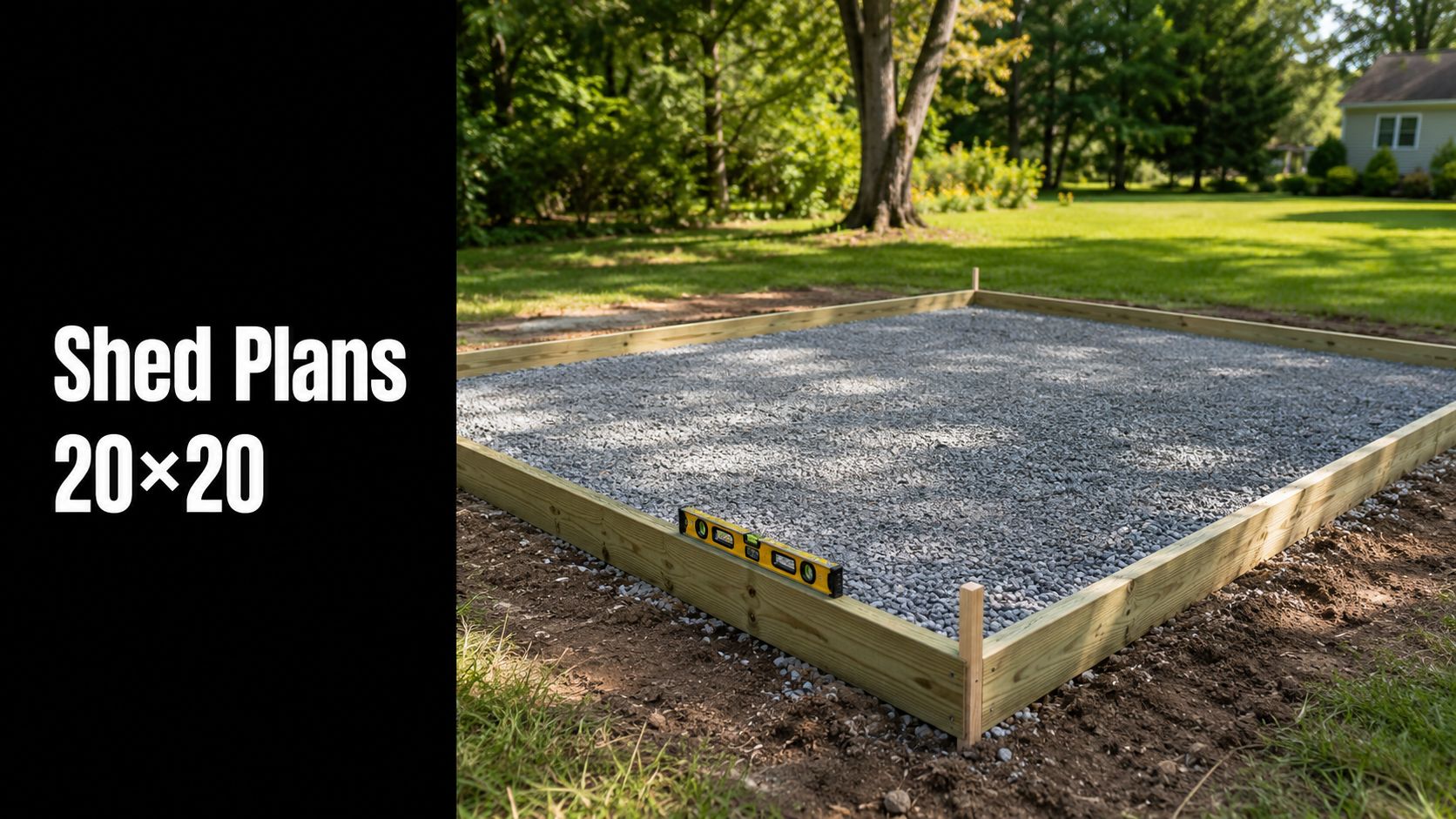
When considering shed plans 20 x 20, one is probably thinking past a simple lawnmower shed. A building this size can become a serious workshop, equipment bay, hobby space, or utility structure. At 400 square feet, it stops behaving like a lightweight backyard box and starts acting more like a small building.
That's where many homeowners get into trouble. They spend hours comparing roof styles, doors, windows, and siding, then treat the base like a minor detail. It isn't. The ground prep and foundation choice will decide whether that shed stays level, drains properly, and still opens and closes the way it should years from now.
In Honey Brook, and across Pennsylvania, Maryland, Delaware, and New Jersey, I've seen the same pattern. The framing may be decent. The roof may look fine on day one. But if the base was rushed, everything above it starts fighting gravity and moisture.
Your 20×20 Shed Starts with the Right Foundation
Most shed plan pages show you how to frame walls and set rafters. They spend far less time on the part that determines whether the building performs. One of the biggest gaps in 20 x 20 shed plan coverage is the lack of real guidance around foundation and site prep, including the practical question of what foundation type makes sense for a 400-square-foot shed in your climate and jurisdiction, as noted in this 20×20 shed plan reference.
A 20×20 footprint gives you options, but it also raises the stakes. The larger the building, the less forgiving the base becomes. Minor errors in grade, drainage, and compaction that might go unnoticed under a tiny prefab shed can create obvious problems under a structure this size.
What goes wrong when the base is treated like an afterthought
A homeowner often starts with the visible parts of the project:
- Door layout: Wide double doors for mowers, ATVs, or a workbench move-in
- Window placement: More daylight for a workshop or hobby area
- Roof style: Gable, lean-to, or something that matches the house
- Interior use: Storage now, workspace later
Those are all fair questions. But before any of that, the site needs to answer a few harder ones. Does water move across the yard and toward the building area? Is the soil stable enough for the chosen base? Will the structure need skids, footings, or a slab to satisfy local code and long-term performance?
Practical rule: If the site holds water, shifts seasonally, or slopes more than the homeowner realizes, the shed plan on paper stops matching the shed that gets built.
The base has to be level and square
For a 20×20 shed, the first critical move is establishing a level, square base. The framing needs to start from a true footprint, and one accepted way to verify square is the 3-4-5 triangulation method. On a larger structure, being “close enough” isn't close enough. Errors multiply fast once floor framing, wall framing, and roof loads stack up.
That's why I tell homeowners to think of the foundation as the one part you can't afford to get wrong. Siding can be replaced. Roofing can be updated. Doors can be adjusted for a while. A bad base keeps showing up in every stage of the build.
For anyone comparing shed foundations near me, base for storage shed options, or even garage foundation contractors near me, this is the right mindset. A 20×20 shed is large enough that the foundation decision should be made with the same care you'd give any other permanent outbuilding.
Navigating Permits for Your 400 Sq Ft Structure
A 20 x 20 shed often lands in a gray area for homeowners and a very clear area for local officials. On your property, it may feel like a shed. On paper, it can behave much more like a small building.
A structure this size changes the conversation about setbacks, drainage, access, use, and code compliance. The bigger question isn't just whether you can fit it in the backyard. It's whether your township or county will treat it as a basic accessory structure, or as something that needs a more formal review.
Why size changes the permit conversation
The design questions become more serious at this footprint. A 20 x 20 shed crosses the line from simple storage to a structure that behaves more like a small building, which affects wind and snow loading, access, and interior use, as discussed in this 20×20 workshop and utility shed reference.
That matters in southeastern Pennsylvania and throughout MD, DE, and NJ because local offices usually care about more than square footage alone. They may look at:
- Setbacks: Distance from property lines, septic fields, easements, and other structures
- Stormwater impact: Whether the new roof and base change runoff patterns
- Intended use: Storage gets treated differently from workshop or utility use
- Foundation type: Some jurisdictions accept one support system more easily than another
If you're planning a utility shed, a hobby space, or a barn shed setup instead of basic storage, don't assume a standard plan covers the structural and code side of that change.
What homeowners should check before ordering materials
A lot of project delays happen because the shed package gets ordered before the site questions are settled. The better order is the opposite.
Use this short permit checklist early:
Confirm zoning placement
Check rear-yard placement rules, setback distances, and whether corner lots have extra restrictions.Ask how the township classifies the structure
The same 20×20 building may be reviewed differently based on whether it's open storage, enclosed workspace, or utility use.Verify the approved base type
Some municipalities are comfortable with certain shed pad systems, while others may require footings or another code-compliant support approach.Ask about drainage and grade
A permit office may want to know how runoff will be handled, especially on a sloped lot.
For a good starting point, homeowners can review building requirements for a shed before submitting plans or scheduling excavation.
The permit process feels slow until you compare it to moving a completed shed because it was built in the wrong place or on the wrong type of base.
The local trade-off most people miss
Homeowners often want the largest building they can fit. That makes sense. But the practical trade-off is this. A larger shed gives you more use, yet it also increases the chance that zoning, foundation design, and drainage details need professional attention.
That's especially true when the building is expected to function like a workshop, a storage-and-utility combo, or a future finished space. A small shed can hide mistakes for a while. A 20×20 usually won't.
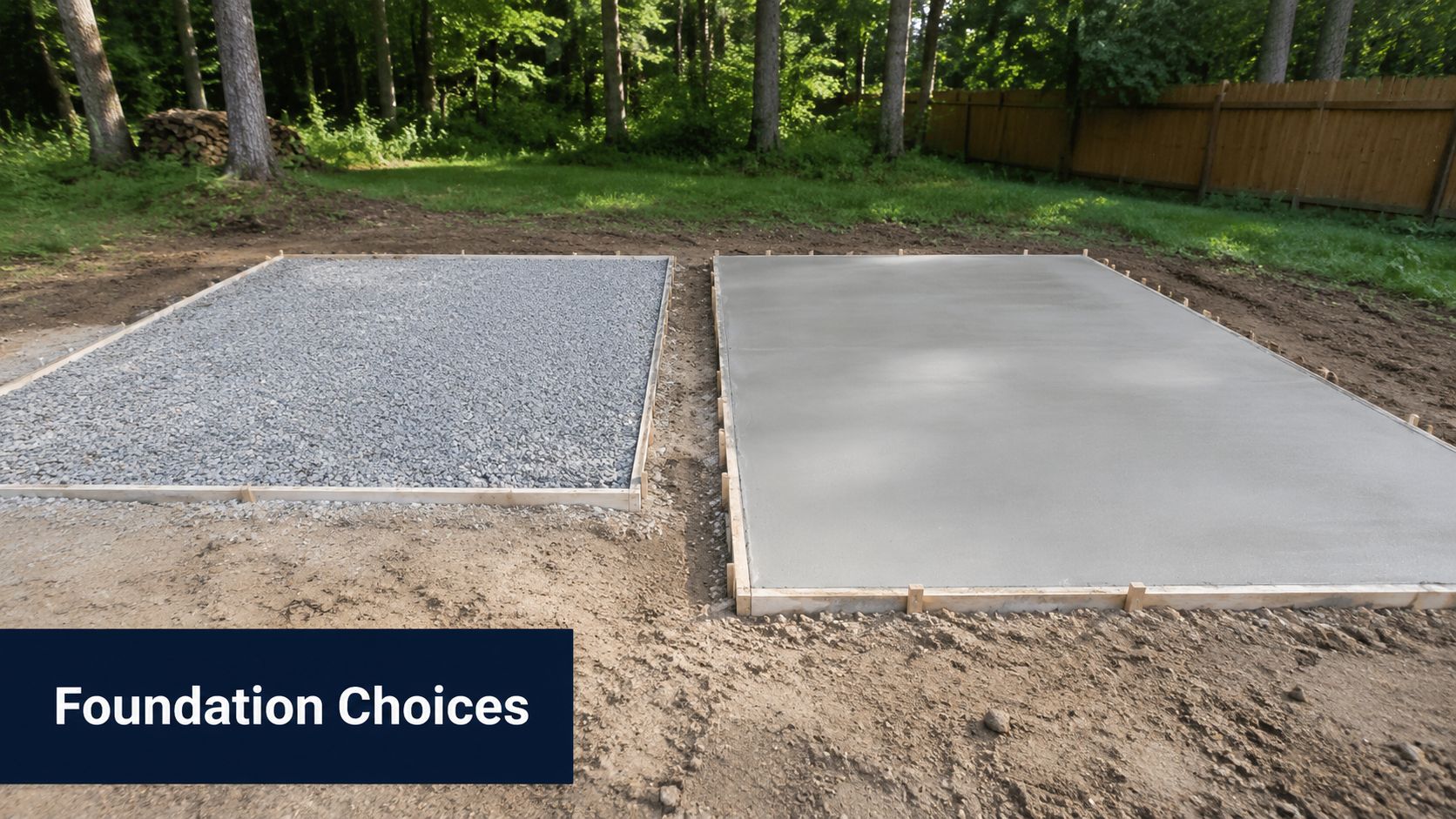
Choosing Your Shed Foundation Gravel Pad vs Concrete Slab
A 20×20 shed changes the conversation. At 400 square feet, you are no longer deciding where to set a small prefab box. You are choosing the base for a real structure, and the wrong call shows up later as sticking doors, soft floors, drainage trouble, and a building that never feels quite right again.
In my line of work around Honey Brook and the surrounding region, I see homeowners spend weeks comparing siding, roof pitch, and door layouts. Then they treat the foundation like a minor detail. On a 20×20 shed, the foundation is the one part you cannot afford to get wrong.
When a gravel pad makes the most sense
A properly built gravel pad is a solid choice for many storage sheds. It drains well, handles freeze-thaw conditions better than many people expect, and works especially well for prefab buildings designed to sit on skids or runners.
It also gives you some forgiveness on sites where water management is the main issue.
A gravel pad usually fits best when the shed will be used for:
- General storage
- Lawn and garden equipment
- Seasonal items
- Prefab shed installations on skids
- Sites where drainage is the main concern
The catch is installation quality. A real shed pad is excavated to suitable depth, built with proper stone, compacted in lifts, and contained so the base keeps its shape. Gravel spread over topsoil will settle unevenly, hold moisture at the edges, and shift under load. I have replaced plenty of failed "pads" that were really just a few tons of stone dumped where the shed was going.
When concrete is the better long-term answer
Concrete makes more sense when the shed will act like a small shop or utility building instead of simple storage. If you plan to park heavy equipment inside, roll tool chests across the floor, add a workbench, or finish the space later, a slab gives you a harder working surface and a stronger sense of permanence.
That is why the same questions that come up with small garages often come up here too. A 20×20 shed can carry similar expectations, even if it is still called a shed on paper.
Some homeowners want to understand slab design before they commit. This overview of a floating slab foundation is useful if you want a plain-English explanation of one common slab approach and where it fits.
A mower shed and a workshop do not ask the same thing from a foundation. The base should match the job from day one.
Side-by-side comparison
| Foundation type | Best fit | Main strength | Main caution |
|---|---|---|---|
| Gravel pad | Storage sheds, prefab buildings, drainage-focused sites | Sheds water well and supports many standard shed installs | Requires careful excavation, grading, and compaction |
| Concrete slab | Workshops, utility rooms, heavier-use structures | Durable working surface with strong long-term stability | Needs accurate forming, subgrade prep, and finishing |
In my experience, the better question is not which one is better in general. The better question is what the shed will do, what the site looks like, and whether local code will accept that foundation type for that structure.
What matters more than the material
The hidden work under the surface decides whether gravel or concrete performs well. Soil bearing conditions, drainage path, edge support, and compaction all matter more than the simple label of pad versus slab.
That is where professional site prep earns its keep. A well-built gravel pad can outlast a poorly prepared slab. A well-built slab can serve for decades. Either one can fail early if the subgrade is soft, water is trapped, or the grade pushes runoff back toward the building.
For homeowners leaning toward concrete, this guide on how to build a concrete pad gives a helpful look at the steps behind a slab that is formed, reinforced, and poured the right way.
This short video helps visualize the difference in approach and why foundation prep matters before the shed arrives.
What works and what doesn't
What works is matching the base to the building's actual use and the conditions on the lot. For many storage-focused sheds, a professionally installed gravel pad is the right answer. For work-focused buildings, concrete is often the better investment.
What fails is choosing by price alone. On a 20×20 shed, cheap foundation work usually turns into expensive correction work later. That is exactly why many homeowners in PA, MD, DE, and NJ bring in a foundation contractor first. Framing and finishes are visible. The base is what keeps the whole building worth having.
Key Design and Framing Elements for a 20×20 Shed
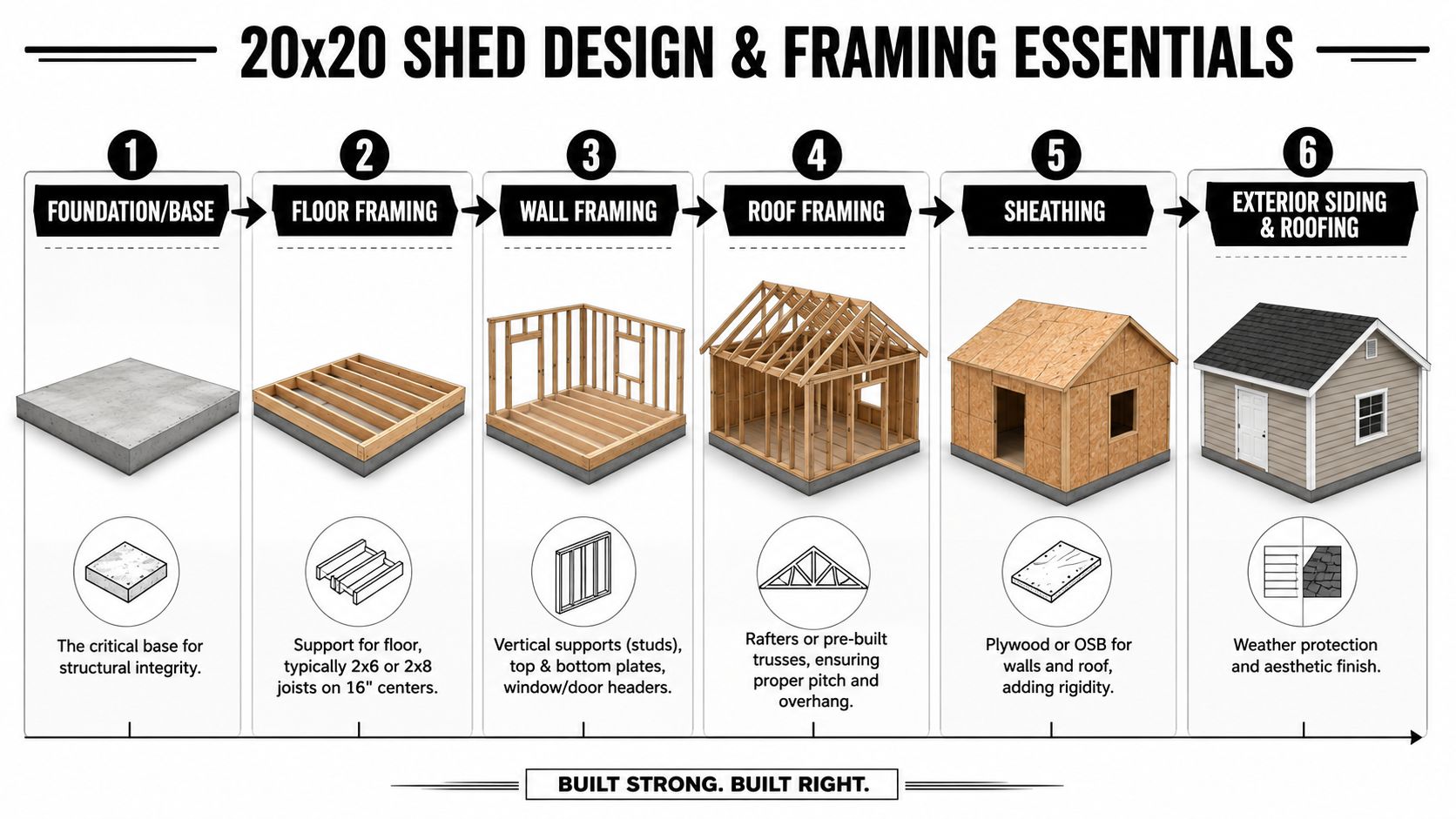
A 20×20 shed stops being a light backyard structure and starts acting like a small building. At 400 square feet, the framing has to be laid out cleanly, fastened correctly, and matched to the way the shed will be used. Storage, workshop use, vehicle parking, and conditioned space all put different demands on the frame.
The mistake I see in larger shed plans is simple. They treat a 20×20 like an upsized garden shed. It is not. Once the footprint gets this large, small framing errors show up fast as floor bounce, wall movement, roof sag, and doors that never quite close right.
Floor framing that matches the load
The floor system has to carry the weight of the building and whatever goes inside it. On many 20×20 sheds, joists spaced 16 inches on center give a firmer floor and better support for the subfloor than wider spacing. Joist size depends on span, use, and layout, but 2x6s or 2x8s are common starting points in shed plans of this size.
Use a subfloor that can handle moisture and traffic. Pressure-treated 3/4-inch plywood is a common choice when the shed will see damp conditions, stored equipment, or hard use. Fasteners matter too. Good framing lumber can still loosen up if the connections are rushed or undersized.
A floor frame only works if it stays square and fully supported. If the base is off, the carpentry crew ends up chasing the problem through the whole build.
Wall framing that keeps openings straight
Long walls need discipline. On a 20-foot run, stud spacing, corner buildouts, and header sizing all affect how well the wall stays plumb over time. Wider spacing may look fine on paper, but it can leave siding wavy and make the wall feel less solid under roof load or wind pressure.
Door openings deserve extra attention. Double doors, overhead doors, and wide workshop entries interrupt the wall structure, so the header has to be sized for that opening and tied into the surrounding studs correctly. If that area is underbuilt, the first signs are usually visible. The opening starts to move, trim joints open up, and the doors begin rubbing before the shed is even a year old.
I do not treat sticky doors as a door problem first. I look at foundation level, wall plumb, and opening support together, because those three conditions usually rise and fall as a set.
Roof framing for snow, wind, and everyday weather
In PA, MD, DE, and NJ, the roof has to do real work. A 20×20 shed roof needs enough pitch to drain well, enough framing to carry local snow loads, and connections that hold when wind gets under the eaves. Basic utility-shed roof details are often too light for a structure this size.
Rafter spacing should match the span and roofing material. Roof sheathing should be thick enough to stay firm between rafters and hold fasteners well. Overhangs should push water away from the siding and base, but they also need to be framed and tied back properly so they do not twist or sag.
Flashing details matter just as much as lumber size. Where roof lines meet taller walls, or where siding transitions near the roof, water control has to be planned before the first panel goes on. Miss those details and the shed can stay structurally sound while still taking on slow water damage around the edges.
Design choices that affect the frame
The simplest 20×20 rectangle is usually the most economical shape to build and brace. Add loft storage, extra-tall walls, multiple large windows, or a wide garage-style opening, and the framing package changes with it. More glass means less wall bracing. Taller walls increase load and can require stronger framing details. A finished interior may also change the wall and roof assembly.
That is why good shed plans matter, but so does judgment in the field. A nice rendering does not tell you whether the floor will feel stiff, whether the doors will stay aligned, or whether the roof load is being carried cleanly to the base.
For a homeowner, the practical takeaway is straightforward. Pick the layout you want, then make sure the framing is designed for the actual use of the building and supported by a base built for that load. On a 20×20 shed, the foundation and frame are one system. If the base is wrong, no amount of neat carpentry fixes it for long.
Estimating Your Project Cost and Timeline in PA and MD
A 20×20 shed looks straightforward on paper. Then the skid loader sinks at the back gate, the grade falls six inches across the footprint, and the "simple" base turns into the part of the job that decides whether the building performs or gives trouble for years.
That is the part many shed plan articles skip. From the foundation side, a 400 square foot shed is a real structure, and the price is driven by site conditions, base type, and how much work it takes to build a level, stable footprint that stays that way in Pennsylvania and Maryland weather.
What drives the price on a 20×20 shed foundation
On site visits around southeastern PA, I see the same factors change the number again and again. The shed package matters, but the ground under it matters more.
The biggest cost drivers are usually:
- Excavation depth and soil condition
- Grading needed to create a level, square base
- Whether the project calls for a gravel pad or a concrete slab
- Access for equipment and material delivery
- Drainage corrections around the building area
- Spoils removal and cleanup
- Coordination with the shed installer or framing crew
A wide, dry backyard with room to work is faster and less expensive to prep. A fenced lot with soft soil, roots, standing water, or a long haul to the install area takes more labor, more machine time, and more planning.
I also hear homeowners compare this work to pricing for excavation or flatwork because the same site realities affect all of it. That comparison is fair. Equipment access, subgrade prep, and water control all show up on the invoice.
Cheap pricing usually means something was left out
The lowest quote often skips the hard parts. If the proposal is light on excavation, compaction, edge restraint, or drainage, the number may look good until the shed starts settling, the doors go out of square, or water begins sitting against the base.
As noted earlier, builders get better long-term results when the base prep and structural details are handled correctly. That is why I tell homeowners to read estimates carefully. Ask what gets excavated, how the base is compacted, how the perimeter is held, where runoff goes, and what level tolerance the contractor is building to.
A foundation quote should read like a scope of work, not a guess.
Homeowners remember the shed price on day one. A few wet seasons later, they remember whether the foundation was built right.
How long the work usually takes
Timeline depends on weather, soil moisture, access, and the type of base you choose. Gravel pads and concrete slabs move on different schedules, and both can stall if the site is too wet to prep properly.
A realistic project schedule usually includes:
- Site visit and quote
- Layout and excavation
- Base preparation and compaction
- Pad or slab installation
- Cure time or readiness for delivery
- Final grading and cleanup
In practical terms, the smoothest projects are the ones with enough lead time to prepare the site before the shed shows up. Rushed foundation work is where mistakes get buried. On a 20×20 shed, that is the one place you do not want shortcuts.
Long-Term Maintenance for Your Shed and Foundation
Three years after a shed goes in, the calls usually sound the same. The door started dragging after a wet spring. Water is sitting along one side. A little washout showed up at the corner of the pad, and now the owner is wondering if the whole building is shifting.
That is why I tell homeowners a 20×20 shed is not a lightweight backyard project. At 400 square feet, it behaves more like a small outbuilding. If the base was built right, maintenance stays simple. If the base was rushed, small symptoms turn into expensive correction work.
The maintenance habits that protect the investment
Walk the shed after every season change, not just after a problem shows up. Start outside at the base. A five-minute check around the perimeter catches more than people expect.
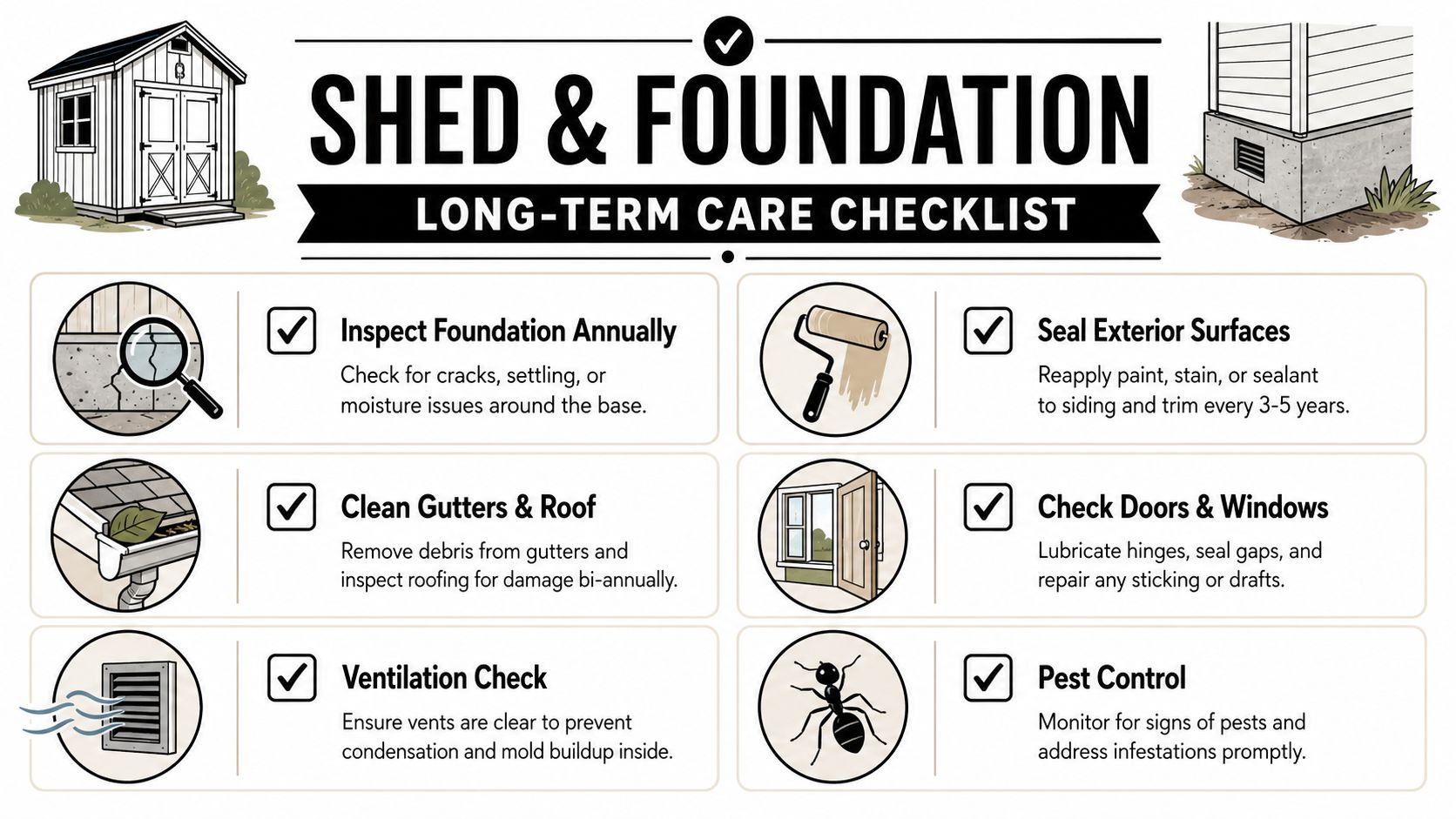
Here is what to look for each year:
- Water near the foundation: Standing water, soft spots, or damp soil at the edge of the pad means runoff is not leaving the site the way it should.
- Stone movement or edge erosion: On gravel pads, look for displaced stone, low corners, or edges that are starting to slough off.
- Door and window movement: Sticking doors, uneven gaps, or latches that no longer line up can point to settlement or frost movement.
- Roof drainage: Downspouts, splash blocks, and roof runoff should carry water away from the shed, not dump it back against the base.
- Siding, trim, and sealant: Open joints let water get into the wall system and keep the area around the shed damp.
- Ventilation: Clear vents help limit condensation, which matters even more if the shed stores tools, equipment, or anything moisture-sensitive.
Roof framing and wall connections matter over time too, especially after wind, snow, and repeated wet-dry cycles. But those parts only stay in line if the foundation stays level and drains properly.
What to pay attention to after storms and wet seasons
After a hard rain, go outside before you inspect the interior. Check where the water went. If runoff is cutting a channel beside the shed, washing stone out from the edge, or ponding against a slab, fix that first.
Freeze-thaw season is another one to watch in Pennsylvania and Maryland. Soil expands, contracts, and moves moisture around. If the ground around the shed was left flat or pitched back toward the structure, winter and spring will expose it fast.
Landscaping causes trouble more often than homeowners expect. Added mulch, flower beds, and topsoil can build up against the shed over time and trap water where it should never sit. Keep the finish grade lower than the siding line and sloped away from the building.
A shed rarely fails without warning. It usually starts with water, movement, and small alignment problems that were easy to correct a few months earlier.
The simplest long-term strategy
The best maintenance plan starts before the shed is delivered. Get the base built correctly, keep water moving away from it, and deal with minor exterior issues while they are still minor.
That is the part many shed plan articles skip. They spend pages on framing and fasteners, then treat the foundation like a box to check. On a 20×20 shed, the foundation decides how the whole structure performs for the next ten or twenty years.
A 20×20 shed is a serious structure. Treat it that way from the ground up.
If you're planning a 20×20 shed in Pennsylvania, Maryland, Delaware, or New Jersey, start with the part that matters most. Firm Foundations builds gravel pads, concrete shed foundations, garage slabs, and excavation-ready bases that are designed to stay level, drain properly, and support the structure for the long haul. If you want a clear quote and experienced guidance on the right base for your site, reach out and get your project started the right way.