
Shed Foundations & Concrete Contractors in PA, MD, DE & NJ
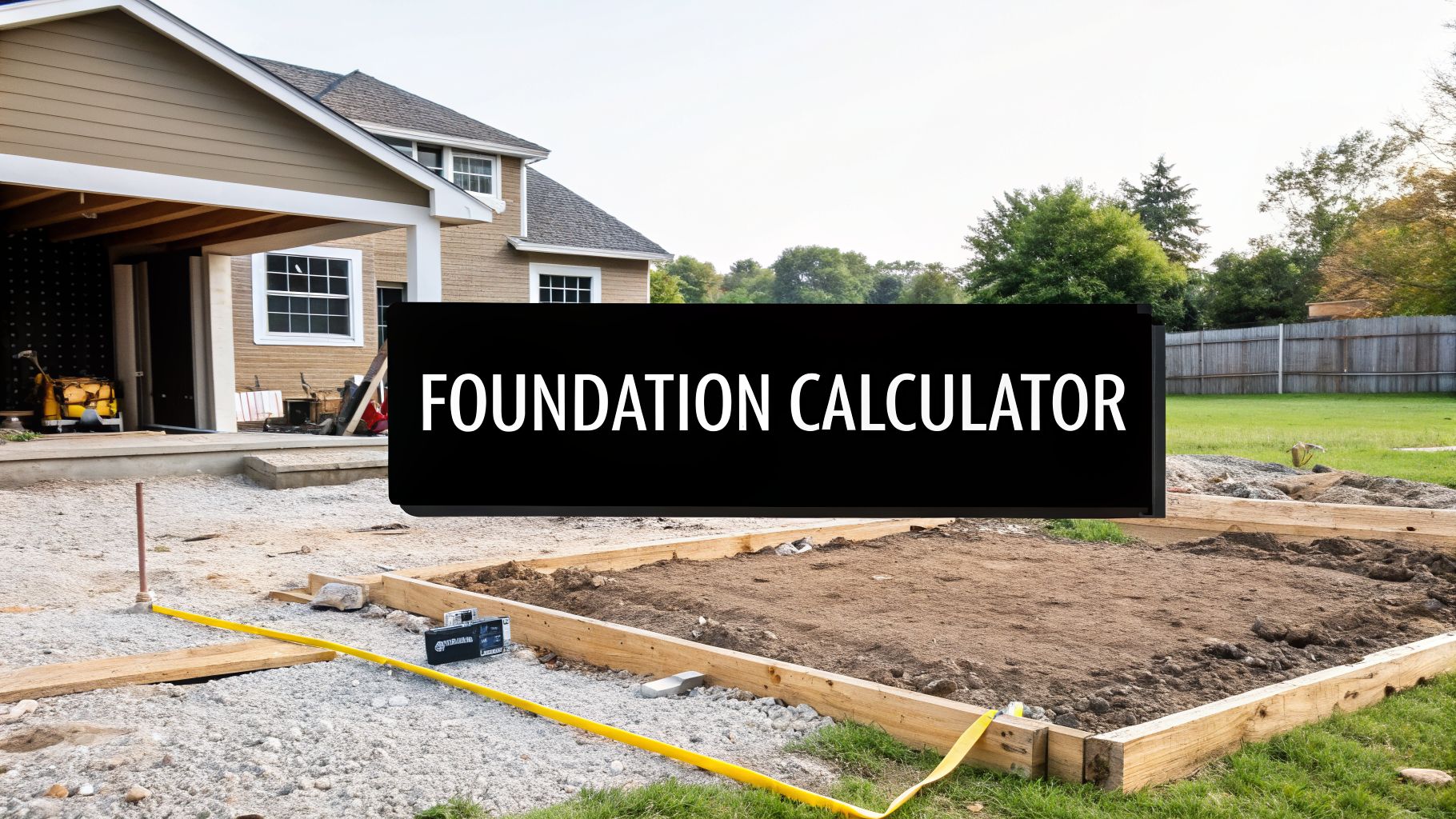
You’re excited about your new shed, but before you start picking out paint colors, let's talk about the most important part: the foundation. A flawless project starts from the ground up, and getting your foundation materials right is the critical first step. As your local construction experts, we know that ordering the right amount of gravel or concrete prevents costly overages and the frustrating delays that come with running short.
At Firm Foundations, we’re not just a company; we’re your neighbors, serving communities across Pennsylvania, Maryland, Delaware, and New Jersey. We’re here to help you get this right.
Why an Accurate Foundation Estimate is Your First Step
Guessing your material needs is a recipe for an unstable base or a lighter wallet. The entire success of your project, whether it's a small 10×10 storage shed or a large barn shed, depends on precise measurements from the very beginning. As the trusted shed foundations contractors near me for homeowners throughout the Mid-Atlantic, we at Firm Foundations are here to walk you through these initial calculations with confidence.
The True Cost of Inaccurate Calculations
Planning a new shed foundation can feel overwhelming, and a miscalculation isn't just a small hiccup; it can cause serious, real-world problems. In fact, poor site prep and foundation issues are behind 40% of shed failures due to shifting or water damage. Using a shed material calculator is the best way to prevent this, ensuring you have the exact amount of material needed from the start.
Take a common 12×16 shed, for example. A quick calculation shows you’ll need about 4-6 tons of gravel or 4 cubic yards of concrete. Getting this right can save you 15-20% on material waste and help you sidestep permit headaches. With material prices fluctuating, precise figures are more crucial than ever to keep your project on budget.
From DIY Projects to Professional Bids
Accuracy is non-negotiable, whether you’re a homeowner tackling a weekend build or a contractor putting together a formal bid. For professionals, mastering accurate estimates is vital for winning jobs. An off-base estimate can quickly eat into your profit margin or make your quote uncompetitive. This principle holds true for any construction project, from a simple base for a storage shed to more complex garage footings and foundations.
A proper foundation isn't just about what you see on the surface. It's about ensuring stability against soil movement, providing adequate drainage to prevent rot, and creating a level base that supports the structure evenly for decades.
What to Consider Before You Calculate
Before you can plug numbers into any calculator, you need to lock in a few key details. These variables are the bedrock of your estimate:
- Shed Dimensions: The final length and width of your structure.
- Foundation Type: Are you building a gravel shed foundation or pouring a concrete foundation for a garage or shed?
- Foundation Depth: The standard depth is 4-6 inches, but this can change based on local building codes and your specific soil conditions.
As the trusted local provider for countless homeowners looking for shed foundations near me, we always account for these local factors. We have hands-on experience with the unique soil types and frost line depths in areas from Honey Brook, PA, to communities all over MD, DE, and NJ. This is the kind of local knowledge that’s essential for building a foundation that truly lasts.
How to Calculate Materials for a Gravel Shed Pad
A gravel pad is a phenomenal choice for a shed foundation. It gives you fantastic drainage and rock-solid stability for anything from a small 4×8 shed with foundation to a much larger workshop. But before any of that can happen, you’ve got to figure out exactly how much stone you need.
Getting that number wrong can bring your whole project to a standstill or leave you with a pricey pile of extra material. As the trusted gravel shed foundation contractors near me for countless homeowners across Pennsylvania and Maryland, we at Firm Foundations have this calculation down to a science. Let us walk you through the simple math and pro tips we use on every job.
The Core Formula for Gravel Volume
Figuring out how much gravel you need is actually pretty straightforward. The goal is to calculate the total volume of your prepared site in cubic feet, and then convert that into cubic yards—which is how every supplier sells it.
The formula we start with is: (Length in feet x Width in feet x Depth in feet) / 27
So, why divide by 27? Simple. There are 27 cubic feet in a single cubic yard. That final division is the key to ordering the right amount from your stone supplier.
A Real-World Calculation Example
Let's put the formula to work on a very common project: a base for a storage shed that’s 10 feet wide by 12 feet long. For most sheds, we aim for a standard depth of 4 inches of compacted gravel, which provides a great balance of stability and drainage.
First, convert your depth from inches to feet. This is a step people often forget. Just divide the depth in inches by 12.
- 4 inches / 12 = 0.333 feet
Next, find the total volume in cubic feet.
- 10 ft. (Length) x 12 ft. (Width) x 0.333 ft. (Depth) = 39.96 cubic feet
Finally, convert that to cubic yards for ordering.
- 39.96 / 27 = 1.48 cubic yards
For a 10×12 shed with a 4-inch deep foundation, you’ll need to order about 1.5 cubic yards of gravel.
This flowchart breaks down how we move from planning the shed to getting the final calculation.

As you can see, every accurate estimate follows the same logical path: define the structure, get precise measurements, and then run the numbers.
Quick-Look Gravel Estimates
To make things even easier, here’s a quick reference table for some popular shed sizes. This gives you a ballpark idea of the material you’ll need for a standard 4-inch deep base.
Estimated Gravel Needed for Common Shed Sizes (4-Inch Depth)
| Shed Size (Feet) | Area (Square Feet) | Cubic Yards of Gravel | Estimated Tons of Gravel |
|---|---|---|---|
| 8×10 | 80 | 1.0 | 1.4 |
| 10×12 | 120 | 1.5 | 2.1 |
| 10×16 | 160 | 2.0 | 2.8 |
| 12×16 | 192 | 2.4 | 3.4 |
| 12×20 | 240 | 3.0 | 4.2 |
| 12×24 | 288 | 3.6 | 5.0 |
Note: Tonnage is an estimate. The actual weight of gravel can vary based on the type of stone and its moisture content.
Don’t Forget About Compaction!
Here’s an insider tip that can save you a major headache: you have to account for compaction. The loose gravel delivered by the truck will settle and decrease in volume once you spread and tamp it down.
We always recommend ordering about 10-15% more gravel than what your initial math says. This buffer ensures you have enough for a truly solid, compacted base and covers any minor inconsistencies in the depth of your site.
Going back to our 10×12 shed example, adding a 10% buffer means ordering 1.65 cubic yards instead of 1.5. It’s a small adjustment that prevents that frustrating, last-minute run back to the supplier. As your local partner, Firm Foundations handles these details so you don't have to.
Choosing the Right Gravel in the Mid-Atlantic
Here in Pennsylvania, Maryland, Delaware, and New Jersey, not all stone is created equal. For a shed foundation gravel base, our crews almost exclusively use #57 stone. This is a type of clean, crushed stone with angular, golf-ball-sized pieces that lock together perfectly when compacted.
That interlocking action is what creates an incredibly stable pad that won't shift over time. It also provides the excellent drainage you need to handle our region’s heavy rain and snow melt. Whether it’s for a simple gazebo foundation or the base for a big barn shed, #57 stone gives you the best mix of stability, drainage, and value. It’s the professional standard for a reason.
Calculating Concrete for a Shed Slab Foundation
When it comes to supporting heavier structures like a large barn shed, workshop, or even a two-car garage, a concrete slab foundation is the undisputed champion. It offers strength and longevity that other foundation types simply can't match, creating a permanent, stable base for whatever you're building.
But getting the concrete volume right is absolutely critical. We've seen homeowners face a 'short pour'—not ordering enough concrete—which brings the entire project to a screeching halt and adds serious costs. On the flip side, ordering too much is literally pouring money down the drain.
As the trusted local concrete contractors for communities across Pennsylvania, Maryland, Delaware, and New Jersey, we at Firm Foundations have this down to a science. Let’s walk through exactly how we calculate the concrete for a job.

The Concrete Volume Formula
The math for figuring out concrete volume isn't all that different from gravel, but the stakes are much higher. Once that truck shows up, the clock is ticking. The goal is to find the total volume you need in cubic yards.
Here’s the formula we use day in and day out:
(Length in feet × Width in feet × Thickness in inches) / 324 = Cubic Yards of Concrete
That magic number, 324, is the key. It’s the conversion factor that takes your project’s dimensions and translates them into cubic yards, which is the standard unit every ready-mix supplier uses.
If you want to get a better handle on the potential budget for your project, our concrete slab cost estimator is a great tool for breaking down the expenses.
Concrete Slab Calculation in Action
Let’s put this into a real-world scenario. Say you’re building a new garage in Honey Brook, PA, and you need to pour the garage footings and foundations for a 16-foot by 20-foot structure. For a standard garage, we'll plan on a 4-inch thick slab.
Here's how the numbers break down:
Multiply your dimensions:
16 ft (Length) × 20 ft (Width) × 4 in (Thickness) = 1,280Divide by the conversion factor:
1,280 / 324 = 3.95 cubic yards
For a 16×20 slab, we'd tell you to order 4 cubic yards of concrete. You always want to round up to the nearest quarter or half-yard. It’s a cheap insurance policy against coming up short.
When to Choose a Thicker Slab
A standard 4-inch slab is perfect for most projects, but you need to know when to go thicker. Heavier loads demand more robust concrete foundations.
4-Inch Slab: This is the go-to for standard storage sheds, home workshops, or a gazebo foundation. It provides more than enough durability for foot traffic and storing things like lawnmowers and outdoor gear.
6-Inch Reinforced Slab: This is non-negotiable for garage foundations that need to support the weight of cars, trucks, or heavy machinery. A slab this thick is almost always reinforced with rebar or wire mesh to give it the tensile strength it needs to prevent cracking under load.
Beyond the Slab: Thickened Edges and Forms
For a true garage foundation, you can’t just pour a flat piece of concrete and call it a day. You need thickened edges, often called footings, which are deeper sections of concrete around the perimeter of the slab. These footings have to extend below the local frost line to stop the slab from heaving and cracking during the winter freeze-thaw cycles.
You also have to account for the lumber needed to build the concrete forms that will frame the pour. These material costs should always be factored into your total project budget. As experienced garage foundation contractors, we handle all these complexities for you, ensuring your foundation is built to code and engineered to last through our tough Mid-Atlantic winters.
Pro Tip: When you order concrete for a project in this region, always specify the right mix. For slabs and foundations, we recommend a 4000 PSI mix. That strength is vital for withstanding the expansion and contraction caused by our weather, preventing cracks and guaranteeing your foundation's durability for years to come.
Site Preparation: The Critical Step Before Materials Arrive
You’ve run the numbers and have a solid estimate for the gravel or concrete you need. That’s a great first step, but the work is far from over. What comes next—properly preparing the site—is just as crucial as ordering the right amount of material.
At Firm Foundations, we know that an exceptional foundation is established long before the first stone is laid or the first yard of concrete is poured. As your local construction partner in PA, MD, DE, and NJ, we want to walk you through the essential hands-on steps that demonstrate the value of professional experience.

The Importance of Proper Excavation
Every great foundation begins with proper excavation. This isn't just about digging a space; it's about creating a perfectly level and stable sub-base that will support your structure for decades. If your site isn't level, your shed won't be either, which can lead to jammed doors, binding windows, and a warped frame over time.
As seasoned excavation near me experts for our local service areas, our process is meticulous:
- Stripping the topsoil: We begin by removing the grass and organic top layer, getting down to the stable subsoil beneath.
- Leveling the site: Using professional-grade equipment, we grade the entire area to ensure it is perfectly flat and compacted.
- Ensuring proper drainage: We strategically shape the surrounding ground to direct water away from the foundation, protecting your investment from costly moisture damage.
A poorly prepared site can inevitably lead to settling, shifting, and water pooling—all issues that can cause a new foundation to fail. We help homeowners like you avoid these common pitfalls.
Navigating Local Codes and Frost Lines
Building in the Mid-Atlantic region presents unique challenges, primarily due to our variable weather. Local building codes exist for a reason: to ensure all structures are safe and durable. In the U.S., where residential applications make up 70% of the shed market, an estimated 30% of projects are tripped up by failing to account for proper material estimates and site plans. A precise calculator that considers local factors can help achieve a 95% first-time pass rate on permits and potentially cut project timelines by 20%.
One of the most critical factors we contend with in Pennsylvania, Maryland, Delaware, and New Jersey is the frost line. This is the maximum depth to which the ground freezes solid during the winter.
For our area, the frost line is typically between 36 and 48 inches deep. Any permanent structure, especially one requiring robust garage footings and foundations, must have its footings extend below this depth to prevent frost heave—a powerful upward force that can crack and destroy concrete.
Hiring an experienced team like Firm Foundations provides immense value here. We are intimately familiar with the specific codes and requirements in your local municipality, whether it's for a simple gazebo foundation or a complex house foundation. We handle the permits and ensure every detail of your project is up to code, saving you the headache and potential expense of a failed inspection.
Why Your Foundation Should Be Larger Than Your Shed
Here’s a final pro tip that many people overlook: the base for a storage shed should always extend beyond the shed's actual footprint. As a rule, we recommend adding at least one foot of extra space on all sides.
This extra perimeter serves several important functions:
- It creates a stable "drip edge" that prevents water from splashing back onto the siding, reducing the risk of rot.
- It provides a clean and sturdy walkway around your shed for easy access.
- Most importantly, it ensures the edges of your shed are fully supported, preventing them from sinking into softer soil over time.
It is this kind of attention to detail that separates a professionally built foundation from a standard DIY project. When you're ready to move beyond the math and get your site prepped correctly, give your neighbors at Firm Foundations a call.
Turn Your Plan Into a Professionally Built Foundation
Now that you understand the formulas for your shed material calculator, the final step is turning that blueprint into a reality. While a DIY approach has its appeal, there’s a noticeable difference between an amateur base and a professional-grade shed foundation built to last for decades. That difference comes down to experience, specialized equipment, and a deep understanding of local ground conditions.
This is exactly where we excel. At Firm Foundations, we bridge the gap between your calculations and a perfectly executed project on your property. We are the trusted shed foundations contractors near me for homeowners across Pennsylvania, Maryland, Delaware, and New Jersey because we remove the guesswork and risk from such a critical job.
Why Partnering with a Pro Makes All the Difference
Choosing a professional contractor isn’t just about saving yourself a weekend of hard labor; it’s an investment in the long-term integrity of your shed or garage. A properly built base for a storage shed is more than a simple mix of stone—it’s an engineered system designed for stability and longevity.
Here's what our professional installation provides:
- Guaranteed Accuracy: We do more than just run the numbers. Our process includes a full site assessment, accounting for soil compaction and grade, so we can order the precise amount of material. This prevents both costly overages and project-halting shortages.
- Specialized Equipment: Achieving a perfectly level and compacted base requires more than a wheelbarrow. Our crews arrive with professional-grade excavation and compaction machinery to create a flawless sub-base.
- Code Compliance: Navigating the complex web of local building codes can be a major hurdle, especially for garage footings and foundations that must respect regional frost lines. We manage all necessary permits and ensure your project meets or exceeds every local requirement.
When you hire Firm Foundations, you are investing in the peace of mind that comes from knowing the job will be done right the first time.
We’ve built our reputation by being the go-to foundation partner for some of the best shed builders in the region, including Stoltzfus Structures and Sheds Unlimited. They trust us to provide a flawless base for their buildings, and you can, too.
Your Simple Path to a Perfect Foundation
We believe getting a professionally built foundation should be a straightforward and reassuring experience. You won’t find any high-pressure sales tactics or confusing estimates—just honest work from a local team dedicated to helping you achieve your goals. The next logical step is to get a free, no-obligation quote from us.
Our customer-focused process is simple:
- Tell Us About Your Project: Give us a call or fill out our online form. We’ll listen to your plans, whether it's for a 10×10 storage shed, a new gazebo foundation, or a multi-car garage.
- Receive a Transparent Quote: Based on your needs, we provide a clear, detailed estimate with no hidden fees. You’ll know exactly what to expect from start to finish.
- Schedule Your Installation: Once you approve the quote, we’ll get your project on our schedule and handle every last detail, from site prep to the final cleanup.
Don't Let Your Project Rest on an Unstable Base
From the rolling hills of Honey Brook, Pennsylvania, to the coastal plains of Delaware, we are proud to serve homeowners and businesses throughout the Mid-Atlantic. Our deep experience with the region’s specific soil types and weather patterns means your foundation is built to withstand local conditions for years to come.
You’ve done the research. Now, let the experts at Firm Foundations turn that plan into a durable, professionally built reality. Your new shed, garage, or barn shed deserves nothing less.
Answering Your Shed Foundation Questions
Planning a new shed foundation often brings up specific questions, even after doing the math. We've compiled answers to the most common inquiries we receive from homeowners throughout Pennsylvania, Maryland, Delaware, and New Jersey to help guide your project and build your confidence.
How Much Extra Material Should I Order for Waste?
This is a critical planning question. As a standard practice, we recommend adding a 5-10% buffer to your final material calculation. This small overage provides a necessary safeguard during the installation process.
For a shed foundation gravel base, this extra stone accounts for volume loss during compaction and ensures there's enough material to level out any unexpected low spots in the excavated area. It’s the key to achieving a perfectly flat pad.
With concrete, that 5-10% buffer prevents a "short pour," a costly and time-sensitive problem that can compromise the slab's integrity. The small upfront cost of extra material is far better than the emergency of running out. When you partner with Firm Foundations, we handle these precise calculations for you, ensuring efficiency without waste.
Are Shed Foundation Kits a Good Alternative?
While shed foundation kits may seem like a convenient option, their effectiveness is limited. They can occasionally work for small, standard sheds on perfectly level ground, but they are often unsuitable for the real-world conditions we find across the Mid-Atlantic.
Our region's variable soil, slopes, and freeze-thaw cycles demand a more robust solution than a one-size-fits-all kit can provide. A custom-calculated and professionally installed gravel pad or cement foundation for garage or shed use is superior in several ways:
- Stability: A custom foundation is engineered for your specific ground conditions.
- Drainage: It is designed to manage water flow effectively, preventing moisture damage.
- Longevity: It is built to provide decades of support, not just a few years.
For a durable, long-lasting result, especially for larger structures or on any site with a slope, a custom-built foundation is essential.
What Is the Difference Between a Floating Slab and Footings?
Understanding this distinction is vital, particularly when constructing something more substantial than a simple storage shed.
A floating slab is a single, solid pour of concrete that "floats" on a prepared base of compacted gravel. This is the most cost-effective and appropriate solution for the vast majority of sheds, workshops, and many single-car garages.
In contrast, a foundation with footings is a more complex system. It involves digging trenches around the perimeter and pouring concrete footers that extend below the local frost line. This is necessary for heavier buildings like two-car garages or structures attached to a house foundation. These footings anchor the structure deep into the ground, preventing it from shifting or cracking during winter freeze-thaw cycles.
As your local garage foundation contractors, we construct every foundation according to the specific codes in your Pennsylvania, Maryland, Delaware, or New Jersey municipality. This guarantees your structure is stable, permanent, and fully protected from frost heave.
Why Is Compacted Gravel So Critical for a Shed Base?
It's tempting to view a gravel base as just a layer of stone, but the compaction process is what transforms it into a solid, engineered platform. Loose, uncompacted gravel will inevitably settle unevenly under your shed's weight, causing the structure to become unlevel.
Compacted gravel, however, creates an incredibly dense, interlocked base that resists settling for decades. It also maintains small voids between the stones that facilitate excellent drainage. This allows water to flow away from your shed's base, which is the most important factor in preventing the rot and moisture damage that lead to premature structural failure.
We utilize professional-grade compaction equipment on every project, from a small gazebo foundation to a large barn shed. This step is non-negotiable for creating a base for a storage shed that will perform for years to come.
The experienced crews at Firm Foundations are ready to help you lay the proper groundwork for your project. Get your free, no-obligation quote today and let's build something that lasts.