
How To Secure Shed To Ground: Top Foundation Methods
A lot of homeowners reach the same point on delivery day. The shed is in place, it looks great, and for a few minutes it feels like the project is done. Then the practical question hits. How do you secure the shed to the ground so it stays put, stays level, and lasts?
That question matters even more in Pennsylvania and Maryland, where soil movement, drainage issues, and seasonal weather can turn a simple outbuilding into a repair project if the base and anchoring are wrong. A shed that isn’t properly secured can shift, rack, hold moisture in the wrong places, and start stressing doors, floor framing, and wall connections.
Homeowners across PA, MD, DE, and NJ usually aren’t looking for a complicated engineering lecture. They want a straight answer about what works, what doesn’t, and when it makes sense to call a shed foundations contractor near me instead of guessing. That’s what this guide is for. It covers the practical ways to handle a shed foundation, a base for storage shed, and the anchoring methods that make that foundation do its job.
Your New Shed is Here Now What
The most common mistake happens right after delivery. A homeowner sees the shed sitting in roughly the right spot and assumes the hard part is over. It isn’t.
A shed can look stable on day one and still be poorly supported. That’s especially true when it’s set on bare soil, a thin layer of stone, random patio blocks, or a spot in the yard that was never excavated and leveled correctly. The building may feel solid when empty, but a true test comes later, after rain, freeze and thaw cycles, and a few windy weekends.
In our area, this usually starts with a simple concern. The doors don’t line up quite right. One corner feels soft underfoot. Water sits near the perimeter after a storm. Homeowners then realize they don’t just need a shed. They need a proper shed foundation gravel base or a concrete pad, plus anchoring that fits the structure and soil.
The question behind the question
When people search for shed foundations near me or gravel shed foundation contractors near me, they’re usually asking three things at once:
- Will the shed stay level through changing seasons
- Will the base drain properly so the floor framing doesn’t stay damp
- Will the shed stay put in strong wind
Those are the right questions to ask before storing tools, lawn equipment, feed, furniture, or anything else you don’t want damaged.
A shed isn’t just a box in the yard. It’s a small structure, and small structures still need real support.
What homeowners usually need next
After delivery, the next step is to match the building to the right foundation system. For some properties, that means a well-built gravel pad with the right edging, compaction, and anchor layout. For heavier uses, such as a workshop or a garage-style building, it often means looking at concrete foundations, garage footings and foundations, or a slab built for that load.
That decision should be based on ground conditions, drainage, shed size, intended use, and how permanent you want the installation to be. If you get that part right, the anchoring becomes straightforward. If you get it wrong, the anchors won’t solve the bigger problem underneath.
Why Securing Your Shed is Non-Negotiable in Our Region
A shed can look fine the day it is dropped in your yard, then start showing trouble after one wet season and one hard wind event. Around Pennsylvania, Maryland, Delaware, and New Jersey, that usually starts with small signs. A door that sticks. A corner that settles. Fasteners that loosen because the building is shifting against the base instead of staying tied to it.
At Firm Foundations, we see this after stormy springs, summer downpours, and freeze-thaw winters. Homeowners often assume the shed itself is the problem. In many cases, the actual issue is that the structure was set on a base that was never prepared for local soil movement, drainage, or wind uplift.
Our local soils don’t forgive shortcuts
This region has all kinds of ground conditions. Dense clay is common in parts of Pennsylvania and Maryland. Some properties in Delaware and South Jersey drain fast near the surface, then turn soft below. A yard can look dry on top and still pump water underneath after a storm.
That matters because anchoring is only part of the job. The base has to stay stable, drain correctly, and resist frost movement. If it does not, the anchors start carrying loads they were never meant to handle alone.
Homeowners comparing different shed foundation methods for 2025 usually focus on cost first. The better question is how that foundation will behave in January, in April, and after three inches of rain.
Wind loads are real, even away from the coast
A lot of shed damage in our area comes from ordinary storm systems, not headline hurricanes. A broad wall catches gusts. An overhang gives wind a place to get under the structure. Once the shed lifts even a little, hardware loosens and the whole building becomes more vulnerable.
The Federal Emergency Management Agency documented after Hurricane Andrew that widespread structural failures led to major changes in how wind resistance and anchoring were evaluated for buildings in exposed conditions, especially connections between the structure and the ground, as noted in FEMA's review of the storm's building performance: Hurricane Andrew in Florida, observations and recommendations. We do not need Florida conditions to learn from that lesson. Small detached buildings fail early when the connection to the ground is weak.
Most shed problems start low, at the base, the anchors, and the soil underneath them.
The risk is bigger than a crooked shed
An unsecured shed does more than go out of level. It can rack the frame, crack siding, wear out doors, and let water in where it was never supposed to be. In a stronger wind event, it can shift into a fence line, a patio, or utility equipment.
Insurance questions also get harder when an outbuilding was never installed on a proper base. For owners storing feed, tools, tack, or equipment, there is also the issue of what the shed supports on the rest of the property. Homeowners thinking about that bigger picture may find guidance on protecting your New York hobby farm useful, especially when sheds are part of daily operations.
Why local judgment matters
Generic DIY advice often assumes flat, dry ground and mild seasonal movement. That is not how many properties in PA, MD, DE, and NJ behave. In our service area, a light resin shed on a well-drained gravel pad may be a reasonable do-it-yourself project. A larger wood shed, a workshop, or any building going on soft ground, fill soil, or a site with poor drainage deserves a closer look.
That is usually the point where searching for a shed foundations contractor near me makes sense. You are not just paying for labor. You are paying for site judgment, proper prep depth, the right anchor layout, and a foundation choice that fits the shed and the property. That saves a lot of re-leveling and repair later.
Your Foundation Options A Firm Foundations Guide
A shed can only stay square and secure if the base under it matches the building, the soil, and the weather it has to handle. Around Pennsylvania and Maryland, that usually comes down to freeze-thaw movement, soft or filled spots in the yard, and drainage that looks fine in July but causes trouble after a wet fall or late-winter thaw.
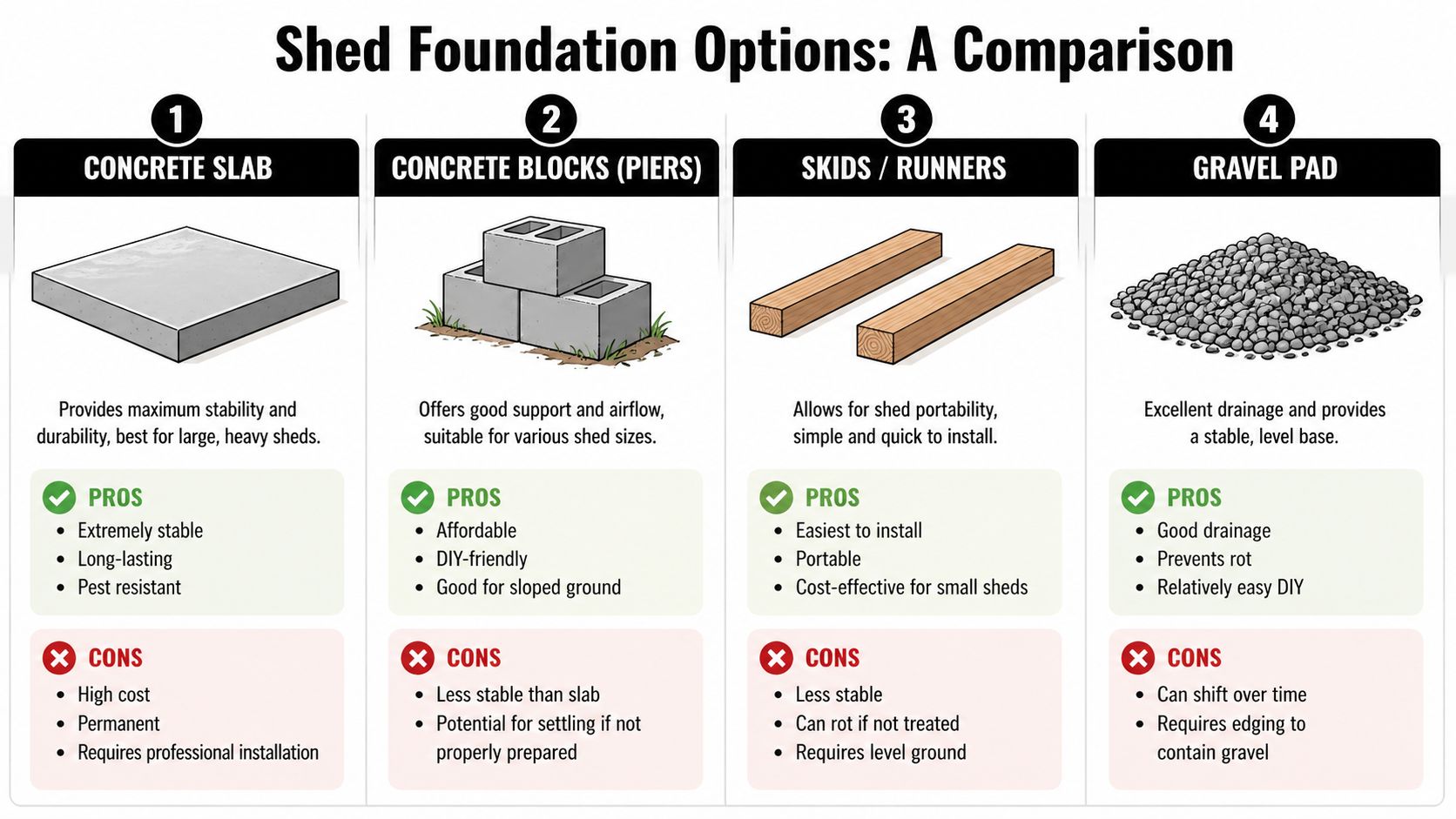
Homeowners searching for shed foundations near me, garage foundation contractors near me, or a practical base for storage shed are usually choosing between two foundation types that hold up well over time. Those are a properly built gravel pad and a properly built concrete slab.
Gravel pad foundations
For many storage sheds, prefab barns, gazebo foundations, and similar backyard structures, a gravel pad is the best fit. It drains well, adapts to many shed styles, and avoids turning the whole area into a permanent concrete surface.
The key is how it is built. A real gravel pad starts with excavation, compacted stone, and clear edges that keep the base from spreading. The pad should extend beyond the shed footprint so the structure is fully supported and splash-back stays down. The USDA Natural Resources Conservation Service notes that drainage and soil conditions directly affect how water moves and how surfaces perform over time, which is one reason stone pads work well on many sites when they are graded and compacted correctly (NRCS soil and drainage guidance).
That makes gravel a strong choice for:
- standard storage sheds
- many delivered prefab buildings
- gazebos and pavilions
- sites where drainage is the main concern
- homeowners who may want to modify or remove the structure later
There is a trade-off. Gravel is forgiving with water, but not with shortcuts. Stone dumped over grass settles unevenly, loses its edges, and leaves the shed bearing on weak spots. In our service area, I see this often on clay-heavy soils and on lots with old fill near newer subdivisions.
If you are comparing layouts and base types, this overview of different ways to build a shed foundation gives a useful side-by-side look at common options.
Concrete slab foundations
A concrete slab fits heavier buildings and higher-use spaces. If the shed is really a workshop, equipment building, or small garage-style structure, concrete often makes more sense than gravel.
A slab gives you a finished floor, a rigid footprint, and a reliable surface for anchor bolts. The National Ready Mixed Concrete Association explains that slab performance depends on subgrade preparation, drainage, jointing, and intended use, not just the concrete itself (NRMCA concrete in practice resources). That lines up with what we see in the field. The slab only performs as well as the base and drainage plan under it.
Concrete works well for:
- workshop sheds
- garage-style outbuildings
- equipment and tool storage
- buildings with heavier shelving
- spaces expected to see regular foot traffic or rolling loads
The trade-off is cost and permanence. A slab usually takes more excavation, more forming, more site access planning, and more commitment from the homeowner. If the location is wrong, changing it later is a much bigger job.
For sheds placed beside patios, walkways, or outdoor work areas, the surrounding hardscape matters too. Homeowners planning adjacent paver work can benefit from understanding installing lasting pavers correctly, especially where drainage and edge restraint affect the shed site.
Concrete blocks and skids
Blocks and skids still have a place, but only in the right situations. Small temporary sheds, movable structures, and some light-duty prefab units can sit on skids or block supports if the ground is prepared correctly and the manufacturer allows it.
They also create more callbacks than either gravel pads or slabs.
Blocks concentrate weight at a few points. That is a problem on soft soil, wet ground, or any site with uneven compaction. Skids can work for portable buildings, but they are not the same as a finished foundation. If the shed is expected to stay put for years, hold valuable equipment, or survive repeated freeze-thaw cycles without seasonal adjustment, blocks and skids are usually the weaker choice.
If the shed is staying in one spot for the long haul, build the base for the site conditions, not just the delivery day.
Side-by-side comparison
| Feature | Gravel Shed Pad | Concrete Slab Foundation |
|---|---|---|
| Drainage | Handles water well when excavated, compacted, and contained properly | Works well if grading carries water away from the slab |
| Best fit | Storage sheds, gazebos, many prefab buildings, barn-style sheds | Workshops, heavier sheds, garage-style structures |
| Installation feel | Less permanent and often easier on an existing yard | More permanent and usually more labor-intensive |
| Anchoring approach | Ground anchors, brackets, and frame connections suited to stone-base installations | Concrete anchors and bolts attached to the shed base rail or framing |
| Future changes | Easier to adjust, expand around, or remove later | Harder to alter after the pour |
| Surface use | Support base under the building | Support base and finished floor |
| Common risk if done poorly | Edge spread, settlement, uneven bearing | Cracking, water problems, poor anchor placement |
Which one is right for your property
Choose a gravel pad if the shed is a standard storage building, drainage is your main concern, and you want strong support without committing to a full slab.
Choose a concrete slab if the building is heavier, the floor needs to function as part of the structure, or the shed will be used more like a shop or garage.
Firm Foundations installs both gravel pads and concrete slabs for sheds, garages, gazebos, barns, and similar structures across PA, MD, DE, and NJ. The right choice depends on how the shed will be used, how the yard drains, and how much seasonal ground movement the site is likely to see.
How to Secure Your Shed to the Ground Step by Step
Once the base is right, anchoring becomes a clear, methodical job. In this phase, many DIY projects go sideways, not because the homeowner lacks effort, but because spacing, depth, and attachment details matter more than they first appear.
Before you anchor anything
Start with three checks before a single bolt or anchor goes in.
Confirm the base is level
If the shed already rocks or leans, anchoring it will lock that problem in place.Identify what you’re anchoring to
A slab, gravel pad, skids, and pier-style setup all require different hardware.Inspect the shed frame
You want to secure the structure through solid framing members or the manufacturer’s base rail, not just thin trim or non-structural flooring material.
A useful rule for homeowners is that anchoring should resist movement without distorting the shed frame. If you have to force the building into alignment with straps or bolts, the support system underneath probably needs correction first.
Anchoring to a concrete slab
This method works well when the slab is already in the right place, sized correctly, and in good condition.
Step 1
Set the shed where it belongs and check for full bearing. The structure should sit flat without gaps that suggest a twisted frame or uneven concrete.
Step 2
Mark anchor locations at the corners and along the sides. In high-wind anchoring guidance, the spacing is at each corner and along the sides every 10 feet or less, using bolts through the shed’s u-channel into the slab, installed with a masonry bit and tightened with a wrench, as described in this concrete and shed anchoring guide.
Step 3
Drill through the metal base channel or framing attachment point and into the slab. Use the correct masonry bit size for the anchor hardware. Keep the drill straight so the anchor seats properly.
Step 4
Insert the concrete bolts or anchors and tighten them evenly. Don’t over-tighten one corner while others are still loose. Pull the building down snugly and check that it remains square.
Step 5
If the site is especially exposed, some builders add strap tie-downs connected to concrete blocks around skid runners for additional hold-down resistance. That can be a practical supplement in some situations, but it doesn’t replace a slab that was sized or poured poorly.
Practical rule: On concrete, the anchor is only as dependable as the slab edge, slab condition, and the framing point you attach to.
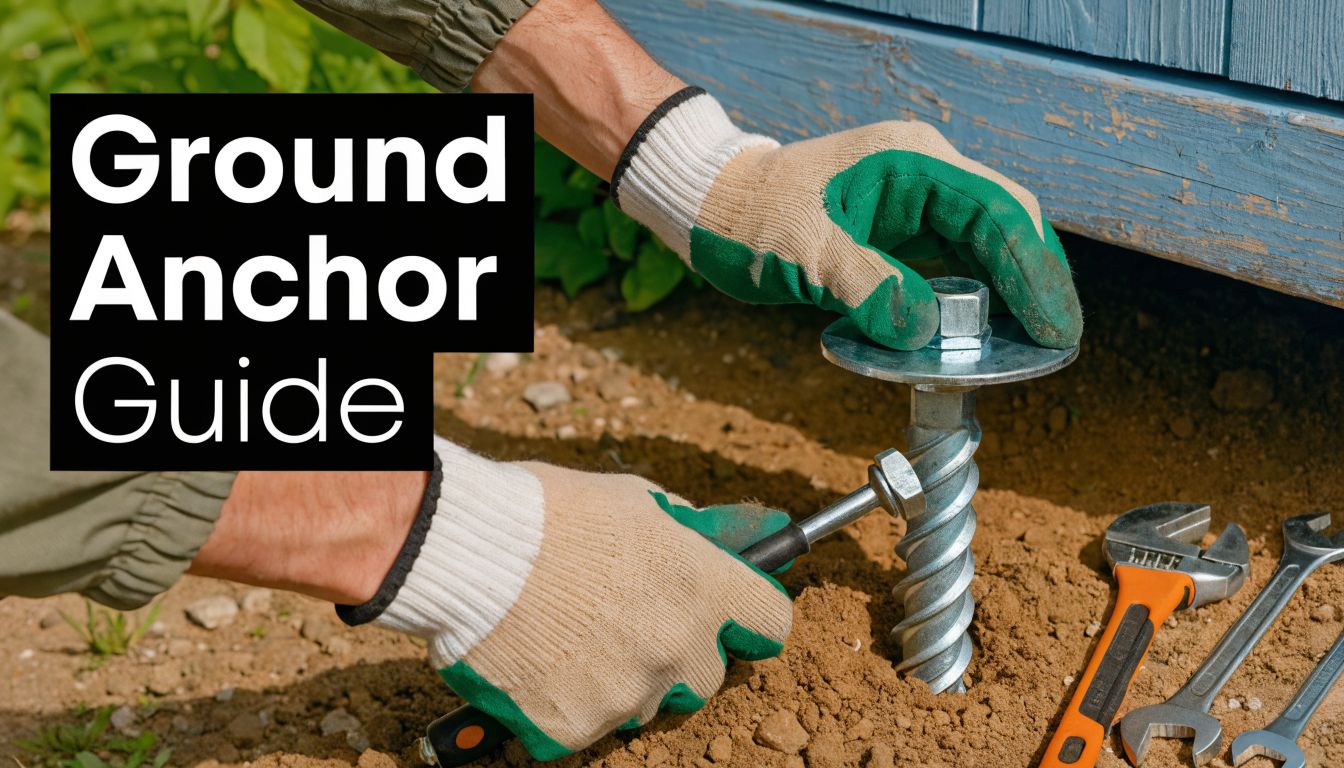
Securing a shed on gravel with auger-style anchors
This is one of the most common approaches for sheds in our region, especially when the building sits on a gravel pad or skids rather than a poured slab.
The core idea is simple. Screw anchors go into the ground, then brackets or cables tie them back to the shed frame. The execution is where homeowners need to slow down and be precise.
Soil type changes the anchor choice
For sheds without concrete using auger-style Penetrator anchors, sandy or loamy soils require 46-inch anchors rated for 5,000+ lbs uplift resistance per anchor, and anchors should be positioned at corners and mid-sides, with 4-8 anchors spaced at a minimum equal to the anchor depth, such as 46 inches apart, to avoid overlapping soil cones that can reduce holding strength by up to 40%, according to this auger anchor installation reference.
That spacing rule matters more than one might expect. Installing anchors too close together feels safer, but it can weaken the system because the anchors compete for the same body of soil.
Basic installation sequence
- Lay out the anchor positions according to the shed size and frame layout
- Keep anchors near corners and mid-sides so uplift and lateral forces are shared
- Drive or screw the anchors to full depth instead of stopping early because the top feels tight
- Attach with L-brackets or cable loops to structural framing, not decorative trim
- Tighten for a snug hold without crushing wood members
If the shed sits on skids, many installers loop cable around the skid or use brackets that tie directly into the skid assembly. If it sits on a framed base, galvanized L-brackets and bolts with washers often make for a cleaner attachment.
The equal-to-depth spacing rule
Ground anchors hold by engaging a cone of soil around the helix or screw section. If anchors are placed too closely, those cones overlap and reduce each anchor’s effective grip.
That’s why the spacing guidance above isn’t just a suggestion. It’s one of the most important details in the whole system. A homeowner can buy the right anchor and still get a poor result by clustering them at the corners.
Here’s a good place to see the general hardware style many owners ask about when researching hurricane anchors for sheds.
What the actual work looks like
A lot of homeowners want to see the process before deciding whether to tackle it themselves. This short video helps show the physical side of anchor installation and attachment.
Special cases that need extra care
Not every yard gives you ideal conditions. A few examples come up often in PA and MD.
Rocky ground
Augers may refuse to bite cleanly in rocky soil. When that happens, forcing the install can bend hardware or leave the anchor only partly embedded. Some sites need a different anchor style or a change in layout.
Soft or wet spots
A shed can be level on top and still be sitting over weak subgrade. If one side of the base is consistently wet, the problem is site prep and drainage first. Anchors don’t fix bad ground.
Larger buildings
As sheds get bigger, they act less like light storage boxes and more like real outbuildings. The loading path matters more. Attachment points, support distribution, and center support become more important than just adding extra hardware at the perimeter.
Hand tools and hardware homeowners usually need
For a typical anchoring project, the working kit often includes:
- Masonry bit and hammer drill for concrete attachment
- Drive rod or steel bar for screw-in ground anchors
- Socket set or wrench for tightening bolts and brackets
- Ratchet strap to help hold framing in position during final attachment
- Galvanized L-brackets, bolts, washers, and nuts for wood-frame connections
If you’re also improving the area around the shed, it helps to think of the whole site together. The same habits that matter for stable outbuilding pads matter for hardscape work too. Homeowners comparing drainage, sub-base prep, and long-term surface stability may also find guidance on installing lasting pavers correctly useful.
Final stability check
After anchoring, push at the corners and watch for rocking. Open and close the doors. Check the base rail again. A properly secured shed should feel planted, not merely heavy.
If the building moves, don’t assume a tighter bolt will solve it. Movement after anchoring usually points to one of three things. The base isn’t level, the anchor layout is wrong, or the hardware is attached to the wrong part of the shed.
Common Mistakes and When to Call a Pro in Your Area
A shed can look solid on install day and still be headed for trouble by the first hard winter or summer storm. Around Pennsylvania and Maryland, that usually shows up after a stretch of rain, a freeze-thaw cycle, or a windy thunderstorm that puts stress on a base that was never stable.
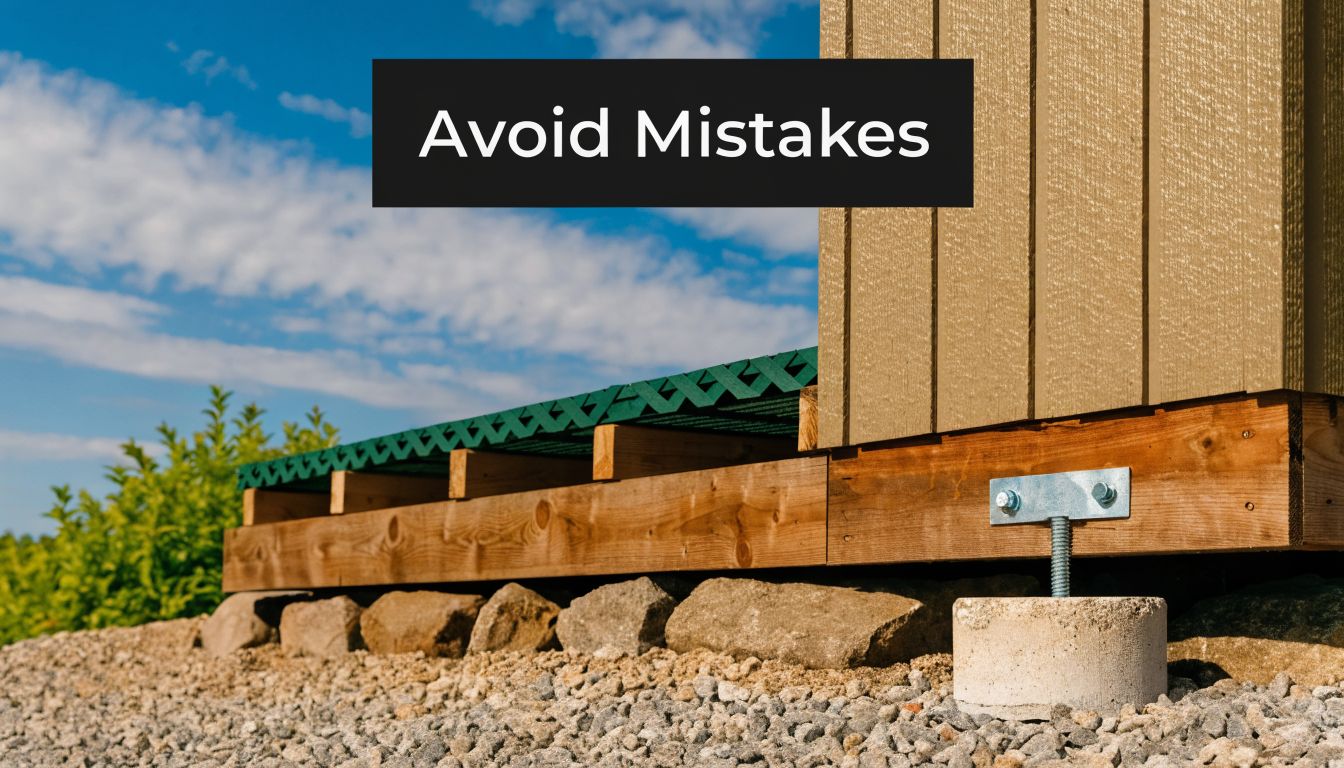
At Firm Foundations, we see the same pattern over and over. The owner bought decent hardware, followed the shed kit instructions, and ended up with movement anyway because the problem was under the shed or at the connection point. Anchoring only works when the base, the soil, and the framing all work together.
Mistakes that cause the most trouble
Anchoring to the wrong part of the shed
Bolting through floor decking, siding, or trim does very little under load. Anchors need to connect to structural members such as the skid, base rail, or framing that can carry force into the foundation.
Going too shallow
This is a common failure in softer or wetter ground. An anchor can feel tight on day one and still lose holding power after heavy rain loosens the soil. In parts of PA, MD, DE, and NJ, depth also matters because frost movement can work against a shallow installation.
Ignoring the base
A poorly built pad causes more trouble than homeowners expect. If the gravel was not excavated deep enough, compacted in lifts, or contained properly, the shed can settle out of level even if the anchors themselves are installed correctly. Once that twist starts, doors stick, corners rack, and attachment points take uneven stress.
Treating all soils the same
Backyard soil changes fast in our region. One side of the shed may be sitting on firm ground while another is over fill, soft clay, or an area that stays wet after storms. The anchor layout that works in a dry, compact yard in one part of Maryland may not hold the same way in a softer Pennsylvania site with seasonal frost and drainage issues.
A shed that keeps needing to be re-leveled usually had a base or anchoring problem from the start.
Why professional installation can save money
The expensive part is usually not the anchor hardware. It is the redo.
If a shed has to be lifted, re-leveled, re-blocked, or moved onto a rebuilt pad, the cost climbs fast. I have seen homeowners spend more correcting a failed DIY setup than they would have spent having the site prepared properly the first time. That is especially true for larger storage sheds, workshops, and garage-style buildings, where extra weight does not make up for poor support.
Storm history matters here too. After major wind events, building standards for anchoring and load transfer received much more attention nationwide. The lesson for homeowners is straightforward. Wind finds weak connections, and our local freeze-thaw cycles and wet spells make those weak points show up sooner.
Call a pro when these conditions apply
- Your site slopes, holds water, or needs excavation before any pad can be built
- The ground is soft, rocky, or inconsistent and you are not sure which anchor type fits the soil
- The shed is large, tall, or heavy enough to behave more like a small garage or workshop
- You want a gravel pad, concrete slab, or piers installed correctly instead of trying to piece together base work and anchoring separately
- The shed will store expensive equipment or sit close to a fence, driveway, home, or neighboring property
- You already see movement such as rocking, door misalignment, corner settling, or gaps under the skids
In those cases, the smart question is not only how to secure shed to ground. It is who can evaluate the soil, build the right support, and anchor the structure so it holds up in local conditions.
For homeowners in Pennsylvania, Maryland, Delaware, and New Jersey, that usually means hiring a contractor who handles grading, base prep, and anchoring as one system. If you are searching for a shed foundations contractor near me, garage foundation contractors near me, or excavation near me, get the site assessed before a small problem turns into a reset.
Your Questions Answered by Our Foundation Experts
Do I need a permit for a shed foundation
Sometimes yes, sometimes no. Permit rules vary by township, borough, and county. In places across PA and MD, the answer often depends on shed size, location on the lot, and whether you’re installing a permanent concrete foundation. Always check local requirements before work starts.
Does anchoring affect homeowners insurance
It can. Insurers usually care whether outbuildings are installed responsibly and whether storm damage was made worse by poor setup. If your shed stores valuable equipment or supports a rural property, anchoring and documentation are worth keeping on file.
Is gravel or concrete usually better
It depends on the structure and how you’ll use it. A shed foundation gravel base is often the practical choice for standard storage sheds because of drainage and flexibility. Concrete is usually the better fit for garage-style buildings, heavier use, or when the floor itself needs to act like a finished slab.
How long does installation take
That depends on site access, grading needs, weather, and the type of base. A simple pad can move quickly. A more involved project with excavation, concrete work, or difficult access takes longer. The important part is that the site prep, leveling, and anchoring are done correctly rather than rushed.
If you need help deciding between a gravel pad and a slab, or you want a quote from a licensed crew serving Pennsylvania, Maryland, Delaware, and New Jersey, contact Firm Foundations. We build shed pads, garage foundations, concrete pads, and excavation-ready bases that are designed to stay level, drain properly, and hold up over time.