
Concrete Slab Foundations: Trusted Local Builders in [City, State]
When you're starting a new construction project in [City, State]—whether it's a garage, a new barn, or a commercial space—the success of your entire investment rests on what’s underneath. A concrete slab foundation isn't just a simple layer of cement. It's a carefully engineered structural base, designed from the ground up for rock-solid stability. It’s the platform that has to support everything from a basic 10×10 storage shed to a multi-car garage, and getting it right is the most important first step.
Building Your Project on a Solid Base
Starting any new project, whether it's a backyard barn shed, a new garage, or even just a gazebo foundation, begins with one crucial decision: the base. You might be tempted by options like shed foundation blocks or a simple gravel pad because they seem cheaper upfront. But for homeowners here in [City], those shortcuts often fall short when it comes to the long-term durability your investment deserves.
That’s where a professionally installed concrete slab from Firm Foundations, your local [City] concrete contractor, comes in. It’s a far superior alternative that’s built to stand the test of time and weather.
Unlike temporary, DIY-style solutions, a concrete slab provides a solid, perfectly level, and permanent surface. This single step eliminates common headaches like shifting, settling, and moisture damage that can ruin lesser foundations. When you're planning any outdoor project, from a sturdy garage to a charming patio, building on a solid base is everything. After all, a well-built slab of concrete for a patio can become the heart of your entire outdoor living space for years to come.
Why Choose a Concrete Foundation?
For homeowners and businesses here in the [City] area, choosing a professionally poured concrete foundation is an investment in peace of mind. The benefits are clear and have a direct impact on how long your structure lasts and how well it performs.
- Unmatched Durability: Concrete foundations are incredibly tough. They resist pests, rot, and fire, ensuring your building is protected from the ground up.
- Speed of Installation: A major advantage. An entire concrete foundation can often be poured in a single operation, which cuts down on labor costs and shortens your project timeline.
- Low Maintenance: Once poured and cured, a concrete slab needs very little maintenance, saving you time and money over the years.
- Cost-Effectiveness: Because the installation is straightforward and requires less extensive framework than other foundation types, concrete slabs are often the most budget-friendly permanent option.
A strong foundation is the cornerstone of any building, ensuring its structural integrity and the safety of everything inside. Choosing the right base isn't just a construction step—it's an investment in your property's future.
As your trusted local concrete contractors in [City], Firm Foundations specializes in creating the perfect base for your project. We live and work here, so we understand the unique soil conditions and frost considerations across [City] and the surrounding communities.
Whether you need heavy-duty garage footings and foundations designed to support multiple vehicles or a simple, stable base for a new gazebo foundation, our team has the local expertise to get it done right. This guide will walk you through the different types of concrete slab foundations, helping you understand the best choice for your specific needs right here in our community.
From Ancient Structures to Modern Garages
When you opt for a concrete foundation for your new garage or shed, you're not just picking a building material. You're tapping into a technology with a track record for strength that goes back thousands of years. The principles behind today’s shed foundations and complex garage footings have been tested and refined for millennia, creating the rock-solid solutions we build today.
Knowing this history helps you appreciate the incredible durability you’re investing in. It frames our work here at Firm Foundations not just as another construction job, but as the continuation of a craft. We apply time-tested principles to protect your investment, right here in [City, State].
A Legacy Cast in Stone
The story of concrete is remarkable, with roots stretching back to ancient ingenuity. Early builders mastered techniques that still influence our work. The first known use of a concrete-like material goes way back to around 6500 B.C. with Nabataean traders in the Middle East. They created a type of hydraulic lime-based concrete that could harden underwater, using it to build floors and secret cisterns.
That knowledge was mostly lost after the Roman Empire fell, but was rediscovered in the 18th century, paving the way for the modern concrete we use now. You can explore the full evolution of concrete foundations to see just how those ancient techniques shaped today's building codes.
Fast forward to the United States in the early 1900s, and poured concrete slabs began to catch on, offering a much faster and more affordable alternative to traditional wood-framed floors.
As early as 1907, the American Concrete Institute (ACI) was publishing standards for concrete floors, stressing a firm subbase and proper material mixing—the same core principles we live by at Firm Foundations to deliver quality work for our [City] neighbors.
Those early standards laid the groundwork for the reliable, high-quality cement foundations for garages and homes we see all over our region.
Shaping American Homes
The real explosion for concrete slab foundations happened after World War II. When veterans returned home, the demand for housing went through the roof, kicking off the suburban boom that shaped the very neighborhoods many of our clients in [City] and nearby areas live in today.
Builders needed a way to put up homes quickly and affordably. The monolithic concrete slab was the perfect answer. Pouring the entire foundation in one go was a game-changer, slashing construction time and costs. By the 1950s, the concrete slab was the go-to standard for residential construction.
Today, that same trusted technology is the backbone of everything we build, from a simple base for a storage shed to a reinforced gazebo foundation. As your local foundation contractors, we bring that legacy of strength to every project. We know the specific soil conditions and weather patterns of [City], making sure that every job—whether it’s excavation near me for a new home or pouring a durable driveway—is built on a solid, reliable, and historically proven base.
Choosing The Right Foundation For Your Project
Not all concrete foundations are built the same. The foundation you need for a simple 4×8 shed is a world apart from the heavy-duty garage footings required to support multiple vehicles and a workshop. Picking the right one from the start is the single most important step you can take to protect your investment and ensure your new structure stands strong for decades.
As the go-to shed foundations contractors near me for folks in [City, State], we believe in empowering our customers. We want you to understand your options so you can make a confident choice. Let's break down the most common types of concrete slabs we install and figure out which one makes the most sense for your project.
This decision tree is a great way to visualize how the demands of your project push you toward a professional-grade solution.
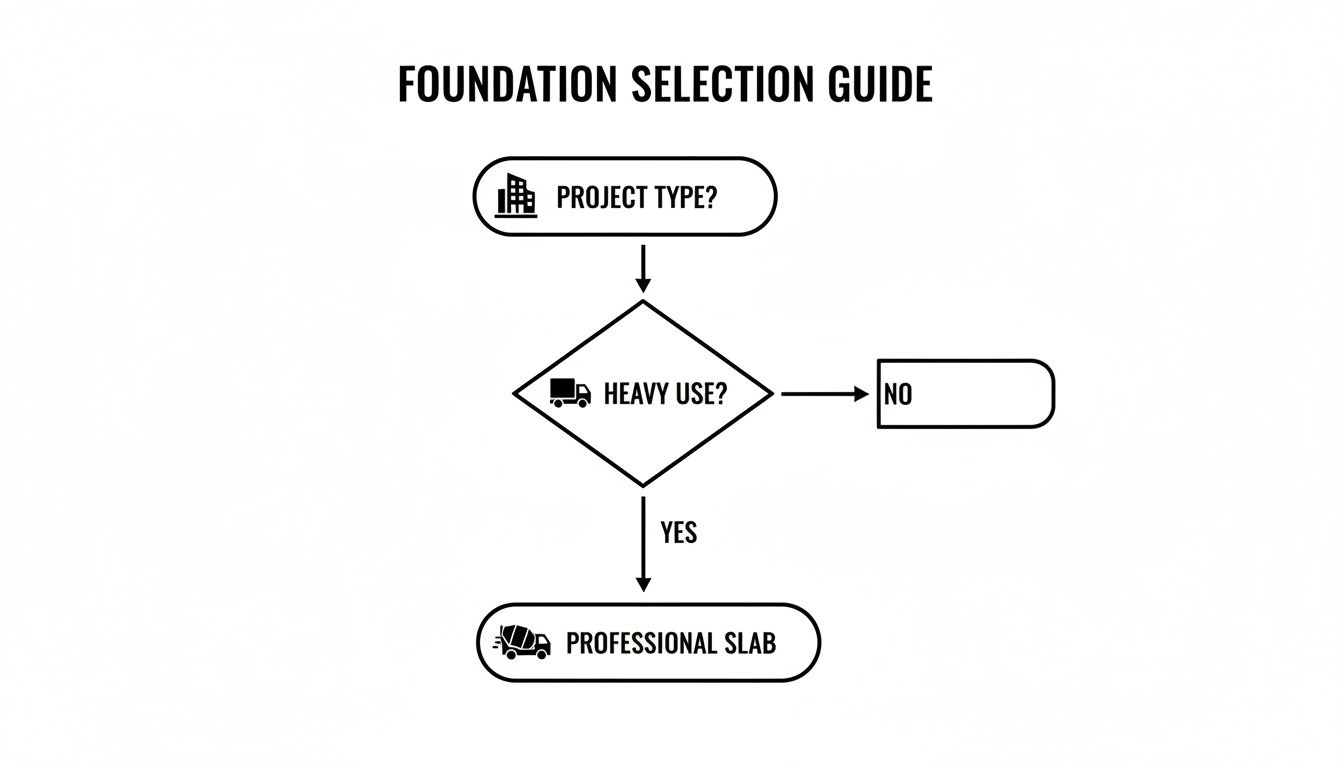
As you can see, the more you plan to put your structure through, the more crucial it becomes to have a professionally engineered concrete slab holding it all up.
To help you understand the options, we put together this quick comparison table. It lines up the most common slab types we work with here in the [City] area so you can see which one might be the best fit.
Comparing Concrete Slab Foundation Types
| Foundation Type | Best For | Key Feature | Local Consideration for [City, State] |
|---|---|---|---|
| Monolithic Slab | Garages, workshops, large sheds, home additions on level ground. | Footing and floor are poured as one single, solid piece. | Excellent value and performance on the stable soils common across our area. |
| Thickened-Edge Slab | Structures with heavy wall loads, like pole barns or larger garages. | Perimeter is poured deeper and wider to create an integrated footing. | A smart upgrade for projects in our region that need extra load-bearing support. |
| Floating Slab | Detached garages, sheds, workshops, and cabins. | Designed to "float" on a gravel base, moving with ground shifts. | Ideal for handling the freeze-thaw cycles we see every winter right here in [City]. |
Each of these has its place, and the right choice really boils down to your specific project, budget, and local ground conditions. Now, let's dig into what makes each one tick.
Monolithic Slab Foundations
A monolithic slab is one of the most popular and budget-friendly concrete foundations we pour, and for good reason. The name itself gives you a clue—"monolithic" means it's formed from a single, massive piece. The entire foundation, from the outer footings to the interior floor, is poured all at once in one continuous flow.
This process creates a solid, seamless base with no joints or weak spots. Since the installation is more straightforward than other methods, it cuts down on both labor and material costs, making it a go-to choice for homeowners in [City] looking to get the most bang for their buck.
- Best For: Garages, workshops, large sheds, and home additions on level ground.
- Key Feature: The footing and floor are poured together, creating a strong, unified structure without seams or cold joints.
- Local Consideration: In areas with stable soil around [City], monolithic slabs provide excellent performance and value.
Thickened-Edge Slabs
Think of a thickened-edge slab as a smarter, stronger version of the monolithic slab. It’s designed to put extra strength right where you need it most: around the perimeter. While the main floor area of the slab is a standard thickness (usually four inches), the edges are poured much deeper and wider. This essentially creates a built-in footing that runs along the outside of the foundation.
This clever design focuses the concrete's strength directly under the structure's load-bearing walls without needing a separate, deep trench for footings. It's an efficient way to boost structural integrity, especially for buildings that will be carrying serious weight. To see how we customize these designs, you can learn more about our concrete foundations and our approach.
Choosing the right slab type isn't just about meeting code; it's about matching the engineering to the intended use. A thickened-edge design is a smart upgrade that provides long-term stability for heavier structures without a major increase in cost.
Floating Slab Foundations
A floating slab foundation does exactly what its name suggests—it "floats" on the ground rather than being anchored deep into it. Instead of deep footings, this slab sits on a meticulously prepared gravel base, which allows it to move just a little bit with the ground as it freezes and thaws. In a climate like ours here in [City], that's a game-changer.
To handle that movement without cracking, the slab is heavily reinforced with steel rebar or wire mesh. This gives it the tensile strength it needs to stay in one piece as the soil underneath shifts with the seasons. Floating slabs are a fantastic choice for any detached structure, like a garage or shed, that doesn't need the deep frost footings required for a house. This same reliable design is also why concrete slabs are a premier choice for building durable concrete patios and decks, giving you a solid, long-lasting base for your outdoor living space.
- Best For: Detached garages, sheds, workshops, and cabins.
- Key Feature: Designed to move with seasonal ground shifts, minimizing the risk of structural cracks.
- Local Consideration: An excellent solution for the freeze-thaw cycles common in [City], protecting the structure from frost heave damage.
The Firm Foundations Installation Process
We believe in total transparency. When you hire us for a project on your [City] property, you deserve to know exactly what’s happening, from start to finish. We’ve spent years perfecting our installation process to be as efficient and predictable as possible, all while delivering a foundation built to last a lifetime.
From the first shovel hitting the dirt to the final sweep-up, our crew handles every single detail with precision. This isn't just about pouring concrete for us. It’s about building a rock-solid base for your valuable investment. We manage the whole project so you don't have to worry about a thing.
Step 1: Site Preparation and Excavation
It all begins with getting the ground ready. Long before the concrete truck shows up, our team gets to work clearing and leveling the site. We strip away the topsoil, grass, and any loose dirt to get down to solid, undisturbed earth. This step is absolutely critical—it’s what ensures your foundation won’t settle or shift down the road.
Our crew uses precise measurements to mark out the exact footprint and elevation for the new slab. We also pay close attention to the grade, making sure water will naturally drain away from your foundation, not pool up against it. Getting this right is one of the biggest factors in preventing moisture problems later on.
Step 2: Building the Sub-Base
Once the site is excavated, we bring in a thick layer of crushed stone or gravel. This shed foundation gravel base is the unsung hero of a truly durable concrete slab. It might not be visible in the final product, but it does some heavy lifting to protect your investment, especially with the harsh freeze-thaw cycles we get here in [City].
A properly compacted gravel base is a game-changer because it:
- Drains Water Effectively: It gives water a clear path to flow away from the bottom of the concrete, stopping moisture from sitting there.
- Fights Frost Heave: By draining water, it dramatically reduces the chance of ice forming underneath and pushing your slab up from below.
- Creates a Stable Platform: It gives us a solid, perfectly level surface to pour on, which guarantees the concrete is a uniform thickness and strength.
Step 3: Forming and Reinforcement
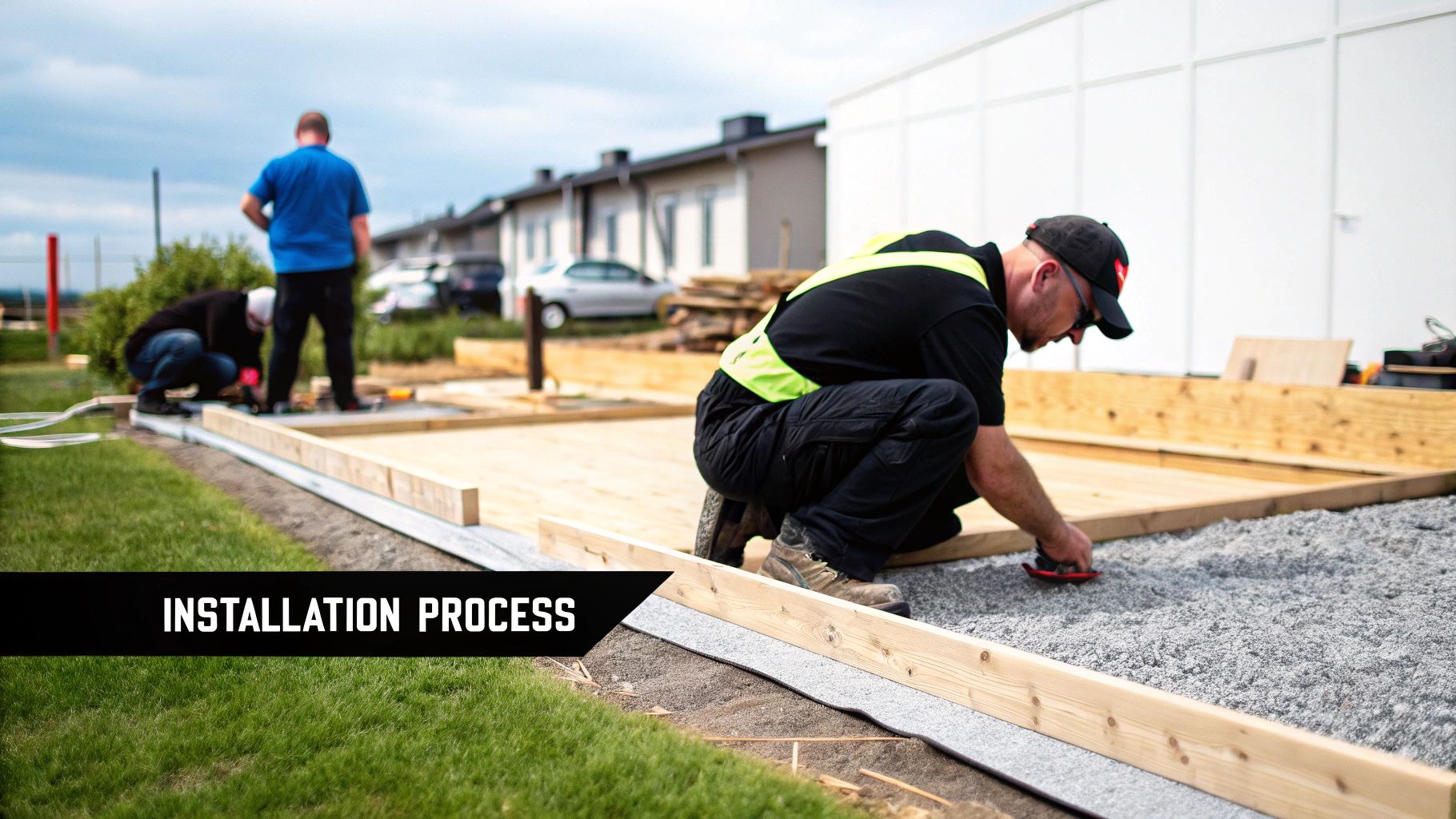
Next up, we build the concrete forms. Think of these temporary wooden frames as a mold that holds the wet concrete and gives the foundation its final shape and size. Our team makes sure the forms are perfectly square, level, and braced to withstand the incredible pressure of thousands of pounds of concrete.
Inside these forms, we lay down a grid of steel reinforcement, usually rebar or a wire mesh. This steel is what gives the concrete its tensile strength, helping it resist cracks caused by temperature swings and heavy loads. It’s a technique that has been proven since the 1850s and is the reason modern concrete is so reliable for everything from driveways to garages.
The combination of meticulous site prep and proper reinforcement is what separates a professional-grade foundation from a DIY job. Getting these early steps right is the key to a slab that performs flawlessly for decades.
Step 4: The Pour and Finish
With all the prep work done, it’s time for the main event: the pour. We use a high-strength concrete mix specifically formulated for foundations, ensuring it meets or exceeds the 4,000 PSI strength needed for long-term durability. Our experienced crew works quickly to place the concrete, making sure it fills every last inch of the forms.
As the concrete starts to set, our finishing experts take over. They use special tools to screed the surface level, float it, and trowel it to create a smooth, dense finish. This isn't just for looks—a professional finish makes the surface much more resistant to wear and tear. After a few days of curing, your new foundation is ready for construction to begin.
Trying to decide between tackling this yourself and calling in a pro can be a tough call. That's why we put together a guide exploring the pros and cons of DIY vs. professional foundation installation.
Understanding Concrete Foundation Costs in [City, State]
Let's get right to it. One of the first questions we always get from homeowners across [City] and the surrounding areas is simple: “How much is this foundation going to cost?”
It's a fair question, and a critical one for planning any project, whether you're putting in a small shed pad or a heavy-duty foundation for a two-car garage. Here at Firm Foundations, we believe in being upfront about pricing. That starts with helping you understand exactly what goes into your quote.
The final price tag for a concrete slab isn’t a random number. It’s a sum of its parts, carefully calculated based on the specifics of your project and your property. Once you understand the breakdown, you can see where every dollar goes and appreciate what it takes to do the job right.
Key Factors That Influence Your Quote
Several big-ticket items will shape the final price of your foundation. Our team looks at every single one of these when we come out for your free on-site estimate to give you a quote you can count on.
- Size and Thickness: This is the most straightforward factor. A bigger foundation for a multi-car garage will naturally use more concrete and take more time than a simple base for a storage shed. Likewise, a standard 4-inch slab will be less expensive than a beefier 5- or 6-inch slab designed to handle heavy trucks or workshop equipment.
- Reinforcement Needs: For a garage or pole barn that needs to support serious weight, we’ll almost always add steel rebar or a wire mesh grid. While this adds to the material cost, it's non-negotiable for preventing cracks and ensuring the foundation holds up for decades.
- Site Accessibility: How easy is it for us to get our trucks and machinery to the spot? If we can pull right up, labor costs are lower. If we’re navigating a tight backyard or a tricky slope, it takes more time and manual effort to get materials where they need to go.
Your quote is a direct reflection of the work and materials required to build a foundation that lasts. By considering factors like excavation depth and reinforcement, we ensure your investment is tailored to your project's specific needs, not a one-size-fits-all price.
Regional and Site-Specific Considerations
Beyond the basics of the slab itself, the conditions on your [City] property play a huge role. As your local garage foundation contractors near me, we’ve seen it all in this region and know how to handle the unique challenges our local environment throws at us.
Excavation and Site Prep
The amount of digging and dirt-moving required is a major variable. A perfectly flat, clear spot needs very little prep work. But if your property is sloped or uneven, we have to bring in machinery to grade the land and haul away excess soil to create a perfectly level base. That extra time and labor will be factored into the cost.
Soil Conditions and Drainage
The dirt in your backyard really matters. The heavy clay soils common around [City] can be tricky, often requiring a thicker, more robust gravel shed foundation base to let water drain away properly and stop the ground from shifting. Tackling drainage issues from the start is a smart investment that protects your foundation down the road.
Frost Depth Requirements
Here in [City, State], we have to pay close attention to the frost line—that’s how deep the ground freezes solid in the winter. For certain structures, the footings must sit below this line to prevent "frost heave," a powerful force that can literally lift and crack a foundation. This dictates how deep we have to dig, which can impact the cost of your garage footings and foundations. Don’t worry, our crew knows the local building codes inside and out to make sure your project is 100% compliant.
Ready to Get a Quote for Your Foundation?
Taking that first step on a new project is always exciting, and our goal is to make the foundation part as simple and clear as possible. When you’re ready to build, you need shed foundations near me that you can depend on—a team that will show up, do the job right, and keep you in the loop without any frustrating surprises.
For homeowners and businesses across [City, State] and nearby areas, Firm Foundations has become that trusted partner.
We've earned our reputation by focusing on quality work, open communication, and reliability. Our team is fully licensed and insured, which gives you complete peace of mind from the moment we set foot on your property. We understand that whether it’s a simple shed foundation or a more involved garage footing and slab, you're making a real investment. We respect that by delivering a finished product built to last.
Your Local Foundation Experts
Being a local [City] company means we're committed to the communities we serve. We’re not some faceless national chain; we’re your neighbors. We know the soil conditions here, we’re up-to-date on all the regional building codes, and we understand what it takes to pour a foundation that can handle the freeze-thaw cycles of our local weather.
There’s a reason the top shed builders in the area trust us to prepare the base for their structures—our local experience makes a difference. Let our team answer your questions, walk you through the options, and provide a clear, no-obligation quote that’s built around your project's specific needs.
Choosing the right contractor is just as important as choosing the right type of foundation. We combine proven, hands-on expertise with a genuine commitment to making our customers happy.
Let's Start Building
Getting the ball rolling is easy. Our team will guide you through a smooth, hassle-free process, from the first time we visit your site to the day you have a finished slab ready for construction.
Contact Firm Foundations today for your free, no-obligation estimate! We’re ready to talk about your project and find a time that works for you. Let's lay the groundwork for your success, together.
Got Questions About Concrete Slabs? We’ve Got Answers.
When you’re gearing up for a big project, questions are a good thing. It means you’re thinking through the details. Here at Firm Foundations, we’ve heard just about every question there is from homeowners across [City], and we believe the best customer is an informed one.
We’ve pulled together some of the most common questions we get. Our goal is simple: give you clear, straight-up answers so you can move forward with total confidence.
Do I Need a Permit for My Foundation?
This is a great question, and the short answer is: it depends. Permit rules can change from one town to the next.
For something small like a base for a storage shed, you might not need a permit in some places. But once you get into larger structures like a barn shed or pretty much any garage, a permit will almost certainly be required. It’s all about making sure the new building meets local safety and zoning codes. As your local garage foundation contractors, we know the ins and outs of the regulations in [City] and surrounding towns. We’ll help you understand exactly what's needed so your project is compliant from day one.
How Thick Should a Garage Slab Be?
Getting the thickness right is absolutely critical. You want a concrete foundation for a garage that can easily handle the weight you're putting on it. For a standard residential garage meant for cars and light trucks, a 4-inch thick concrete slab is the industry standard and does the job perfectly.
But what if you're planning to store a boat, an RV, or heavy equipment? That's when we need to beef things up. In those cases, we strongly recommend going with a 5 or 6-inch slab. We also work steel rebar into the design for serious extra strength and to fight off cracks. When we come out for your free quote, we'll assess your exact needs and recommend the perfect specs for your build.
How Long Does Installation Take?
The timeline really comes down to three things: the size of the job, the weather, and how much prep work the site needs. We always give you a realistic schedule before we start, so there are no surprises.
- A standard shed foundation can often be excavated and poured in just 1-2 days.
- A more involved garage footing and foundation might take 2-4 days for all the prep and the pour itself.
Of course, the concrete needs time to cure properly. You can typically walk on it after 24-48 hours, and it's ready to bear the weight of a structure after about 7 days.
Ready to build on a solid base? The team at Firm Foundations is here to provide a durable, professionally installed foundation tailored to your exact needs in [City, State]. Request your free, no-obligation quote today!