
Concrete Foundation for Garage
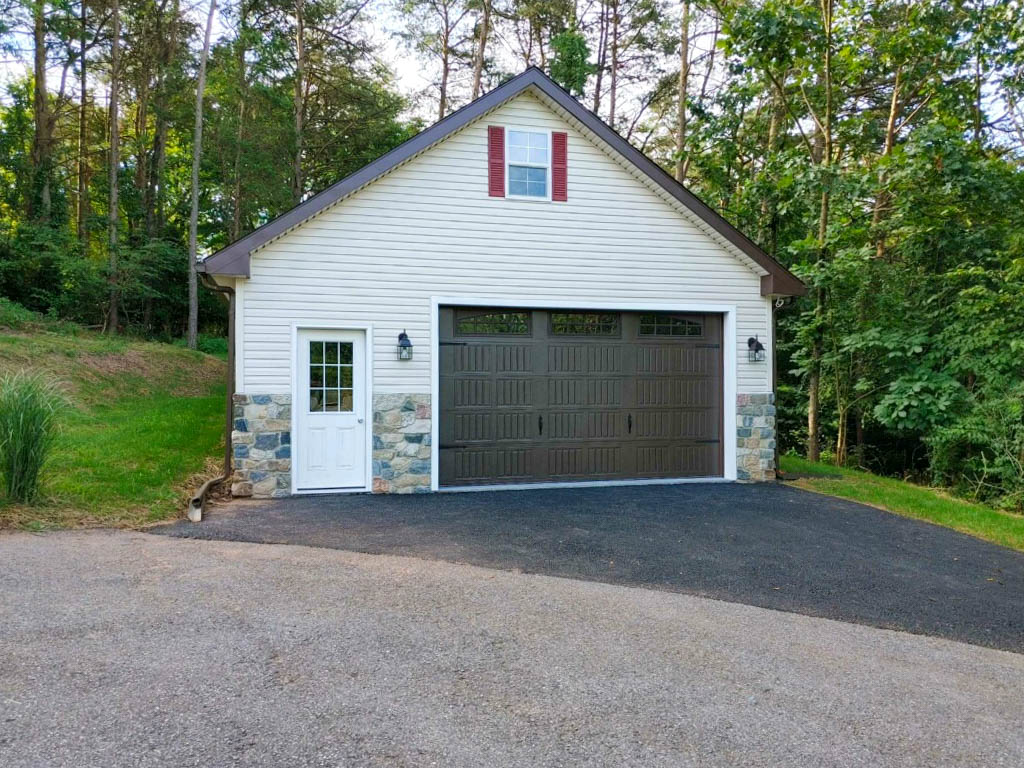
Garage Goals: Choosing the Right Concrete Foundation for Garage
Building a garage involves many decisions, but none are as crucial as the foundation. It’s the unsung hero that supports your vehicles, endures seasonal changes, and protects your belongings. A poor foundation can lead to cracked walls, sticking doors, and water damage, turning your dream garage into a nightmare.
At Firm Foundations, we’ve spent years perfecting concrete work for homes and businesses. We know that choosing the right foundation can add decades to your garage’s lifespan. This guide will cover the different types of concrete foundation for garage, key environmental factors to consider, and the professional process needed to ensure a flawless result from the start.
Why Your Foundation Choice Matters
The foundation is more than just a floor; it is the structural anchor of the entire building. In a garage setting, the demands on the foundation are unique compared to the rest of a home.
First, consider the load-bearing requirements. A standard car weighs around 3,000 to 4,000 pounds, while trucks and SUVs can weigh significantly more. If you plan to use your garage for heavy machinery, lifts, or storage of dense materials, that load increases exponentially. The concrete must have the correct compressive strength and reinforcement to handle this weight without cracking or shifting.
Second, garages are often unheated or only semi-conditioned spaces. This exposes the slab to temperature fluctuations that interior floors never face. The concrete needs to handle thermal expansion and contraction without compromising its integrity. If you live in an area with freezing winters, the foundation must also resist “frost heave”—the upward swelling of soil during freezing conditions.
Finally, moisture control is critical. Concrete is porous by nature. Without the right vapor barriers and finishing techniques, ground moisture can seep up through the slab, rusting your tools and damaging your stored items. A well-designed foundation mitigates these risks from day one.
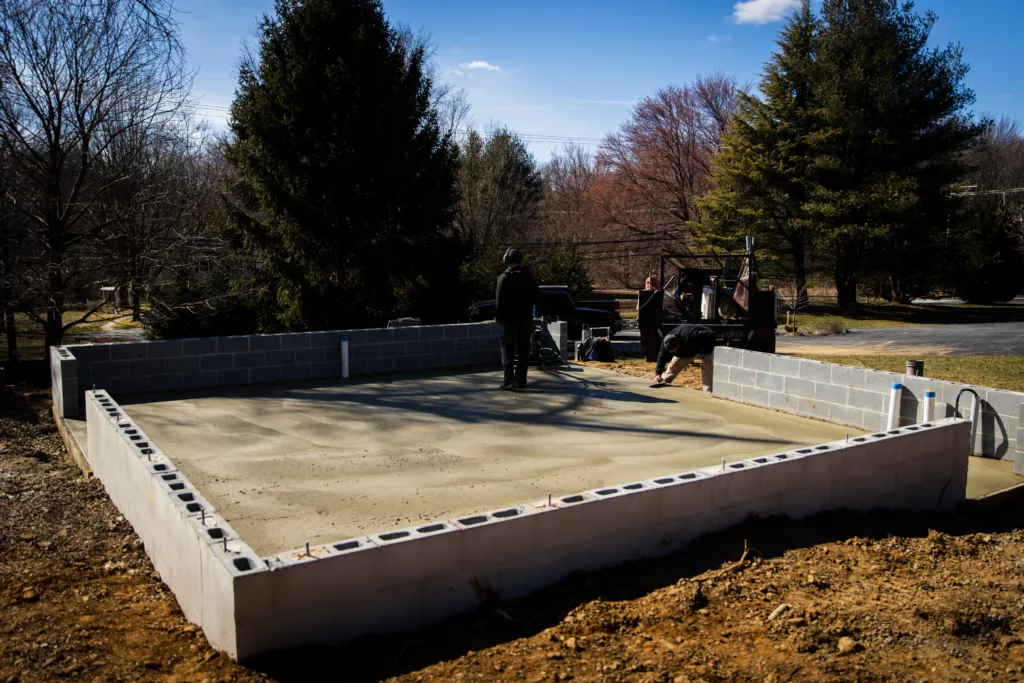
Exploring Concrete Foundation Types
Not all slabs are created equal. The right choice often depends on your geography and the specific codes in your municipality. Here are the three most common foundation types used for garages.
Slab-on-Grade Foundations
Slab-on-grade foundations are a cost-effective choice for garages in warmer climates where the ground doesn’t freeze. This foundation is a single layer of concrete poured onto a gravel bed, with thicker edges for added strength. While efficient to pour, it requires thorough site preparation. The soil must be perfectly compacted and leveled to prevent the slab from cracking if the ground shifts.
T-Shaped Foundations
For regions with harsh winters and deep frost lines, the T-shaped foundation is the industry standard for stability. This method involves three distinct steps:
- ** The Footing:** A wide concrete base is poured below the frost line. This wide base (the bottom of the “T”) anchors the structure and prevents the frozen ground from pushing the building up.
- ** The Wall:** A narrow wall is constructed on top of the footing, extending up to ground level.
- ** The Slab:** The garage floor is poured between the walls.
While this method is more labor-intensive and requires more material than a slab-on-grade, it offers superior protection against structural movement caused by freezing ground. If you are building a heavy-duty workshop or an attached garage in a northern climate, this is often the safest bet.
Frost-Protected Shallow Foundations (FPSF)
The Frost-Protected Shallow Foundation (FPSF) is a cost-effective alternative to traditional deep T-shaped foundations. By using rigid foam insulation around the concrete foundation, it traps heat from the building or the earth to prevent the soil below from freezing, effectively raising the frost line. This method reduces excavation and concrete use, offering a more efficient and affordable solution, particularly for heated garages or areas with moderate frost depths.
Critical Factors Influencing Your Decision
You cannot choose a foundation in a vacuum. The specific conditions of your property dictate which of the above methods will work best. At Firm Foundations, we assess three main variables before recommending a solution.
Soil Composition
The composition of your soil is crucial. Sandy soil drains well and provides a stable base for concrete. In contrast, clay soil expands and contracts with moisture changes, which can damage a concrete slab.
A soil test is essential before construction. Unsuitable soil may need to be replaced with compacted fill or gravel to create a stable base. Overlooking soil composition is a primary cause of foundation failure.
Local Climate and Frost Line
Water expands when it freezes, and frozen soil beneath your garage foundation can exert enough force to lift the structure. To prevent this, foundations must either extend below the frost line (T-shaped) or block the cold from reaching the soil (FPSF). In mild climates with minimal freezing, a slab-on-grade foundation works fine. Knowing your local frost line is essential for both compliance and durability.
Intended Use of the Space
How you plan to use the garage influences the technical specifications of the pour.
- Standard Parking: A typical 4-inch thick slab with standard mesh reinforcement is usually adequate.
- Heavy Equipment/RV: If you plan to park a heavy recreational vehicle or install a two-post car lift, you may need a 6-inch slab with rebar reinforcement at specific stress points.
- Workshop: If the garage will be a workshop, consider insulation under the slab to keep the floor warmer for standing. You might also want a smoother finish for easy sweeping of sawdust or oil spills.
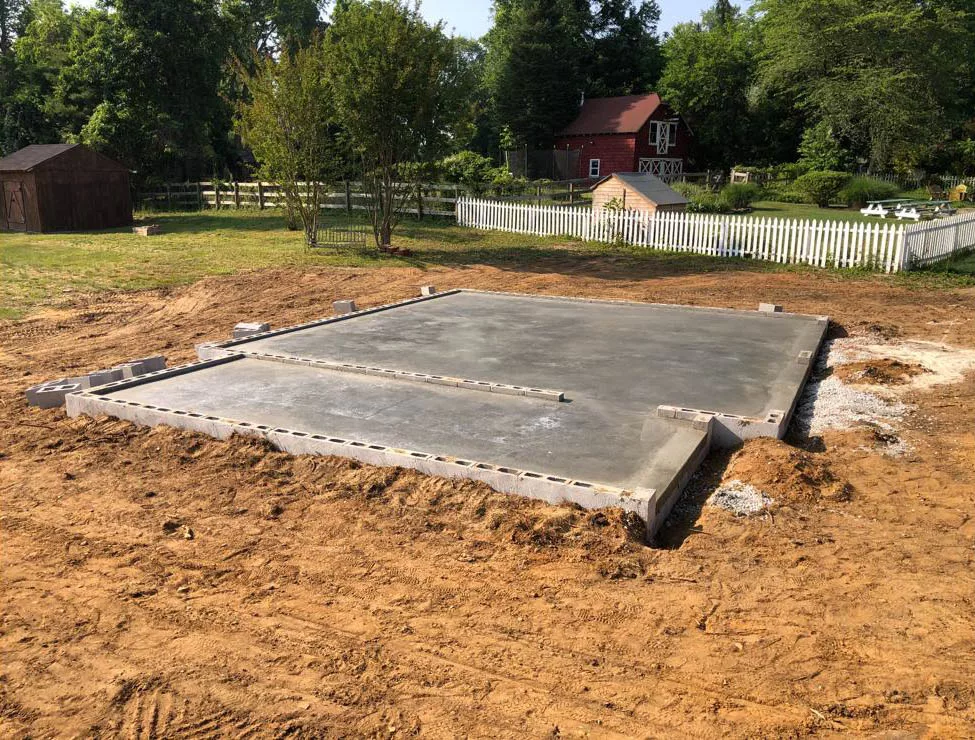
The Professional Pour: A Step-by-Step Process
Pouring a foundation is a science that requires precise timing and execution. While DIY videos make it look like a simple weekend project, the reality involves complex logistics. Here is what the process looks like when handled by the professionals at Firm Foundations.
Site Preparation and Excavation
The site is cleared of all vegetation, rocks, and debris. We excavate to the required depth based on the foundation type. This is also when we grade the land to ensure water drains away from the future garage, preventing pooling around the edges.
Sub-Base Installation
You never pour concrete directly onto dirt. We install a sub-base of gravel or crushed stone. This layer is crucial for drainage and providing a level, stable surface. We then compact this layer thoroughly. If the sub-base is loose, the concrete will settle and crack.
Forming
Wood or metal forms are set up to define the shape of the foundation. These must be perfectly square and level. If the forms are off by even an inch, your garage walls won’t line up, and your roof framing will be a headache.
Reinforcement
Concrete has high compression strength (it holds weight well) but low tensile strength (it cracks when pulled apart). To fix this, we install rebar (steel bars) or wire mesh within the formwork. This steel skeleton holds the concrete together and adds structural integrity.
The Pour and Finishing
The concrete arrives and must be poured continuously to avoid “cold joints” (seams where wet concrete meets dry concrete). Once poured, we use screeds to level the surface and floats to smooth it out.
As the concrete begins to set, we cut control joints. These are intentional grooves cut into the slab. Concrete inevitably shrinks as it cures; control joints encourage the concrete to crack in a straight line inside the groove, rather than forming unsightly spiderweb cracks across the floor.
Curing
The job isn’t done when the truck leaves. Concrete needs to cure slowly to reach maximum strength. If it dries too fast, it becomes weak and brittle. We often apply curing compounds or keep the slab wet for several days to control the moisture evaporation rate.
The Cost of Quality vs. The Cost of Repair
Budget is always a concern in construction projects. It can be tempting to look for the lowest bidder for foundation work, perhaps someone who skimps on rebar or pours a thinner slab.
However, fixing a bad foundation is exponentially more expensive than pouring a good one. If a foundation settles unevenly, you aren’t just paying to patch a crack in the floor. You may be paying to jack up the garage structure, underpin the footing, or in worst-case scenarios, demolish and rebuild.
Investing in Firm Foundations means investing in high-grade materials and expert labor. We use the correct concrete mix ratios for your specific climate. We don’t cut corners on sub-base preparation. We ensure the reinforcement is positioned correctly within the slab—not sitting uselessly at the bottom. This upfront investment pays dividends in a garage that stands straight and a floor that remains crack-free for decades.
Maintaining Your Concrete Investment
Once your foundation is cured and your garage is built, a little maintenance goes a long way in preserving the concrete.
Seal Your Surface: Concrete acts like a hard sponge. Oil, gasoline, and road salts can penetrate the surface, causing stains and deterioration. applying a high-quality penetrating sealer every few years creates a barrier against these contaminants.
Manage Water: Ensure your gutters and downspouts are directing water away from the foundation. Pooling water can soften the soil supporting the slab or freeze and cause heaving.
Fill Cracks Early: If minor hairline cracks appear (which can happen even with the best pours due to natural settling), seal them with a flexible concrete filler. This prevents water from getting into the crack, freezing, and widening it.
Avoid De-icing Chemicals: In the winter, try to avoid using harsh de-icing chemicals on a new garage floor. These chemicals attack the cement paste and can cause the surface to flake or “spall.” Use sand for traction instead.
Build on Solid Ground
Your garage is a valuable extension of your home. It protects your vehicles, houses your hobbies, and adds to your property value. Don’t let a sub-par foundation undermine that value.
Choosing the right foundation requires balancing soil conditions, climate, load requirements, and budget. It is a complex equation, but you don’t have to solve it alone.
At Firm Foundations, we take pride in the precision of our work. We treat every garage slab as if we were pouring it for our own homes. We are here to guide you through the options, handle the heavy lifting, and leave you with a base that is built to last.
If you are planning a garage build, start from the ground up. Contact Firm Foundations today to discuss your project, and let’s ensure your new space stands the test of time.
Firm Foundations LLC
https://maps.app.goo.gl/Uf6XdgtpBTETgNrr7
1535 White School Rd, Honey Brook, PA 19344, United States
(717) 716-7267
https://shedpads.com/