
Concrete Driveway Drainage Solutions That Last
Rain lets up, you step outside, and there it is again. A wide puddle sitting in the same spot on the driveway. Maybe the water is creeping toward the garage door. Maybe it's hugging the edge of the slab near the house. In Pennsylvania, Maryland, Delaware, and New Jersey, that kind of problem doesn't stay cosmetic for long, especially on lots with tighter soils and long wet stretches.
Homeowners usually call about the puddle they can see. The bigger concern is the damage they can't. Water that lingers near a slab edge or runs back toward the house can contribute to seepage, frost-related movement, surface wear, and slick patches when temperatures drop. If you're already searching for driveway contractors near me, concrete contractors, or even garage foundation contractors near me, you're probably trying to solve a site problem, not just replace concrete.
That same drainage thinking matters across other projects too. People looking for shed foundations near me, gravel shed foundation contractors near me, a base for storage shed, a gazebo foundation, or concrete foundations for a garage all run into the same question. Where does the water go after it leaves the surface?
Why Your Concrete Driveway Holds Water and What It Risks
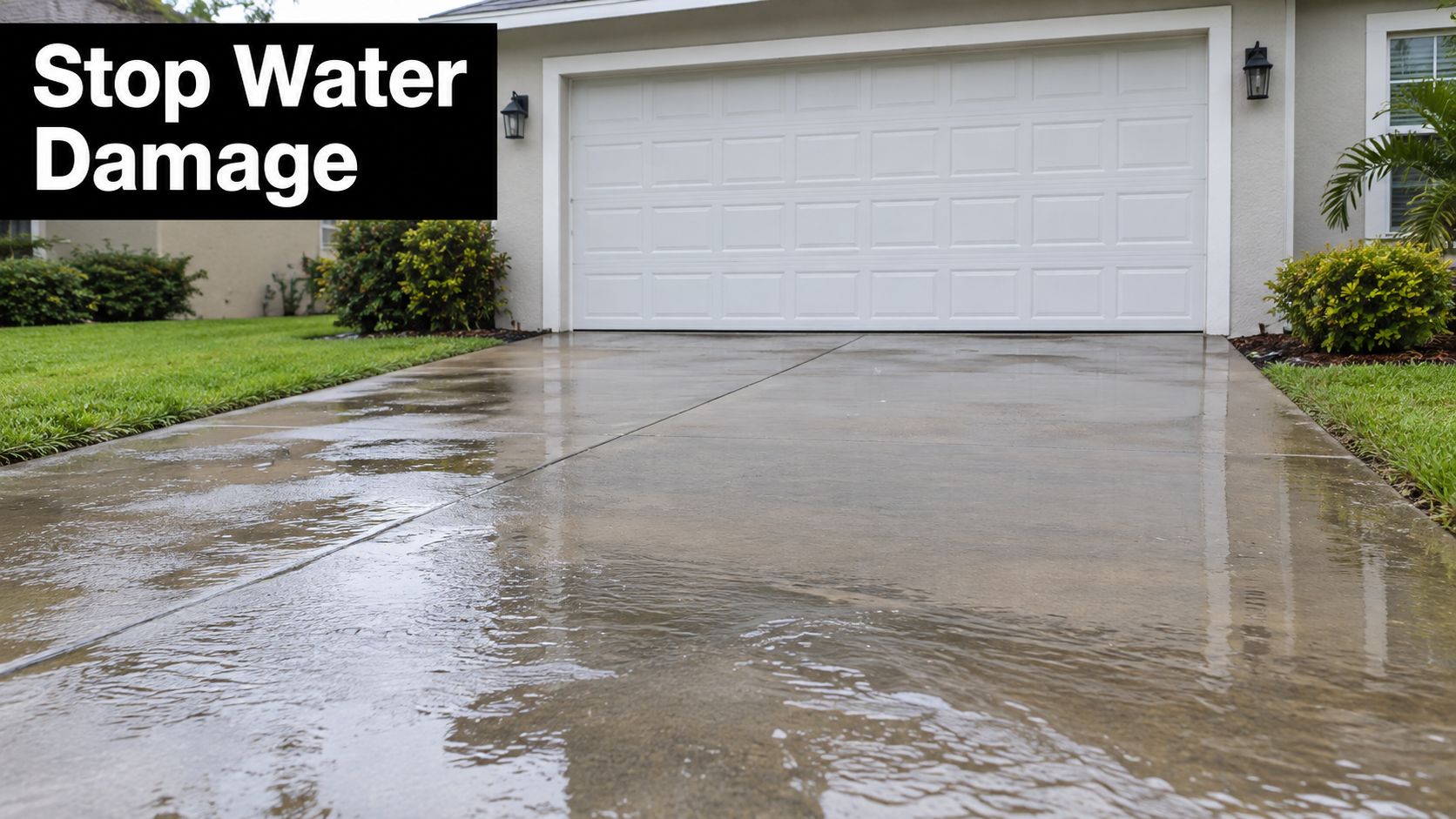
One of the most common situations looks like this. The driveway seems mostly fine in dry weather, but after a steady rain, water gathers in front of the garage or tracks back toward the home instead of draining away. On another property, the middle of the slab dries, but the edge near the foundation stays wet for hours. By winter, that same spot turns into an icy strip.
The puddle is only the first symptom
Standing water matters because it usually points to a drainage path that isn't working. Sometimes the slab is too flat. Sometimes the grade runs the wrong direction. In other cases, the driveway sheds water correctly, but the yard beside it can't absorb or carry that runoff, so the water loops back and settles where you notice it most.
Near the home, that's where trouble starts to stack up:
- Foundation edge exposure: Water collecting near the slab edge can move toward the house instead of away from it.
- Frost problems: In colder weather, trapped moisture can contribute to frost-related movement around the driveway and nearby surfaces.
- Surface deterioration: Repeated wetting at low spots and edges can wear on the concrete over time.
- Safety concerns: Wet concrete near a garage entrance often turns into a slip hazard once temperatures fall.
Water rarely damages a driveway all at once. It keeps using the same weak path until the slab, base, or nearby grade gives it room to do more.
What homeowners usually miss
Most online advice stops at “add slope.” That's part of the answer, but not the full answer. If water leaves the slab and lands in compacted soil, a low strip beside the driveway, or a saturated area near the foundation, the problem isn't solved. It's just moved a few feet.
For homeowners who want a broader property-level view, this guide on Dallas flood prevention for property owners is a helpful reminder that runoff control works best when you look beyond the surface you're standing on.
If you're planning a replacement driveway, cement foundations for garage, garage footings and foundations, or site prep for a barn shed or 10×10 storage shed, drainage should be part of the layout from the start. That's usually where a long-lasting fix begins.
How Concrete Driveway Drainage Really Works
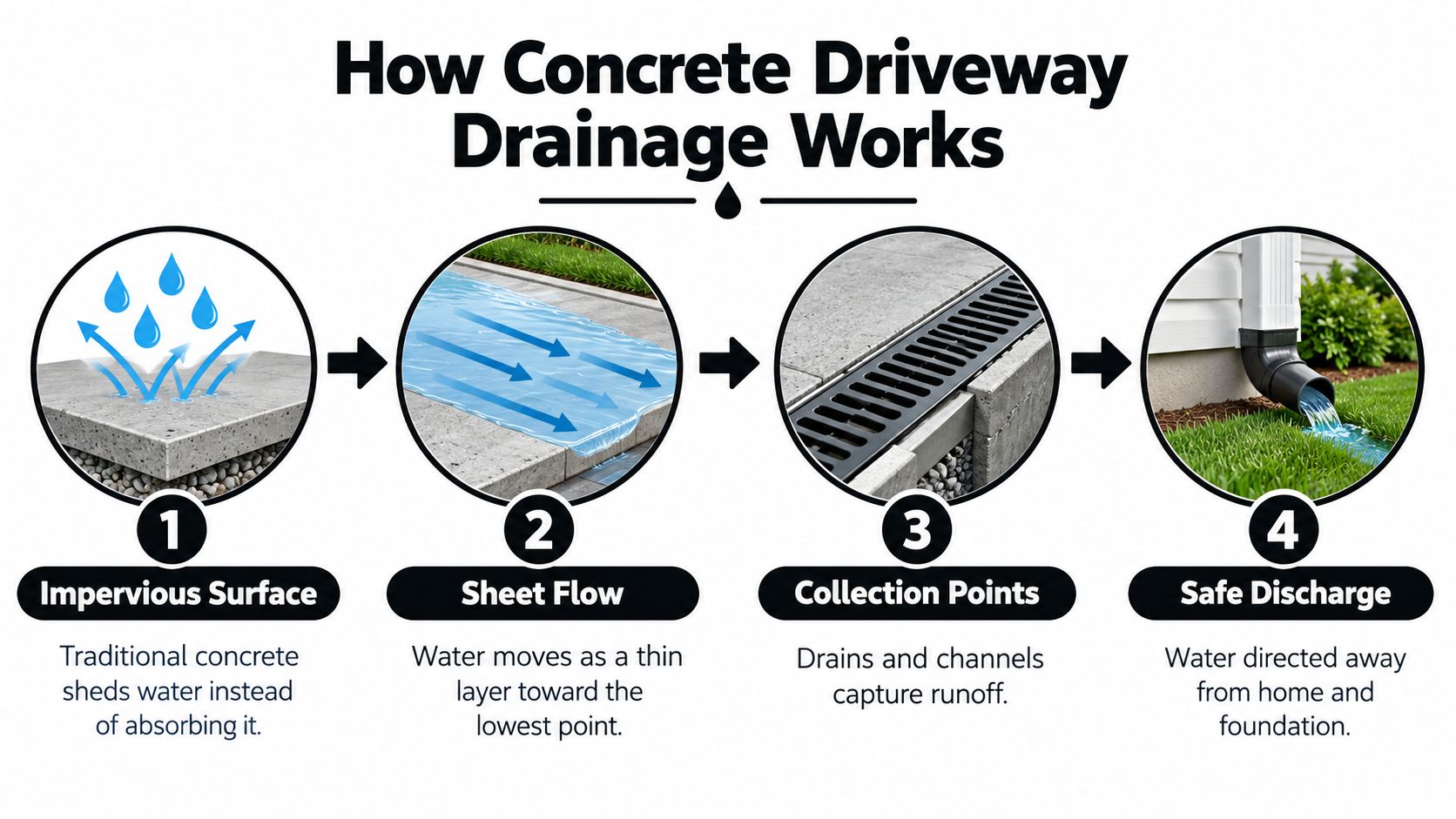
Traditional concrete behaves like a roof. Rain hits it, but instead of soaking in, the surface sheds that water and sends it toward the lowest point. The U.S. EPA distinguishes traditional concrete from permeable surfaces because standard concrete is impermeable, meaning it does not absorb rainfall into the soil or groundwater. The EPA also identifies pervious concrete, porous asphalt, and interlocking or grid pavers as suitable permeable-surface options for parking lots, driveways, and sidewalks, and notes that pervious concrete can pass water at 3 to 5 gallons per minute per square foot, or about 270 to 450 inches per hour in appropriate applications (EPA permeable pavements guidance).
Surface flow is only stage one
When rain lands on a conventional driveway, it usually moves as a thin sheet across the slab. That part is straightforward. The confusion starts after the water reaches the edge.
At that point, a few different things can happen:
- It can flow into a drain and get carried away.
- It can spread onto nearby grade and soak in, if the soil allows it.
- It can hit tight, compacted, or clay-heavy ground and stall.
- It can run back toward a low area, often near the garage, sidewalk, or foundation.
That third and fourth outcome are common on wet-region homes. The slab itself may look like the problem, but the actual weak point is often the receiving area beside or below it.
Core idea: Concrete driveway drainage is a system. The slab sheds water, the grade moves it, the soil or drain system accepts it, and the property needs a safe discharge path.
Why runoff path matters on local sites
A lot of homeowners in this region have some version of dense or slow-draining soil. On those sites, good-looking concrete can still perform poorly if runoff has nowhere useful to go. Guidance on permeable driveway design also emphasizes that success depends on infiltration testing, subsoil capacity, and a stone reservoir beneath the surface, not just visible slope. The same guidance notes that permeable systems work best on sites with low slopes and good infiltration, while compacted or poorly draining soils can undermine performance even when the top looks properly graded (Toronto permeable pavement guidance).
That's why a driveway should never be judged by surface pitch alone. Whether you're planning a new slab, comparing foundation builds, or pricing excavation near me, the question is simple. After the water leaves the concrete, what receives it, stores it, or carries it away?
Getting the Grade Right to Move Water Away
Slope is still the first thing to check. If the slab doesn't encourage water to move, every other fix gets harder.
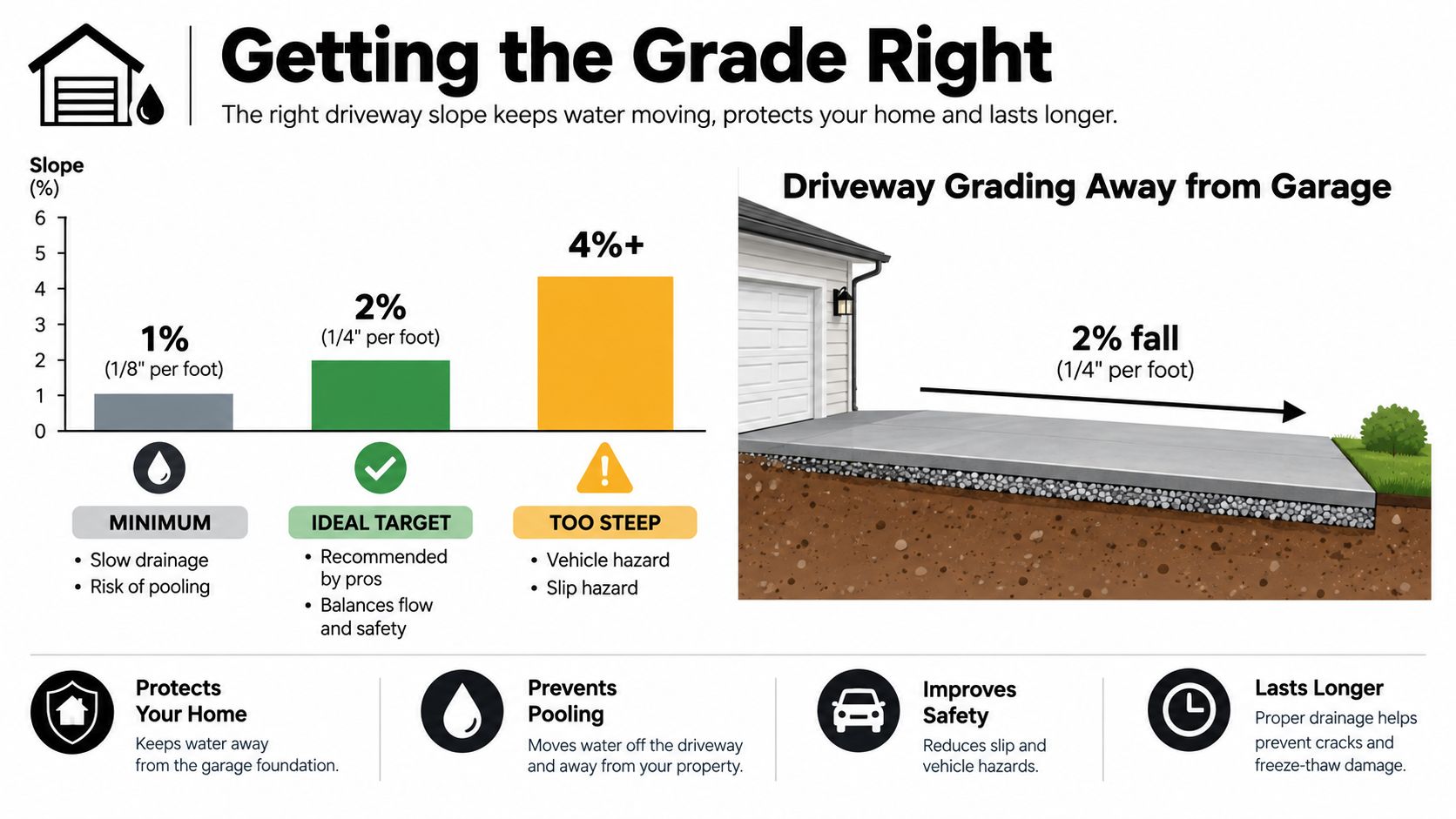
A concrete driveway should typically be designed with at least a 1% to 2% surface slope away from structures, and many guides recommend about 2%, which is roughly 1/4 inch of fall per foot. On a 50-foot driveway, that works out to about 12.5 inches of total drop (driveway drainage slope guide). That amount is enough to improve runoff without making normal use awkward.
What that looks like in real life
Most homeowners don't think in percentages. They think in puddles, low corners, and whether water reaches the garage.
A practical way to picture the target is this:
- Minimum working slope: A driveway can still drain at the lower end of the recommended range, but runoff may move more slowly.
- Reliable target: About 1/4 inch per foot is a common benchmark because it keeps water moving without creating an uncomfortable surface.
- Visible warning sign: If one section looks flat to your eye and repeatedly holds water, it usually is.
If you want to understand the visual side of measuring grade before a pour or replacement, this short clip helps show what installers are checking in the field.
The first 10 feet matter most
The strictest drainage zone is the part closest to the house and garage. Impervious surfaces within 10 feet of a foundation are commonly specified to slope down and away at 2% grade, which equals 0.25 inch per foot, so water does not collect at the slab edge or migrate toward the foundation (building guidance on sloping away from the house).
Related code guidance also states that impervious surfaces within 10 feet of a foundation, including driveways and patios, are required by the IRC R401.3 exception to slope not less than 2% away from the building when site conditions prevent the full fall otherwise expected across that area (grading and slope reference).
If water is going to fail, it often fails in the first 10 feet next to the structure. That's the zone to inspect first.
A simple homeowner check
You don't need a survey crew to spot an obvious grading issue. A basic site check can include:
- Use a level and tape: Set the level on a straight board and check whether the driveway falls away from the garage.
- Watch the next rain: Look for sheet flow heading toward the house, not just standing puddles.
- Check the slab edge: If water lingers near the foundation line, the problem may be a flat or reversed grade right where drainage matters most.
This same grading logic also applies to a concrete foundation for garage, a shed foundation, or a house foundation apron. Water needs an intentional path from day one.
Trench Drains Catch Basins and French Drains Compared
Sometimes slope can't solve the whole problem. A driveway may run toward the garage, end at a low point, or sit on a lot where runoff concentrates too quickly. That's where collection systems come in.
When each system fits best
A trench drain or channel drain is usually the first choice when water moves across the driveway surface as a sheet. These drains sit flush with the concrete and intercept runoff before it reaches the garage or another vulnerable point. Guidance for driveway drainage notes that trench drains or channel drains are a standard mechanical solution when the grade runs toward a building or low point, and that they should be set with roughly a 1% slope toward the outlet to keep water moving and avoid standing water inside the system (driveway trench drain guidance).
A catch basin works differently. It's meant to collect water at a defined low spot. If one corner of a driveway or an adjacent paved area receives concentrated runoff, a basin can serve as the collection point before water enters piping.
A French drain usually handles water below or beside the surface rather than broad sheet flow across the face of the driveway. It often makes sense along edges where the surrounding soil stays wet or where subsurface water keeps softening the area next to the slab.
Surface water and subsurface water don't behave the same way. The best drain choice depends on which one is causing the trouble.
Choosing Between Trench Drains Catch Basins and French Drains
| System | Best For | Placement | Maintenance |
|---|---|---|---|
| Trench drain | Sheet flow moving toward a garage door or across the width of the driveway | Across the driveway at the low intercept point, often near the garage threshold | Keep grate clear and outlet flowing |
| Catch basin | A defined low point where water collects in one area | At the lowest visible collection spot with piping to discharge | Clean debris from basin and check grate |
| French drain | Wet edges, softened side areas, or subsurface moisture near the slab | Along driveway sides or nearby grade transitions | Watch for clogging over time and protect from sediment |
How to decide on a real property
In Honey Brook Township and nearby service areas, the right answer usually comes down to three questions:
- Where is the water coming from: If rain is sliding over the slab, think interception. If the sides stay soggy, think subsurface control.
- What shape is the driveway: A long run into a garage often points to a trench drain. A bowl-shaped corner may call for a basin.
- What can the site discharge to: Every drain still needs a destination.
Homeowners comparing drainage layouts often also need to understand the piping side of the job. This guide to drainage pipe installation gives a useful look at how collected water is routed once it enters the system.
For many projects, the drain hardware isn't the hard part. Matching the drain type to the water source, slope pattern, and site outlet is what determines whether the fix lasts.
Permeable Surfaces and the Base Beneath Your Slab
The surface you see is only part of the drainage system. Long-term performance often comes from what's underneath.
When permeable surfaces make sense
Some properties are good candidates for a permeable driveway approach. The EPA identifies pervious concrete, porous asphalt, and interlocking or grid pavers as suitable options for driveways and similar paved areas, because they allow water to move through the surface rather than shed entirely across the top. That can reduce visible runoff, but only if the rest of the system supports it.
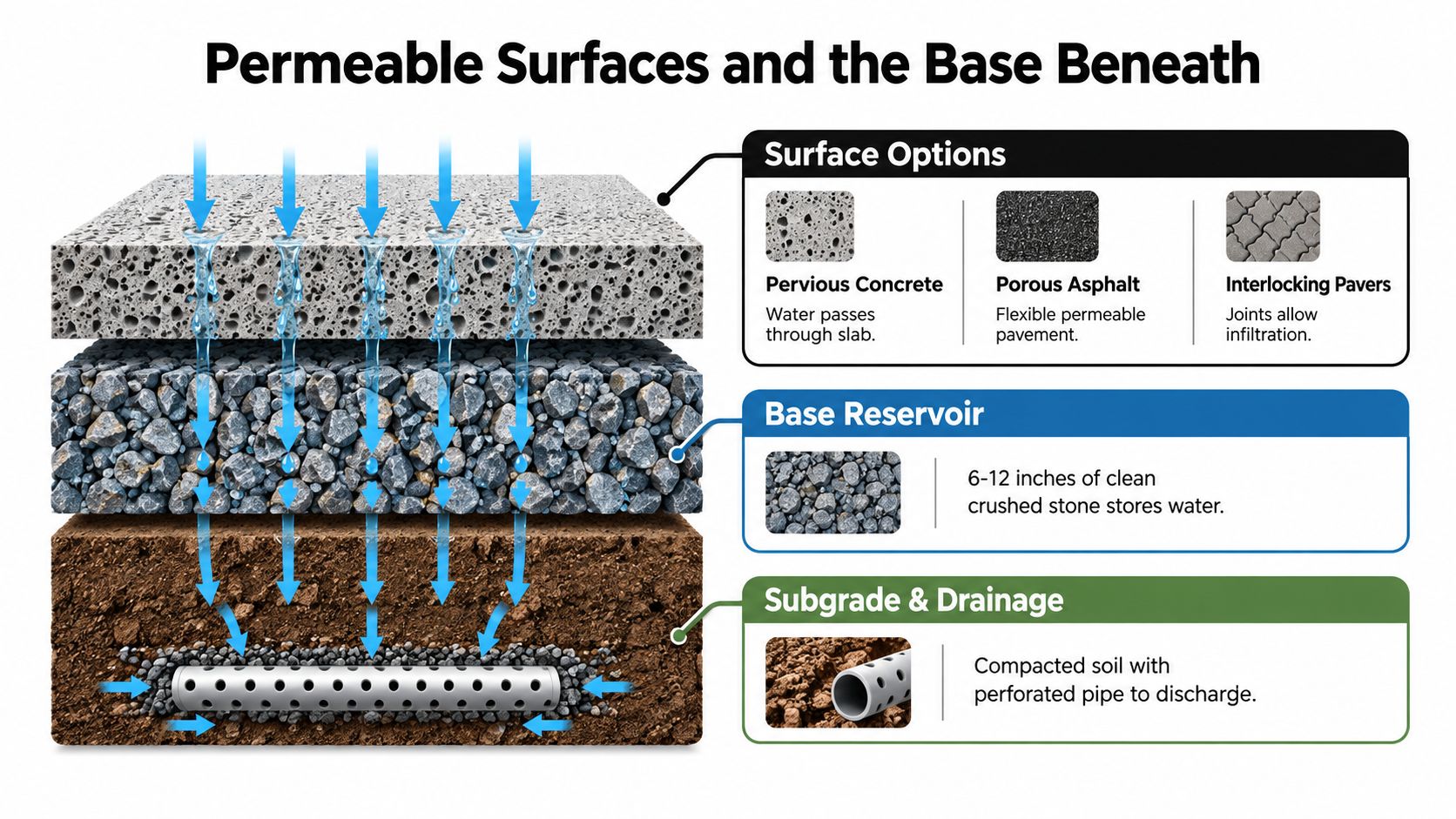
Permeable surfaces usually work best on lower-slope sites with soil that can accept water. On compacted ground or slow-draining soils, the surface may let water through, but the system below may still back up. That's why site prep matters as much as material choice.
The layer most homeowners never see
A well-drained concrete driveway isn't just about the slab itself. Guidance commonly recommends a compacted gravel or crushed-stone base between 6 and 12 inches thick to reduce pooling beneath the concrete, improve stability, and help manage water below the slab where surface grading alone can't solve the issue (gravel base guidance for driveway drainage).
That stone layer does two jobs at once. It supports the slab structurally, and it gives water a place to move or temporarily reside instead of sitting directly against soil under the concrete.
A related explanation of concrete pad drainage is useful if you're comparing driveway work with a shed foundation gravel base, shed foundation blocks, or a slab for a garage or outbuilding. The same principle applies. Surface water and subsurface water both need a plan.
Why excavation quality changes the outcome
Contractors often separate themselves. One crew may focus on pouring the slab. Another may spend more time checking subgrade condition, preparing stone depth, and confirming where water will go after the storm.
Firm Foundations handles projects that way across Pennsylvania, Maryland, Delaware, and New Jersey, including driveway slabs, excavation, and pads for structures such as sheds, garages, gazebos, and shipping containers. On sites where runoff and soft soils are part of the challenge, that base-first approach matters more than decorative finish details.
A driveway can look perfectly finished on top and still fail early if the base holds water or the soil below can't handle what the slab sheds.
If you're comparing options for a 4×8 shed with foundation, a shed foundation kit, or broader concrete foundations, this is the lesson to keep in mind. Drainage success depends on the whole assembly, not only the top layer.
Designing a Driveway That Drains for Decades
A durable driveway starts before the concrete truck arrives. Good results come from tying site assessment, grading, collection, base prep, and finishing into one plan.
The sequence that prevents repeat problems
Start with the lot, not the slab. Walk the runoff path during or after a rain if you can. Look at the first area near the garage or house, then trace where water would go once it leaves the driveway. If that route ends in saturated grass, a side yard depression, or compacted clay, the design needs more than surface pitch.
From there, the checklist becomes more practical:
- Verify fall near the structure: The critical area by the home needs clear drainage away from the building.
- Match drain type to water behavior: Surface flow, low-point collection, and edge saturation need different tools.
- Build the support layers correctly: Excavation depth, subgrade condition, and stone placement affect both drainage and slab life.
- Coordinate transitions: Garage thresholds, sidewalks, aprons, and foundation edges are where many failures start.
Details that save headaches later
Driveway planning also has to account for surrounding conditions that can change over time. If nearby trees are lifting adjacent pavement or pushing moisture patterns around the slab, that can alter drainage and crack development. Homeowners dealing with root-related movement may find this resource on how to fix driveway cracks from tree roots useful as part of the bigger site picture.
Trusted shed and garage foundation work follows that same logic. Whether you're pricing garage footings and foundations, planning a gazebo foundation, or searching for shed foundations contractors near me, it's worth asking the same questions before work begins.
The best driveway drainage plan is the one that still makes sense after the first hard rain, not just on pour day.
What to confirm before you sign off
Before any new driveway or replacement project moves ahead, make sure you can answer these plainly:
| Checkpoint | What to verify |
|---|---|
| Surface direction | Water will leave the slab away from the house and garage |
| Collection plan | Any low point or inward pitch has a drain strategy |
| Base preparation | The excavation and stone layers are part of the scope |
| Discharge path | Collected runoff has a safe place to go |
| Adjacent conditions | Nearby roots, edges, and grade transitions have been considered |
That same planning discipline is a good sign on any related project, including concrete foundations, garage slabs, or a base for storage shed.
Get a Free Quote for Your Driveway Drainage Project
Concrete driveway drainage works when three parts support each other. The slab needs the right slope, the site needs the right way to intercept or direct runoff, and the base below needs to handle moisture without turning into a weak spot. If one part gets skipped, the puddle usually comes back.
That's why homeowners searching for driveway companies near me, concrete contractors, garage foundation contractors near me, or even gravel shed foundation contractors near me should pay close attention to drainage during the quote stage. The same site conditions that affect a driveway often affect a shed foundation, concrete foundation for garage, patio, or outbuilding pad too.
Across Pennsylvania, Maryland, Delaware, and New Jersey, wet weather, tight soils, and changing grades can make a simple-looking slab more complicated than it appears. Clear communication and a no-surprises scope matter. You want to know how the surface will drain, what happens at the edges, and where the water goes after that.
If your driveway holds water near the garage, sends runoff toward the home, or keeps icing in the same spot, it's worth having the site evaluated before the problem spreads into cracking, settlement, or seepage. A good quote should answer the drainage questions in plain language, not hide them behind vague line items.
Whether you need a new driveway, replacement slab, excavation, cement foundations for garage, or site work tied to a shed or barn project, the next step is simple. Get eyes on the grade, the runoff path, and the base conditions before more concrete goes down.
If you need help with a driveway, garage slab, shed pad, or excavation project, Firm Foundations offers site preparation and concrete work with drainage planning built into the job. Reach out for a free quote if you want a clear plan for moving water away from the slab and keeping it away from your home.