
Gravel Driveway Dust Control That Actually Works
A summer afternoon can expose every weakness in a gravel driveway. You pull out toward the road, a brown cloud rolls across the lawn, porch furniture collects a gritty film, and the car looks dusty before you reach the mailbox. The first instinct is usually to search for a spray, but lasting gravel driveway dust control starts with the surface beneath the product.
Dust usually points to a combination of missing fines, poor grading, and dry conditions. A driveway that can't shed rain, hold its crown, or lock angular stone together will keep failing no matter how expensive the suppressant is. The right sequence is simple: diagnose the aggregate, correct the grade and drainage, compact the surface, then choose a treatment that fits your traffic and property.
Why Your Gravel Driveway Turns Into a Dust Cloud
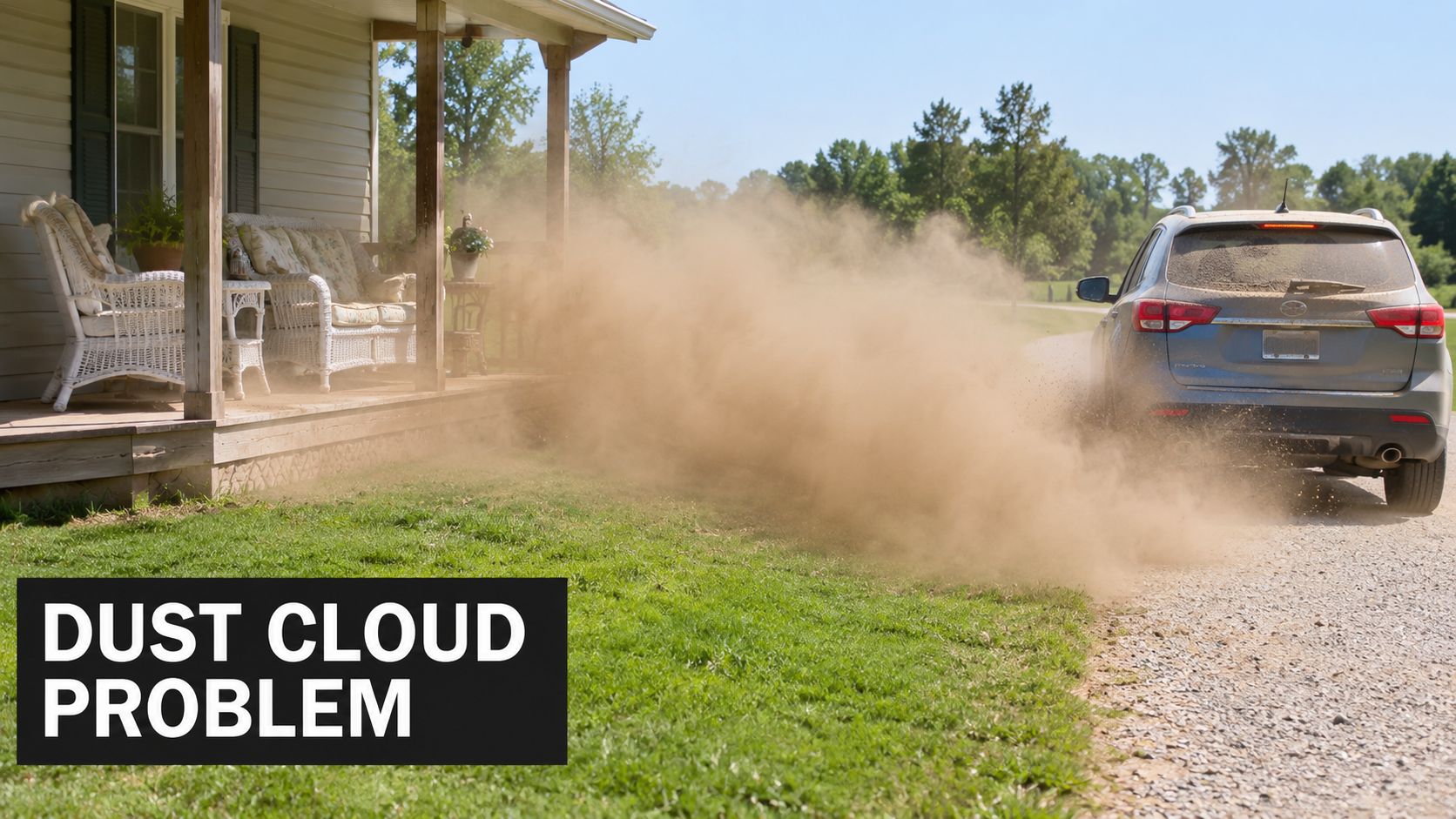
The dust behind your vehicle is usually driveway material, not dirt drifting in from somewhere else. A well-graded gravel surface contains larger aggregate, smaller stone, and fine particles that fill the voids between them. Those fines help the surface knit together. Once traffic and weather remove too much of that binder, the larger pieces roll and scour instead of behaving like a compacted driving layer.
Some drives start with the wrong material. Washed gravel or rounded pea gravel has little binding material and doesn't lock together under tires the way angular crushed stone does. A surface built from clean, loose stone may look attractive when installed, but it can remain unstable and dusty because the material has nothing to hold the layer together.
Three conditions create the cloud
Missing fines are the first warning. Years of rain, wind, and vehicle movement can carry fine material toward the shoulders or off the property entirely. If the surface looks increasingly rocky and loose, adding more of the same clean stone won't solve the problem.
Weak grading creates the second failure. A flat or dished drive lets tires scour the top layer in the wheel paths. Water then finds the low areas, softens the base, and leaves ruts that become even more difficult to compact.
Dry weather finishes the process. Moisture helps hold fine particles down. During hot, dry conditions, remaining fines lift more easily under tires and wind.
Practical rule: If a driveway is dusty, loose, and rutting at the same time, treat the structure before treating the symptom.
Research on unpaved roads shows why this matters. Untreated roads have been estimated to generate about 7.9 tons of dust per mile per year, and successful suppressants can reduce dusting by up to 90% while reducing total aggregate loss by 55% to 67% compared with untreated gravel, as reported in this independent gravel-road treatment research. Your private driveway isn't a public highway, but the same surface mechanics apply.
Diagnosing the Cause of Driveway Dust
Before buying calcium chloride, magnesium chloride, lignosulphonate, or a polymer, inspect the driveway as an excavation contractor would. Dust usually points to a surface, grading, or drainage fault. A short audit shows whether the next step is a binder, compatible aggregate, reshaping, or a combination.
Start with the surface material
Scoop material from the driving layer and squeeze it in your hand. Useful fines should hold the gravel together somewhat. If the sample falls apart immediately and blows away like loose sand, the surface has lost the material that helps it bind.
Stone shape also affects stability. Angular crushed aggregate can key together, while smooth, rounded pieces roll apart. Loose rounded stone over hard dirt lacks interlock, and a suppressant cannot create that missing structure. Review this guide to the best gravel for a driveway when deciding whether the drive needs a compatible top layer instead of another chemical treatment.
Check the crown and water movement
Set a long, straight board across the drive with a level on top. The center should sit higher than the edges, allowing water to leave the wheel paths. A practical crown is 2% to 4%. Road-preparation guidance recommends shaping a crown near 4% for effective runoff, as described in this gravel-road preparation guidance.
Inspect the edges after rain. Mark ponding, cross-flow, muddy shoulders, and channels cutting across the driving surface. Water pooling in the center indicates poor grading. Water arriving from a hillside may require a swale, ditch, or culvert before any suppressant can perform.
Map the traffic
Record where vehicles enter, brake, turn, reverse, and park. These areas receive more tire shear than straight sections. A turning area that keeps producing dust after treatment may need stronger aggregate and deeper compaction, not another coat.
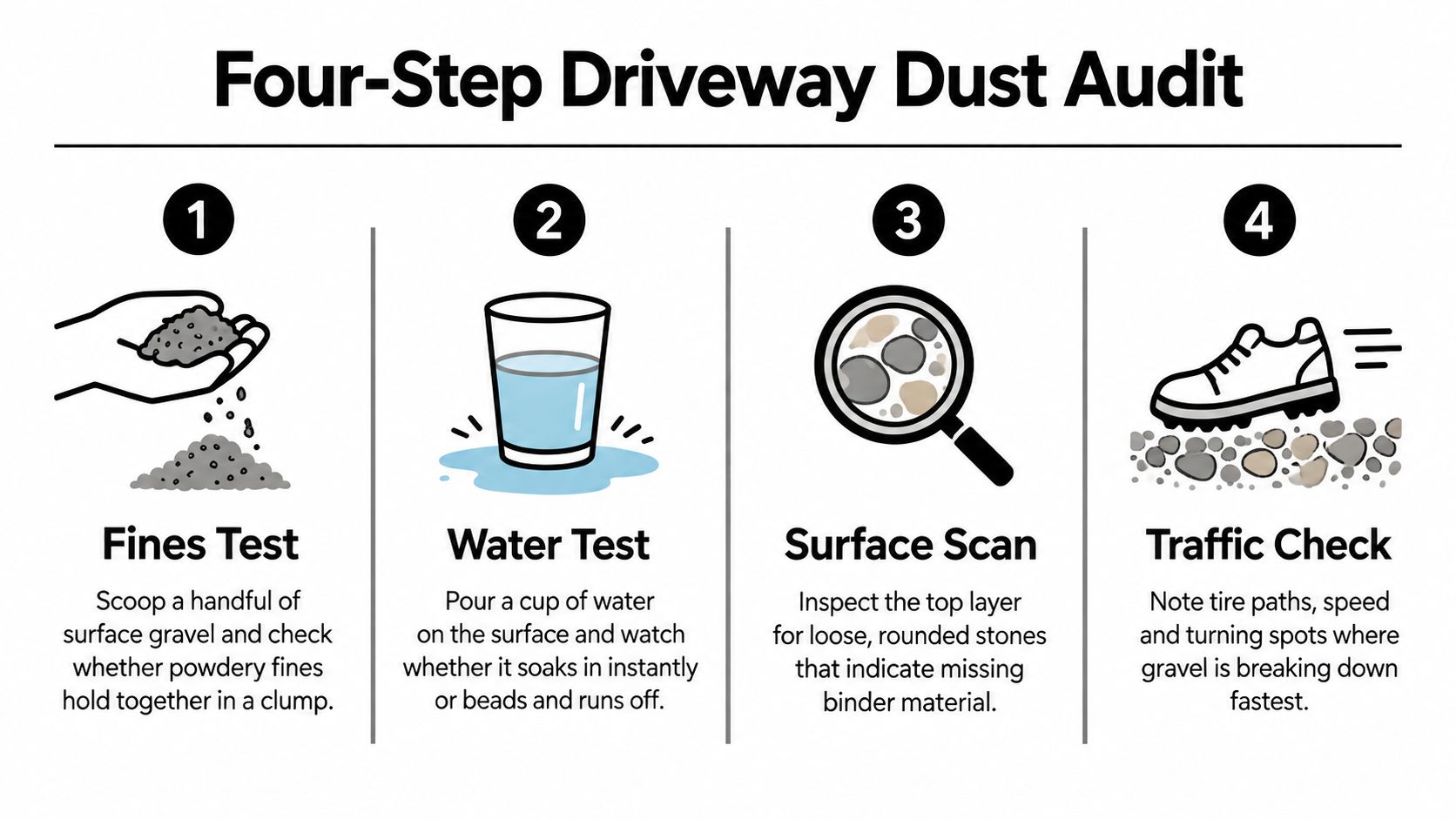
Match the repair to the finding. Missing fines points toward re-topping with well-graded crushed material. A flat crown requires reshaping. Standing water requires drainage work. Concentrated tire damage calls for traffic changes, stronger compaction, or a more durable treatment. Firm Foundations can assess grading and drainage when the site needs professional correction before suppressant application.
Comparing Dust Suppressants That Actually Work
Homeowners usually compare five choices: plain water, chloride salts, lignosulphonate, polymer emulsions, and asphalt emulsions. They don't work the same way. Water temporarily settles particles, chlorides help the surface retain moisture, and binders hold particles together. The condition of the gravel determines whether any of them can perform.
The table below provides a practical qualitative comparison. Exact prices and service life vary by product concentration, driveway size, site preparation, traffic, weather, and whether a contractor supplies the equipment. No reliable cost figures are provided here, so it would be misleading to attach invented dollar amounts to the choices.
Gravel Driveway Dust Suppressant Comparison
| Suppressant | Approx. Cost per sq yd | Typical Lifespan | Best For |
|---|---|---|---|
| Plain water | Low material cost | Short lived, often hours in hot, dry conditions | Temporary relief before gatherings or during active work |
| Calcium chloride or magnesium chloride | Product and application cost varies | Seasonal performance with maintenance | Gravel surfaces that retain fines and need moisture retention |
| Lignosulphonate | Product and application cost varies | Seasonal performance, depending on rain and traffic | Surfaces needing a binding treatment and a darker finished appearance |
| Polymer emulsion | Product and application cost varies | Longer service than simple wetting treatments when properly prepared | Drives with repeated traffic and a need for stronger surface binding |
| Asphalt emulsion | Product and professional application cost varies | Durable treatment when correctly installed | Higher-wear drives where professional spraying is appropriate |
Water is the easiest shortcut, but it has the shortest reach. It can knock down dust immediately, yet it evaporates or disappears into the surface quickly during dry weather. It isn't a maintenance plan for a busy driveway.
Chloride products became common in roadway dust control because they attract and hold moisture. Historical transportation data shows calcium chloride has been used for about 60 years, and among 134 agencies with dust-control programs, 56% reported using calcium chloride brine or flakes while 50% reported using magnesium chloride, according to this archived transportation dust-control reference. Those salts can work well, but runoff near lawns, gardens, wells, streams, and drainage swales requires caution.
Lignosulphonate binds fine material rather than relying primarily on moisture retention. It can darken the driveway, which some owners like and others don't. Polymer emulsions can handle traffic effectively when the surface has been shaped and compacted first. Asphalt emulsions are more durable but are less forgiving of poor application and usually belong with an experienced applicator.
A field evaluation found suppressants reduced fugitive dust emissions by 50% to 70%, while treated sections retained 42% to 61% more aggregate than untreated controls, with estimated savings of 28% to 42% compared with no treatment, as documented in this comparative unpaved-road evaluation0733-947X(1997)123:5(393)). Match the product to traffic, climate, drainage, vegetation, and the maintenance interval you're willing to manage.
Grading and Drainage Prep That Makes Suppressants Last
A suppressant cannot save a driveway that ponds water or washes aggregate into the ditch. Dust control starts with the grade, then moves to product selection and application.
Build a surface that carries water away
Walk the entire drive after rain and mark low spots, ruts, and areas where runoff crosses the wheel paths. Remove loose or unstable material until you reach a firmer base. Replace it with compatible crushed aggregate containing fines, then compact it in manageable lifts. Covering a soft area with a thick layer only hides the failure until traffic and water expose it again.
Shape a crown so the center sits higher than the edges. A properly crowned surface sheds water before it can soften the base or strip fines from the driving lane. The road-surface preparation resource explains how crown, aggregate moisture, and split applications affect gravel-road performance. For a residential drive, the driveway dust-control application guide provides a practical example of setting a center crown several inches above the edges.
Compact in controlled layers
Spread aggregate in 2- to 3-inch lifts, compacting each lift with a plate compactor or vibratory roller. A thick, single pass can bridge a weak area and leave voids beneath the surface. Those voids collapse under tires, creating ruts that collect water and loosen more material. Moderate moisture helps fines fill the gaps and produces a tighter driving surface.
Contain the edges as well. A stable shoulder or edging keeps aggregate from migrating into grass, where it becomes difficult to recover and leaves the lane thinner. At a low point, use a shallow swale or culvert when needed to route runoff away from the wheel paths.
A good suppressant applied to a bad grade is an expensive way to postpone the same repair.
Persistent runoff may require more than routine regrading. Homeowners can review this resource on how to fix Prescott yard drainage issues for examples of grading and drainage corrections. Firm Foundations can assess the base, crown, shoulders, and outlet when the site keeps failing after surface repairs.
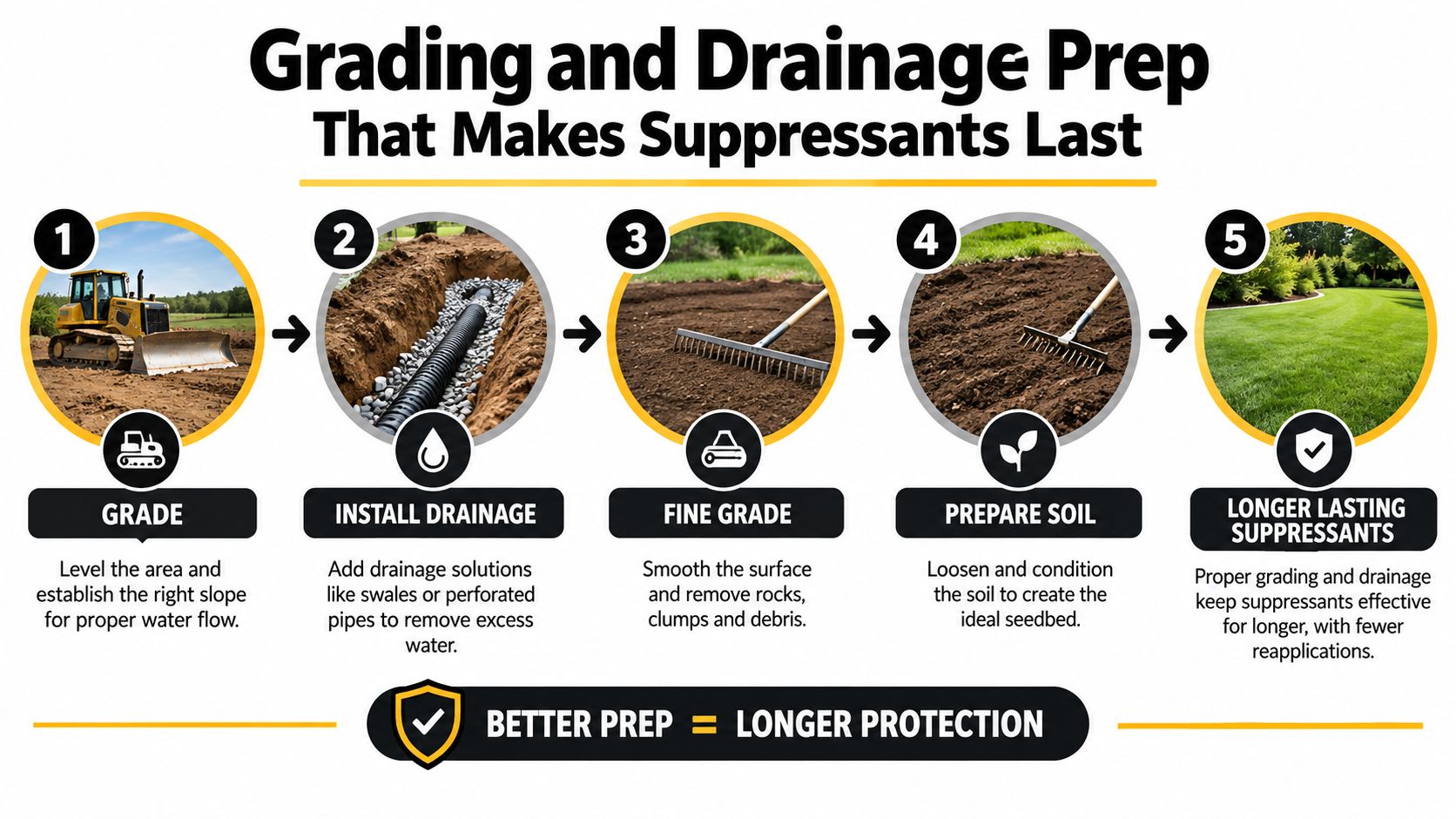
The visual shows how grading and drainage preparation fit together before treatment.
Apply suppressant only after the driveway sheds water, holds its aggregate, and maintains compaction. Otherwise, a major storm can carry the treatment away before it binds.
Applying Suppressants the Right Way
Application errors often make a sound product look ineffective. The most common mistake is stretching the coverage rate to save material. An under-dosed treatment may wet the surface without creating consistent coverage, leaving dry strips that begin dusting almost immediately.
Read the product label and calculate the driveway area before mixing or loading equipment. FHWA guidance lists calcium chloride flake applications around 0.5 to 1.1 kilograms per square meter, with typical use near 0.9 kilograms per square meter, while liquid products are listed in the 35% to 38% range, as reported in this FHWA calcium chloride application reference. University of Wisconsin guidance lists flake calcium chloride at 1.0 to 1.5 pounds per square yard, pellet calcium chloride at 0.8 to 1.3 pounds per square yard, and liquid at 0.2 to 0.3 gallons per square yard, with an example initial liquid treatment using a 30% solution at 0.5 gallons per square yard, as summarized in this unpaved-road maintenance dosing guide.
Use controlled passes
Apply two lighter passes instead of one heavy coat. The first pass should penetrate the upper aggregate, and the second should close the surface after the first has had time to settle or flash off according to the product label. This approach reduces puddling and helps prevent runoff at the shoulders.
For chloride solutions and lignosulphonate, a pressurized spray bar or watering truck with a rear-mounted nozzle distributes material more evenly than a handheld garden sprayer. A calibrated distributor or pump sprayer can work on a small drive with polymer or asphalt emulsion, but the operator still needs a steady walking speed and consistent overlap.
Choose the weather carefully
Select a warm, dry window with no rain expected for 24 to 48 hours, and apply when the surface is above 50 degrees Fahrenheit, following the stated application conditions in the project plan. Roll the treated surface with a rubber-tired roller so the binder moves into the upper aggregate rather than sitting as a film.
Schedule an inspection at the 30-day mark. Look for dry stripes, tire-polished areas, runoff tracks, and fresh fines collecting at the edges. A study reported immediate control effectiveness above 95%, followed by declines of as much as 50% over 30 days, and identified surface silt loading as a useful indicator of relative performance, according to this EPA field study on suppressant effectiveness. Early inspection lets you correct a weak area before the whole drive deteriorates.
Maintenance Schedule and Long-Term Costs
Dust control works best as a cycle, not a one-time purchase. Traffic, rain, freeze-thaw movement, surface fines, and drainage all determine how quickly the treatment wears. A lightly used residential drive may need a different plan from a long access road serving deliveries, trailers, or farm equipment.
Water-based treatments need frequent attention during dry summer weather. Chloride and lignosulphonate treatments generally need seasonal maintenance, while polymer and asphalt systems can last longer when applied over a properly prepared base. The longer-lasting options usually require more careful preparation and professional equipment, so the cheapest treatment per application isn't automatically the cheapest choice over the life of the driveway.
Dust Suppressant Cost and Reapplication Schedule
| Suppressant Type | Cost per Sq Ft per Year | Reapplication Interval |
|---|---|---|
| Water-based options | Varies by water access, labor, and frequency | Frequent during dry conditions |
| Chloride salts | Varies by product, concentration, and application | Seasonal maintenance based on wear |
| Lignosulphonate | Varies by product and application | Seasonal maintenance based on rain and traffic |
| Polymer emulsion | Varies by product and preparation | Longer interval than simple wetting treatments |
| Asphalt emulsion | Varies by product, equipment, and professional labor | Longer interval when the surface remains structurally sound |
Don't use a generic annual budget without measuring the site and choosing the treatment. Product concentration, surface area, access, equipment, and regrading can change the total substantially.
Inspect the structure every spring
Spring is the right time to look for ruts, a flattened crown, bare patches, migrating aggregate, and water marks. Bare patches in the wheel paths may indicate product wear, but repeated washouts or ponding usually point to drainage failure. Spot-treating those locations early costs less effort than allowing water and traffic to spread the damage.
A practical maintenance record should include the application date, product, weather, areas treated, and observations after rain. Keep vehicle speeds down, avoid unnecessary turning on the drive, and refresh the surface when the aggregate begins separating. For broader upkeep guidance, see these essential gravel driveway maintenance tips.
When to Call a Contractor for Lasting Results
Some driveway problems are beyond the useful scope of a bucket, hose, and store-bought treatment. If the surface keeps washboarding after reapplication, water stands after storms, the crown is flat or reversed, ruts are deeper than 2 inches, or the base was never installed correctly, the problem is structural.
No suppressant can rebuild a failed sub-base. It can't redirect stormwater, replace missing aggregate, or hold a crown that traffic has flattened. Repeated spraying under those conditions adds cost without correcting the reason the driveway keeps failing.
What professional correction includes
A qualified excavation contractor can evaluate the existing material, re-establish the crown, correct weak sub-base areas, reshape ditches, and install or repair culverts. The crew can then compact the surface and apply a compatible treatment, if one makes sense for the site.
This work is particularly valuable across Pennsylvania, Maryland, Delaware, and New Jersey, where regional soils, frost conditions, slopes, and stormwater patterns affect driveway performance. A local crew should understand how the site behaves after heavy rain and seasonal ground movement, not just how to spread gravel on a dry day.
Firm Foundations offers driveway preparation and installation alongside excavation and foundation work. The same site-planning skills used for concrete foundations, garage footings and foundations, a base for a storage shed, a gazebo foundation, or a house foundation also matter when a gravel drive needs proper grade, compaction, and drainage.
Before hiring anyone, verify licensing and insurance, request a written scope, and ask the contractor to separate earthwork, aggregate placement, compaction, drainage, and suppressant application. That makes it clear what you're paying for and gives you a way to evaluate whether the proposed fix addresses the cause rather than just covering the dust.
For driveway contractors near me, gravel driveway contractors near me, or excavation near me, look for a crew willing to inspect the full surface and explain the sequence. The right solution may be a regrade, a new gravel driveway base, drainage work, a binder, or a combination. A quote should reflect the actual site conditions.
Firm Foundations can inspect your driveway, correct grading and drainage problems, install and compact the right gravel surface, and recommend dust-control treatment when it fits the property. Visit Firm Foundations to request a free quote for driveway preparation, excavation, concrete foundations, or a durable pad built for your home or business.