
Drainage Pipe Installation Guide for PA, MD, DE and NJ Homes
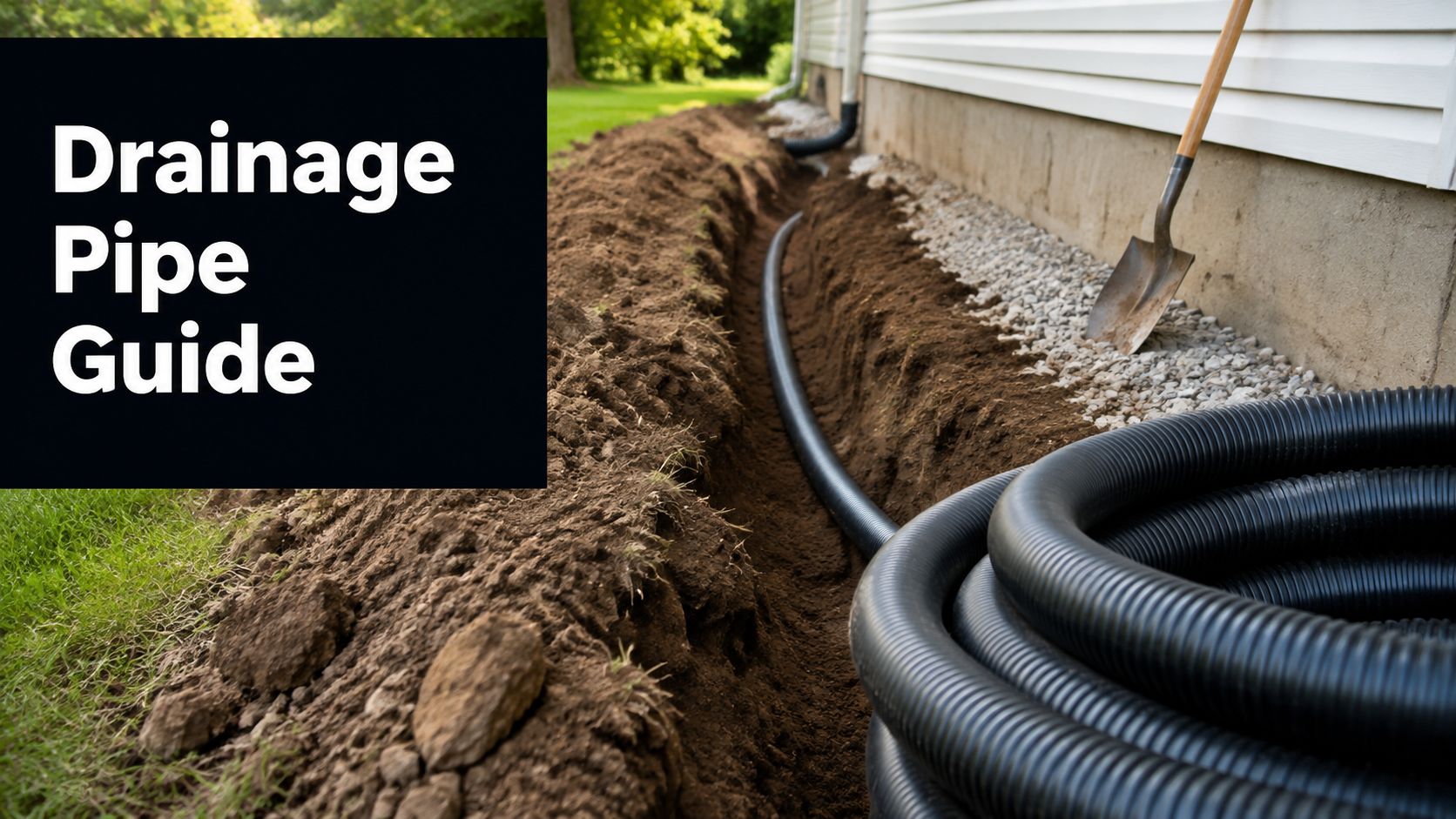
After a heavy storm, you may notice water collecting beside the foundation, a yard that stays soft underfoot, or a basement wall that feels damp every spring. A shed pad, garage slab, patio, or driveway can show the same warning signs when runoff has nowhere reliable to go. These problems rarely disappear on their own. They usually point to a grading, bedding, pipe, or outlet decision that needs attention before saturated soil creates larger trouble.
Drainage pipe installation works when the system does more than collect water. It must move that water along a steady grade, rest on stable bedding, remain supported through backfill, and discharge somewhere appropriate. That standard matters throughout Pennsylvania, Maryland, Delaware, and New Jersey, where seasonal freezing and thawing can expose weak installation practices. Whether you're searching for excavation near me, a foundation drainage solution, or contractors who understand concrete foundations and shed pads, the details below will help you evaluate the work.
Why Proper Drainage Pipe Installation Protects Your Foundation
A homeowner may first see a puddle near the house and assume the problem is cosmetic. Then the same area stays wet after the lawn dries, soil begins to settle beside the wall, or water appears in the basement after the next storm. That progression is common because water follows the easiest path. If the ground around a foundation offers no controlled route, moisture can remain against concrete, wash soil away, and place pressure on walls, slabs, and nearby hardscape.
The same concern applies to a gravel shed foundation, a gazebo foundation, a patio base, or garage footings and foundations. A structure can have excellent concrete forms and a properly finished surface, but unstable, saturated soil beneath or beside it can still cause movement. Drainage doesn't replace sound excavation or a correctly built foundation. It protects those investments by controlling where water travels.
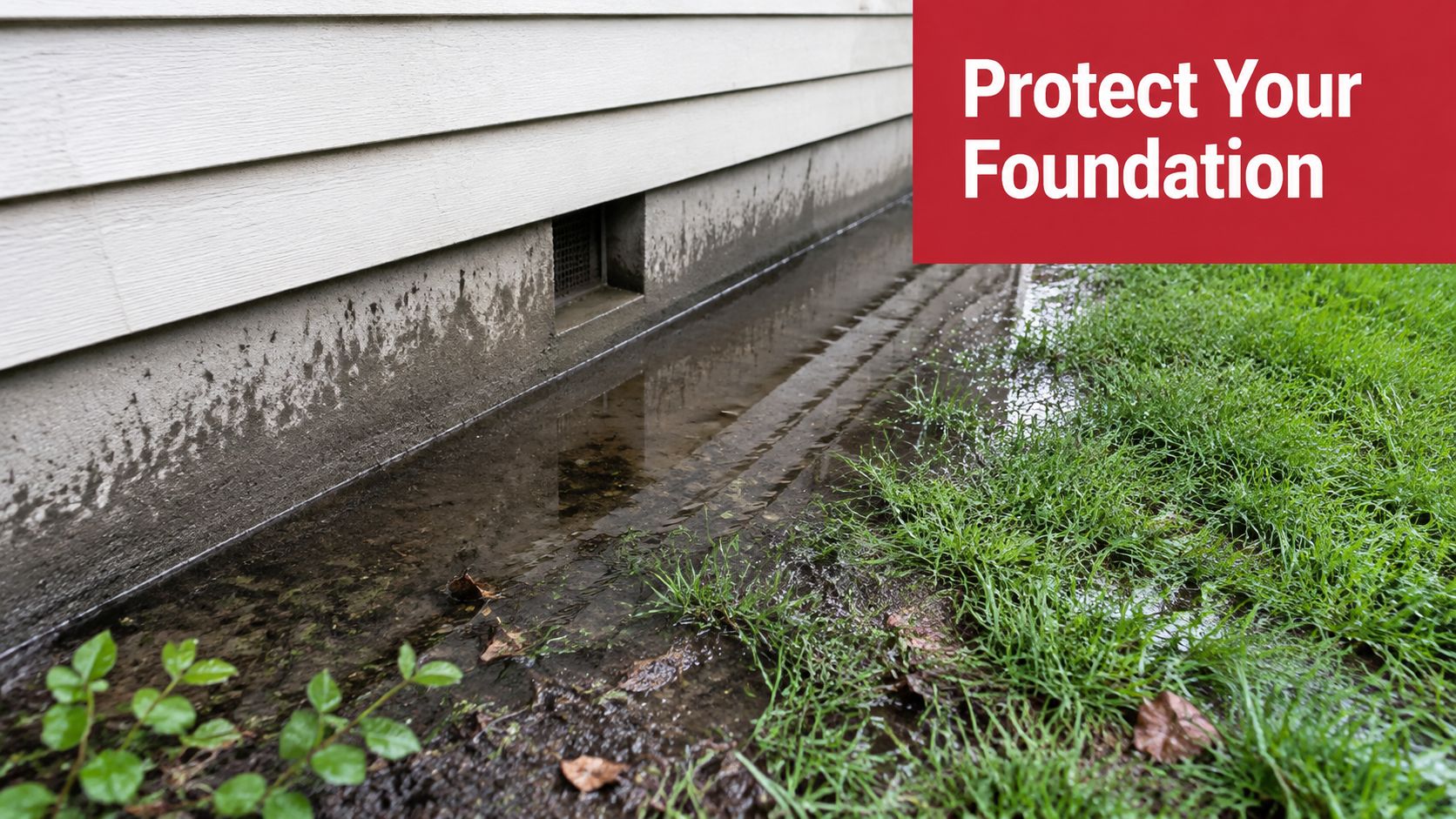
What standing water tells you
Persistent pooling can come from roof runoff, a low point in the yard, a high water table, compacted soil, or a failed existing line. Damp basement conditions may also indicate that footing drainage is missing, clogged, damaged, or discharging improperly. Cracks deserve their own inspection rather than an automatic drainage diagnosis. For homeowners researching how to fix a cracked foundation, the important first step is identifying whether water management, structural movement, or both are involved.
A well-planned system can help protect:
- House foundations: It reduces prolonged water contact and helps direct runoff away from basement and crawlspace walls.
- Garage foundations: It supports stable soil around slabs and footings, particularly where driveways shed water toward the structure.
- Shed and gazebo bases: It helps keep gravel or concrete pads from remaining saturated and settling unevenly.
- Pavement: It limits erosion that can undermine walkways, patios, and driveway edges.
Field observation: A pipe buried in the wrong grade is still a buried problem. The trench, bedding, outlet, and final surface all matter as much as the pipe itself.
Subsurface drainage has been used for thousands of years. Historical records identify buried clay pipe use as early as 5,000 B.C. on Crete, Roman drainage writing by Cato around 200 B.C., and the first documented U.S. tile-drain installation in 1835 by John Johnston in New York, as described by the Soil and Water Conservation Society's drainage history. Modern plow-in equipment and corrugated plastic tubing changed installation methods in the late 1960s, replacing much of the hand-dug trench work used earlier.
Firm Foundations is a licensed, insured foundation and excavation contractor serving Pennsylvania, Maryland, Delaware, and New Jersey. Since 2011, its work has included site preparation and drainage-related excavation for durable foundations, pads, slabs, and other structures where water control affects long-term performance.
Choosing the Right Drainage System for Your Property
The right drainage system depends on where water starts, whether it moves above or below grade, and where it can legally and safely discharge. A French drain can collect groundwater, but it isn't automatically the right answer for driveway runoff. A trench drain can capture surface water, but it won't substitute for a footing drain beside a basement wall.
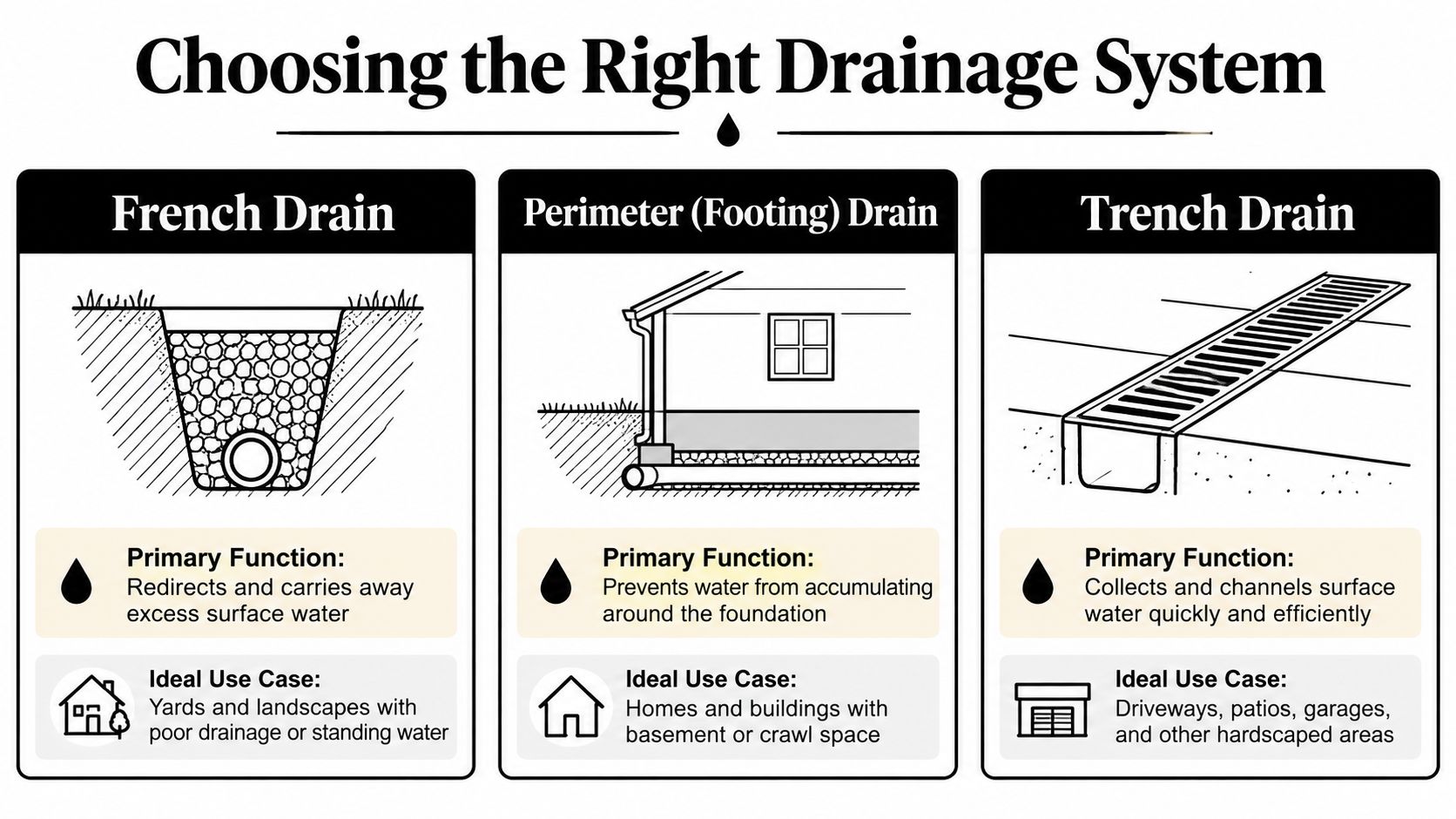
French drains collect subsurface water
A French drain typically uses a perforated pipe surrounded by clean stone and a filter layer. It suits low areas of a yard, groundwater moving toward a foundation, and sites where water needs to travel toward a lower outlet. The pipe collects water through its openings while the surrounding stone creates a permeable path.
The system needs a genuine destination. Depending on site conditions and local approval, that may be daylight discharge, a dry well, or a connection to a sump system. A French drain that ends underground without adequate capacity can relocate the pooling problem.
Perimeter drains protect walls and footings
A perimeter drain, also called a footing drain, runs around a foundation or a portion of it. Building guidance places the pipe outside the footing and below slab or crawlspace level, with discharge to daylight, a drywell, an approved municipal storm sewer, or a sump pump. It shouldn't terminate beside the home.
This type of drainage is especially relevant to basement walls, crawlspaces, and garage footings. Homeowners comparing garage foundation contractors near me should ask how the proposal handles water around the footing, not just how the concrete will be formed. A foundation drainage design may require excavation, stable trench support, perforated pipe, clean crushed stone, and a filter layer. For a more focused look at this application, review perimeter drain systems for shed and foundation projects.
Trench drains capture surface runoff
A trench drain uses a channel and grate at the surface. It works well across driveways, patios, garage entrances, and walkways where sheet flow needs to be intercepted before it reaches a structure. The grate must remain accessible for cleaning, and the channel must connect to a properly planned solid outlet line.
| System | Best suited for | Main planning question |
|---|---|---|
| French drain | Groundwater and soggy yard areas | Where will collected water discharge? |
| Perimeter drain | Basement, crawlspace, and footing protection | Can the line remain below the protected interior level? |
| Trench drain | Surface runoff at paved areas | Can the channel capture water before it reaches the structure? |
Soil type, site slope, nearby structures, and access all influence the choice. Dense soil may slow infiltration, while a naturally sloping property may make daylight discharge practical. A level lot may require a sump pump or another engineered outlet. The outlet decision should happen before excavation, because it controls the route, grade, depth, and sometimes whether a drain is appropriate at all.
Pipe Materials, Sizing, and Slope Requirements
Material selection should follow the application, not just the lowest material price. PVC has a smooth interior and rigid shape, which makes it useful for straight buried runs, perimeter systems, and main conveyance lines where consistent grade and long-term structural integrity matter. Its rigidity can make curves and obstacles harder to manage, so the installer must plan fittings carefully.
Corrugated polyethylene is flexible and cost-effective for many French drains and yard drainage layouts. It can follow a curved route with fewer connections, but it depends heavily on uniform embedment and side support. ASTM F449-20 treats corrugated polyethylene installation as a flexible-conduit practice. In other words, the surrounding material supports the pipe. Poor bedding can let the pipe deform under load and reduce hydraulic performance, so the manufacturer's instructions and the applicable underground-installation standard control the details. The federal manufactured-home drainage guidance also reflects the importance of proper installation procedures.
Size the line for the site
Pipe diameter should match the drainage area, expected water volume, outlet conditions, and number of contributing lines. A small isolated yard drain doesn't face the same demand as a perimeter system serving a large roof area or a driveway collection network. Bigger isn't automatically better. An oversized line still fails if it has poor grade, offset joints, or an inadequate outlet.
Use perforated pipe where the system needs to collect water from surrounding soil. Use solid pipe where the job is to carry collected water to its discharge point. A transition between the two should be deliberate and accessible where possible.
Fittings should preserve the pipe's smooth interior diameter. Recessed drainage fittings and full-bore alignment reduce turbulence and help maintain flow capacity. Standard-weight or Schedule 40 materials are commonly specified for gravity-flow drainage applications, subject to the project requirements.
Set a measurable grade
The International Plumbing Code provides these horizontal drainage benchmarks:
| Pipe Diameter | Minimum Slope | Drop per 50 Feet |
|---|---|---|
| 2.5 inches and smaller | 1/4 inch per foot | 12.5 inches |
| 3 to 6 inches | 1/8 inch per foot | 6.25 inches |
| 8 inches and larger | 1/16 inch per foot | 3.125 inches |
These conversions come from the code slope values in the International Plumbing Code slope table. For French drains and similar perforated systems, a widely used engineering rule is about 1% slope, or 1/8 inch per foot, toward the outlet. Over a 50-foot run, that represents roughly a 6-inch drop, as outlined in this French drain slope guide.
A string line, laser level, or builder's level can verify the intended fall. Check the trench before bedding, again after placing the pipe, and before backfill. Readers who want broader plumbing context can browse plumbing installation content while keeping in mind that outdoor drainage also requires site-specific excavation and outlet planning.
Step-by-Step Trenching and Drainage Pipe Installation
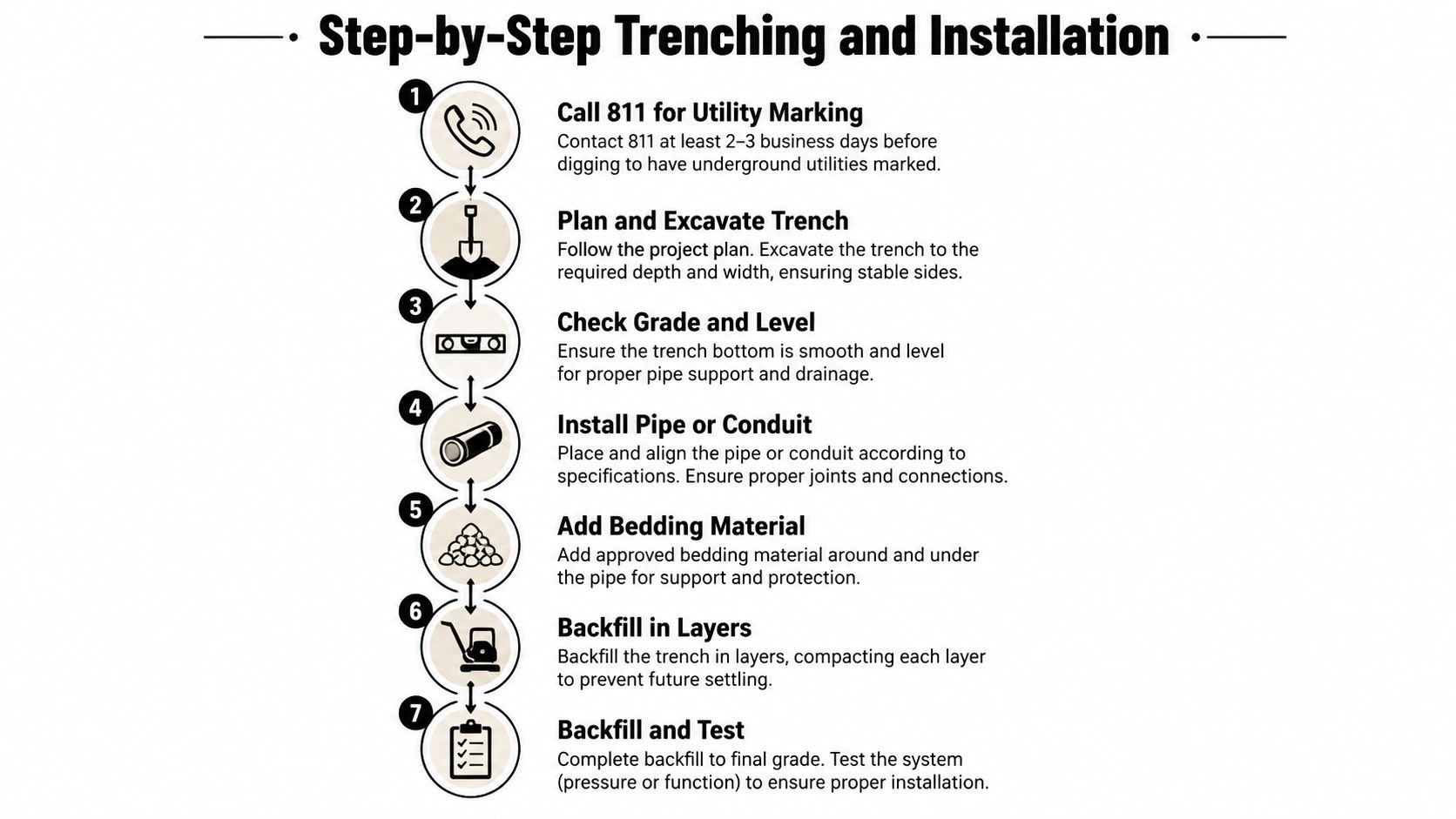
A reliable installation starts before the excavator or shovel touches the soil. Trace the water source, select the outlet, mark the proposed route, and confirm the finished surface will still shed water away from the structure. Call 811 for utility marking and check local permit requirements before digging, especially near a home, public right of way, or municipal connection.
Build the trench around the grade
Mark both trench edges and excavate to a consistent width that allows the pipe and its bedding to be placed without forcing or pinching the line. Depth depends on pipe type, surface loading, the structure being protected, local frost conditions, and the required outlet elevation. In Mid-Atlantic freeze-thaw areas, depth alone won't prevent movement. Stable bedding and proper side support are just as important.
Remove loose soil, large rocks, and roots from the trench bottom. Then establish the continuous fall with stakes and string, a rotary laser, or a long level. Don't rely on the appearance of the ground. A trench can look downhill while containing a low spot that holds water.
Practical rule: Grade the trench first, verify the fall before bedding, and inspect the line again before anyone covers it.
Support the pipe on every side
Place the pipe on a full granular bed. It should not rest on isolated rocks, bricks, clumps of soil, or other point supports. Those hard spots concentrate load and can create a sag or deform flexible pipe after the trench is closed.
For a French drain, place the filter fabric so it can wrap around the stone and pipe. Add clean granular material, set the perforated pipe to the planned alignment, and surround it with the specified stone. The fabric keeps surrounding soil and silt from entering the drainage zone, but it must be installed as a filter layer, not as a substitute for proper stone or bedding.
Connect, test, and backfill carefully
Align fittings so the pipe maintains a smooth interior and full-bore flow. Offset joints can trap solids and produce standing water, even when the outlet looks correct. Solid conveyance sections, catch basins, downspout connections, and the final discharge point should be secured before backfilling.
Test the line with water where practical. Confirm that the outlet flows, joints remain aligned, and water doesn't back up or escape at an unintended location. Backfill in controlled lifts and compact each layer without crushing or shifting the pipe. Restore soil, gravel, pavement, or landscaping only after the line passes inspection.
The embedded video below offers another visual reference for trenching and underground pipe work.
A written plumbing installation case study from Queen City Digital can also help homeowners see how project communication and installation scope are documented. For a local drainage project, ask for the same clarity about route, materials, grade, bedding, testing, restoration, and outlet responsibility.
Common Drainage Installation Mistakes to Avoid
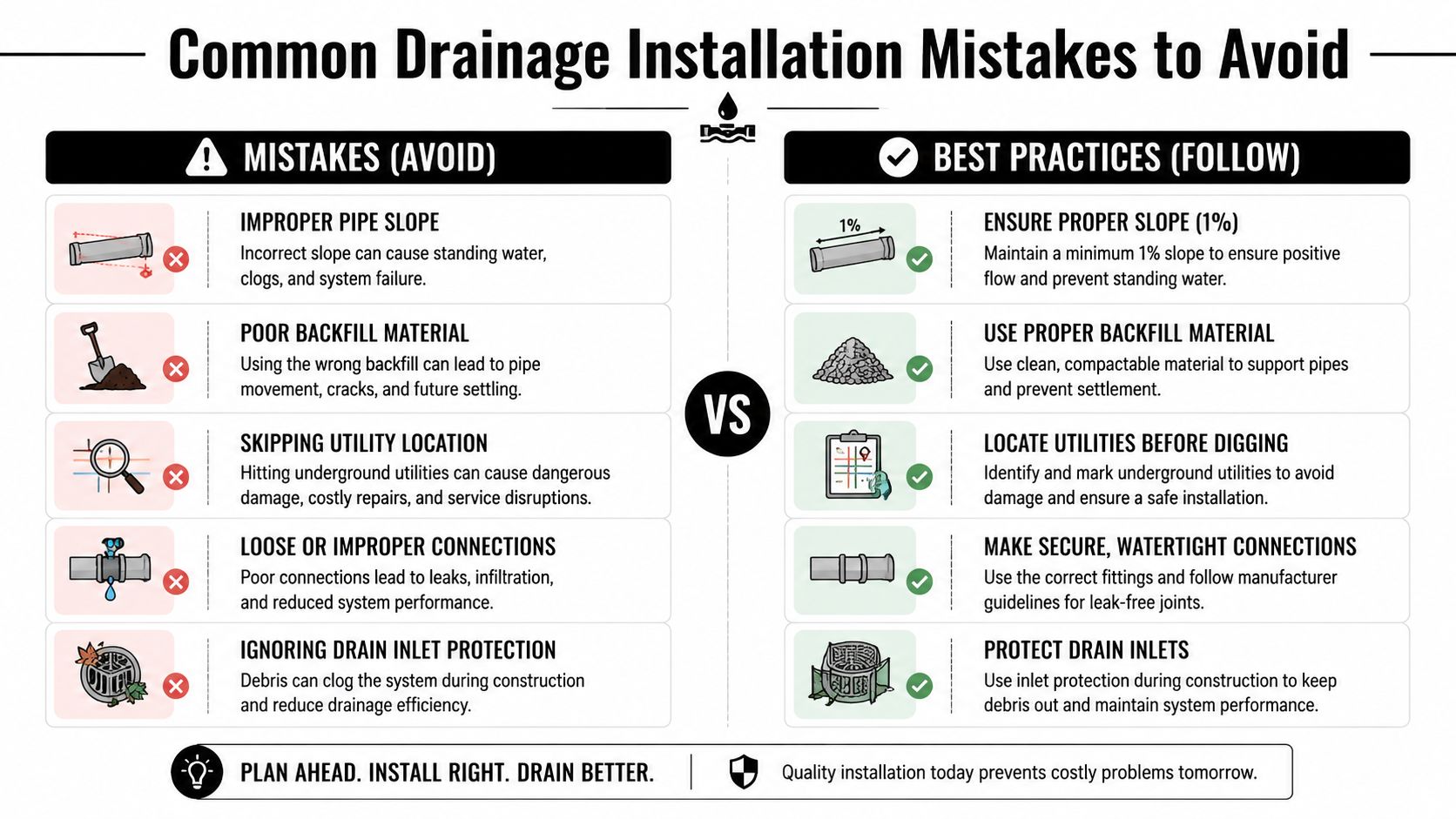
Many failed systems weren't ruined by the pipe itself. They failed because the installer treated the trench as a hole to fill instead of a structural support system. Flexible corrugated pipe is particularly dependent on uniform side support. If the embedment is weak or inconsistent, the pipe can deform beneath soil and surface loads, reducing its ability to carry water.
The errors that create delayed failures
- Skipping utility marking: Digging without calling 811 creates a safety risk and can force route changes after excavation has started. Mark the route and confirm local requirements first.
- Using point bedding: Rocks and bricks under the pipe create concentrated support instead of a continuous granular bed. Remove them and support the entire invert.
- Guessing the slope: A line with alternating highs and lows can hold water even when its average direction appears downhill. Verify the grade continuously before backfill.
- Offsetting joints: Misaligned fittings reduce the effective opening and provide places for solids to collect. Keep connections centered and smooth inside.
- Leaving out the filter layer: Perforated systems without appropriate fabric and clean stone can admit soil and silt. That material eventually restricts collection and flow.
- Undersizing the system: A line that cannot handle the contributing area may surcharge during storms. Consider roof, yard, driveway, and foundation water together.
- Stopping near the foundation: A pipe that ends beside the house has not solved the water problem. Route it to daylight, a drywell, an approved storm connection, or a sump pump as the site allows.
Why freeze-thaw exposes shortcuts
Pennsylvania, Maryland, Delaware, and New Jersey properties experience repeated seasonal changes that can move poorly supported soil and pipe. Water enters voids, freezes, expands, and later leaves softened or rearranged material behind. When the original trench contains uneven bedding or loose backfill, those cycles can worsen sags, settlement, and ice-related movement.
The risk isn't limited to the pipe. A settling trench beside a garage can pull soil away from an edge, affect a driveway transition, or leave a low area that sends runoff toward a slab. A shed foundation or gazebo foundation may also settle unevenly if water remains trapped beneath its base.
A drainage system should be inspected while it is visible. Once the trench is buried, correcting a bad grade becomes excavation work again.
After installation, look for fresh depressions, erosion at the outlet, exposed fabric, slow discharge, or renewed ponding after rain. These signs don't identify the exact cause by themselves, but they justify an inspection before the problem spreads to the foundation, pavement, or pad.
Drainage Installation Costs and When to Hire Firm Foundations
Residential drainage installation commonly falls between $3,000 and $7,000, while maintenance is often estimated between $300 and $800, according to the residential drainage cost discussion in this footing drain installation guide. Those figures are planning references, not a substitute for a site-specific quote. Trench length, soil, access, surface restoration, pipe material, foundation proximity, and outlet complexity can change the total considerably.
The outlet often creates the biggest difference between a straightforward project and a difficult one. Daylight discharge may require a manageable route, while a sump connection, drywell, municipal storm connection, or constrained property line can require additional planning and work. Homeowners comparing shed foundations near me, garage foundation contractors near me, or gravel shed foundation contractors near me should ask whether drainage and final grading are included in the proposal.
When professional installation makes sense
A capable homeowner may handle a small, open yard project with safe access, a clear outlet, and no structural risk. Professional excavation is the safer choice when the work involves:
- Deep trenching near a foundation: Excavation can affect soil support and wall conditions.
- Utility conflicts: Marked lines, restricted access, and complicated routes require careful planning.
- Freeze-thaw exposure: Bedding, side support, and backfill quality need close control.
- Foundation or slab work: Drainage must coordinate with house foundations, concrete foundations, garage footings and foundations, or a base for a storage shed.
- Uncertain discharge: The water must have a legal and hydraulically suitable destination.
Firm Foundations is licensed and insured, serving Pennsylvania, Maryland, Delaware, and New Jersey since 2011. Its excavation and foundation work can include trench preparation, stable bases, drainage coordination, gravel pads, concrete slabs, garage foundations, shed pads, gazebos, barns, driveways, and patios. If you're also searching for concrete contractors, driveway contractors near me, or a contractor for cement foundations for a garage, ask for a quote that clearly separates excavation, drainage, concrete, grading, and restoration. You can also review this French drain installation cost guide when comparing project scopes.
Firm Foundations can evaluate your drainage route, trench conditions, outlet, and nearby foundation or pad before work begins. Visit Firm Foundations to request a free, transparent quote for drainage pipe installation, excavation, a shed foundation, garage foundation, or concrete foundation built for Mid-Atlantic conditions.