
Concrete Patio vs. Deck: Make the Right Choice
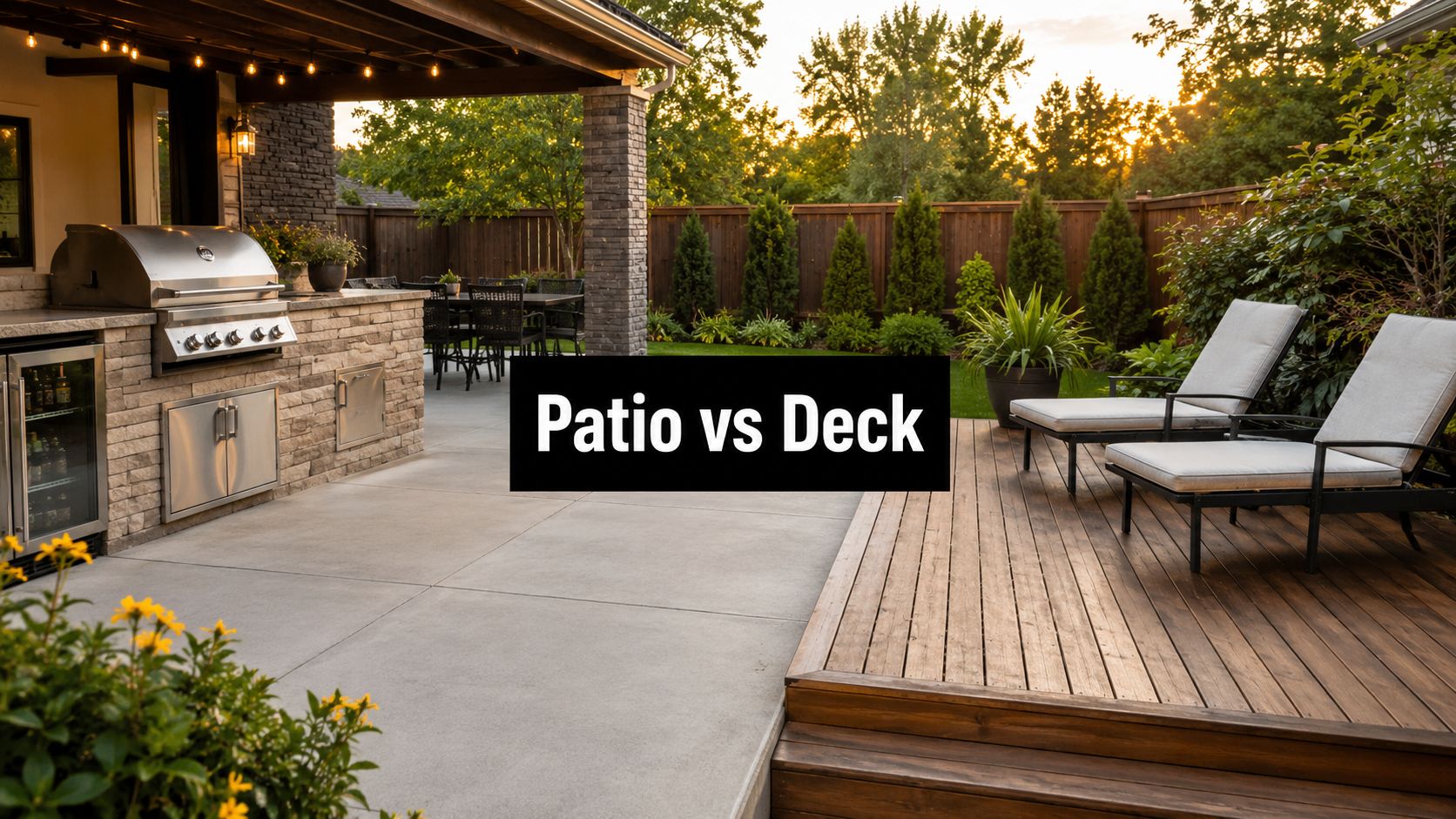
Outdoor projects usually start the same way. You step into the backyard, look at the slope, the grass that never quite grows right, the muddy area near the back door, and start thinking about what the space could become. A clean area for grilling. Room for patio furniture. A stable place for a gazebo, hot tub, or outdoor kitchen. Somewhere that works in spring, summer, and fall across Pennsylvania, Maryland, Delaware, and New Jersey.
Then the question arises. In the concrete patio vs deck decision, which one makes sense for your property, your budget, and the way you'll use the space years from now?
That choice affects more than appearance. It affects excavation, drainage, long-term maintenance, usable weight capacity, and how easily your outdoor project can connect to future work like a shed foundation, garage slab, or a base for storage shed expansion. Homeowners often focus on what they see from the kitchen window. Contractors have to think about what sits underneath it.
Choosing Your Backyard's Future
A lot of homeowners already know what they want the backyard to feel like before they know what they should build. They want easy weekends. They want a place where the grill doesn't wobble, the chairs don't sink, and rainwater doesn't pool against the house. They want something that still makes sense after a few winters and a few humid summers.
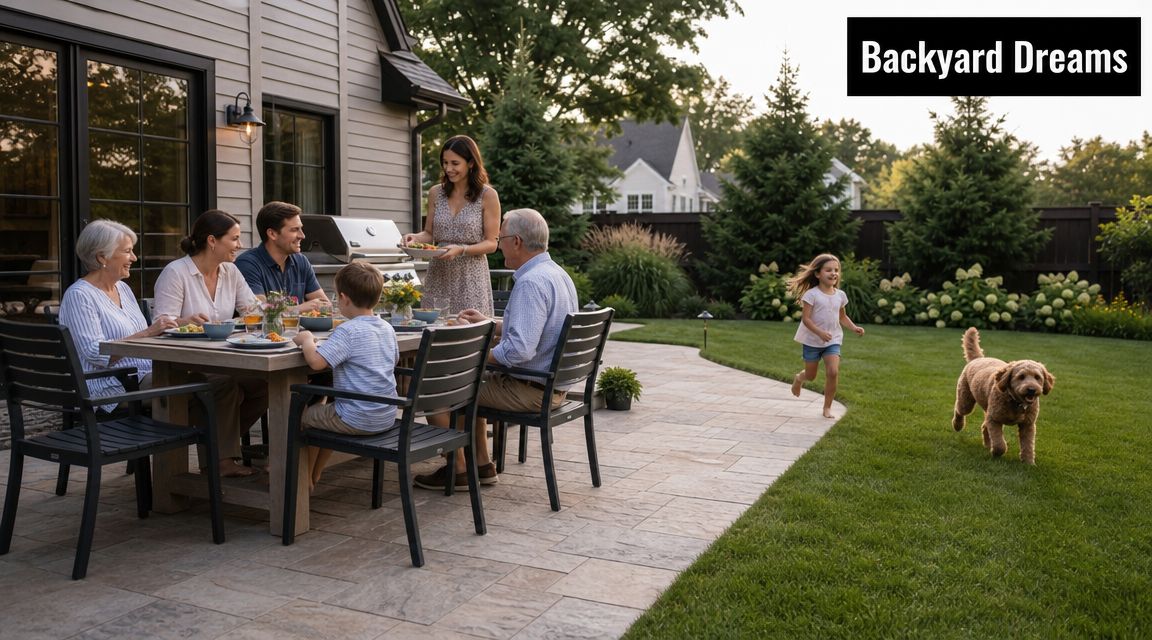
In this region, that decision has to account for real site conditions. A backyard in southeastern Pennsylvania may have rolling grade and heavy clay. A property in Delaware may look flat but hold water after storms. A home in Maryland or New Jersey may have a raised back door that makes ground-level access less convenient. The right choice isn't always the one that looks best in a photo. It's the one that fits the land and holds up under use.
What homeowners are usually deciding between
Early on, individuals are balancing a few practical concerns:
| Factor | Concrete patio | Deck |
|---|---|---|
| Typical placement | At grade | Raised or partially raised |
| Structure | Slab on prepared base | Framed platform on posts and footings |
| Best fit for | Flat yards, heavy features, low-maintenance use | Sloped lots, raised doors, elevated living space |
| Ongoing care | Usually simpler | Usually more involved |
| Project feel | Solid, grounded, flexible for hardscape uses | Elevated, architectural, better for height changes |
A backyard feature should match the property first and the style second. When that order gets reversed, problems usually show up later as drainage issues, movement, or expensive upkeep.
Homeowners who are also planning a gazebo foundation, concrete foundations for a future garage, or a shed pad should think about the whole property as one system. The patio vs deck decision doesn't sit by itself. It affects grading, drainage paths, traffic flow, and where future structures can go.
The regional factor matters
Freeze-thaw cycles, humidity, and stormwater all matter here. So does how your yard transitions away from the house. A beautiful project built on poor prep won't age well. A simpler project built correctly usually will.
That's why the first decision isn't really decorative. It's foundational.
Understanding the Foundational Differences
The simplest way to understand concrete patio vs deck is to look at how each one carries weight into the ground.
A patio is a surface built at grade. In most concrete installations, that means excavation, base preparation, forms, reinforcement as needed, and a slab poured over a prepared area. It behaves much more like the kind of foundation work used for a shed foundation, a gazebo foundation, or a durable base for storage shed placement than people realize. The slab depends on what's beneath it.
A deck works differently. It's a framed structure that stands above grade on posts, beams, and connectors. Independent guidance notes that a patio is generally a single slab at grade, while a deck is a raised framed structure supported by posts, beams, and connections, which increases material count, labor, and maintenance exposure. The same guidance also notes that patios are better suited to flat sites and heavy fixed features because the load transfers directly to the ground, while decks make more sense where elevation changes make a slab impractical, as outlined in this deck vs patio comparison.
Why that changes the whole project
When a slab fails, the problem is usually below the concrete. Poor compaction. Weak base. Bad drainage. In foundation work, that's familiar territory. The same thinking applies whether you're building a shed foundation gravel base or planning a patio area that needs to stay level and drain properly.
A deck introduces more moving parts. Every footing location, post, beam connection, ledger detail, and framing decision affects performance. That doesn't make decks bad. It means decks are more dependent on a larger set of structural components.
For homeowners comparing both options, this is the practical difference:
- With a patio, success starts with excavation, grading, compaction, and base prep.
- With a deck, success depends on footing layout, framing quality, attachment details, and long-term inspection of the structure.
- With either one, bad site prep creates expensive consequences.
How this connects to foundation work
If you've looked into concrete pads for decking, you've already seen the overlap. Some outdoor projects need a slab. Some need isolated footings. Some need both because the property has mixed elevations or a future phase planned for a hot tub, barn shed, or detached garage.
Field observation: Homeowners often think they're choosing between wood and concrete. They're really choosing between two completely different structural systems.
That's why the site should make the first argument. If the yard is flat and the use is heavy, a slab often fits naturally. If the yard drops away quickly from the house, a framed platform may solve a problem that concrete would fight.
Comparing Cost and Lifetime Value
The initial quote matters. It should. But with outdoor construction, the better question is what you're buying over the full life of the project.
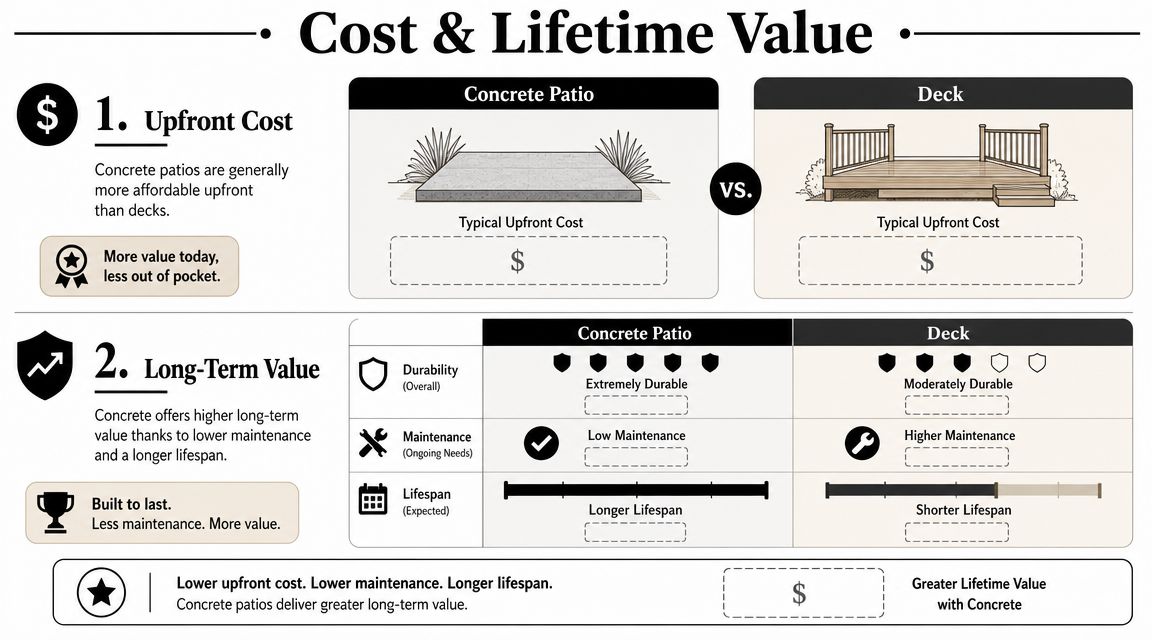
One industry resource puts concrete patios at about $4 per square foot, while a basic pressure-treated wood deck is about $6 per square foot and averages about $9 per square foot when substructure and fasteners are included. For a direct example, a 12×16 poured concrete patio is estimated at $2,800 to $4,600, compared with $6,800 to $9,800 for a pressure-treated wood deck of the same size, according to this decks.com cost comparison.
Upfront cost comparison
Those numbers line up with what many homeowners find once labor, framing, fasteners, and structure are fully accounted for on a deck.
| Project type | Cost reference |
|---|---|
| Concrete patio | About $4 per square foot |
| Basic pressure-treated wood deck | About $6 per square foot |
| Pressure-treated wood deck with substructure and fasteners | Averages about $9 per square foot |
| 12×16 poured concrete patio | $2,800 to $4,600 |
| 12×16 pressure-treated wood deck | $6,800 to $9,800 |
If your top priority is upfront affordability, a concrete patio usually starts with a clear advantage. That's one reason patios come up so often in quote requests for homeowners planning an outdoor seating area, a hot tub pad, or a wider hardscape zone that may later connect to driveway work or another slab.
Looking past the first invoice
A lower initial price doesn't automatically mean better long-term value. The question is what kind of upkeep you're taking on.
Concrete usually asks for less routine attention. Wood decks usually ask for more. Boards weather. Fasteners loosen. Surfaces need regular care to keep the deck looking good and to protect exposed materials. Composite products can reduce some of that upkeep, but they change the budget on day one.
If you're also thinking about screens, roof structures, or seasonal enclosure options, it helps to review the benefits and costs of enclosures before locking in the base structure. The enclosure decision can change how much value you get from either a patio or deck.
The cheapest proposal on paper isn't always the lower-cost project over time. Outdoor structures keep billing you after install, either in maintenance hours or repair dollars.
For homeowners pricing a slab, this concrete patio slab cost guide is useful because it keeps the conversation focused on prep, conditions, and scope instead of just square footage.
Where value usually lands
A patio often wins when you want:
- Lower entry cost
- A solid surface for heavier features
- Less ongoing upkeep
- A project that fits into a broader concrete plan on the property
A deck often makes sense when the height advantage is worth paying for. If the back door sits high, if the yard falls away fast, or if the layout demands raised access, a deck can justify the additional expense.
Durability Maintenance and Local Climate
Outdoor construction in Pennsylvania, Maryland, Delaware, and New Jersey doesn't get judged on install day. It gets judged after wet springs, humid summers, leaf buildup in fall, and repeated freeze-thaw cycles in winter.
That's where concrete patio vs deck becomes less about style and more about exposure.
How each system handles the region
Concrete doesn't rot, and it doesn't invite the same pest issues that affect wood. When the base is prepared correctly and drainage is handled well, a patio gives homeowners a straightforward surface that's easy to use for furniture, grills, and everyday traffic.
That said, concrete isn't magic. If the subgrade is weak, water sits under the slab, or the patio is poured without proper control planning, you can still end up with cracking and movement. Good concrete work starts before the truck arrives.
A wood deck lives with more exposure points. Boards face moisture. Framing connections live through seasonal expansion and contraction. Organic debris gets trapped in corners. If you choose pressure-treated lumber, it helps to understand how that material behaves over time. This pressure treated decking guide offers a useful plain-language overview for homeowners comparing maintenance expectations.
Why structural complexity matters
A patio is still vulnerable to site mistakes, but the structure itself is simpler. A deck has more components out in the weather, and each one is a maintenance item over time.
Here's the practical distinction homeowners should keep in mind:
Concrete patio
Fewer exposed structural parts. More dependent on proper grading, compaction, and drainage from the start.Wood deck
More exposed structural parts. More likely to need ongoing inspection, surface care, and replacement of individual components over time.Composite deck
Less surface maintenance than wood in many cases, but still relies on a framed system beneath it.
In this region, long-term durability usually comes down to water control first. Material choice matters, but drainage and base prep decide whether that material gets a fair chance to last.
Climate-specific reality
In flat yards, a patio often performs well because the load goes straight into the ground and the surface stays easy to use for heavier features. In sloped yards, trying to force concrete into a site that really wants a framed structure can create its own problems.
Wood decks can be the right answer when elevation changes make a slab awkward or expensive to integrate. They also keep you from having to overbuild retaining conditions just to create a level outdoor area.
The point isn't that one always lasts longer. The point is that each system has conditions where it naturally performs better. In the Mid-Atlantic, the project that fits the site usually ages better than the one chosen for appearance alone.
Installation Process and Site Preparation
A backyard project can look simple from the patio door. Then the crew starts pulling grade stakes, checking drainage, and measuring elevations, and the true nature of the work becomes clear.
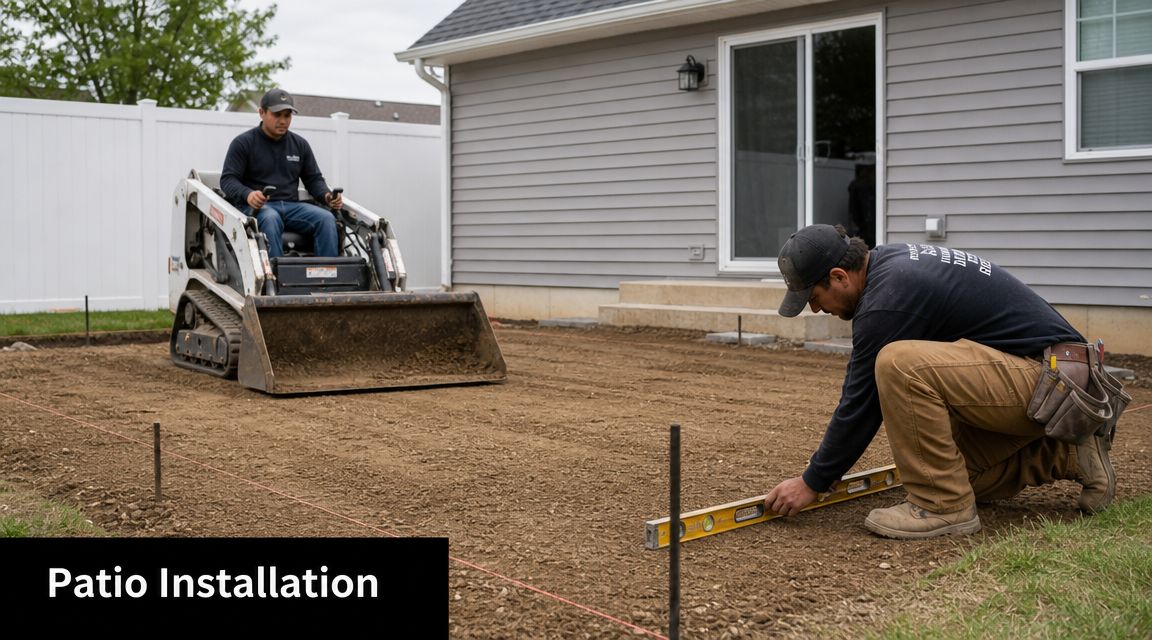
In PA, MD, DE, and NJ, site prep usually decides whether the finished space stays useful or turns into a nuisance. Freeze-thaw cycles, heavy spring rains, soft spots, and runoff from neighboring lots all show up before the surface goes in. Homeowners looking for excavation or concrete contractors often think they are buying a slab or a frame. They are really buying judgment about soil, drainage, access, and long-term layout.
What goes into a patio installation
A concrete patio starts below finished grade. The slab you see is the last step, not the first one.
Site evaluation
The crew checks slope, drainage direction, door height, access for equipment, and how the patio will connect to walks, steps, or future additions.Excavation and base preparation
Soil comes out to the right depth, weak material gets addressed, and a compacted gravel base goes in. This is the same site-prep logic used for shed pads, garage foundations, and other projects where a stable base matters more than the finished surface.Forms, reinforcement, and elevation control
Forms set the perimeter and final height. Reinforcement, control joints, and thickness should match the use of the space, whether that means a sitting area, grill zone, or a pad near heavier backyard features.Pour and finish
The surface texture and layout need to fit the job. A broom finish for traction, clean edges for mowing and drainage, and enough fall to move water away from the house all matter more than decorative details at this stage.
Wet yards need attention early. Before any slab or footing work, homeowners should find effective lawn drainage options so the new surface is not sitting in a problem area from day one.
How deck installation differs
A deck follows a different sequence because it is built on support points instead of a full ground-supported base. The crew lays out footings, digs to proper depth, sets posts or piers, and builds the framing system upward. After that come joists, decking, stairs, rails, and any house connection details.
That usually means less broad excavation but more structural coordination. A deck can be the cleaner solution on a sloped lot or where the back door sits high above grade. It also brings more individual components into the build, more hardware, and more inspection attention around spans, ledger attachment, and guard requirements.
This video gives a useful visual on how outdoor site prep and build sequencing come together on real jobs:
Why prep work deserves close attention
The wrong choice usually shows up before the first shovel goes in. A flat, open yard may be a strong candidate for concrete. A yard with elevation change, drainage conflicts, or limited access may push the project toward a deck, or toward a larger grading plan before either one makes sense.
This is also where long-term property planning matters. I have seen homeowners place a patio where they later needed a shed pad, a garage approach, or room to correct drainage around the house. A foundation contractor specializing in site prep and concrete work should look at the whole yard, not just the footprint of today's project.
Build sequence rule: If the conversation stays on color, stamp pattern, or board style and skips drainage, compaction, elevations, and future use, the project is being discussed in the wrong order.
The best installs leave options open. A patio, deck, shed base, and future garage foundation should fit one sensible site plan instead of competing for the same space later.
Best Uses for Patios and Decks
The easiest way to settle the concrete patio vs deck decision is to match the structure to the way you'll use it.
When a concrete patio is usually the better fit
A homeowner with a flat backyard in Delaware wants a clean outdoor dining area, space for a grill, and a future gazebo foundation. They don't want stairs, and they don't want to spend weekends keeping up with boards and railings. That's a patio job.
A family in Maryland wants to place a hot tub and keep the surrounding area easy to sweep, hose off, and furnish. That also points strongly toward concrete. Heavy, fixed features generally belong on ground-supported construction when the site allows it.
A homeowner in New Jersey plans the backyard in phases. First a patio. Later a base for storage shed use, then maybe a concrete foundation for garage expansion. In that case, keeping the property on one coordinated grading and hardscape plan usually makes life easier.
When a deck earns its place
A house in Pennsylvania has a back door that sits well above the yard. The lot drops away quickly, and stepping down to a slab would take a long stair run and a lot of grade manipulation. A deck solves the access problem cleanly.
Another common example is a walkout-style backyard where the owner wants the entertaining area level with the main floor. A deck can create that connection without reshaping the entire site.
A practical way to look at it:
- Choose a patio if you want ground-level living, a solid surface, lower upkeep, or support for heavier fixed features.
- Choose a deck if your yard is sloped, your home sits high off grade, or raised access matters more than a ground-level slab.
- Consider both if the property naturally supports an upper deck with stairs down to a lower patio zone.
Some of the best backyard layouts use each material where it performs best. Height gets handled by a deck. Weight and gathering space get handled by a patio.
The property plan matters more than the feature
Homeowners often shop for a single project. The smarter move is to plan around traffic flow, drainage, and future additions. If you already know you'll need garage foundation contractors near me, concrete foundations for an outbuilding, or a barn shed pad later, choose the outdoor structure that keeps those future options open.
Your Decision Checklist and Next Steps
By the time you narrow it down, the right answer is usually the one that fits your site with the fewest compromises.
Use this checklist before you request quotes.
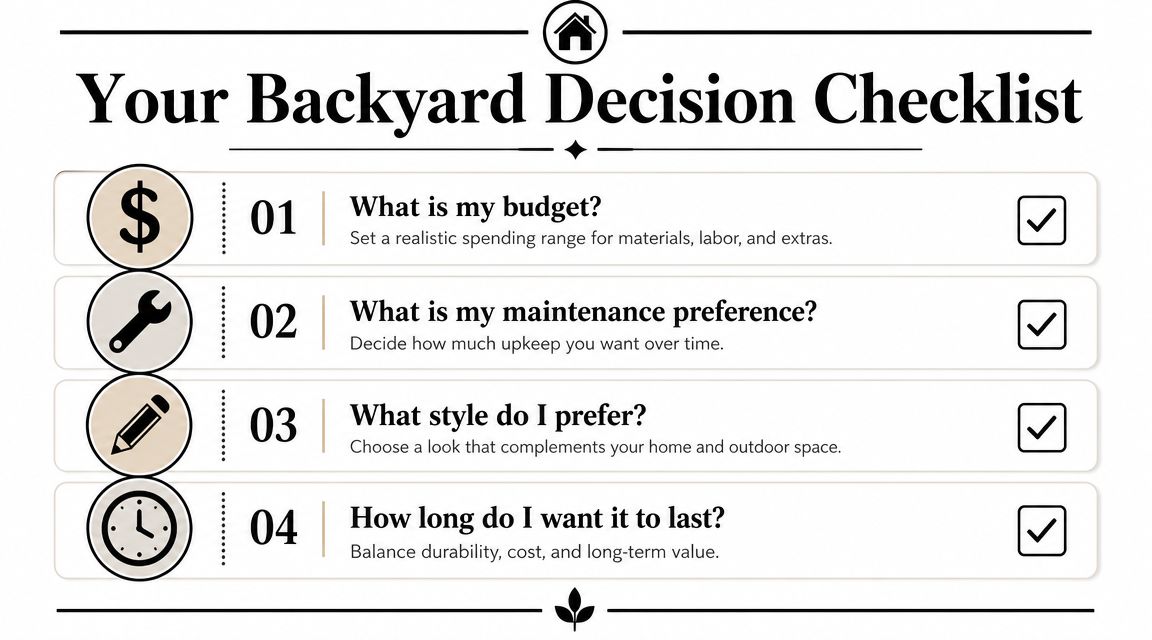
Questions worth answering first
What does the yard already want to do
Is it flat, sloped, wet, soft, or hard to drain?How will you use the space
Light seating, grilling, a gazebo foundation, outdoor kitchen, hot tub, or daily entry from the house?What kind of maintenance are you willing to live with
Be honest here. Some homeowners like upkeep. Most don't.Will this project connect to future work
Think about shed foundation plans, garage footings and foundations, driveway work, or a larger house foundation or excavation project later.Do you need a surface or a raised structure
Ground-level use points one direction. Height changes point the other.
A simple rule of thumb
If your yard is reasonably flat and you want a durable, ground-supported surface with fewer moving parts, a concrete patio usually makes more sense.
If your home or lot geometry creates a height problem, a deck may be the right structural answer even if it costs more and asks more of you later.
A good quote should address drainage, subgrade conditions, access, and intended use. If those topics aren't part of the conversation, you're not getting the full picture.
If you're weighing a patio, shed pad, gazebo foundation, garage slab, or broader excavation project in Pennsylvania, Maryland, Delaware, or New Jersey, Firm Foundations can help you start with the right base and a clear quote. The goal is simple. Match the structure to the site, prepare the ground correctly, and build something that still makes sense years from now.