
Concrete Pads for Decking: Build a Solid 2026 Foundation
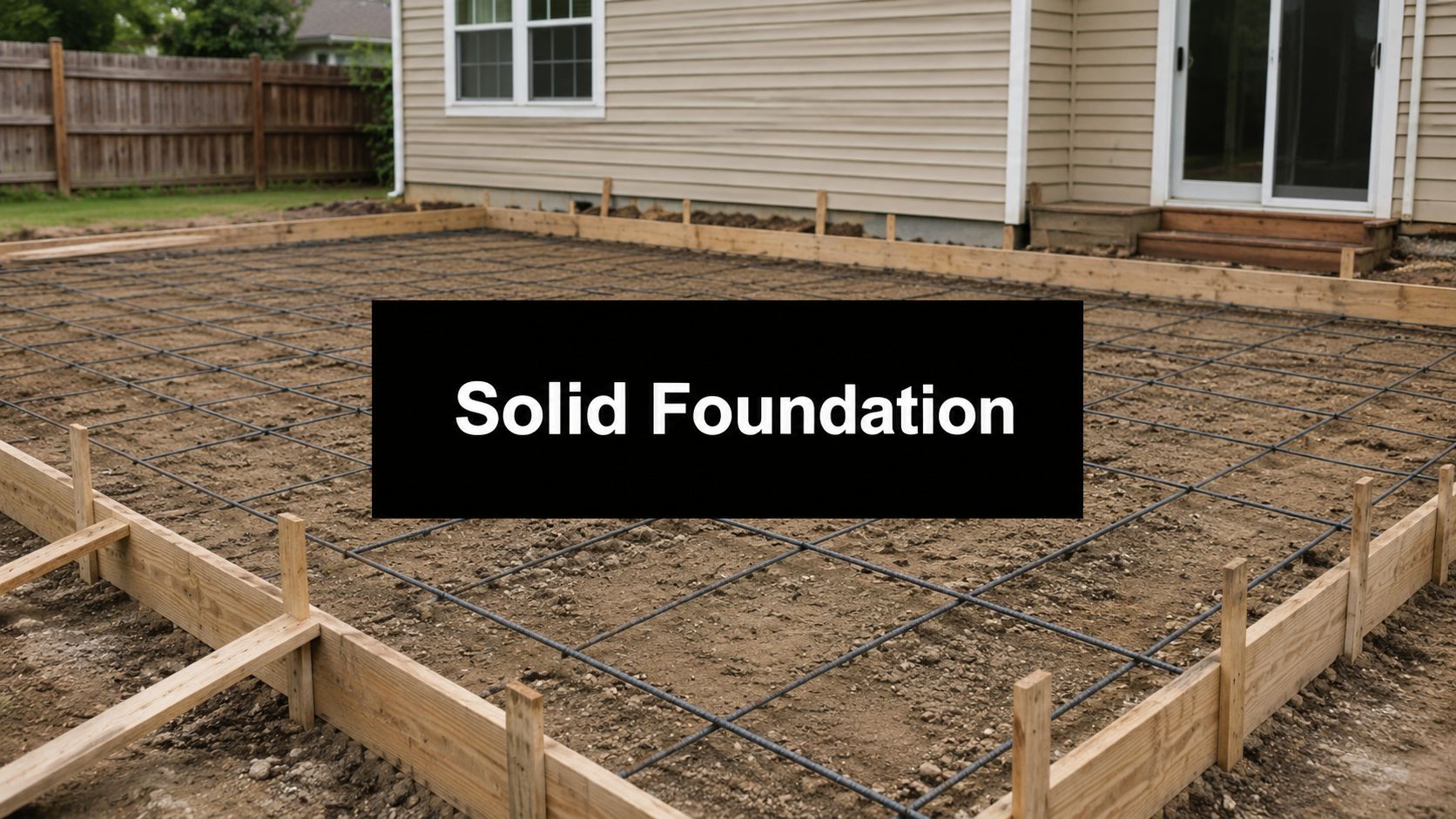
You're probably looking at the fun part first. Deck boards, railing style, stair layout, maybe a spot for a grill or a quiet seating area. Then the practical question shows up: what is this deck going to sit on, and will that base still be solid after years of rain, freeze-thaw cycles, and heavy use?
That question matters even more in Pennsylvania, Maryland, Delaware, and New Jersey, where soil conditions, drainage, and winter movement can change from one property to the next. A deck can look great on day one and still develop problems later if the support system wasn't matched to the site.
For homeowners searching for concrete foundations, gazebo foundation work, a shed foundation, or even garage footings and foundations, the same rule applies. The visible structure gets the attention, but the foundation decides how long it lasts. Concrete pads for decking can be the right choice, but only when they fit the actual job and the actual ground.
Why Your Deck's Foundation Matters Most
A deck can look finished and still be headed for trouble. The surface stays straight through the first few cookouts, then winter passes, spring rain sets in, and one corner starts to sit lower than the rest. A railing loosens. A door near the ledger binds. What changed was usually below grade.
That is why the foundation deserves a harder look than the visible materials. Concrete pads for decking are load-bearing support points. If the pad is too small, too shallow, or placed on soil that was never properly prepared, the framing above has to absorb that movement.
For homeowners in PA, MD, DE, and NJ, the first question should not be whether concrete sounds stronger. It should be whether a concrete pad is the right foundation for this deck, on this soil, with this drainage pattern, and at this height. The same question matters if you are checking an older deck and trying to decide whether an existing pad can stay in service or needs replacement.
What usually goes wrong first
In this region, early foundation trouble usually starts with soil movement and moisture, not with the deck boards.
- Frost heave: Water in the soil freezes and lifts one support point higher than the others.
- Differential settlement: One pad bears on weaker or wetter soil and drops more than the rest.
- Post rotation: A support point that lacks proper bearing or connection lets the post drift out of plumb.
- Moisture exposure: Poor height and layout leave framing too close to grade or standing water.
Those problems show up in ways homeowners notice fast. Gaps open where they were not there before. Stairs pull away slightly. Railings feel less rigid. The deck may still stand, but it stops behaving like a properly supported structure.
A quick site check tells you a lot. Look for water holding near the pads after rain. Check whether the tops of the supports are still level with each other. Probe around the base for washout, soft soil, or roots that were never removed. On an existing deck, cracking alone does not always mean failure. Vertical displacement, tilting, settlement, and loose post connections are the bigger warning signs.
Why homeowners ask about concrete first
Concrete has earned its reputation. Installed at the right size and depth, it carries load well and gives a deck a permanent base. For heavier builds, long-term use, and sites where movement is a concern, that can be the right call.
But the value is not just that it is concrete. The value comes from matching the foundation type to the job. A small low deck on stable, well-drained ground may not need the same support approach as a larger structure with stairs, roof load, or a hot tub. Good foundation work starts with diagnosis, not habit.
That same mindset applies whether the finished surface is built with composite boards or premium timber decking. Surface materials affect appearance and maintenance. The support system determines whether the structure stays level, safe, and worth keeping.
At Firm Foundations, we treat deck foundations the same way we treat shed pads, gazebo bases, and garage footings. We look at the ground first, then the load, then the footing choice. That approach prevents expensive cosmetic fixes from covering up a support problem that should have been addressed at the start.
Choosing Your Deck's Support System
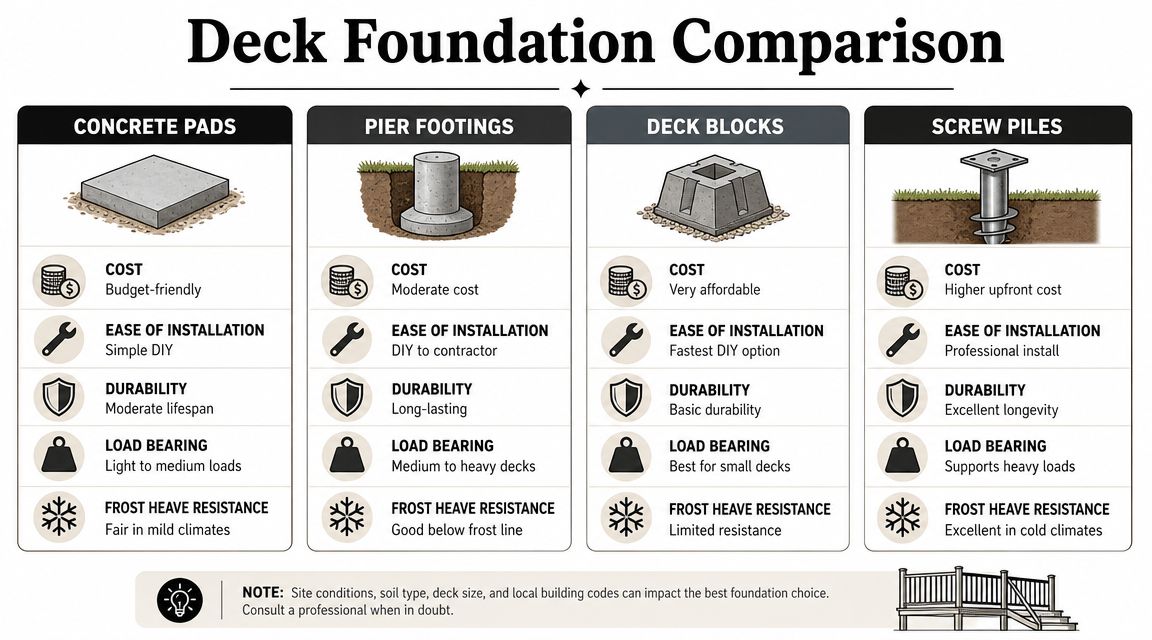
Not every deck needs the same support system. Some sites call for full concrete work. Others are better served by pier footings, blocks, or an adjustable system that handles a low-clearance layout without overbuilding the base.
That's where a lot of online advice falls short. It treats concrete as the automatic answer. In practice, footing choice should follow the site, the load, and how permanent the structure really is.
When concrete pads make sense
Concrete pads for decking are usually the better fit when you're building for long-term use and want a support system that behaves like part of the structure, not a temporary base. They're especially worth considering when the deck carries more weight, the site has challenging soil, or you need a foundation strategy that can be laid out precisely for posts and beams.
Poured concrete footings and precast concrete footings are the two common concrete options used to support posts with metal brackets, and another construction guide describes concrete piers as the most common type of deck footing while noting that concrete blocks are seldom used for permanent builds (market context and footing types from Grand View Research).
When another option may be smarter
A lighter floating deck, a simple platform, or a structure that may be modified later doesn't always justify a full concrete approach. The footing type should adapt to the conditions. Poured concrete footings are particularly effective on steep slopes or soft soil, while blocks are typically reserved for small, low-load projects (deck footing selection by site conditions from Decks & Docks).
Here's the practical comparison:
| Support type | Where it works well | Main limitation |
|---|---|---|
| Concrete pads | Permanent decks, heavier loads, precise post support | More excavation and less flexibility later |
| Pier footings | Sloped sites, soft soil, elevated decks | Layout and depth must be exact |
| Deck blocks | Very small, low-load, low-clearance projects | Not a substitute for true footings on demanding sites |
| Adjustable systems | Reconfiguration, low-clearance builds, drainage-sensitive layouts | Still needs sound bearing and careful planning |
Concrete is often the right answer. It just isn't the right answer by default.
A better question than which material is strongest
The better question is: what support system fits the way this deck will be used on this property? Strength matters, but so do drainage, slope, access for excavation, frost conditions, and whether the owner wants a permanent installation or something more adaptable.
If you're still choosing finish materials, it can help to look at examples of premium timber decking while thinking through how the framing and foundation below will support that surface over time. Good-looking boards can't make up for a base that moves.
For homeowners searching terms like shed foundations near me, gravel shed foundation contractors near me, or garage foundation contractors near me, the same comparison mindset is useful. The right base is the one that fits the structure and the ground, not the one that sounds heaviest.
Planning Your Footings for Load and Frost
A deck can look perfectly straight on install day and still start moving after its first hard winter. I see that when footings were laid out by rule of thumb instead of by the actual conditions in the yard. Concrete pads for decking work well only when the load, soil, water movement, and frost depth all point to the same solution.
Load starts with use, not just size
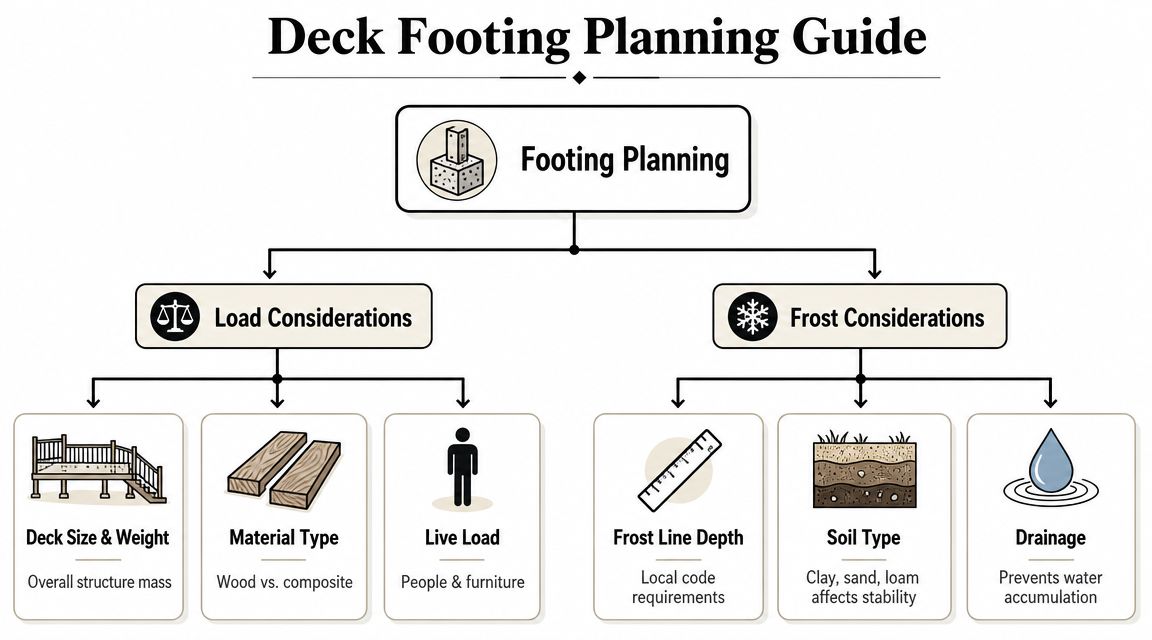
A small platform deck and a large entertainment deck can sit in the same neighborhood and need different footing plans. The reason is simple. Footings carry more than lumber. They carry furniture, people, grill stations, snow, and the concentrated load at each post location.
So the first question is not “How big is the deck?” It is “What will each support point be asked to carry, and can this soil bear it without settling?”
That is also where homeowners in PA, MD, DE, and NJ need a little caution. Regional code requirements may be similar from town to town, but site conditions are not. A sandy, well-drained lot behaves very differently from a shaded backyard with clay and runoff washing toward the house. Two decks with the same framing plan may not be good candidates for the same pad size or spacing.
Frost depth decides whether a pad stays put
Frost heave is what turns a decent-looking install into a call-back. If a footing is too shallow, or if water collects around it and freezes, the ground can lift one support point higher than the next. That shows up as racking, uneven stair landings, doors that start sticking, and rails that no longer feel solid.
In this region, frost planning is not paperwork. It changes the excavation depth, the amount of spoil removed, and sometimes whether a simple pad approach makes sense at all. On some sites, concrete pads are the right choice. On others, deeper piers or a different support system are the safer call because the soil stays wet or the deck sits high enough that movement becomes more noticeable.
A good footing plan accounts for:
- Soil type. Clay can hold water and shift more than compact, granular soil.
- Drainage patterns. Downspouts, slopes, and low spots often matter as much as the soil itself.
- Post layout. Wide spacing can overload individual bearing points if the framing above is not planned correctly.
- Seasonal loading. Snow exposure and winter moisture affect how much stress reaches the footing and how the ground reacts.
How to judge whether an existing pad is suitable
This is the diagnostic part that gets skipped too often. An existing concrete pad is not automatically usable just because it looks intact from above. Surface appearance tells only part of the story.
Check the pad's thickness, width, depth below grade, and whether it was placed on stable bearing soil. Look for signs of movement around the perimeter, post bases pulling out of square, cracks that line up with settlement, or standing water that sits against the support point after rain. If the deck above has soft spots, a visible slope, or gaps opening at connections, the problem may be below grade.
For homeowners trying to sort out whether a pad can stay, this plain-language guide to concrete footings and foundations gives useful background. For a related post-setting example, these lasting fence foundation techniques show why depth, drainage, and bearing preparation matter anywhere posts have to resist seasonal ground movement.
At Firm Foundations, this is usually where the right answer becomes clear. If the soil is stable, drainage is controlled, and the loads are modest, concrete pads can be a sound long-term choice. If any of those conditions are off, the pad may need to be resized, deepened, reinforced differently, or replaced with another footing system.
Concrete pads for decking are a good option when the site supports them. They are a poor shortcut when the ground does not.
Concrete Mix and Reinforcement Choices
A concrete pad is only as good as the material inside it and the way it was specified. Homeowners often hear “we'll pour concrete” as if that settles the question. It doesn't. Concrete for structural support needs to match the intended use, the climate, and the load path above it.
That matters because not every slab or pad is doing the same job. A deck support point behaves differently than a patio surface, and a pad for decking shouldn't be treated like generic flatwork.
What actually affects performance
For slabs and deck-supporting systems, the performance of the assembly depends on the deck depth and steel gauge, and the concrete placed above it is typically structural concrete, available as normal-weight concrete at roughly 145 to 155 pcf or lightweight concrete around 110 pcf. The same guidance notes that 1.5, 2, and 3 inch composite deck profiles are selected based on span and slab requirements (structural concrete and deck profile guidance from MetalDeck).
For homeowners, the lesson is straightforward. Heavier isn't automatically better. The concrete choice has to work with the load, the support spacing, and the conditions on site.
Reinforcement is part of the system
Reinforcement gives concrete better resistance where plain concrete alone is weaker. That may include rebar, welded wire, or another reinforcement plan called for in the design. The point isn't to throw steel into every pour and hope for the best. The point is to match reinforcement and pad thickness to the actual structural job.
A sound specification usually asks:
- What load is this pad carrying
- How is that load transferred into the concrete
- What climate will the pad live in
- What reinforcement fits that geometry
That's also why a deck base shouldn't be copied from a driveway detail, a patio detail, or a small shed pad detail unless the structural demands are similar. A concrete foundation for garage work, for example, follows a different loading logic than a modest backyard deck, even if both involve excavation, forms, and concrete.
One-size-fits-all pours create long-term problems
A generic pour might look fine when the forms come off. The trouble shows up later as cracking, edge breakdown, movement at hardware locations, or uneven support under posts. Structural concrete is a system of material choice, thickness, reinforcement, drainage, and curing, not just a truck delivery.
That's why good deck foundation work starts with specification, not just scheduling.
The Foundation Building Process from Start to Finish
A deck can look square and level on build day and still develop problems a season later if the foundation work was rushed. Around PA, MD, DE, and NJ, the jobs that hold up are the ones where the crew reads the site correctly before a shovel goes in the ground. That matters even more if you are deciding whether concrete pads are the right support system for your deck at all, or whether an older pad under an existing deck is still worth building on.
How a proper install unfolds
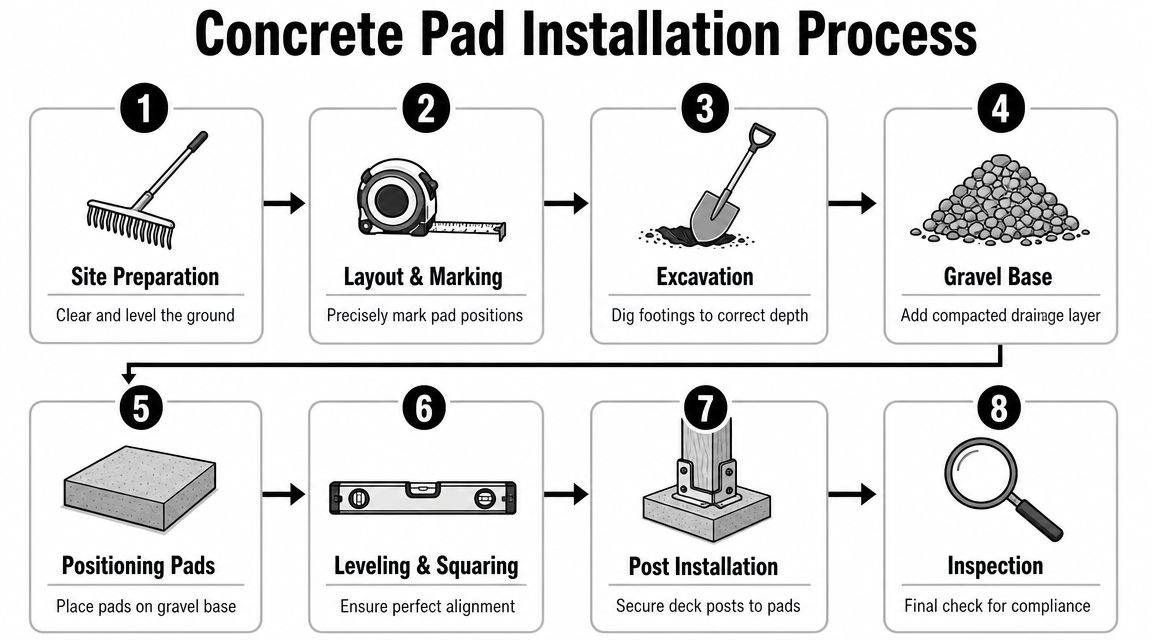
The order of work matters because each step affects the next one. Drainage has to be understood before excavation. Layout has to be confirmed before forms are set. Elevation mistakes made early usually show up later as crooked framing, shimmed posts, or uneven beam bearing.
Site preparation
Vegetation, loose topsoil, buried debris, and wet spots are dealt with first. If water already sits in the deck area, a pad alone will not fix the problem. The drainage issue has to be addressed before concrete placement.Layout and marking
Post locations, beam lines, and finished heights are marked from the framing plan. This is also the point where a good contractor confirms that the chosen footing style still makes sense for the actual yard conditions, not just the drawing.Excavation to the correct depth
Depth is set by local code, frost exposure, soil conditions, and the deck design. In this region, shallow digging is one of the main reasons pads move, tilt, or heave through winter. Existing pads need the same scrutiny. If a homeowner wants to reuse one, I look at depth, thickness, cracking, edge condition, and whether the pad is bearing on stable soil or on disturbed fill.Base preparation and forming
The bottom of the excavation needs firm, consistent bearing. Forms or footing shapes are then built to match the actual support detail. A pad that works under one post size or bracket condition may be the wrong shape for another.Reinforcement placement
Reinforcement is placed where the design calls for it and held in position during the pour. Steel lying in the dirt does not help the concrete do its job.Concrete placement and finishing
Concrete is placed, consolidated, and finished so the pad supports hardware cleanly and stays on elevation. Sloppy placement creates headaches fast, especially when post bases need to line up with framing above.
Curing affects the whole schedule
Concrete does not gain working strength the moment the surface looks hard. Loading it too early can damage alignment, weaken bearing at brackets, or start small cracks that get worse with freeze-thaw cycling.
The safe schedule depends on the mix, the weather, and the load being applied. Cold temperatures slow strength gain. Wet conditions can interfere with the work around the footing. That is why experienced crews plan the sequence around curing time instead of treating it like dead time.
The mistakes that cost homeowners later
The failures I see most often are not dramatic. They are predictable.
- Shallow excavation: Footings shift in winter and the deck starts moving out of level.
- Poor water control: Saturated soil loses bearing strength and shortens the life of the support.
- Bad layout: Posts miss hardware locations, beams need correction, and framing gets forced into place.
- Rushed curing: Concrete gets loaded before it is ready and never performs as intended.
- Blind reuse of old pads: A pad can look acceptable from above and still be undersized, undermined, or cracked through below grade.
Homeowners comparing methods can get a useful overview from this guide on how to build a concrete pad for proper site prep, forming, and finishing. In practice, Firm Foundations handles this work as a full sequence that includes evaluating the site, checking whether pads are the right choice for the deck plan, preparing the ground properly, and building supports that fit local conditions.
What to Expect from Firm Foundations
Most homeowners don't call because they want a lecture on footing design. They call because they want to know whether their deck plan is sound, whether their site will support it, and what the job is really going to involve.
That's where a consultative approach matters. A useful estimate isn't just a price for concrete. It should answer whether concrete pads for decking are even the right move for your yard, your deck layout, and your long-term plans.
What affects the quote
The final cost can vary quite a bit from one property to another, even when the deck size looks similar on paper. Access for excavation, slope, soil behavior, drainage needs, and how much prep the site requires all change the amount of work involved.
Homeowners searching for concrete contractors, excavation near me, driveway contractors near me, or a house foundation often run into the same issue. The visible size of the project is only part of the cost. What's happening below the surface usually dictates the true scope.
A straightforward estimate should account for things like:
- Access to the site: Tight backyards and limited equipment access can change labor and sequencing.
- Existing conditions: Old patios, buried debris, poor drainage, and unstable soils all matter.
- Foundation type: A simple platform deck and a heavily loaded structure won't use the same support strategy.
- Finish goals: Post locations, bracket details, and elevation requirements affect layout precision.
The question most articles miss
A major gap in online advice is the failure to provide diagnostic criteria for using an existing concrete patio as a deck foundation. Most guides talk about the installation process, not whether the existing slab should be used at all. A proper assessment should check slope, drainage, slab thickness, and cracking to determine whether the pad can safely support concentrated post loads (diagnostic checklist gap discussed in this video reference).
That's the kind of question worth paying attention to before building starts. If an old slab drains toward the house, has movement cracks, or wasn't built for concentrated loads, building over it can lock a structural problem underneath a brand-new deck.
The cheapest base is often the one you already have. It's only a bargain if it's actually suitable.
What a dependable process looks like
When homeowners in Pennsylvania, Maryland, Delaware, and New Jersey ask for a quote, they should expect clarity from the first conversation. That means discussing the intended structure, reviewing the site, and recommending a foundation type that matches the use case instead of pushing one material for every job.
That same practical mindset helps whether you need shed foundation blocks, a shed foundation kit alternative, a 10×10 storage shed base, garage footings and foundations, or a base for storage shed that won't settle after the first wet season. The right recommendation may be concrete. It may be gravel. It may be another footing system altogether.
Homeowners and builders in places like Honey Brook Township and throughout the surrounding service area usually want the same things. A clear quote. Real answers about what will and won't work. Reliable scheduling. A finished foundation that supports the structure the way it should for the long haul.
If you're planning a deck and aren't sure whether new concrete, individual footings, or an existing pad is the smart choice, getting that evaluation first is the move that saves money and frustration later.
If you need a practical opinion on concrete pads for decking, an existing slab, or any foundation project in Pennsylvania, Maryland, Delaware, or New Jersey, contact Firm Foundations. You can request a quote, get a site-specific recommendation, and find out whether your project needs concrete, gravel, or a different foundation approach before construction begins.