
20×20 Pole Barn Guide for PA, MD, DE & NJ
A lot of homeowners start the same way. They stand in the yard, look at a crowded garage, a tractor sitting in the weather, or a growing pile of tools and seasonal equipment, and realize the property needs one more useful structure.
A 20×20 pole barn is often where that conversation gets serious. It’s compact enough to fit on many residential lots, but it still gives you enough room to create something that solves a real problem. For some families, that means vehicle storage. For others, it means a workshop, hobby space, or a cleaner way to organize equipment that’s been living in the wrong places for too long.
In Pennsylvania and across nearby parts of Maryland, Delaware, and New Jersey, the building itself usually gets most of the attention. People compare doors, siding, rooflines, and kits first. The smarter place to start is underneath it. The foundation decides whether the barn stays level, drains correctly, accepts the kit without fighting you, and holds up through Mid-Atlantic weather.
Your Guide to Building a 20×20 Pole Barn
A 20×20 project sounds simple on paper. In practice, it asks the same questions as much larger buildings. Where will water go after a storm? Is the site level enough to build on without overcutting? Will the post locations bear properly? Can vehicles enter without dragging mud into the structure? Will the layout still work once doors, shelving, and actual use get involved?
Those are the decisions that separate a useful barn from one that becomes a constant annoyance.
In Pennsylvania, a common example is the homeowner who wants a small garage behind the house and assumes the site is “close enough” because it looks flat from the driveway. Then layout begins, grade starts moving, and the project reveals a slope, soft spots, drainage issues, or access problems that weren’t obvious at first glance. None of that means the project is a bad idea. It means planning matters.
A good pole barn starts long before the first post goes in. The site and foundation determine how smoothly everything else goes.
The right approach is straightforward. Define how the building will be used. Match the foundation to that use. Confirm access, drainage, and local approvals before the building package is ordered. Then build from a layout that is square, stable, and ready for the structure you chose.
That’s how homeowners avoid the usual headaches. It’s also how a 20×20 pole barn becomes one of the most practical additions you can make to a property.
What Can You Do with a 400 Square Foot Pole Barn
A 20×20 pole barn provides 400 square feet of usable space, which makes it a compact but flexible option for residential and agricultural use, according to The Metal Shop’s 20×20 pole barn guide. That same source also notes that this size is a viable two-car garage option, alongside common two-car dimensions such as 20×22, 20×24, and 24×24.
That flexibility is why this footprint shows up so often on residential properties. It’s small enough to stay manageable, but large enough to solve a real storage or workspace problem.
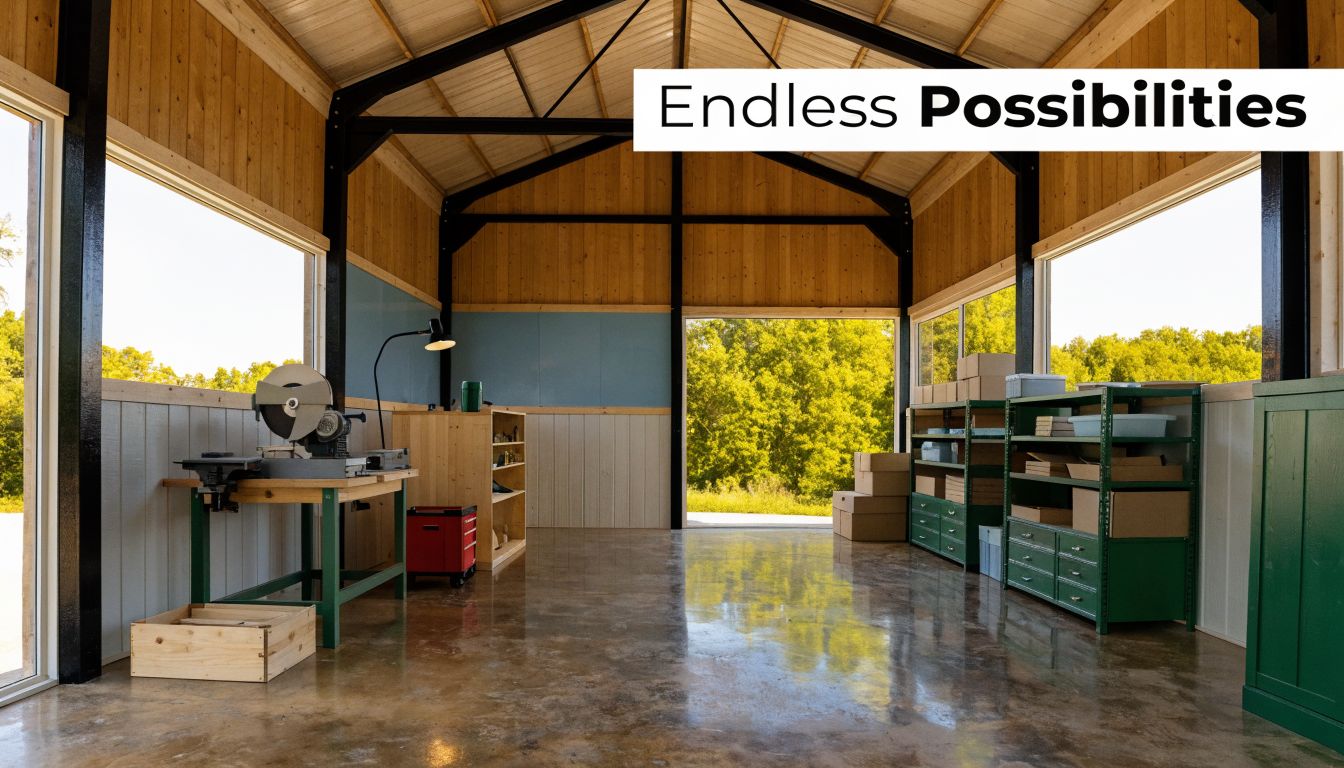
Two car garage use
A lot of homeowners first consider a 20×20 pole barn because they want covered parking. It can work as a two-car setup, but it’s important to treat it as a practical minimum, not a roomy luxury.
If you’re parking two vehicles, layout becomes everything. Door placement, wall clearance, and where you plan to store tools or a mower all matter. A space that works well on day one can feel tight very quickly if the walls get lined with cabinets, shelving, or bikes.
For garage use, think through these details early:
- Vehicle width and swing room: Leave realistic room for opening doors and walking around the vehicles.
- Entry path: Make sure the driveway approach is straight and usable in wet weather.
- Storage creep: Plan where seasonal items will go before they steal vehicle space.
- Floor choice: If you expect regular vehicle use, mud, and cleanup, the surface under the barn matters.
Workshop and hobby space
This size also works well as a dedicated workshop. Woodworking, small engine repair, welding, and home maintenance projects all fit comfortably if the layout is planned around the workbench and material flow instead of just the walls.
A workshop needs different things than a garage. You may want a clean slab floor, better lighting placement, wall space for pegboard or shelving, and enough door access to move long material in and out. If you skip those decisions at the beginning, the building may still go up fine, but it won’t work as smoothly once you start using it every weekend.
Equipment and property storage
Many 20×20 buildings end up being the answer to a simple problem. The property has grown, but storage never did.
That can mean:
- Lawn and garden equipment: Mowers, trimmers, attachments, fuel cans, and hand tools.
- Small agricultural storage: Feed, fencing supplies, compact implements, and utility gear.
- Seasonal overflow: Patio furniture, generators, snow equipment, and bulk household storage.
In these cases, a gravel-based setup can be perfectly practical if the use is straightforward and the drainage is handled correctly. But if you want a cleaner, more finished interior, many owners prefer a concrete floor.
Mixed use is often the best use
The most successful 20×20 pole barns usually aren’t built for one narrow purpose. They’re built to handle a mix of needs without becoming cluttered.
Practical rule: Choose the main use first, then reserve a clear zone for the secondary use. Don’t let “general storage” take over the whole footprint.
A barn that stores one vehicle and still leaves room for a workbench often gets used more than a larger building with no plan behind it. The same goes for a structure that keeps equipment dry while still giving you a clean corner to work in.
Choosing Your Foundation Gravel Pads vs Concrete Slabs
The foundation is the most important decision in the whole project. Not the roof color. Not the doors. Not the trim package. If the base is wrong, every part above it becomes harder to install and harder to live with.
For a 20×20 pole barn, local post-frame standards commonly use post spacing of 8 feet on center, and each post needs a stable, compacted gravel pad or concrete-filled footing to prevent settlement, as outlined in post and frame construction standards. In practical terms, that means the ground prep and footing support are doing real structural work. This isn’t decorative site cleanup. It’s load management.
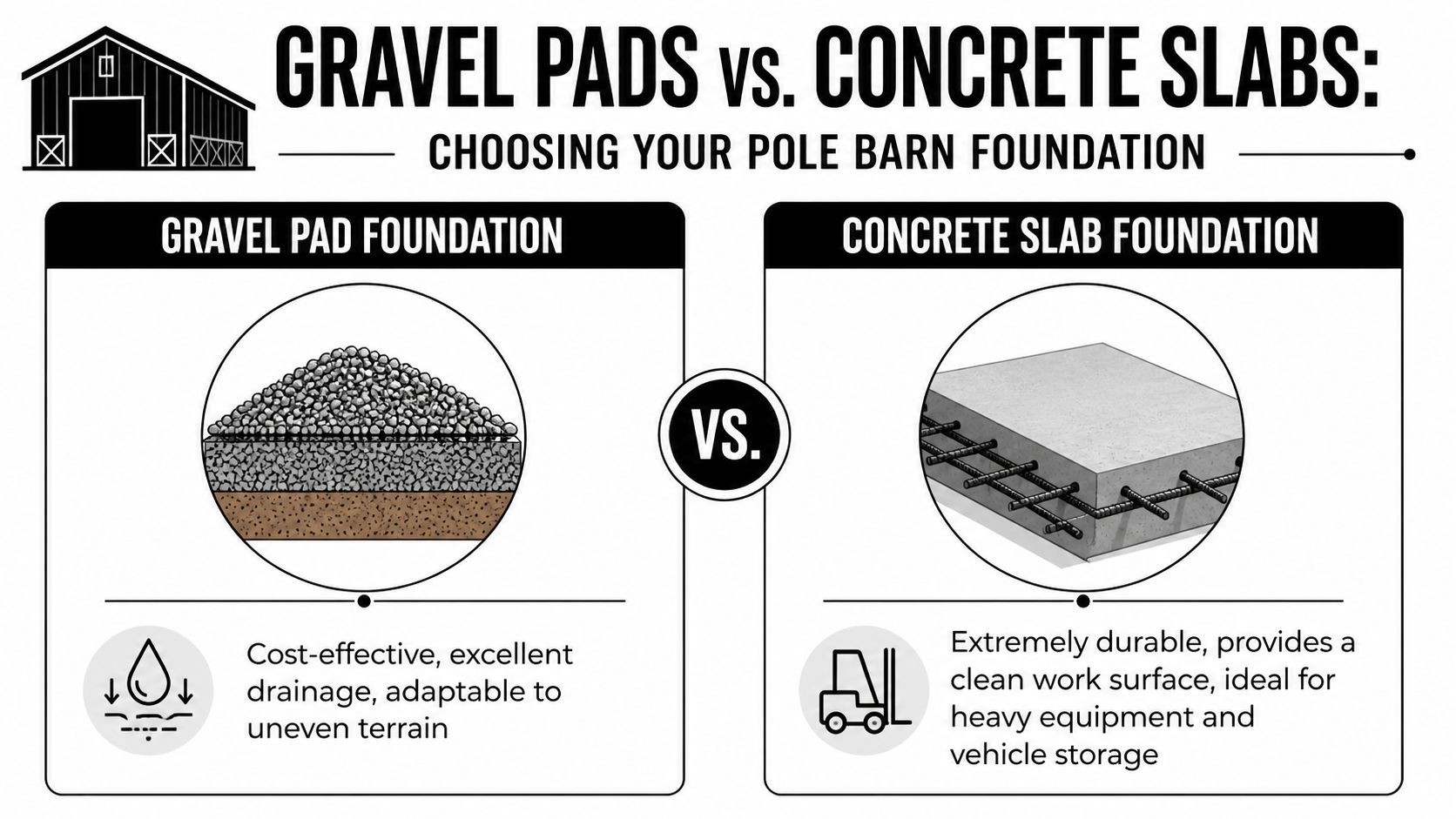
When a gravel pad makes sense
A shed foundation built with compacted gravel is a strong choice for many pole barn projects, especially when the barn will be used for storage, light equipment, or general utility use.
A well-built gravel pad does several things well. It sheds water. It creates a stable, compacted base. It can adapt to properties where grade needs to be corrected without overcomplicating the project. For homeowners searching for gravel shed foundation contractors near me or a reliable base for storage shed, this option often makes sense when the building’s interior doesn’t require a finished floor.
Gravel pads tend to work best when you want:
- Good drainage: Water moves away from the building instead of pooling around it.
- A simpler utility structure: Storage barns and equipment shelters often don’t need a full slab.
- Adaptability on the site: Uneven ground can often be corrected efficiently with proper excavation and compacted fill.
- A practical starting point: Some owners begin with a gravel foundation and add other improvements later.
That said, gravel isn’t “cheap fill dumped in a square.” If it’s not excavated correctly, compacted in lifts, and contained properly, it won’t perform the way homeowners expect.
When a concrete slab is the better choice
A concrete foundation for garage use is often the better fit when the 20×20 pole barn will be used daily, especially for vehicles, finished workspace, or heavier equipment.
Concrete gives you a cleaner and harder-wearing surface. It’s easier to sweep, easier to work on, and better suited for jacks, rolling equipment, and regular foot traffic. If you’re comparing garage footings and foundations, this is usually the option that supports a more finished end result.
A slab usually makes more sense when the barn will be used as:
- A garage: Especially if you want a durable, easy-to-clean floor.
- A workshop: Concrete supports benches, tool storage, and routine project use.
- A multi-use outbuilding: If you want the structure to feel more like an extension of the property than simple storage.
- A long-term utility building: The cleaner floor often improves day-to-day use.
Gravel supports the building. Concrete supports the way you plan to live and work inside it.
Side by side comparison
| Foundation type | Best fit | Main advantage | Main caution |
|---|---|---|---|
| Gravel pad | Storage, utility, lighter-use barn shed applications | Drainage and adaptability | Needs careful compaction and grading |
| Concrete slab | Garage, workshop, heavier-use space | Clean and durable work surface | Requires more planning before the pour |
The right answer depends on use, site conditions, and how finished you want the space to feel.
What works in Mid Atlantic conditions
In Pennsylvania and nearby states, freeze-thaw conditions and drainage are part of the conversation whether you want them to be or not. Water is what causes trouble. Water under the slab, water against the perimeter, water collecting at post locations, and water flowing from a higher yard toward the building.
That’s why the foundation choice has to match both the structure and the site. A gravel pad can perform very well when grading and drainage are done correctly. A slab can be excellent too, but only when the subgrade is prepared properly and water is directed away from the building.
Homeowners who want a more detailed breakdown of the decision can review this guide on how to choose the right foundation.
What doesn’t work
A few shortcuts cause repeated problems on small pole barn jobs:
- Building on topsoil: Organic material moves and settles.
- Ignoring runoff: Water will always find the low spot.
- Underpreparing post locations: Concentrated loads need firm support.
- Choosing by price alone: A lower upfront cost can become the wrong value if the barn’s use calls for a slab.
- Treating layout as secondary: If the foundation is out, the building installation gets harder immediately.
For homeowners looking up shed foundations near me, garage foundation contractors near me, or concrete foundations in Pennsylvania, the best result usually comes from deciding how the building will be used before choosing the base.
Navigating Local Permits and Site Preparation
Permits make homeowners nervous for a reason. The rules can vary by township, borough, county, and intended use, and the language often isn’t written for someone building their first outbuilding.
The good news is that most permit problems aren’t caused by the barn itself. They’re caused by poor preparation, vague site plans, or assumptions about setbacks, grading, and drainage. In Pennsylvania, and across nearby parts of Maryland, Delaware, and New Jersey, the cleaner your site plan is, the smoother the approval process usually goes.
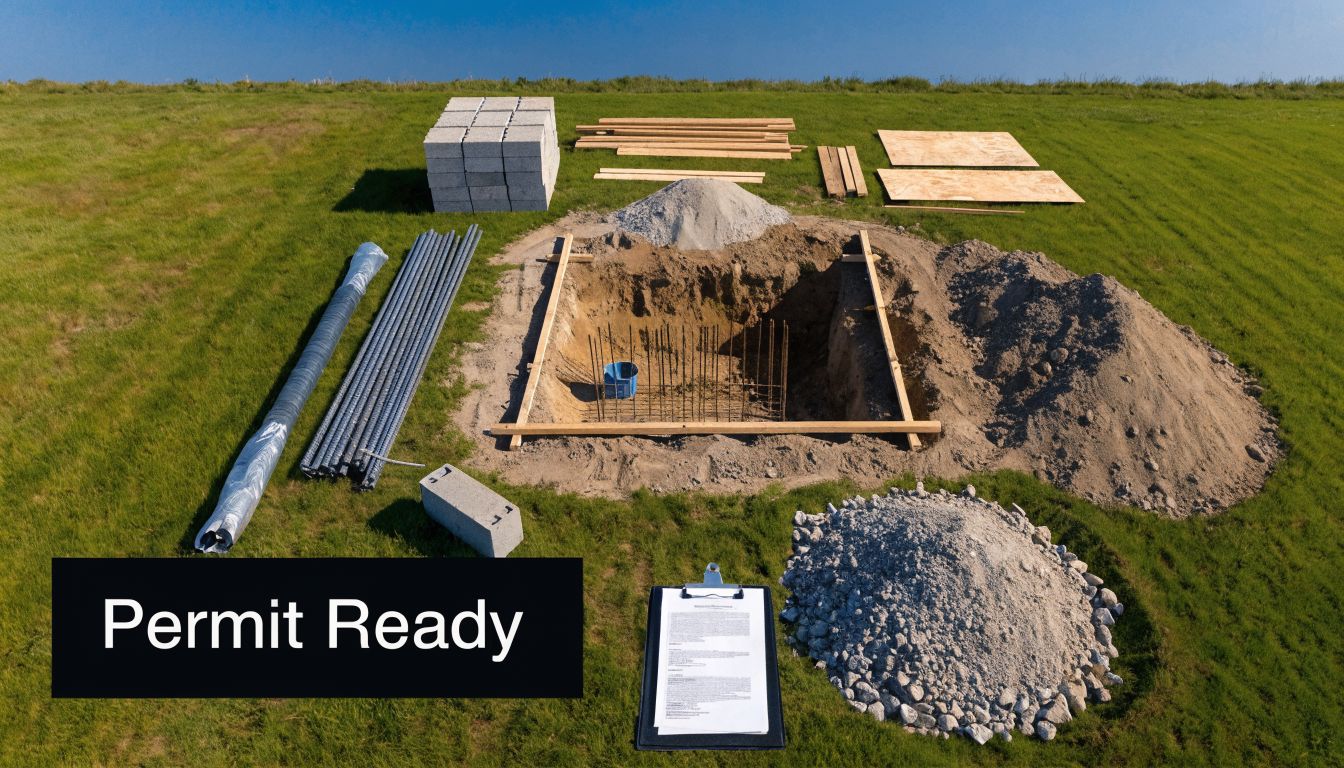
What to ask before you build
Before any excavation begins, contact the local authority having jurisdiction and ask direct questions. Don’t ask only whether a 20×20 pole barn is “allowed.” Ask what they need from you to approve it.
Start with these:
- Setbacks: Where can the structure sit in relation to property lines, easements, and existing buildings?
- Stormwater expectations: Will added roof area trigger drainage requirements on your lot?
- Foundation requirements: Are there local expectations for footing detail, frost protection, or engineered review?
- Access and grading: Will site changes affect runoff toward neighbors, driveways, or septic areas?
- Use classification: Is the building strictly accessory, or will your intended use change how it’s reviewed?
A surprising number of delays come from homeowners ordering a building package before they know whether the chosen location can be approved.
Sloped sites need a real plan
Sloped properties are common across this region, and they create more foundation decisions than flat lots do. According to Hansen Pole Buildings’ discussion of sloped sites, up to 30 to 40 percent of properties have slope issues, and those challenges are often underexplained in DIY content.
That matters because building on a slope isn’t just a grading issue. It affects post embedment, drainage flow, access, and how much soil disturbance happens around the footprint.
On a sloped site, “making it look level” and “building it correctly” are not the same thing.
One common solution is ordering longer columns, embedding them properly in undisturbed ground, and then backfilling to create the finished level plane. That approach can be much better than trying to force a shortcut with loose fill where structural support should be.
For a useful overview of this stage, review this page on site prep for a pole barn.
Site preparation is more than clearing grass
A lot of people think site prep means scraping off vegetation and bringing in stone. Real prep is more deliberate.
It usually includes evaluating the grade, removing unsuitable material, shaping the subgrade, controlling water movement, establishing access, and preparing the exact footprint the building needs. If the barn is close to a driveway, house, retaining area, or drainage swale, those relationships matter too.
A property owner searching for excavation near me or even driveway contractors near me is often solving part of the same problem. Access and drainage work affect how well the pole barn performs after construction.
This video gives a good visual sense of what thoughtful groundwork can involve before the structure goes up.
Common site mistakes
A few errors show up repeatedly on smaller barn projects:
- Choosing the low spot because it’s out of the way: That often creates long-term drainage headaches.
- Cutting too aggressively into a slope: This can create erosion and water management problems.
- Failing to protect undisturbed bearing areas: Once those areas are compromised, the foundation plan may need to change.
- Ignoring access for trucks and equipment: Delivery and installation still need room to work.
- Treating permits as an afterthought: Approval delays can stop the project before it starts.
The smoother projects usually begin with the least glamorous work: measurements, grading decisions, drainage planning, and a realistic reading of the lot.
Mapping Your Project Timeline and Budget
Most 20×20 pole barn projects feel less stressful when the owner knows what happens first, what can happen at the same time, and what has to wait. The timeline doesn’t need to be mysterious. It just needs to be realistic.
The budget works the same way. You don’t need every dollar figured out on day one, but you do need to understand which decisions drive cost and which ones create changes later.
The sequence that keeps projects moving
A solid project usually follows a clean order.
Site conversation and intended use
Start with how the building will be used. A garage, workshop, and storage barn may all share the same footprint, but they don’t ask the same things of the foundation.Layout and approvals
Confirm where the barn can sit on the lot. At this stage, setbacks, drainage, access, and local permitting questions need to be resolved.Foundation design and site prep
Excavation, grading, and base preparation come before the structure. Proper execution of these steps can prevent many project delays.Foundation installation
The pad, footings, or slab are built to the building’s required layout. Accuracy matters here because the kit has to land on what was prepared.Curing, verification, and delivery readiness
Before the structure crew arrives, the site should be stable, accessible, and ready for installation.
The best timeline is the one that prevents rework. Rushing into the barn package before the site is ready usually costs more time, not less.
Why the kit specs matter early
A lot of engineered 20×20 post-frame kits commonly use treated 4×6 posts on 8 to 10 foot centers, and that creates specific expectations for the foundation below, as noted in this 20x20x12 post-frame kit specification. The key takeaway isn’t just the post size. It’s that the loads are concentrated at post locations, so each location needs support that prevents bearing failure and helps resist frost uplift in places like Pennsylvania and New Jersey.
That’s why site prep should happen with the actual building package in mind. Foundation work shouldn’t be guessed from a rough sketch if the finished structure already has engineered spacing and load assumptions.
Budget categories that shape the project
A 20×20 pole barn budget usually breaks into a few practical groups.
| Budget category | What it covers |
|---|---|
| Building package | Posts, framing, roofing, siding, doors, and related materials |
| Foundation work | Gravel pad, slab, footings, layout, and finishing details |
| Site preparation | Excavation, grading, drainage correction, and access work |
| Labor and coordination | Installation effort, scheduling, and any specialty work required |
Some cost drivers are easy to overlook. Slope adds work. Poor access adds work. Drainage correction adds work. Last-minute plan changes add work. None of that means the project is out of reach. It just means a clean site plan saves money better than wishful thinking does.
Where homeowners get surprised
The usual surprises don’t come from the concept of a 20×20 pole barn. They come from the lot.
A yard that looks level may need more excavation than expected. A driveway may not support delivery as-is. Water may run toward the planned location during storms. The owner may decide halfway through that the barn should function more like a garage, which changes what a cement foundation for garage use should be.
The easiest way to stay in control is to decide early what the building needs to do for the next several years, not just what gets it installed fastest.
Checklist for Hiring Foundation Contractors Near You
Hiring the right contractor matters more than most homeowners realize. A good-looking barn on a weak or poorly prepared base still gives you a bad project. If you’re searching for shed foundations contractors near me, garage foundation contractors near me, or local concrete contractors, the questions you ask at the start can save you a lot of frustration later.

What to verify first
Don’t start with price. Start with whether the contractor is qualified for the exact type of work your property needs.
- State coverage: If your project is in Pennsylvania, Maryland, Delaware, or New Jersey, confirm they work in your state and understand local conditions.
- Insurance and licensing: Ask for current documentation, not a verbal assurance.
- Relevant project type: A crew that pours sidewalks isn’t automatically the right crew for post-frame foundations, garage footings and foundations, or a proper gazebo foundation on changing grade.
- Excavation capability: If site prep and foundation work are split between multiple contractors, mistakes tend to get blamed on the other trade.
Questions that reveal how they work
A strong contractor should be able to answer practical questions without getting vague or defensive.
Ask things like:
- How do you prepare a base for storage shed or barn projects on sloped ground?
- How do you handle drainage around a 20×20 pole barn site?
- What does your layout process look like before excavation or forms begin?
- If I’m using a building kit, how do you verify the foundation matches the plan?
- Do you provide a clear written quote with scope spelled out?
If the answers sound rushed, generic, or dismissive, keep looking.
On hiring: The contractor should make the process clearer after the first conversation, not foggier.
Look for scope clarity
Good quotes are specific. They identify what’s included, what assumptions were made, and what could change the scope. That matters for concrete forms, compacted bases, grading limits, and access requirements.
A vague quote can hide a lot of future arguments. A detailed quote helps both sides know what’s being built.
Review local experience, not just photos
Photo galleries are useful, but they don’t tell you everything. Ask whether the contractor has recent work similar to yours and whether they’ve handled nearby residential lots with drainage, access, or grade issues similar to your property.
That’s especially important if you’re comparing providers for:
- Concrete foundation for garage projects
- Shed foundation gravel base installations
- House foundation or larger foundation builds
- Driveway approach work tied to the barn site
- Pads for accessory structures like a barn shed or play area
A local crew with real experience in regional soil, frost, and weather conditions usually sees potential issues earlier.
The contractor should care about squareness
A lot of homeowners focus on level. Professionals focus on level and square.
If the layout is off, the building crew feels it immediately. Doors, framing, roof alignment, and panel fit all become harder than they should be. A contractor who treats that step casually is telling you something about the rest of the project too.
Start Your Project on Solid Ground with Firm Foundations
A 20×20 pole barn can be one of the most useful structures on your property. It can solve storage problems, protect vehicles, create workspace, and make the rest of your property function better. But the success of the project isn’t decided by the catalog photo. It’s decided by planning, site prep, drainage, and a foundation that fits the way you’ll use the building.
That matters even more in Pennsylvania, Maryland, Delaware, and New Jersey, where slope, runoff, frost, and local approvals all play a role in how well the final structure performs.
If you want a gravel pad, a concrete slab, or full site preparation done right, Firm Foundations can help you start with the part of the project that matters most. The team builds durable foundations, handles excavation with care, and gives homeowners a clear path from quote to completed base.
If you’re ready to move forward, request a free quote and get your 20×20 pole barn project started on solid ground.
Frequently Asked Questions About 20×20 Pole Barns
How precise does my foundation need to be
It needs to be exact.
A 20×20 pole barn is small enough that people often assume minor layout errors will not matter. On the ground, they matter fast. If the foundation is out of square, posts fight the frame, trusses stop lining up cleanly, panels get harder to install, and doors often become the first place you see the problem.
As noted in The Metal Shop’s guide to squaring a pole barn, poor squaring can create framing, roof, and weather-sealing problems that are expensive to correct. I tell homeowners to treat layout like permanent work, because it is. You can hide a lot of things on a jobsite for a day. You cannot hide an out-of-square foundation for the life of the building.
Can I build a 20×20 pole barn on a sloped yard in rural Pennsylvania
Yes, if the site is prepared for the slope instead of worked around with shortcuts.
In Pennsylvania and across the Mid-Atlantic, sloped yards bring drainage, access, and soil stability into the decision early. A good build starts with knowing where water already wants to go, how much cut or fill the site can handle, and whether the building area will stay stable through freeze-thaw cycles. On some properties, grading and a properly compacted pad solve the problem. On others, the post depths, retaining approach, or finished floor elevation need to change before the barn goes up.
The mistake is assuming a level-looking top surface means the site is ready. What matters is what supports that surface underneath.
Do I need a full concrete floor for a workshop
Only if your use calls for it.
For lawn equipment, seasonal storage, and general household overflow, a well-built gravel foundation can perform very well. For a shop with rolling toolboxes, vehicle work, welders, benches, or a lift planned later, concrete usually makes the building more useful and easier to maintain. I also tell homeowners to think about moisture, cleanup, and comfort. A floor that works for parking may be frustrating for weekend projects.
Is 20×20 big enough for two vehicles
Sometimes, but it is usually a tight fit.
Two standard vehicles may fit inside a 20×20 pole barn if door placement, wall clearance, and turning room are planned carefully. Space gets limited once you add shelves, a mower, a workbench, or larger trucks and SUVs. If the building needs to do more than basic parking, many homeowners are happier sizing up before the foundation is installed than wishing they had more room a year later.
Should I order the building kit before the foundation is planned
No.
The foundation should be settled first, especially on properties with slope, drainage issues, soft areas, or difficult access for excavation and delivery. In PA, MD, DE, and NJ, local permit requirements and frost-depth expectations can also affect the right foundation approach. The kit, site plan, and foundation need to agree with each other. When they do not, the corrections usually cost more than the early planning would have.