
Optimal Shed Floor Joist Spacing for Your Project
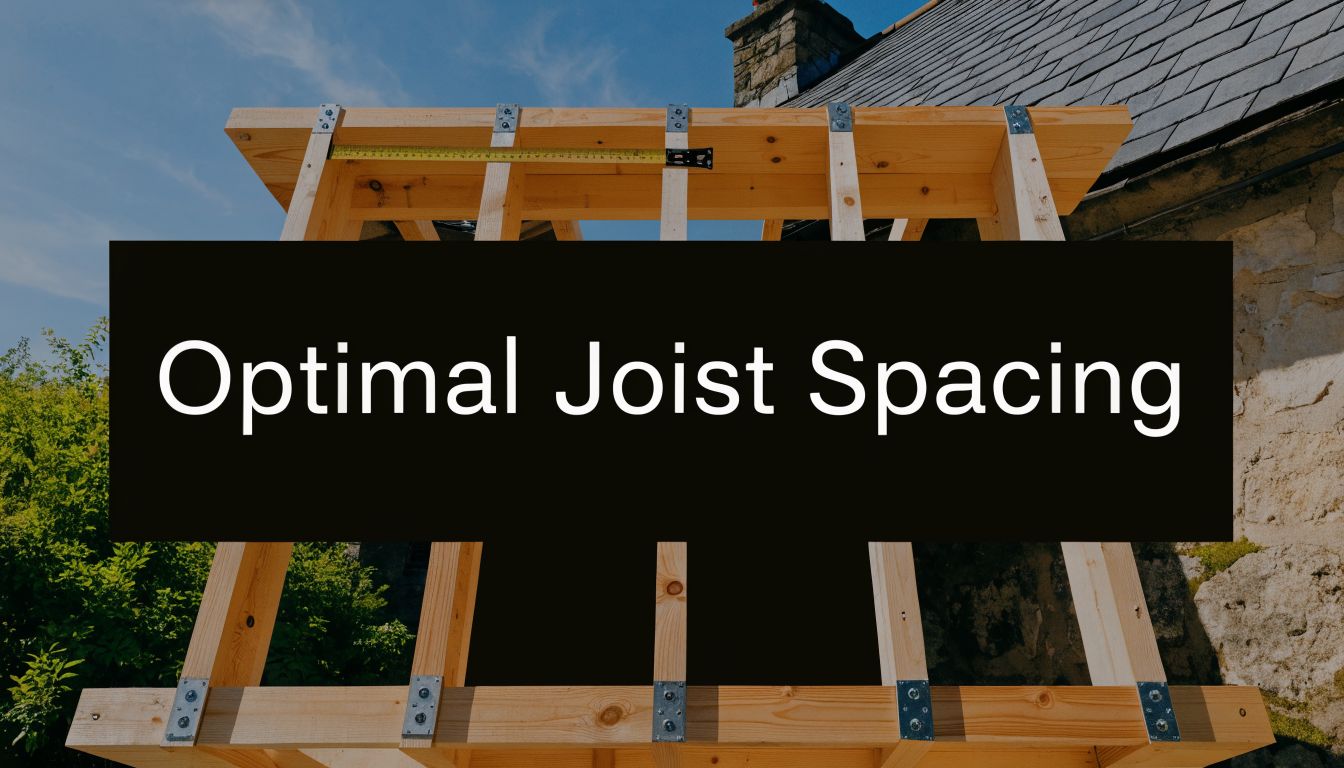
A lot of shed projects start the same way. The shed is picked out, the site seems close enough to level, and the next question is, “What should it sit on?”
That question matters more than most homeowners expect. In Pennsylvania, Maryland, Delaware, and New Jersey, a shed floor has to deal with seasonal moisture, soft ground, drainage issues, and freeze-thaw movement. If the base shifts, the floor frame starts working harder than it should. If the joists are spaced too wide for the way the shed will be used, the floor gets springy, seams telegraph through the decking, and sagging shows up sooner than people expect.
Shed floor joist spacing is one of those details that looks small on paper but changes how the whole building performs. It affects how solid the floor feels under your feet, how well the decking holds up, and whether the shed can handle lawn equipment, a workbench, or heavier storage without trouble. Just as important, the right joist layout has to match the foundation underneath it. A gravel pad and a concrete slab don’t behave the same way, and good shed construction accounts for that from the start.
Planning Your Shed Foundation in PA, MD, DE, or NJ
Homeowners across our region usually call when they’re at one of two points. They either haven’t started yet and want the job done right, or they already have a shed with a floor that feels soft, uneven, or out of square.
The pattern is easy to spot. A customer chooses a nice prefab building or starts planning a custom barn shed, but the focus stays on siding, doors, roof style, and color. The floor system gets treated like a standard package. Then the site conditions in PA, MD, DE, or NJ start making decisions for them. Wet ground, runoff, and winter movement don’t care how good the shed looks from the driveway.
The foundation decides how forgiving the floor can be
A shed on a gravel shed foundation needs a floor frame that can tolerate small real-world variations and still stay stiff over time. A shed on a concrete foundation gets more continuous support, which changes how the load transfers through the floor. That’s why joist spacing shouldn’t be chosen in isolation.
If you’re searching for shed foundations near me, gravel shed foundation contractors near me, or even garage foundation contractors near me, what you’re really looking for is someone who understands the whole assembly. The base, drainage, framing support, and intended use all have to agree with each other.
A strong floor frame on a poor base still fails early. The base always gets the final vote.
Water control matters more than most DIY plans admit
In this part of the Mid-Atlantic, drainage is never a side issue. Water moving across a yard, pooling at a low corner, or washing fines out of a pad changes how the shed sits and how the floor ages. That’s one reason homeowners should think about grading and runoff before the shed arrives. If you want a useful overview of site drainage considerations around a structure, these stormwater management best practices are worth reviewing.
A good base for storage shed work starts below the shed, not inside it. That’s true for a compact 10×10 storage shed, a workshop, a gazebo foundation, or larger garage footings and foundations. The floor joists can only do their job if the support below them stays stable, level, and dry.
Understanding Shed Floor Joist Spacing Standards
A shed floor can look fine on delivery day and still feel soft six months later. In PA, MD, DE, and NJ, that usually traces back to one of two decisions. Joists were spaced too far apart for the load, or the spacing was chosen without respect for the foundation under it.
When builders talk about on-center spacing, they mean the distance from the center of one joist to the center of the next. That spacing controls how the floor sheathing spans, how weight gets shared, and how stiff the floor feels underfoot.
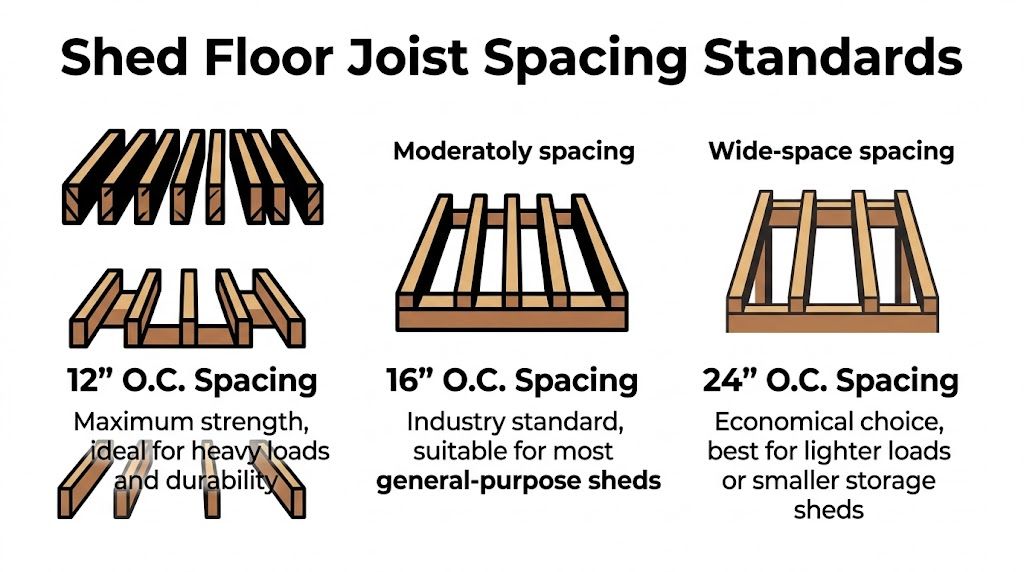
The standards you’ll hear most often are 12 inches on center, 16 inches on center, and sometimes 24 inches on center.
Why 16 inches OC became the default
16 inches on center is the common starting point for shed and residential floor framing. It lines up cleanly with sheet goods, keeps framing efficient, and suits many standard storage sheds. Leland’s Sheds gives a good basic explanation in this IRC-based joist spacing overview.
On a properly prepared base, 16 inches OC often performs well for ordinary storage. Holiday bins, hand tools, lawn supplies, and similar loads usually fit that standard without trouble if the joist size, span, and decking are also matched correctly.
Why 12 inches OC often makes more sense on sheds
Shed floors see point loads that house floors often do not. A mower tire, a snowblower, a compact tractor attachment, or a loaded workbench can bear down on one small area instead of spreading weight across the room.
That matters even more on a gravel pad foundation, where the shed relies on framed support points rather than continuous bearing across the whole underside. If the base is built correctly and stays level, the floor system performs well. If the pad settles, washes, or was undersized to begin with, wider joist spacing gives the floor less margin for error.
On a concrete slab, the load path is different. The slab gives the structure more continuous support, so joist spacing choices are less exposed to minor inconsistencies below. That does not mean spacing stops mattering. It means the foundation type changes how forgiving the floor system will be.
For many sheds in Mid-Atlantic climates, 12 inches OC is the better call when the building will hold equipment, dense storage, or workshop loads, especially if it sits over a gravel-based system. It costs more in lumber, but it usually pays back in stiffness, better sheathing support, and fewer callbacks for a floor that feels bouncy.
The practical difference between the spacing choices
In the field, the choice usually looks like this:
- 12 inches OC fits sheds expected to carry heavier equipment, rolling loads, shop tools, or long-term dense storage.
- 16 inches OC works for many general-purpose sheds with lighter, more evenly distributed contents.
- 24 inches OC shows up in some framing discussions, but it is rarely a good target for a shed floor that needs to stay firm.
If a customer tells me they want the floor to feel solid every time they step in, I do not try to save a few boards and hope for the best.
Spacing and joist type need to agree
Spacing standards also depend on the framing material itself. Solid-sawn lumber, treated lumber near grade, and engineered members do not all behave the same way in wet and seasonal conditions. This overview of types of floor joists for shed foundations helps explain why the joist material and the spacing decision should be made together.
That is especially important in PA, MD, DE, and NJ, where freeze-thaw cycles, humid summers, and wet shoulder seasons expose weak spots fast.
Sheathing layout is part of the standard too
Joist spacing is not only a strength question. It also determines whether plywood or OSB edges land where they should. When sheet edges miss framing, fasteners split out near the edge, or seams float between joists, the floor starts with built-in weak spots.
Good shed floors come from matching four parts of the system. The foundation, the joist spacing, the joist size, and the decking layout all have to work together. Get that right at the start, and the shed stays flatter, stiffer, and easier to live with for years.
How Load and Lumber Size Determine Joist Spacing
The right spacing comes from four things working together. Load, span, lumber size, and decking thickness. If one of those changes, the spacing decision can change with it.
Load changes everything
A shed storing hand tools and seasonal bins doesn’t ask the same thing from a floor as a shed holding a mower, heavy equipment, or dense shop materials. That’s where tighter shed floor joist spacing earns its keep.
For shed floors, 12 inches OC with standard 2×6 joists supports higher point loads than 16 inches OC. Old Hickory notes 450 lbs on 5/8-inch decking at 12 inches OC versus 300 lbs at 16 inches OC, and 700 lbs on 3/4-inch decking at 12 inches OC versus 500 lbs at 16 inches OC in their shed floor load guidance. If the shed is going to carry heavy items in a small footprint, that’s a meaningful difference.
Span decides whether the floor feels stiff or springy
The farther a joist has to travel without support, the more it wants to bend. That’s basic framing behavior. A short span can often get away with lighter framing. A longer span usually needs either deeper lumber, tighter spacing, or both.
Homeowners sometimes get tripped up with a 4×8 shed with foundation or a mid-sized workshop. They assume small building equals simple framing. But a narrow shed with one concentrated heavy load can still feel bouncy if the joists are stretched too far for the material and spacing chosen.
Lumber size and species matter
A 2×6 and a 2×8 are not interchangeable just because both are common shed materials. The deeper member resists bending better. Species and grade matter too, which is why span tables exist in the first place.
If you want a helpful primer on the framing options themselves, this overview of types of floor joists gives a practical starting point before you compare layouts.
The joist size you choose should match the use of the shed, not just the footprint on the order form.
Decking thickness is part of the floor system
Decking doesn’t just cover the frame. It becomes part of the load-sharing system. Thicker decking spans better between joists and handles point loads more confidently. Thinner decking over wide joist spacing is one of the fastest ways to create a floor that sounds hollow and feels weak.
A useful way to think about it is this:
| Floor factor | What happens when it’s undersized |
|---|---|
| Joist spacing | The floor feels soft between members |
| Joist depth | The whole span starts to flex |
| Decking thickness | Wheels, feet, and point loads stress the surface |
| Foundation support | The frame racks, settles, or goes out of level |
Gravel pad versus concrete slab
This is the trade-off many guides skip. A shed on a gravel shed foundation depends on a floor frame that acts like a reliable bridge over a compacted, well-drained base. A shed on a concrete slab gets more uniform bearing, which can reduce how much the framed floor has to compensate for minor movement.
That doesn’t mean a slab excuses bad framing, and it doesn’t mean a gravel pad is second best. It means the framing should respect the support condition below it. For many outbuildings in our region, a tighter joist layout on a well-built gravel pad is a smart combination because it gives the floor extra stiffness where weather and ground movement tend to be less forgiving.
Shed Joist Span Tables and Practical Examples
Span tables can look intimidating, but the lesson is simple. As joists get deeper or spacing gets tighter, they can usually span farther while keeping the floor stronger.
One verified benchmark is useful here. Under a standard 40 psf live load, a 2×8 joist at 16 inches OC can span 13 feet 1 inch, according to the Southern Pine data referenced in this floor joist spacing guide. That tells you why lumber size and spacing can’t be separated.
Simplified shed joist span guide
| Joist Size | Spacing (O.C.) | Maximum Span |
|---|---|---|
| 2×8 | 16 inches | 13 feet 1 inch |
If you want a more focused look at one of the most common shed framing members, this 2 x 6 floor joist span reference is a good companion when you’re comparing shed sizes and intended use.
Example for a general storage shed
Say you’re planning a 10×10 storage shed in Delaware for garden tools, shelving, and lighter seasonal storage. That’s usually a general-use floor, not a shop floor. In that case, a standard layout can work well if the base is level and the decking plan is clean.
The mistake would be treating that same framing package as universal. If the use changes later, the floor may become the weak point.
Example for a barn shed with heavier equipment
Take a barn shed in southeastern Pennsylvania that will hold a mower and compact equipment. The footprint may still look modest, but the loads are more demanding and more concentrated. That kind of shed benefits from closer attention to spacing, decking, and how level the shed foundation stays through the seasons.
Example for workshop use on a gravel base
A homeowner in Maryland might want a shed that starts as storage and later becomes a work area. That’s where planning ahead pays off. If the structure sits on a compacted gravel pad instead of a full slab, it often makes sense to build the floor with extra stiffness from the beginning rather than try to solve bounce after the shed is in place.
Small sheds don’t automatically need light-duty floors. The intended use matters more than the footprint alone.
For real projects, I always tell people to read the span data, then step back and think about the base. A perfectly chosen joist on a poor pad is still a compromised floor.
Proper Joist Installation for a Long-Lasting Shed Floor
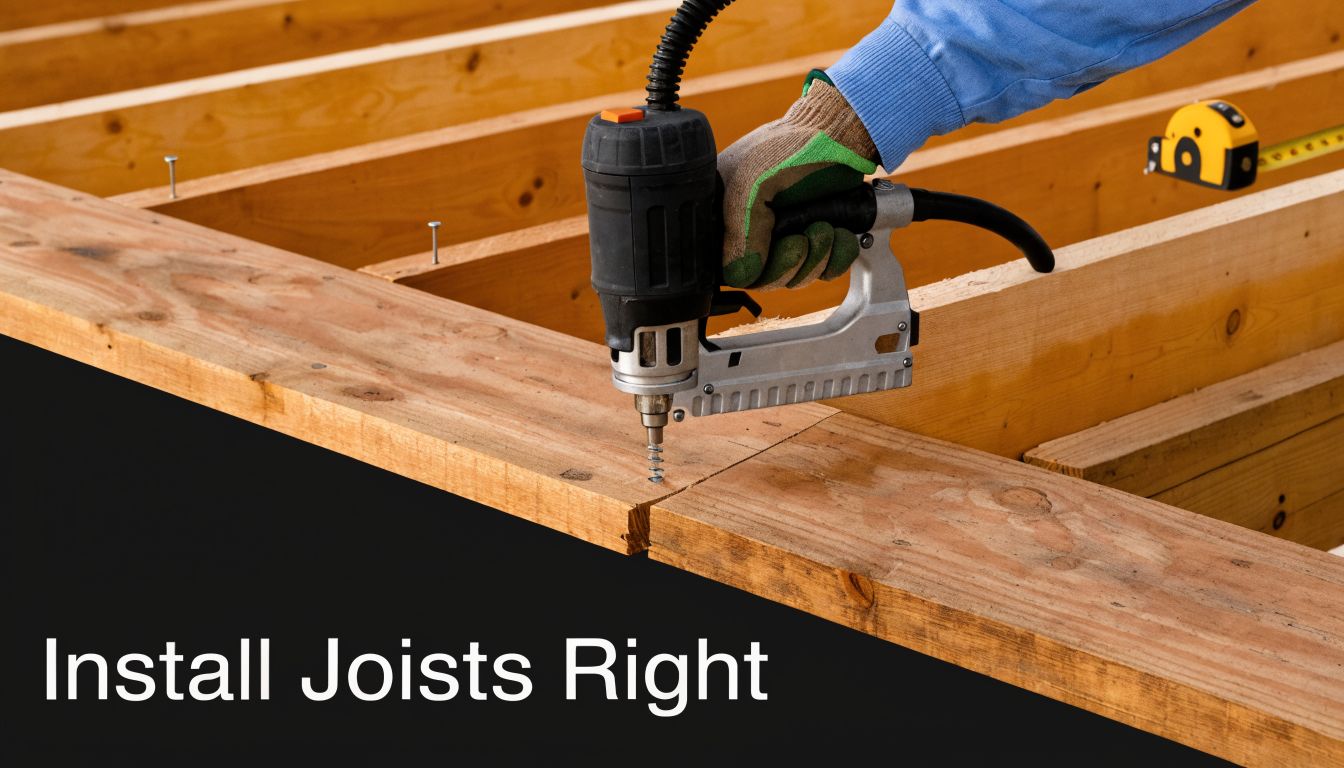
Good spacing won’t save a sloppy install. Most floor problems I see come from layout errors, crowned joists set randomly, missing blocking, or sheathing seams that don’t land where they should.
Start with straight layout lines
Before any joist goes in, mark the frame carefully. For a 16-inch O.C. layout, a common and important detail is placing the first interior joist 15.25 inches from the outer edge of the rim joist so 4×8 plywood lands cleanly over joist centers, as explained in this shed joist layout article.
That one mark prevents a lot of headaches. If the first layout is off, every sheet after it wants to fight you.
Crown the joists the same direction
Every framer knows lumber isn’t perfectly uniform. Most joists have a natural crown. Install them with the crowns facing the same direction, typically upward, so the finished floor stays more consistent under load.
If you mix crown directions, the deck telegraphs it. One joist sits proud, the next sits low, and now you’re trying to force sheet goods across an uneven field.
Blocking and fastening matter
Blocking helps keep joists from twisting and helps the floor act more like one system instead of separate strips of lumber. That matters on shed floors that see rolling loads, repeated foot traffic, and seasonal movement.
A few habits make a noticeable difference:
- Use blocking where the layout calls for it so joists stay upright and share load more evenly.
- Fasten decking with care because missed framing and edge blowouts create weak spots from the start.
- Check the frame for square early instead of trying to pull it into shape after the floor is skinned.
Here’s a useful visual for seeing how careful framing habits come together in the field.
Build the frame to match the support underneath
A floor frame on a shed foundation gravel base needs full, even bearing at the points or runners designed to support it. On a slab, the contact condition is different. Either way, the lesson is the same. Don’t force the frame to “fix” a support problem that should’ve been handled during site prep or excavation near me work.
Good joist installation starts before the first board is cut. If the base isn’t flat and stable, the framing crew spends the whole job compensating.
Common Mistakes to Avoid with Your Shed Foundation
Most shed floor failures aren’t caused by one dramatic mistake. They come from a stack of smaller shortcuts that all lean the same wrong direction.
The biggest bad assumption is that the shed floor can make up for a mediocre base. It can’t. If the support underneath settles, washes, or goes out of level, the joists and decking start carrying stresses they were never meant to carry.

Mistakes that show up later and cost more
Some problems don’t reveal themselves on installation day. They appear after a wet season, after winter, or after the shed starts carrying real weight.
- Choosing spacing by habit instead of use. A general-purpose layout might be fine for bins and hand tools, but it may disappoint fast under heavier equipment.
- Ignoring local code expectations. Shed work in PA, MD, DE, and NJ still has to respect local requirements, site conditions, and support details.
- Using an uneven base for a framed floor. Once the floor frame starts out twisted or rocking, every layer above it inherits the problem.
- Treating gravel as loose fill instead of a built pad. A proper shed foundation gravel base should support drainage and stability, not just create a place to set the shed.
- Assuming blocks alone are a foundation system. Blocks can be part of a setup, but they don’t solve poor grading, soft soil, or water movement by themselves.
The foundation type should match the shed use
A light-duty storage building may be well served by a properly prepared gravel pad. A workshop, heavy equipment storage building, or concrete foundation for garage project may call for a slab or more substantial support. The issue isn’t which option sounds stronger in theory. The issue is whether the support matches the load, the site, and the climate.
In this region, freeze-thaw cycles and wet ground expose weak prep quickly. That’s why professional site prep, grading, and base construction save money. They prevent rework.
What actually works
What works is straightforward. A level base. Drainage that moves water away. Framing that fits the intended use. Joist spacing that matches the load. Decking that’s thick enough for the job. That combination gives a shed floor the best chance to stay quiet, firm, and long-lasting.
A shed doesn’t fail from the top down. Most of the trouble starts at ground level.
Get a Rock-Solid Foundation with Firm Foundations
The right shed floor joist spacing matters. So does joist size, decking thickness, and careful layout. But the long-term result still comes back to the same truth. The floor only performs as well as the base supporting it.
That’s especially true in Pennsylvania, Maryland, Delaware, and New Jersey, where drainage, soft spots, and seasonal movement can turn a decent-looking shed install into a frustrating repair project. A properly built shed foundation, gravel pad, or concrete foundation takes that uncertainty out of the job. It protects your shed, your floor system, and everything you plan to store inside.
If you’re comparing shed foundations contractors near me, planning a base for storage shed, or need help with garage footings and foundations, it pays to start with the company that handles the groundwork correctly. Firm Foundations builds durable gravel pads and long-lasting concrete foundations with the excavation, forming, drainage, and precision that these projects require.
If you want a shed pad, garage slab, cement foundations for garage, or a reliable gazebo foundation built the right way from the start, contact Firm Foundations for a free quote. You’ll get clear guidance, experienced crews, and a foundation built to match your structure, your site, and the way you plan to use it.