
Concrete Forms
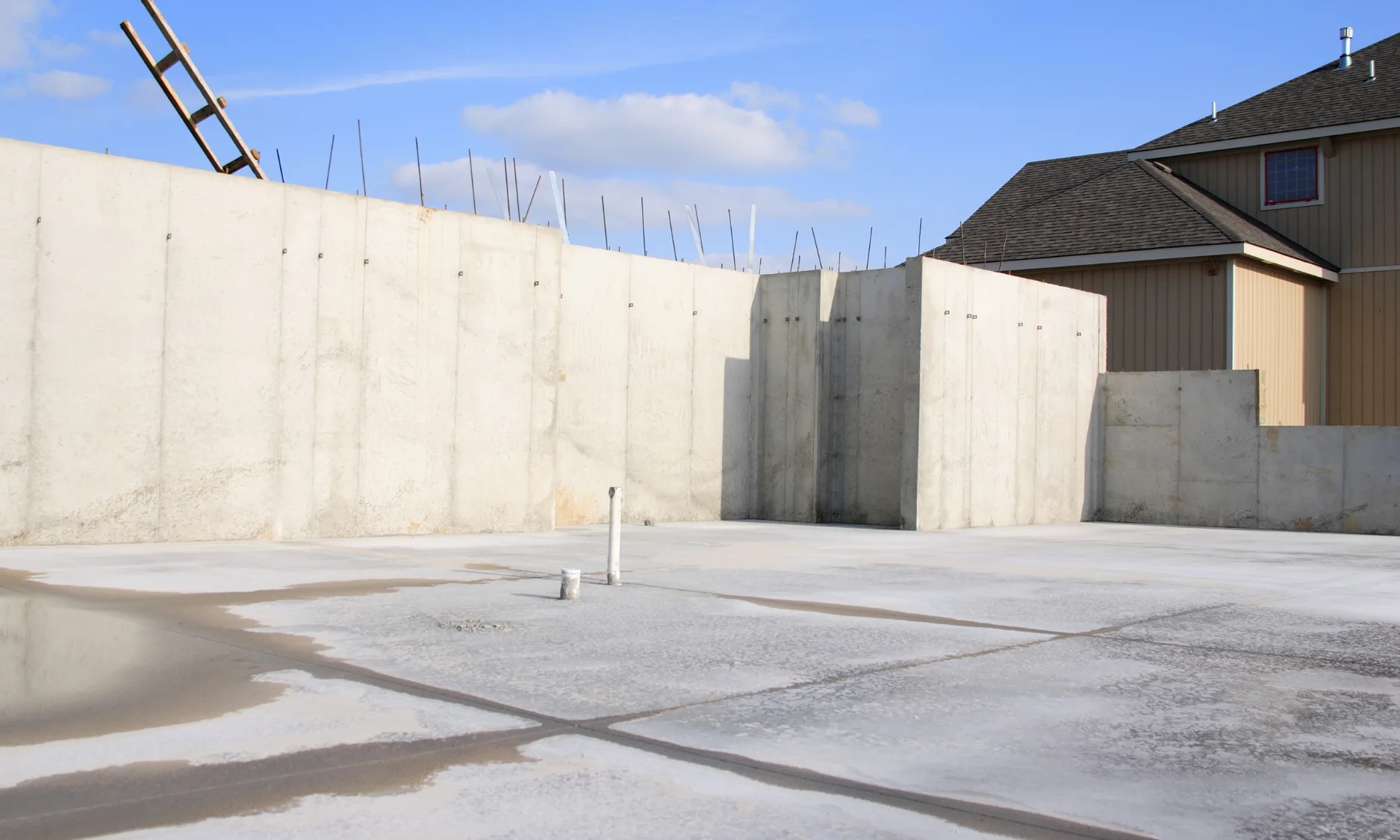
Concrete Forms Explained: The Backbone of Every Strong Build
Walk onto any active construction site before the structure rises, and you will likely see a labyrinth of wood, metal, or foam. These are not the permanent walls or the final foundation, but they are arguably the most critical component of the early build phase. They are concrete forms.
Concrete is a miraculous material. It is durable, fire-resistant, and capable of supporting immense loads. However, in its initial state, it is nothing more than a heavy, semi-liquid slurry. It has no shape of its own. It requires a mold to define its dimensions, texture, and structural integrity. That mold is the formwork.
For anyone looking to understand the complexities of construction—from a backyard retaining wall to a high-rise foundation—grasping the mechanics of concrete forming is essential. The quality of the formwork dictates the quality of the finish. If the forms are weak, the concrete will bulge or blow out. If the forms are misaligned, the building will be out of square.
At Firm Foundations, we believe that the temporary structures we build are just as important as the permanent ones they create. This guide explores the science, the systems, and the safety protocols behind concrete forms, revealing why this step is truly the backbone of every strong build.
Understanding the Landscape of Concrete Forms
Not all forms are created equal. The industry has evolved significantly from the days when basic lumber was the only option. Today, contractors choose from a variety of systems based on the project’s scale, budget, and architectural requirements.
Traditional Timber Forms
Timber forming is the oldest method and remains widely used, particularly for smaller projects or complex, custom shapes. This method involves building molds on-site using plywood sheets and lumber framing (usually 2x4s or 4x4s).
The advantages:
- Versatility: Wood can be cut to any dimension, making it ideal for non-standard geometries or intricate architectural details.
- Availability: Materials are readily available at any supply store.
- Cost-effectiveness: For one-off pours where the forms won’t be reused, timber is often the cheapest upfront option.
However, timber forms are labor-intensive. They require skilled carpenters to measure, cut, and assemble the molds precisely. They also have a shorter lifespan compared to other systems, as the wood absorbs moisture and warps over time.
Engineered Form Systems
For larger commercial projects or repetitive residential builds, engineered systems are the standard. These are prefabricated modules, usually made from steel or aluminum frames with a plywood or metal face.
The advantages:
- Speed: These systems lock together with pins or clamps, allowing for rapid assembly and disassembly.
- Durability: Metal frames can withstand thousands of pours without losing their shape or strength.
- Precision: Because they are manufactured in a factory, the tolerances are incredibly tight, resulting in straighter walls and cleaner finishes.
While the initial investment for engineered systems is higher, the labor savings and reusability make them cost-effective for companies like Firm Foundations that handle high-volume work.
Stay-in-Place (SIP) Forms
This category creates a permanent part of the structure. The most common type is Insulated Concrete Forms (ICFs). These are hollow blocks or panels made of expanded polystyrene foam (similar to Styrofoam) that are stacked like LEGO bricks. Reinforcing steel is placed inside, and concrete is poured into the cavity.
The advantages:
- Insulation: The foam remains in place, providing exceptional thermal insulation and soundproofing.
- Efficiency: You accomplish framing, insulating, and furring (for drywall attachment) in a single step.
- Curing: The foam protects the wet concrete from extreme temperatures, allowing it to cure at an optimal rate.
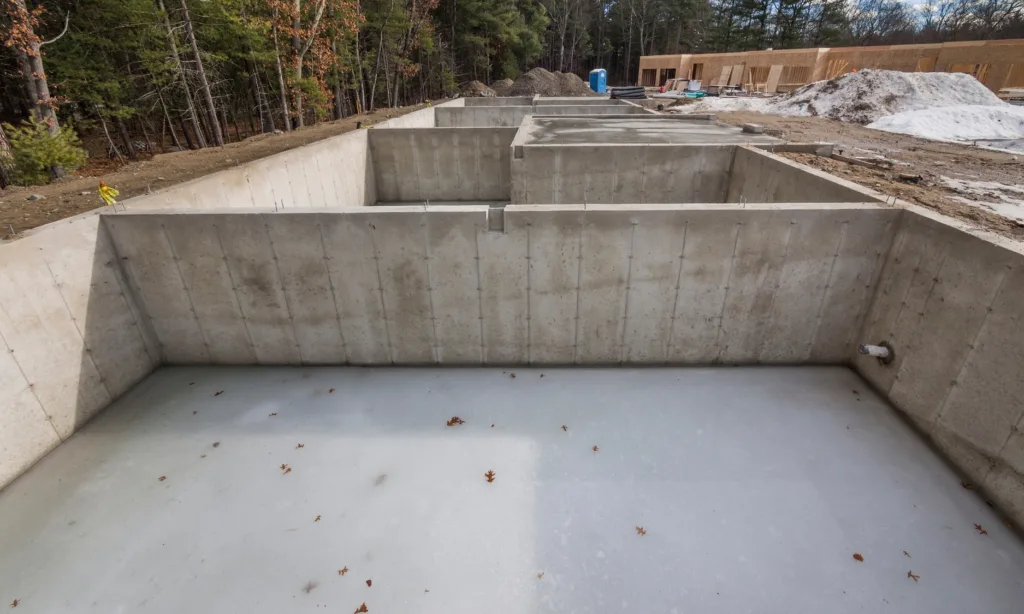
The Science of Structural Integrity
Concrete forming is not just about carpentry; it is about physics. When concrete is poured, it exerts “hydrostatic pressure” against the formwork. This pressure is significant. Wet concrete weighs approximately 150 pounds per cubic foot.
Battling Hydrostatic Pressure
The pressure is not uniform. It increases with depth. At the bottom of a tall wall form, the outward force is immense compared to the top. If the forms are not properly braced, or if the “ties” (metal rods holding the two sides of the form together) are spaced too far apart, the form will fail.
A failure can manifest as a slight bulge, which ruins the straightness of the wall, or a catastrophic “blowout.” A blowout is a builder’s nightmare—the form creates a breach, and tons of wet concrete spill out onto the job site. It is dangerous, expensive to clean up, and usually requires the entire wall to be demolished and re-poured.
Precision and Tolerances
Beyond holding the weight, forms must ensure the concrete ends up exactly where the blueprints say it should be. A foundation that is out of level by even half an inch can cause cascading problems for the carpenters framing the house, the window installers, and the drywallers.
Structural integrity relies on the steel reinforcement (rebar) staying in the correct position within the concrete. The formwork includes spacers and chairs to keep the rebar centered. If the form shifts, the rebar might end up too close to the surface, leading to “spalling” (concrete flaking off) and rust issues later on.
Why Firm Foundations Prioritizes High-Quality Formwork
At Firm Foundations, we operate under a simple philosophy: you cannot build a perfect structure with an imperfect mold. Many budget-focused contractors view formwork as a place to cut costs because the client never sees the forms—they only see the finished product.
We take the opposite approach. We invest in premium engineered systems and high-grade timber because we know that the quality of the formwork directly correlates to the longevity of the concrete.
- Surface Finish: High-quality face materials on our forms mean the stripped concrete is smooth and free of “honeycombing” (rocky pockets caused by poor consolidation or leaking forms).
- Dimensional Accuracy: We use laser levels and digital transits to ensure our forms are perfectly plumb and square before a single truck arrives.
- Safety: We do not rely on makeshift bracing. We use rated strutting and tying systems calculated to withstand the specific pour pressures of the job.
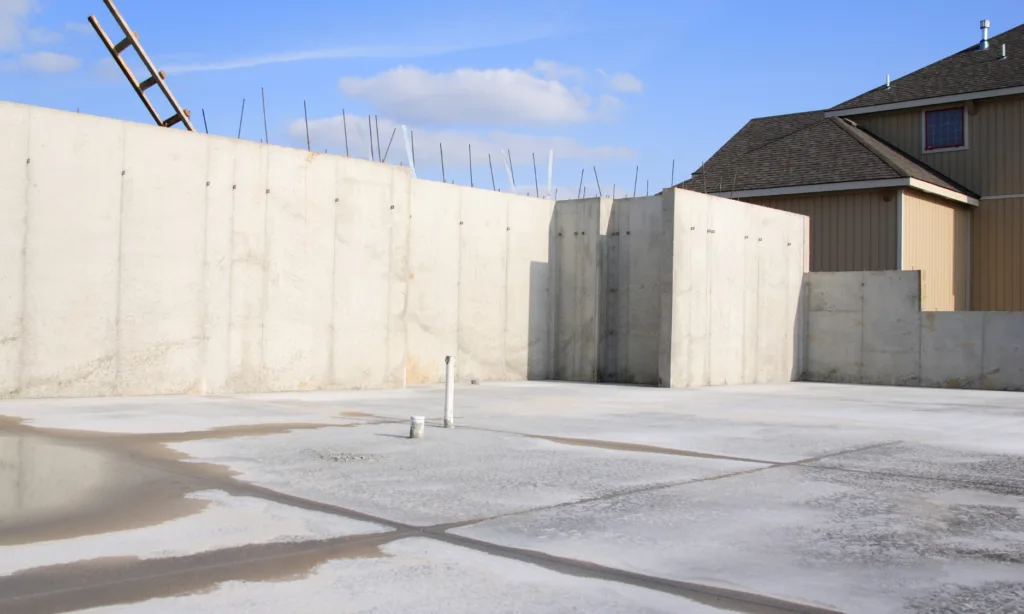
The Step-by-Step Concrete Forming Process
To understand the effort involved, it helps to look at the workflow of a typical vertical wall pour. This is a rigorous process where attention to detail is paramount.
Site Preparation and Layout
Before forms appear, the ground must be prepared. This usually involves excavating the trench and pouring a “footing”—a wide, flat pad of concrete that spreads the building’s weight. Once the footing is cured, the layout crew snaps chalk lines to mark exactly where the walls will sit.
Preparation of Forms
Whether using wood or metal, the form faces must be clean. We apply a “release agent” or form oil. This is similar to greasing a cake pan; it ensures that when the concrete dries, the forms can be peeled away without sticking to the wall or ripping the concrete surface.
Erection and Reinforcement
One side of the formwork is erected first. Then, the steel reinforcement (rebar) grid is tied together and placed against that side. Once the rebar is inspected, the second side of the form is closed up.
During this phase, “walers” and “strongbacks” are installed. These are horizontal and vertical beams that stiffen the formwork, preventing it from bowing out under the pressure of the wet mix.
Alignment and Bracing
Once the box is built, it needs to be straightened. Adjustable turnbuckle braces are attached to the forms and staked into the ground. A crew member checks the wall with a level while another adjusts the braces until the wall is perfectly vertical.
The Pour
The concrete truck arrives, and the mix is pumped into the forms. This must be done carefully. Pouring too fast increases the pressure at the bottom (known as “liquid head”). We pour in “lifts” (layers), allowing the bottom concrete to stiffen slightly before adding more weight on top.
Simultaneously, we use mechanical vibrators. These are dipped into the wet concrete to release trapped air pockets and ensure the mix flows around the rebar completely.
Curing and Stripping
After the pour, the concrete generates heat as it hardens (a chemical reaction called hydration). The forms help retain moisture, which aids this process. Depending on the weather and the mix design, the forms are removed (stripped) anywhere from 12 to 48 hours later.
Safety Protocols and Industry Standards
Working with concrete forms presents unique hazards. The sheer weight of the materials, combined with the active nature of a job site, demands strict adherence to safety protocols.
Load Calculations
For large-scale builds, we don’t guess. We follow strict engineering guidelines regarding “pour rate.” If the forms are rated for 800 pounds per square foot of pressure, we must calculate how fast we can fill them based on the temperature and the concrete’s slump (fluidity).
Fall Protection
When building tall walls or columns, workers often have to climb the formwork. Firm Foundations mandates 100% tie-off policies. If a worker is off the ground, they are harnessed and clipped to a secure anchor point.
Blowout Zones
During the pour, the area immediately surrounding the forms is a controlled zone. All non-essential personnel are kept clear. If a form tie snaps or a brace fails, the resulting failure is sudden and violent. Maintaining a safety perimeter is a non-negotiable industry standard.
OSHA Compliance
We adhere to all Occupational Safety and Health Administration (OSHA) standards regarding concrete and masonry construction (Subpart Q). This covers everything from the strength of the shoring to the protection of exposed rebar tips, which must be capped to prevent impalement injuries.
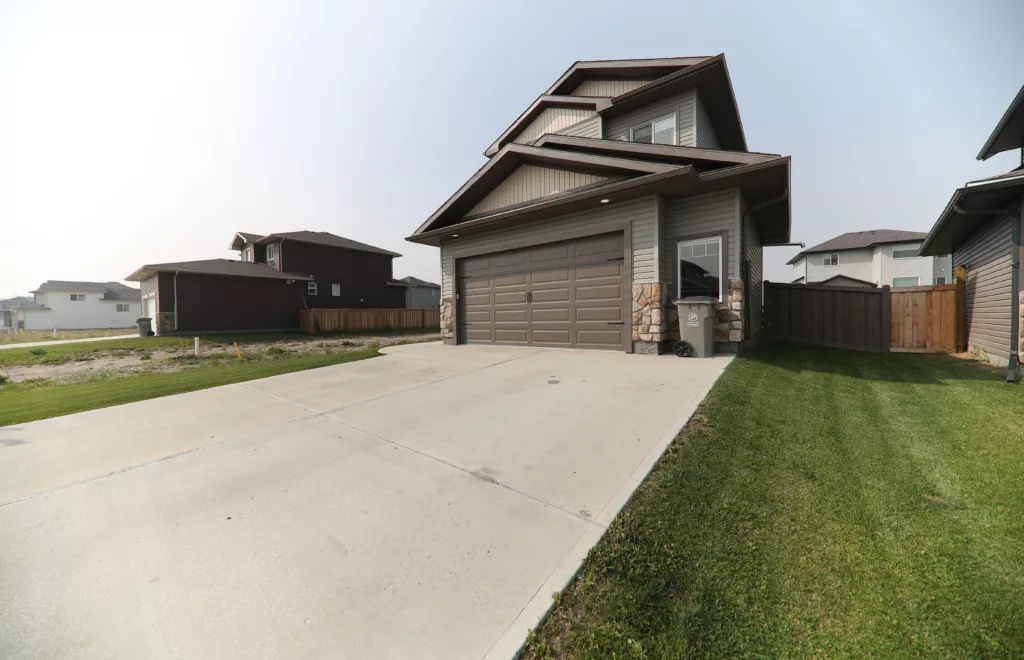
Conclusion: The Hidden Investment
When you look at a finished building, you see the siding, the windows, and the roof. You rarely think about the concrete foundation sitting silently beneath it all. Yet, that foundation is the only part of the building that cannot be easily fixed or replaced.
The formwork is the womb of that foundation. It determines the strength, the shape, and the surface quality of the concrete. Skimping on forms is akin to buying a luxury car engine and putting it in a rusted chassis.
At Firm Foundations, we treat concrete forming as the main event, not a preliminary nuisance. By understanding the science of pressure, utilizing the best engineered systems, and prioritizing safety and precision, we ensure that the structures we build remain standing for generations. A strong build starts before the concrete is even poured—it starts with the form.
Firm Foundations LLC
https://maps.app.goo.gl/Uf6XdgtpBTETgNrr7
1535 White School Rd, Honey Brook, PA 19344, United States
(717) 716-7267
https://shedpads.com/