
2×12 Floor Joist: Spans, Loads & Installation
A lot of homeowners start in the same place. They’ve picked the shed, mapped out the garage, or cleared a spot for a workshop, and they’re focused on walls, doors, storage, and how the finished space will look. Then the practical questions show up. Will the floor feel solid? Will it stay level through wet seasons and freeze-thaw cycles in Pennsylvania or New Jersey? Will the structure still feel right years from now?
That’s where floor framing and foundation work stop being separate topics. A good building needs both. If the base isn’t level, framing becomes a workaround job. If the joists are undersized, even a well-built pad or slab can’t save a weak floor system. For many sheds, garages, barn sheds, and workshops in PA, MD, DE, and NJ, the 2×12 floor joist is part of that answer because it gives builders more strength and more room to span open areas without a soft, springy floor.
Building Your Dream Shed or Garage in PA It Starts From the Ground Up
A homeowner in southeastern Pennsylvania might be planning a garage for a collector car. Another family in New Jersey may want a backyard shed that feels more like a real workshop than a garden box. Someone else in Maryland may be setting a prefab building on a gravel shed foundation and wants the floor to handle lawn equipment, shelving, and seasonal storage without sagging.
Those projects all sound different, but the concern is usually the same. People want a building that feels permanent. They don’t want a floor that dips in the middle, doors that stop lining up, or a structure that looks fine on day one and starts showing movement after a few winters.
The floor system matters as much as the pad
Homeowners often search for shed foundations contractors near me, garage foundation contractors near me, or a base for storage shed because they know the site has to be prepared correctly. That instinct is right. A shed foundation gravel base or concrete foundation has to be level, drained properly, and built for the structure it will carry.
But the framing above it matters too. If your builder is using a framed floor, the joists become the bridge between the foundation and the building you use every day. That’s why 2×12 floor joists come up so often on larger sheds, garage footings and foundations, and outbuildings with wider open spans.
Practical rule: A floor only feels as solid as the combination of the foundation below it and the joist system above it.
Planning details tie into this earlier than many people expect. Door openings are one example. If you’re still deciding layout, these expert garage door size recommendations are useful because opening width and use case affect how open the interior needs to be, which can influence framing choices and support placement.
What homeowners usually want to avoid
Many aren’t trying to become framing experts. They just want to avoid expensive mistakes.
- Floor bounce: A workshop or garage floor should feel firm under normal use.
- Future movement: In PA and NJ, seasonal moisture and frost make proper support even more important.
- Mid-project changes: If the foundation is out of level, framing crews spend time correcting instead of building.
- Callback problems: Squeaks, soft spots, and visible sag usually trace back to poor support, poor framing decisions, or both.
That’s why the conversation about a shed foundation, concrete foundation for garage, or gazebo foundation should include the floor framing plan from the start.
What Are 2×12 Floor Joists and Why Choose Them
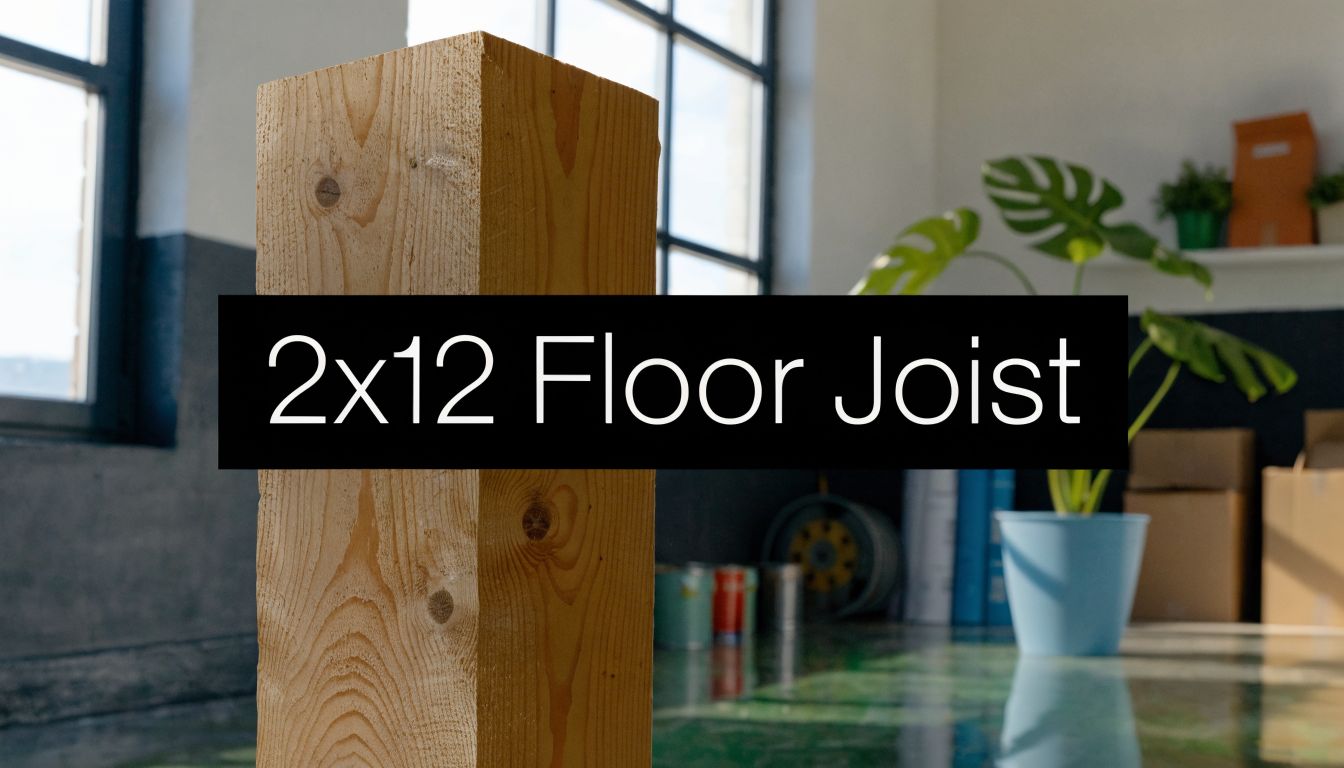
A 2×12 floor joist is a piece of dimensional lumber used to support a floor system. The nominal label says 2×12, but the actual size is 1.5 inches wide by 11.25 inches deep. That actual depth matters because joist strength comes largely from depth, not just width.
In practical terms, a 2×12 gives a builder more structural depth to work with than smaller joists. That extra depth is a big reason it shows up in garages, larger sheds, workshops, and barn shed projects where owners want open floor space and fewer support interruptions.

Why builders step up from smaller joists
The main advantage is span capacity. In Southern Pine span tables from the Southern Forest Products Association, #2 grade Southern Pine 2×12 joists at 24-inch spacing can span 14 feet 11 inches, which is a 14% increase over 2x10s. That advantage comes from the joist’s 20% greater depth.
That matters on real projects. A larger joist can help preserve an open bay in a garage, reduce the need for extra supports under a workshop floor, or make a larger prefab shed floor feel more stable under everyday use.
What the extra depth gives you on site
A deeper joist usually helps with three things homeowners notice:
- A stiffer floor feel
- Better support over longer distances
- More flexibility in layout
That doesn’t mean 2x12s are always the answer. On a small 4×8 shed with foundation blocks or a compact utility building, they can be more than the job requires. But once the project gets wider, heavier, or more demanding, stepping up often makes sense.
Species and grade still matter
Not every 2×12 performs the same. Species and grade affect how much load the joist can carry and how far it can span. You’ll commonly hear species like Southern Pine or Douglas Fir discussed for floor framing. Grade matters too. A better grade generally means fewer defects and more predictable structural performance.
For homeowners comparing options, a good starting point is understanding the broader types of joists for floors. That helps put dimensional lumber, engineered options, and project size in context.
A joist schedule isn’t just a lumber list. It’s a decision about how the finished floor will feel after the building is loaded, furnished, and used for years.
When 2×12 joists make the most sense
They’re especially common when the building is expected to do real work, not just sit in the yard.
- Garages: Better suited to wider bays and heavier day-to-day use.
- Workshops: Helpful when tools, benches, and storage all share the same floor.
- Larger sheds: Useful when owners want fewer supports and more uninterrupted floor area.
- Agricultural outbuildings: A solid option when durability matters more than shaving material size.
The takeaway is simple. A 2×12 floor joist isn’t “better” just because it’s bigger. It’s better when the project needs longer spans, a firmer feel, or a more forgiving structure over a properly prepared foundation.
Understanding Joist Span Load and Spacing
When homeowners ask whether a 2×12 floor joist is “strong enough,” the answer depends on span, load, and spacing. Those three work together. Change one, and the others change with it.
Span is the unsupported distance a joist covers from one bearing point to another. Load includes the weight of the floor itself and the things the floor carries. Spacing is how far apart the joists are installed, measured on center.
A simple way to think about load
Dead load is the weight that stays put, such as subflooring and the joists themselves. Live load is what comes and goes, such as people, tools, furniture, or everyday use in a garage or shed.
For residential floors under a 40 psf live load, a high-quality 2×12 floor joist from a species like Douglas Fir can span up to 18 feet when spaced at 16 inches on center, based on IRC tables that limit deflection to keep the floor stiff and reduce bounce, as summarized in this IRC-based span discussion.
Why spacing changes everything
Wider spacing means each joist carries more floor area. That increases the burden on each member. Tight spacing spreads the load across more joists and usually makes the floor feel better underfoot.
If you’re working through layout options, this guide to shed floor joist spacing is a practical companion because spacing decisions affect both performance and material use.
A planning table homeowners can actually use
The values below combine the verified span points available for 2×12 floor joists under 40 PSF live load, 10 PSF dead load, and L/360 deflection. Where exact verified values were not provided for a species and spacing combination, the table keeps the cell qualitative instead of guessing.
| Lumber Species | Spacing 12 in. o.c. | Spacing 16 in. o.c. | Spacing 24 in. o.c. |
|---|---|---|---|
| Douglas Fir or similar high-quality species | not specified in verified data | up to 18 ft | typically less than 16 in. o.c. layouts |
| #2 Southern Pine | not specified in verified data | not specified in verified data | 14 ft 11 in |
That table is intentionally conservative. It’s meant to help with planning, not replace the actual span table, stamped plan, or local code review.
Floors don’t fail only when they break. They also fail the homeowner when they feel bouncy, squeak under normal use, or telegraph movement through the whole building.
Deflection is what people feel
Deflection is the amount a joist bends under load. The common L/360 limit exists so the floor doesn’t feel soft or unstable in normal use. Homeowners may not care about the formula, but they care about what it prevents. Bounce. Flex. That uneasy feeling when you cross the room and everything seems to move with you.
That’s why bigger isn’t the only issue. A floor system has to be sized for how the building will be used.
Common examples in PA and NJ projects
A 10×10 storage shed usually places fewer demands on the floor than a detached garage with tool storage, lawn equipment, and regular foot traffic. A workshop with shelving along the perimeter may load the floor differently than an open room. A two-bay garage foundation may need framing that prioritizes open space without a maze of supports below.
The practical lesson is this:
- Longer span: usually pushes you toward a stronger joist or more support
- Wider spacing: usually reduces how far a joist should span
- Heavier use: often calls for closer review even if the building seems “residential”
The most expensive floor problems often come from treating all outbuildings the same. They’re not.
Design and Code Rules You Cant Ignore
A lot of framing mistakes happen after the joists are installed. Someone needs to run plumbing. Someone drills for wiring. Someone cuts a notch because it seems quicker than rerouting a pipe. That’s where a strong floor system can get weakened fast.
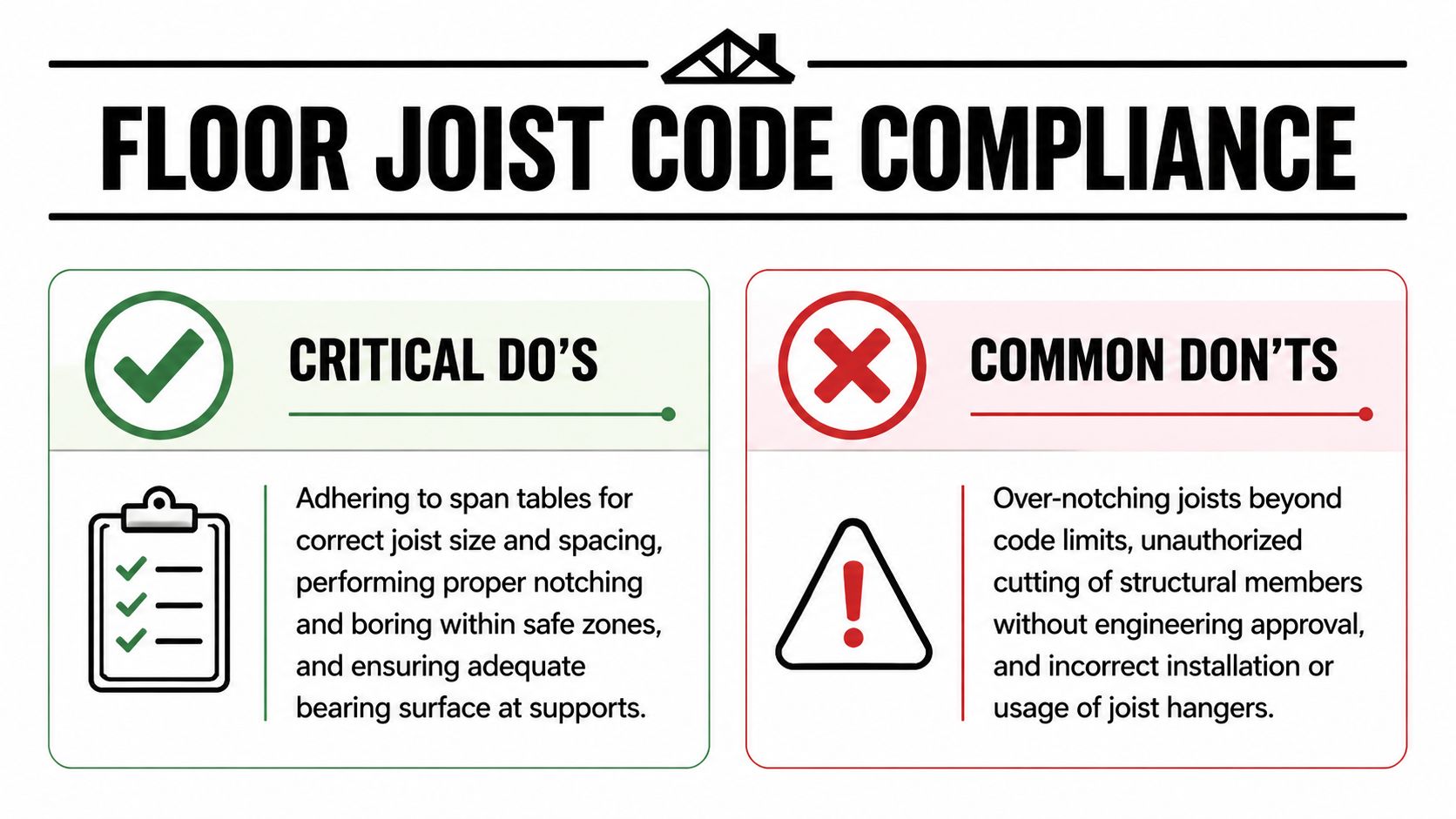
With a 2×12 floor joist, the code limits for boring and notching are strict for a reason. They protect the part of the joist that carries the load.
Boring holes the right way
According to the International Residential Code, the maximum hole size in a 2×12 joist is one-third of its depth, or 3-3/4 inches, and the hole must be at least 2 inches from any edge, as outlined in this joist notching and boring guide.
Those numbers aren’t suggestions. They’re the difference between a joist that still works as designed and one that has been compromised.
Notching is even more restricted
Notches remove material from the edge of the joist, which is often the worst place to lose strength. For a 2×12, the IRC limits a notch to one-sixth of the joist depth, or 1-7/8 inches, and notches are only allowed at the ends of the joist, not in the middle third of the span.
That’s where many DIY jobs go wrong. The cut looks small. The joist still seems solid. But the damage shows up later as sagging, squeaks, or excessive movement.
Field advice: If a pipe or duct path requires “just a little extra cut,” stop and rethink the route before you touch the joist.
What works and what doesn't
Here’s the practical version builders and homeowners should remember:
- Works: Drilling within the allowed zone and staying clear of top and bottom edges.
- Works: Planning mechanical routes before framing is complete.
- Doesn’t work: Oversized holes because the fitting is almost the right size.
- Doesn’t work: Mid-span bottom notches to make room for plumbing or ductwork.
- Doesn’t work: Treating code limits as rough guidelines instead of hard limits.
Why this matters more in the Mid-Atlantic
In PA and NJ, buildings often deal with snow, seasonal moisture, and repeated freeze-thaw conditions. Those aren’t excuses to oversize framing cuts. They’re reasons to be more disciplined. The floor system and the support system both need margin, especially in garages, barn sheds, and workshops where owners tend to add storage, equipment, and heavier use over time.
A common mistake is assuming the concrete contractors only need to worry about the slab or footings, and the framer only needs to worry about lumber. Good building doesn’t work that way. The joist layout, support points, bearing conditions, and penetrations all affect one another.
The best time to solve this problem
Before saws come out.
If you know a floor will need plumbing, drains, conduit, or future utility runs, the cleanest approach is to account for those paths during planning. That keeps the framing intact and makes code compliance much easier. Once someone starts cutting first and thinking second, you’re in repair mode instead of build mode.
Proper Joist Installation on Your New Foundation
A 2×12 floor joist can be perfectly selected and still perform poorly if it lands on an uneven or poorly prepared base. That’s the part many homeowners don’t see until the framing crew starts working around a problem that should’ve been solved before lumber arrived.
A good floor starts with a level, stable support condition. On some projects that means a gravel shed foundation. On others it means a concrete foundation for garage use, footings and walls, or a slab with the right layout for the building above.

Different foundations change the installation details
On a framed shed floor over a gravel pad, the key issue is uniform support and consistent elevation. The pad has to be compacted, well drained, and built to the structure’s footprint so the skids, beams, or support system don’t settle unevenly.
On a concrete foundation, the floor framing has a different set of demands. Sill plates need to sit flat. Anchor bolt placement matters. Bearing surfaces need to line up with the framing plan. If the concrete is out of square or out of level, the joists may still go in, but the whole assembly becomes harder to straighten.
Good framing crews pay attention to the crown
Every joist has natural shape variation. Installers typically check the crown and orient joists consistently so the floor settles into a flatter plane. That sounds like a small detail, but it affects how the subfloor sits and how the finished floor feels.
Other details that matter:
- Joist hangers: The right metal hangers help keep the connection secure where joists bear into beams or ledgers.
- Layout accuracy: Consistent on-center spacing keeps loads where the design expects them.
- Bearing quality: Full, solid contact at supports matters more than people think.
- Subfloor fastening: A clean, tight top layer helps reduce movement and squeaks.
A level foundation doesn’t make framing optional. It makes good framing possible.
Why the first stage affects every stage after it
When a site is prepped correctly and the base is true, builders move faster and with fewer corrections. The floor system goes in cleaner. Wall framing starts from a straighter platform. Door openings behave better. Roof loads transfer more predictably.
That’s one reason homeowners looking for garage footings and foundations, cement foundations for garage, or excavation near me should think beyond the pour itself. The value isn’t just concrete or stone. It’s the downstream accuracy it creates for the whole build.
For a visual overview of how joist framing comes together during installation, this video is helpful:
Where projects get into trouble
Most callback issues start with one of these:
- The base isn’t level, so framing gets shimmed and adjusted instead of installed cleanly.
- Support locations don’t match the framing plan, which forces field changes.
- Drainage was ignored, so movement shows up after weather cycles.
- Hardware or fastening is treated casually, even though the floor system depends on those connections.
For a shed, garage, gazebo foundation, or even a small house foundation addition, joists and foundation should be treated as one coordinated system. That’s what gives the finished structure a stable, durable feel.
Applications From Garages to Horse Barns
A 2×12 floor joist shows its value when the project has to do more than enclose space. Different buildings ask different things from the floor, and the framing should match that use.
A small gazebo foundation usually doesn’t call for the same floor framing approach as a detached garage. A storage shed for holiday bins isn’t the same as a workshop with shelving, rolling tools, and regular traffic. That’s why one-size-fits-all advice misses the point.
Garage and workshop floors
For a garage or workshop, people usually want open usable space and a floor that feels dependable. If the structure has framed flooring instead of a slab-on-grade setup, 2x12s are often chosen because they help carry wider layouts with fewer interruptions below.
That matters when owners want room for benches, rolling cabinets, or heavier stored items. It also matters when they don’t want the center of the room to feel soft six months after move-in.
Barn sheds and utility buildings
Barn sheds and horse-related outbuildings often bring a different kind of demand. The structure may need to handle storage patterns that change throughout the year. One season it’s feed and tack. Another season it’s equipment, bins, or larger concentrated loads near the walls.
That’s where practical planning matters more than generic charts. The floor system has to fit the actual use case, not just the footprint on paper.
A building can be modest in size and still need serious framing if the owner plans to load it like a working space.
Retrofit work on older floors
Retrofitting is where things get more complicated. A frequent challenge for homeowners in the Mid-Atlantic is adding heavy features like hot tubs, which can weigh over 1000 lbs. In those cases, standard 2×12 joist spans may not be enough for that kind of point load, and reinforcement such as sistering or additional blocking is often needed to control deflection and squeaks, as discussed in this retrofit-focused forum thread.
That doesn’t mean every older floor needs to be rebuilt. It means heavy upgrades deserve an honest assessment before the load is added.
Common situations that deserve a closer look
- Hot tub rooms or covered spa areas
- Older garages converted into workshops
- Barn shed retrofits with heavier storage
- Utility rooms with clustered equipment
- Outbuildings where the original framing plan is unknown
Some fixes are straightforward. Additional blocking can help. Sistering may help. In other cases, support below the floor needs to change. The right answer depends on where the load sits, how the joists span, and what the structure is already doing.
What works in practice
The projects that hold up best are the ones where the floor system is matched to the use from the beginning. For new construction, that means choosing the right foundation type and joist layout before the building arrives. For remodels, it means checking what’s there before adding more demand.
A garage used for storage is one thing. A workshop with heavy machinery is another. A barn shed for light equipment may be fine with a standard layout, while a retrofit under a hot tub deserves professional review. That kind of judgment is where experience matters most.
Lay the Groundwork for Success with Firm Foundations
A strong building starts long before the first wall goes up. If the site prep is rushed or the support system is wrong for the structure, the problems usually show up later as movement, framing adjustments, drainage trouble, or a floor that never feels quite right.
That’s why the smartest decision on a shed, garage, barn shed, or residential outbuilding project is getting the groundwork right first. A properly built shed foundation gravel base, concrete foundation, or set of garage footings and foundations gives the framing crew a true starting point and gives the finished structure a better chance to stay level and durable over time.
What homeowners usually need most
They need a contractor who can keep the process simple:
- Clear quoting: Know what’s being built and why it fits the project
- Accurate site prep: Excavation, grading, and drainage matter before material shows up
- Correct foundation type: Gravel, concrete, and other foundation builds each fit different structures
- Reliable installation: A pad or slab should match the planned building and framing layout
For homeowners in Pennsylvania, Maryland, Delaware, and New Jersey searching for shed foundations near me, garage foundation contractors near me, concrete contractors, or excavation near me, the goal isn’t just to get a pad in the ground. It’s to set up the whole structure for success.
Good joists matter. Good framing matters. But neither performs the way it should without a base that was built correctly from the start.
Frequently Asked Questions About Floor Joists
Are 2×12 floor joists always the best option for a shed or garage
No. They’re a strong option when the project needs longer spans, a stiffer floor, or support for heavier use. On smaller buildings, they may be more than the job requires. The right joist depends on the building size, support layout, and how the floor will be used.
Can I drill or notch a 2×12 joist for plumbing or wiring
Yes, but only within code limits. Those cuts aren’t casual field decisions. If utilities need to pass through framing, the route should be planned carefully so the joists stay compliant and strong.
Is a gravel base enough for a framed shed floor
Often, yes, if the structure and site conditions fit that approach and the pad is built correctly. A gravel shed foundation can perform very well for many shed applications because it promotes drainage and gives the structure a stable base. The key is building it to the right size, elevation, and compaction for the structure above it.
What causes a floor to feel bouncy
Usually one of three things. The joists span too far for the load, the spacing is too wide for the intended use, or the overall support system isn’t working together properly. Poor fastening and uneven bearing can add to the problem.
Should I worry about older structures before adding heavy features
Yes. That’s especially true for older garages, workshops, and enclosed additions. If you’re adding something unusually heavy, it makes sense to have the floor system reviewed before the new load goes in.
Who should I call first for a new outbuilding project
Start with the foundation plan. Once the support type, location, and layout are right, the rest of the structure has a much better path forward. That approach reduces guesswork and helps avoid costly changes later.
If you’re planning a shed pad, garage slab, barn foundation, or site prep project in Pennsylvania, Maryland, Delaware, or New Jersey, Firm Foundations can help you start with the right base. From excavation and grading to gravel pads and concrete foundations, the team builds support systems that make the next stage of construction easier, straighter, and more durable. Request a free quote and get your project moving on solid ground.